
The Cultural Cost of Copaganda: How TV Crime Dramas Hinder Justice Reform
Unpacking how television's heroic portrayal of policing distorts reality and blocks vital criminal justice reforms.
Introduction to Media’s Grip on Justice Narratives
In the expanding landscape of broadcast television and streaming platforms, the police procedural reigns supreme as one of the most culturally dominant genres of our time. Turn on the television at almost any hour, and you will inevitably encounter gripping narratives of dedicated detectives and relentless prosecutors systematically solving complex crimes within a neat, one-hour window. This formulaic approach is highly engaging, consistently dominating viewership ratings and commanding prime-time slots. However, beneath the captivating suspense and dramatic courtroom showdowns lies a profound sociological influence. These fictionalized accounts of the justice system are not merely harmless entertainment; they serve as a powerful lens through which millions of viewers understand the law, policing, and justice.
When we immerse ourselves in these narratives, we absorb subtle but persistent messages about who commits crimes, how the legal system operates, and what constitutes acceptable behavior in the pursuit of justice. The problem arises when these compelling fictions sharply diverge from the lived realities of the American criminal justice system, particularly as nationwide calls for systemic reform have never been more urgent. Media representations possess an undeniable capability to shape public policy by first molding public perception. As society wrestles with deep-seated issues like mass incarceration, racial profiling, and police accountability, the ubiquitous presence of law-and-order narratives complicates the push for meaningful reform, often reinforcing outdated and actively harmful stereotypes.
The Phenomenon of “Copaganda”: Fiction Masquerading as Reality
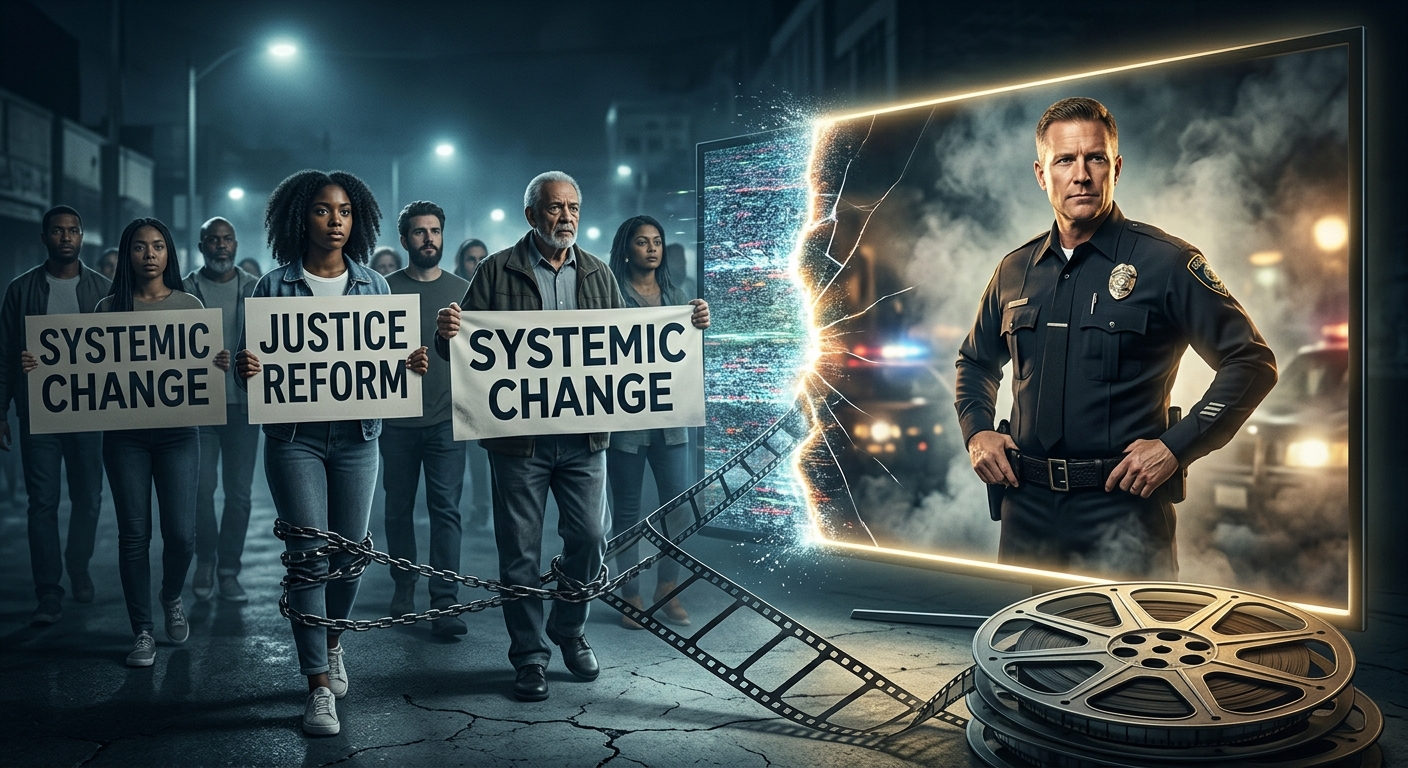
The term “copaganda”—a portmanteau of “cop” and “propaganda”—has increasingly been utilized by media critics, sociologists, and civil rights advocates to describe the uncritical, overwhelmingly positive portrayal of law enforcement in popular media. In a standard police procedural, protagonists are almost universally depicted as dedicated, brilliant, and morally infallible heroes driven by an unyielding desire to protect the innocent. While highlighting the dedication of public servants is not inherently problematic, copaganda’s true danger lies in its erasure of systemic flaws and its subtle justification of constitutional violations.
In many of these shows, due process is treated as a frustrating hurdle rather than a fundamental democratic right. When a fictional detective bypasses a warrant, coerces a confession through physical intimidation, or utilizes excessive force, the narrative consistently frames these actions as necessary evils—the bold moves of a rogue cop who is just doing what it takes to get dangerous criminals off the streets. This framing sends a dangerous message to the public: that the rules designed to protect citizens from state overreach are merely bureaucratic red tape hindering true justice. By normalizing these behaviors, television subtly coaches the audience to accept and even applaud civil rights violations, provided they are committed by the “good guys.” Consequently, when real-life instances of police brutality or misconduct come to light, a public conditioned by decades of copaganda may be more inclined to offer unconditional deference to law enforcement, assuming that harsh tactics were simply required to maintain order.
Cultivation Theory and the Distorted Worldview
To understand exactly why these television tropes are so damaging to the prospect of criminal justice reform, one must look to the sociological framework of “Cultivation Theory.” Originally developed by communication scholar George Gerbner in the 1970s, this theory posits that long-term exposure to media content subtly shapes how viewers perceive the real world. According to Cultivation Theory, heavy television viewers are far more likely to believe that the real world mimics the television world. In the context of crime dramas, this leads to a psychological phenomenon often referred to as the “Mean World Syndrome.”
On television, violent crime is ubiquitous, random, and frequently perpetrated by strangers lurking in the shadows. In reality, violent crime rates have seen significant declines over the past few decades, and crimes are most often committed by individuals known to the victim. Yet, individuals who consume large amounts of crime-related media consistently overestimate their likelihood of becoming victims of violent crime. This heightened sense of fear has direct, measurable political consequences. A fearful electorate is much more likely to support aggressive, punitive policing strategies, draconian sentencing laws, and the expansion of the carceral state.
Furthermore, these shows often present an incredibly skewed depiction of the demographic makeup of both offenders and victims, frequently leaning into racial and socioeconomic stereotypes. When television consistently portrays marginalized communities solely through the lens of criminality, it reinforces implicit biases in the viewer. This cultivated worldview acts as a formidable psychological barrier to criminal justice reform. When activists advocate for decarceration, restorative justice, or the reallocation of police funding to social services, they are not just fighting against political inertia; they are fighting against deeply entrenched, media-cultivated fears that demand retribution over rehabilitation.
The “CSI Effect” and the Adversarial System
Beyond general perceptions of crime and policing, television procedurals have a tangible, documented impact on the inner workings of the courtroom, a phenomenon widely recognized in legal circles as the “CSI Effect.” Named after the massively popular franchise that heavily relies on high-tech forensic science to solve crimes, this effect refers to the ways in which exaggerated portrayals of forensic science heavily influence real-life jurors.
In the fictionalized world, forensic evidence is instantaneous, unequivocally accurate, and available at every single crime scene. A speck of dust or a microscopic fiber is quickly analyzed in a neon-lit laboratory, inevitably pointing directly to the perpetrator. However, in the real world, forensic science is often much slower, less definitive, and sometimes plagued by human error or systemic backlog. Research into the CSI Effect shows how it alters juror expectations. Prosecutors frequently express frustration that juries now demand definitive scientific evidence even in cases where it is entirely irrelevant or impossible to obtain, sometimes leading to the wrongful acquittal of guilty defendants. Conversely, defense attorneys note that when forensic evidence is presented, jurors often treat it as infallible, ignoring the distinct possibility of contamination or methodological flaws.
Coupled with this distorted view of scientific evidence is the procedural genre’s persistent vilification of the defense attorney. In the adversarial legal system of the United States, the defense attorney plays a critical role in holding the state to its burden of proof and ensuring that the rights of the accused are protected. On television, however, defense lawyers are routinely depicted as sleazy, amoral antagonists who employ dirty tricks to put dangerous criminals back on the street. They are positioned as the obstacles our heroic prosecutors and detectives must overcome. This sustained character assassination diminishes public respect for the constitutional right to counsel and the presumption of innocence. It trains the public to view a rigorous legal defense not as a fundamental pillar of a free society, but as a dangerous loophole for the guilty.
The Roadblocks to Real-World Reform
The real-world consequences of these fictional narratives are profound, particularly when observing the trajectory of criminal justice reform in the United States. Over the past decade, a growing bipartisan consensus has emerged acknowledging that the American criminal justice system is deeply flawed. The United States incarcerates a larger percentage of its population than any other nation, with profound racial disparities and a heavy reliance on cash bail systems that inherently criminalize poverty. Reformers have fought tirelessly for policies aimed at reducing the prison population, eliminating mandatory minimum sentences, and establishing robust civilian oversight of police departments.
However, introducing these policies to the public square often meets fierce resistance, much of which is underpinned by the narratives popularized by television procedurals. When legislation is proposed to end cash bail for non-violent offenders, opponents frequently mobilize fear by suggesting that communities will immediately be flooded with dangerous predators—a narrative pulled straight out of a prime-time script. Similarly, efforts to hold police officers legally accountable for misconduct are often met with the argument that police need unrestricted freedom to make split-second decisions to protect society, perfectly mirroring the “rogue but righteous” cop trope.
Furthermore, the narrative often extends to the political sphere, framing progressive prosecutors or reform-minded legislators as naive idealists who put the community in peril. By erasing the historical context of systemic racism and the socioeconomic root causes of crime, television allows viewers to comfortably believe that harsher penalties are the sole antidote to societal ills. When the public consumes thousands of hours of content suggesting that more police and more prisons equate to more safety, it becomes extraordinarily difficult for researchers and activists to break through with data showing that community investment, mental health resources, and education are far more effective at reducing crime. By constantly reaffirming the necessity and benevolence of the status quo, copaganda creates a powerful cultural inertia.
A Call for Nuanced Storytelling in Entertainment
As the public discourse around policing and justice evolves, so too must the entertainment industry. Creators, writers, and network executives hold immense power in shaping societal values, and with that power comes an ethical responsibility to present narratives that do not actively harm marginalized communities or impede necessary social progress. The demand is not for television to transform into dry, educational documentaries, but rather for a commitment to nuanced, responsible storytelling.
There is a pressing need for media that reflects the true complexities of the justice system. This includes portraying the devastating impacts of wrongful convictions, the reality of overcrowded and inhumane carceral facilities, and the systemic biases that pervade the legal process. Protagonists in legal dramas do not have to be flawless heroes; they can be multifaceted individuals operating within a flawed institution. Furthermore, centering the stories of victims, the accused, and communities disproportionately affected by aggressive policing can provide a much-needed counterweight to the traditional law enforcement perspective.
There is also a profound opportunity for cross-industry collaboration. Writers’ rooms can benefit immensely from integrating legal scholars, former public defenders, and individuals who have been directly impacted by the justice system. By democratizing the storytelling process, the industry can move away from relying on law enforcement as the sole consultants for crime narratives. This shift does not mean sacrificing drama or suspense; rather, it means finding the dramatic tension in truth. In recent years, there has been a notable shift as some creators begin to challenge the established copaganda formula. Critically acclaimed series, investigative podcasts, and hard-hitting documentaries have started to pull back the curtain on the inequities of the justice system, proving that audiences are hungry for authentic and challenging narratives.
Conclusion
The intersection of entertainment and the criminal justice system is a vital battleground for public perception. For decades, police procedurals have served as a comforting but misleading mirror, reflecting a world where the lines between good and evil are starkly drawn, and the institutions of justice are inherently righteous. As society confronts the urgent need for comprehensive criminal law reform, we must critically evaluate the media we consume and recognize the ways in which “copaganda” undermines efforts to build a more equitable society. By demanding truth over comforting fictions and supporting nuanced, empathetic storytelling, society can begin to dismantle the cultural barriers that stand in the way of true justice reform.
Frequently Asked Questions (FAQs)
- What exactly is “copaganda”?
Copaganda, a blend of “cop” and “propaganda,” refers to media portrayals that present law enforcement in an overwhelmingly positive, uncritical light while ignoring or justifying systemic issues such as racial profiling, corruption, and excessive force. It shapes public perception to view police actions as inherently heroic and necessary, regardless of legality. - Does the “CSI Effect” actually influence real court cases?
Yes. Extensive legal and academic research indicates that the “CSI Effect” significantly alters juror expectations. Exposure to high-tech forensic television shows often causes jurors to expect definitive, scientific evidence in every trial, which can lead to wrongful acquittals when such evidence is unavailable, or an overreliance on flawed forensic methods when it is presented. - Why are police procedurals so incredibly popular?
Police procedurals offer neatly packaged narratives with clear resolutions. They tap into a fundamental human desire for order, justice, and the restoration of safety. The formulaic approach of solving a complex puzzle within a single episode provides a satisfying emotional catharsis for viewers in an otherwise unpredictable world. - How does television hinder criminal justice reform?
By constantly reinforcing the idea that aggressive policing and harsh sentencing are the only valid ways to keep society safe, crime media cultivates a fearful public. This deeply ingrained fear translates into direct political opposition against crucial reforms like decarceration, cash bail reform, and police accountability. - Does replacing crime shows with other genres help public perception?
While simply switching genres doesn’t solve systemic issues overnight, diversifying media consumption can broadly expand one’s perspective. Watching documentaries, historical dramas, or character-driven narratives focused on marginalized communities helps viewers step outside the “law and order” bubble. This diversity breaks the psychological feedback loop created by Cultivation Theory, fostering empathy and a more realistic understanding of complex social issues.
References
- The ‘CSI Effect’: Does It Really Exist? — National Institute of Justice. 2008-03-16. https://nij.ojp.gov/topics/articles/csi-effect-does-it-really-exist
- The Relationship Between Crime-Related Television Viewing and Perceptions of the Death Penalty: Results of a Large Cross-Sectional Survey Study — Frontiers in Psychology / PMC. 2021-07-21. https://www.ncbi.nlm.nih.gov/pmc/articles/PMC8332514/
- Cultivating Police Use of Force Perceptions through Cinema: Maintaining the Racial Divide? — Criminology, Criminal Justice, Law & Society. 2019-10-21. https://ccjls.scholasticahq.com/article/11183-cultivating-police-use-of-force-perceptions-through-cinema-maintaining-the-racial-divide
Similar Articles








Read full bio of Sneha Tete




