
Arrest and Detention Laws on Cruise Ships
Understanding your rights when facing arrest on a cruise ship in international waters.
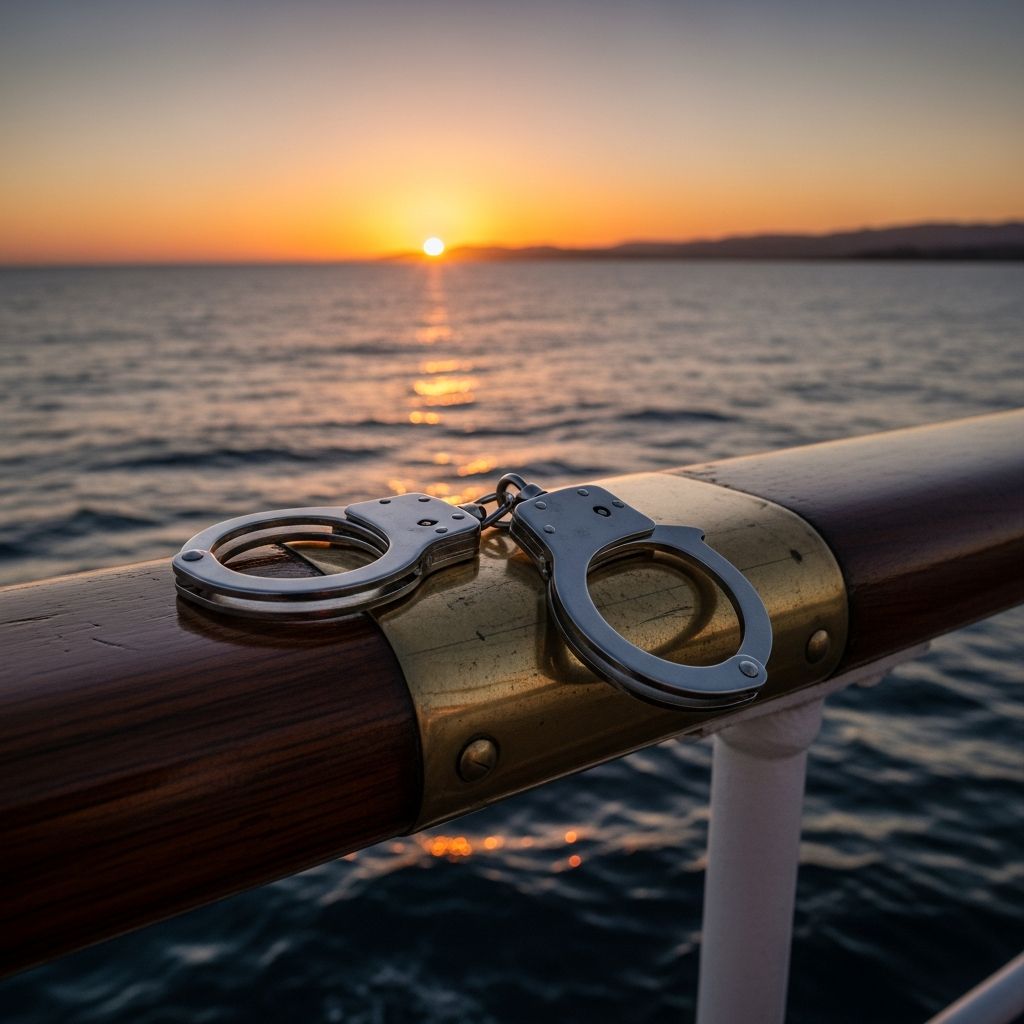
Understanding Arrest Authority on Vessels at Sea
When a crime occurs aboard a cruise ship, determining who has the authority to arrest and prosecute an individual becomes considerably more complex than crimes committed on land. The waters surrounding the vessel, the ship’s registration country, and the location of involved parties all play critical roles in establishing legal jurisdiction. Unlike domestic law enforcement situations where a single police department handles investigations, maritime incidents involve multiple potential authorities competing for jurisdiction, creating a legally intricate environment that demands specialized expertise.
The ship’s captain possesses considerable discretionary authority while a vessel remains at sea. This maritime tradition grants the captain the power to detain suspects temporarily until the ship reaches a port where formal law enforcement can board and take custody of the individual. The captain’s detention authority serves as an interim measure, allowing the vessel to continue its voyage while maintaining security and order aboard.
Jurisdictional Framework Based on Geographic Location
The location of the cruise ship at the moment a crime is allegedly committed establishes the foundational basis for determining which authorities possess jurisdiction. Maritime law recognizes distinct zones with varying levels of national authority and control.
Territorial Waters and Port Jurisdictions
When a cruise ship is docked at a port or operates within a nation’s territorial waters, the country where that port is located exercises primary jurisdiction. Port state jurisdiction provides the most straightforward legal scenario. Local law enforcement agencies can board the vessel, conduct investigations, and make arrests in accordance with that nation’s criminal statutes. For example, if a crime occurs while a ship is docked in Miami, Florida authorities can immediately assert jurisdiction and pursue criminal charges under Florida law.
Coastal Zone Authority
The space immediately adjacent to a nation’s coastline receives special attention under international maritime conventions. Under the United Nations Convention on the Law of the Sea, countries maintain jurisdiction extending 12 nautical miles from their shoreline. Any criminal activity occurring within this zone falls under the coastal nation’s legal authority, even if the vessel remains floating offshore rather than docked. This means crimes committed within this buffer zone are prosecuted according to the coastal nation’s laws, providing an extended reach beyond traditional port boundaries.
Open Ocean and Flag State Control
Beyond the 12-nautical-mile boundary, vessels enter international waters where conventional national authority dissolves. In these regions, the principle of flag state jurisdiction governs. The flag state is the country where a cruise ship is registered, not necessarily where the vessel is owned or operated. This distinction proves crucial because many cruise ships are registered in nations like the Bahamas, Panama, or Malta for regulatory and tax advantages, regardless of where the cruise line’s corporate headquarters operates. The flag state possesses primary authority to investigate crimes occurring on its registered vessels in international waters and to prosecute offenders under its own criminal codes.
Multiple Jurisdictional Claims and Competing Authorities
The complexity of maritime jurisdiction arises because multiple entities may legitimately claim authority over a single criminal incident. Several factors can simultaneously trigger jurisdiction from different countries:
- The nationality of the victim creates an interest for the victim’s home country
- The nationality of the accused gives that country extraterritorial jurisdiction
- The cruise line’s corporate headquarters location establishes a connection for prosecution
- The ship’s flag state maintains primary maritime jurisdiction
- The port state where passengers embarked or where the ship was destined can assert authority
When these overlapping jurisdictions arise, determining which authority takes precedence requires careful analysis of the specific circumstances. In some cases, multiple countries may pursue charges, leading to complex negotiations and potential extradition proceedings. Maritime lawyers play an essential role in navigating this jurisdictional maze and protecting defendants’ rights across different legal systems.
Special Maritime Jurisdiction in the United States
The United States has enacted specific statutory provisions to address criminal activity on cruise ships, recognizing the particular vulnerability of American citizens and the prevalence of cruise ship incidents involving U.S. residents. Federal law provides multiple pathways for American prosecution of shipboard crimes.
Federal Maritime Crime Authority
The Federal Bureau of Investigation possesses broad extraterritorial jurisdiction allowing it to investigate and prosecute crimes against American citizens regardless of where the crime occurred. This authority extends to cruise ships operating anywhere in the world. When a U.S. citizen is victimized aboard a cruise ship, the FBI can assert federal jurisdiction and pursue federal criminal charges, even if the vessel operates in international waters under a foreign flag.
Additionally, major cruise lines such as Royal Caribbean and Carnival operate as U.S.-registered corporations. This corporate connection provides another jurisdictional hook for American prosecution. Crimes committed aboard vessels operated by U.S. companies fall within federal jurisdiction, allowing American courts to prosecute offenders according to federal maritime statutes.
Territorial Water Jurisdiction
When a cruise ship travels within three nautical miles of the U.S. coastline, American jurisdiction immediately attaches. This extended territorial reach gives U.S. authorities the ability to prosecute crimes occurring in these near-shore waters under federal law, even before a vessel reaches port. The Coast Guard and FBI can board vessels in U.S. waters and conduct investigations or make arrests if federal crimes are suspected.
State-Level Special Maritime Jurisdiction
Several states have enacted statutes creating special maritime criminal jurisdiction extending their prosecutorial authority beyond traditional boundaries. Florida, recognizing its position as a major cruise ship hub with numerous passengers and crew members as residents, codified special maritime jurisdiction allowing state prosecution of certain crimes occurring on cruise ships outside territorial waters. This statute permits Florida to prosecute crimes when the victim, defendant, or most passengers are Florida residents, even if the crime occurred in international waters on a foreign-flagged vessel.
The Arrest and Detention Process
Immediate Response and Captain’s Authority
When crew members or passengers report suspicious criminal activity, the ship’s security team conducts an initial investigation. If sufficient evidence suggests a crime has occurred, the ship’s captain can exercise discretionary authority to detain the suspect. This detention is not a formal arrest in the traditional law enforcement sense; rather, it represents the captain’s temporary custody pending transfer to proper authorities at the next port.
The detention can include confining the suspect to a cabin, restricting movement throughout the vessel, or maintaining constant supervision. During this period, the ship continues its voyage while maintaining order and security. The captain must balance the needs of ongoing cruise operations with passenger safety and the security of the detained individual.
Transfer to Port Authority
Upon reaching the next port, the ship notifies port authorities about the detained individual. Formal arrest procedures then commence through official law enforcement channels. The port state’s jurisdiction typically prevails at this stage, with local police or federal agents boarding the vessel to take custody and conduct formal questioning. At this point, the individual receives formal notification of charges, rights notifications in their native language, and access to legal counsel.
Extradition and International Transfer
If the crime falls under a different jurisdiction than the port where the vessel docked, international extradition procedures may become necessary. For instance, if a crime occurs on a ship flagged to the Bahamas, victimizing an American citizen, while the vessel is docked in Nassau, complex negotiations may occur between the Bahamian government and the United States regarding which country will prosecute. Modern extradition treaties between maritime nations generally facilitate the efficient transfer of suspects to appropriate jurisdictions, though this process can consume considerable time and legal resources.
Investigation Procedures and Evidence Collection
Maritime crimes investigations differ significantly from standard terrestrial investigations due to the unique environment and jurisdictional complications. Multiple agencies may participate in the investigation process:
| Investigating Agency | Circumstances of Authority |
|---|---|
| Ship’s Security | First responders aboard vessel; preserve scene, witness statements |
| Port State Police | Board docked vessels; conduct formal investigation and evidence collection |
| Federal Bureau of Investigation | Crimes against U.S. citizens; extraterritorial jurisdiction worldwide |
| U.S. Coast Guard | Crimes in U.S. waters or on U.S.-flagged vessels |
| Flag State Authorities | Primary authority on vessels registered in their country |
Evidence collection presents particular challenges in maritime contexts. Witnesses may disembark at various ports, complicating follow-up interviews. Physical evidence must be meticulously documented aboard the moving vessel before the ship reaches port. Video surveillance footage from shipboard cameras often proves crucial, as do witness statements collected before memories fade and passengers return to their homes across multiple countries.
Your Rights When Detained at Sea
Being detained aboard a cruise ship creates a uniquely vulnerable position. Understanding your rights during this situation is essential for protecting yourself:
- Request immediate access to legal counsel, either through ship communications or awaiting port
- Decline to answer investigatory questions without an attorney present
- Understand that the ship’s captain and security team are not law enforcement and cannot administer your Miranda rights
- Request written notice of charges or reasons for detention
- Ask for communication with your country’s embassy or consulate if you are a foreign national
- Document the conditions of your detention and any treatment by crew members
Many cruise ship detention cases involve inadequate legal protections during the investigative phase. Passengers detained aboard should understand that informal investigations conducted by ship security lack the safeguards and procedural protections of formal law enforcement interrogations. Anything you say to ship security can later be used as evidence in actual criminal proceedings.
Prosecution Under Different Legal Systems
A single cruise ship incident may result in prosecution under multiple different legal systems. An American victim victimized by a German suspect aboard a Panamanian-flagged vessel docked in Jamaica creates a scenario where American federal law, German law, Panamanian maritime law, and Jamaican law all potentially apply. The cruise line’s choice of jurisdiction in passenger contracts and the flag state’s prosecutorial priorities often determine which system ultimately pursues charges.
Different legal systems approach criminal defendants with varying philosophies. Some countries emphasize presumption of innocence more stringently than others. Evidentiary rules differ dramatically, as do sentencing guidelines and opportunities for appeal. A maritime attorney with expertise in multiple jurisdictions becomes invaluable when prosecution under foreign law becomes likely.
Frequently Asked Questions
Can the cruise ship captain arrest me for a crime?
The ship’s captain possesses discretionary authority to detain you temporarily pending arrival at port, but this is not a formal arrest. Only official law enforcement can execute a formal arrest, though this typically occurs after the ship docks.
What happens if I’m detained on a cruise ship at sea?
You will typically be confined to a cabin under observation until the ship reaches its next port. At that point, port authorities board the vessel and may take you into custody for formal arrest and processing according to that port country’s laws.
Which country’s laws apply to my situation?
The applicable laws depend on where the crime occurred. If in port, that port’s laws apply. If within 12 nautical miles of shore, the coastal nation’s laws apply. Beyond 12 nautical miles, the ship’s flag state laws govern. Multiple jurisdictions may claim authority based on citizenship and other factors.
Can the U.S. prosecute crimes on cruise ships in international waters?
Yes, the U.S. can prosecute if the victim or accused is American, if the crime occurred in U.S. waters, or if the ship is U.S.-operated. The FBI has broad extraterritorial jurisdiction over crimes against Americans regardless of location.
Should I answer questions from ship security?
No. Politely decline to answer questions and request an attorney. Ship security investigations do not provide Miranda rights or legal protections, but information you provide can be used against you in criminal proceedings.
References
- Who Has Jurisdiction When a Crime is Committed on a Cruise Ship? — Miami Criminal Lawyer. 2024. https://www.miami-criminal-lawyer.net/blog/who-has-jurisdiction-when-a-crime-is-committed-on-a-cruise-ship
- Can You Be Arrested on a Cruise Ship? — Cruise Ship Accident Lawyer. 2024. https://www.cruiseshipaccidentlawyer.com/can-you-be-arrested-on-a-cruise-ship/
- How Are Crimes Handled on Cruise Ships? — New Jersey Criminal Law Firm. 2024. https://www.newjerseycriminallawfirm.com/blog/how-are-crimes-handled-on-cruise-ships/
- United Nations Convention on the Law of the Sea — United Nations. 1982. https://www.un.org/depts/los/convention_agreements/texts/unclos/unclos_e.pdf
- Maritime Liens and Arrests under U.S. Law — Blank Rome LLP. 2024. https://www.blankrome.com/publications/maritime-law-primer-maritime-liens-and-arrests-under-us-law
Similar Articles








Read full bio of medha deb




