
The Severe Crisis of Underfunded Indigent Defense
Examining the severe lack of resources for public defenders and its impact.
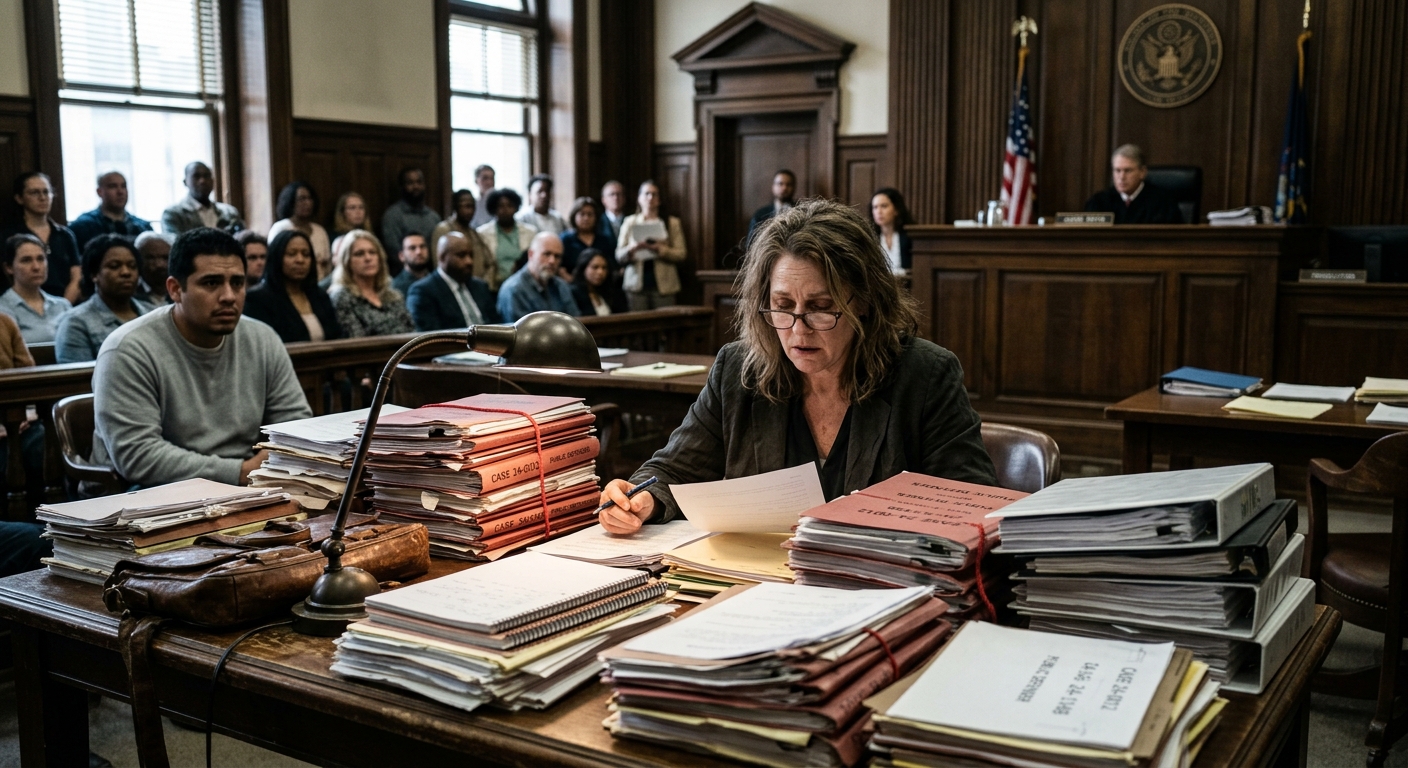
The Imbalance of the Scales: Why We Must Reevaluate Indigent Defense
The bedrock of the American criminal justice system is the adversarial process, a mechanism deliberately designed to uncover the truth through the balanced clash of two opposing sides. The adversarial framework is built on a simple premise: truth emerges when two equally resourced advocates test the evidence before an impartial judge and jury. At the center of this framework is the presumption of innocence. The scales of justice should be evenly matched, ensuring the state bears the heavy burden of proving guilt. However, this theoretical symmetry falls apart rapidly when one side is systematically starved of resources.
Across the United States, the fundamental right to legal counsel is facing a profound crisis. By chronically neglecting to adequately fund indigent defense programs, lawmakers have inadvertently created a system that heavily favors the prosecution. This resource disparity erodes the civil liberties the Constitution was written to protect. When public defense systems are under-resourced, the legal rights of the marginalized are severely compromised. Rather than functioning as a careful arbiter of truth, the judicial process is often transformed into an assembly line of convictions, undermining public trust in the fundamental fairness of the courts.
The Constitutional Promise: Gideon and the Sixth Amendment
To understand this crisis, one must look to the legal foundations of the right to counsel. The Sixth Amendment outlines the rights of the accused, including the right to legal assistance. For over a century, this was largely interpreted as the right to hire a private lawyer if you had the financial means. This narrow interpretation changed drastically in 1963 with the Supreme Court decision in Gideon v. Wainwright. In a unanimous ruling, the Court declared that ‘lawyers in criminal courts are necessities, not luxuries’ . The justices accurately recognized that average citizens lack the specialized legal training to navigate complex evidentiary rules and procedure. Consequently, the Supreme Court mandated that states must provide legal counsel to indigent defendants facing serious felony charges.
Despite the monumental nature of Gideon, the Supreme Court provided a legal mandate without attaching a funding mechanism. The federal government left the heavy responsibility of funding public defense entirely to the individual states . This lack of universal standards resulted in a highly inconsistent patchwork of indigent defense systems. In some jurisdictions, the state assumes full financial responsibility, while in others, the burden is passed down entirely to local county governments relying on fluctuating municipal property taxes .
The Asymmetry of Justice: Funding Disparities Between Prosecution and Defense
To grasp the modern indigent defense crisis, one must thoroughly examine the glaring disparity in financial resources allocated to prosecutorial agencies compared to public defense. District attorney offices and local police departments typically benefit from robust, consistent public funding streams. Prosecutors implicitly have the police acting as their dedicated investigative arm at no additional cost to their office budget. Furthermore, they frequently access state-of-the-art forensic laboratories, specialized investigative teams, massive support staffs, and modern case management technology.
Conversely, public defender offices are frequently forced to operate on severe, shoestring budgets. Funding indigent defense is often viewed as politically unpopular by state legislatures. Allocating taxpayer dollars to adequately defend accused individuals rarely serves as a winning platform in local elections, whereas ‘tough on crime’ rhetoric remains a highly reliable political strategy.
Historically, some states, like Pennsylvania, provided virtually zero state-level funding for indigent defense, leaving cash-strapped local counties to bear the constitutional cost alone . This localized model creates severe geographic inequalities. A wealthy suburban county might easily afford a fully staffed public defender office with dedicated investigators. In sharp contrast, a rural county might be forced to rely on a flawed flat-fee contract system where private attorneys are paid a meager lump sum to handle an unlimited number of cases. Under such extreme financial constraints, defense attorneys cannot afford to hire independent expert witnesses, leaving them forced to rely entirely on the scientific evidence gathered by the opposing police force.
Caseload Crises: The Reality of Assembly-Line Justice
The most devastating consequence of systemic underfunding is the overwhelming caseload routinely assigned to public defenders. National professional standards strongly recommend that a defense attorney handle no more than 150 felony or 400 misdemeanor cases per year. Today, across the United States, those practical limits are routinely ignored. It is remarkably common to find dedicated public defenders juggling upwards of 500 to 700 mixed cases simultaneously.
When well-meaning attorneys are burdened with unmanageable dockets, rigorous legal defense becomes an absolute impossibility. Public defenders are violently forced into a system of legal triage. They must constantly prioritize the relatively few cases involving the most severe penalties while severely minimizing time spent on lower-level felonies. This high-pressure environment fosters what critics refer to as ‘assembly-line justice.’
Because overburdened attorneys literally do not have the hours in a day to file complex pretrial motions, interview civilian witnesses, or thoroughly review thousands of pages of digital discovery, the system relies overwhelmingly on plea bargaining. The vast majority of criminal cases in the United States are resolved quietly through plea deals rather than public jury trials.
For an indigent defendant sitting in jail because they cannot afford exorbitant cash bail, a plea offer that guarantees immediate release is incredibly coercive. Tragically, even entirely innocent individuals will frequently plead guilty just to escape the severe trauma and danger of pretrial detention. This phenomenon is directly exacerbated by having an overburdened public defender who lacks the resources to take every deserving case to trial. The immense psychological toll on defenders leads to massive staff burnout, meaning complex cases are constantly reassigned to brand new attorneys who must start building a defense from scratch.
Systemic and Societal Consequences
The failure to adequately fund public defense carries profound systemic costs that ripple destructively throughout society.
- The Economic Burden of Mass Incarceration: Inadequate legal representation substantially contributes to higher rates of pretrial detention and much longer prison sentences. When public defenders lack resources to successfully argue for alternative sentencing programs or rehabilitation, far more individuals are incarcerated. The staggering financial burden of securely housing an inmate far exceeds the proactive cost of funding robust public defense. Taxpayers ultimately foot the massive bill, draining local resources that could be spent on education or community health.
- Wrongful Convictions and Appellate Costs: When the defense function is critically compromised, the risk of wrongful conviction skyrockets. Innocent people are sent to prison because underfunded attorneys failed to uncover vital exculpatory evidence or challenge flawed forensics. When these tragic errors are eventually exposed, the state must expend massive amounts of taxpayer money on complex appellate litigation, lengthy retrials, and multi-million-dollar civil rights settlements.
- Collateral Damage to Communities: A criminal conviction carries devastating lifelong collateral consequences. It can quickly result in the permanent loss of employment, eviction from public housing, and deportation for non-citizens. Furthermore, these cascading consequences disproportionately impact communities of color, amplifying historical inequalities and creating immense barriers to successful societal reentry. Individuals released from jail often find themselves saddled with court debts and a permanent record that disqualifies them from federal financial aid, effectively locking them out of higher education. When parents are unnecessarily incarcerated due to poor representation, children are frequently pushed into the foster care system, perpetuating intergenerational trauma.
Legislative and Policy Solutions: Restoring the Balance
Addressing the nationwide indigent defense crisis requires bold legislative action and a fundamental shift in how the justice system is continuously funded.
- Mandatory Workload Controls: Jurisdictions must formally enact and heavily enforce mandatory workload limits for all public defenders. If a specific office reaches its maximum capacity, it must be empowered to refuse new cases, legally forcing the state to provide immediate overflow funding for private appointed counsel at competitive rates.
- Strict Funding Parity: State lawmakers should strive for statutory budgetary parity between the prosecution and the defense. Whenever the legislature increases the budget for a district attorney’s office, a proportional increase must be simultaneously awarded to the corresponding public defender’s office.
- State and Federal Oversight: States that rely entirely on fragile county funding must transition to state-administered models to guarantee a high baseline of legal quality across all regions . Furthermore, establishing independent indigent defense commissions can shield public defender budgets from partisan political interference, ensuring adequate funding.
The constitutional right to human liberty is far too precious to be determined by the size of a defendant’s wallet or the exact ZIP code of their arrest. Adequately funding public defense is an absolute prerequisite for the legitimacy and moral authority of the American judicial system.
Frequently Asked Questions (FAQs)
What is the core constitutional basis for indigent defense?
The Sixth Amendment of the United States Constitution specifically guarantees the right to counsel for criminal defendants. The U.S. Supreme Court’s landmark 1963 ruling in Gideon v. Wainwright definitively affirmed that state governments are constitutionally required to provide competent attorneys for defendants who cannot afford one when facing serious criminal charges .
Why do public defenders consistently face such high caseloads?
Public defenders often struggle with astronomically high caseloads due to severe, chronic underfunding by both state and local governments. Without a sufficient budget to hire additional qualified attorneys, paralegals, and dedicated investigators, the existing lawyers must take on hundreds of active cases simultaneously just to manage the consistently high volume of daily arrests.
What happens if a public defender office refuses new cases?
When a public defender’s office enforces strict workload limits and refuses new cases, the court must typically appoint private defense attorneys to represent the indigent defendants. These private attorneys are then paid by the state or county. However, ensuring these private attorneys receive fair compensation rather than low flat-fee rates is essential to maintaining the quality of representation.
How does an underfunded public defense system negatively affect everyday taxpayers?
When indigent defense is systematically underfunded, it directly leads to much higher rates of unnecessary pretrial detention, significantly longer prison sentences, and a higher likelihood of wrongful convictions. The staggering societal and financial cost of mass incarceration, prolonged appeals, and massive civil payouts for wrongful convictions far exceeds the relatively small cost of simply funding defense offices adequately from the start.
Do all U.S. states fund their public defenders the exact same way?
No. Funding mechanisms vary wildly across the country. Some states rely entirely on state-level funds, others utilize a hybrid state-county model, and a few historically relied almost entirely on local county municipal budgets. This disjointed approach creates massive, unfair geographic disparities in the quality of legal representation .
References
- Facts and Case Summary – Gideon v. Wainwright — United States Courts. N.D. https://www.uscourts.gov/educational-resources/educational-activities/facts-and-case-summary-gideon-v-wainwright
- State Government Indigent Defense Expenditures, FY 2008–2012 — Bureau of Justice Statistics. 2014-07-01. https://bjs.ojp.gov/library/publications/state-government-indigent-defense-expenditures-fy-2008-2012-updated
- Pennsylvania Indigent Criminal Defense Services Funding and Caseloads — Legislative Budget and Finance Committee. N.D. http://lbfc.legis.state.pa.us/
Similar Articles








Read full bio of Sneha Tete


