
Crimes Against Justice: Understanding Offenses That Undermine the Legal System
Learn how crimes like perjury, bribery, contempt, and obstruction of justice threaten the fairness and integrity of the legal system.
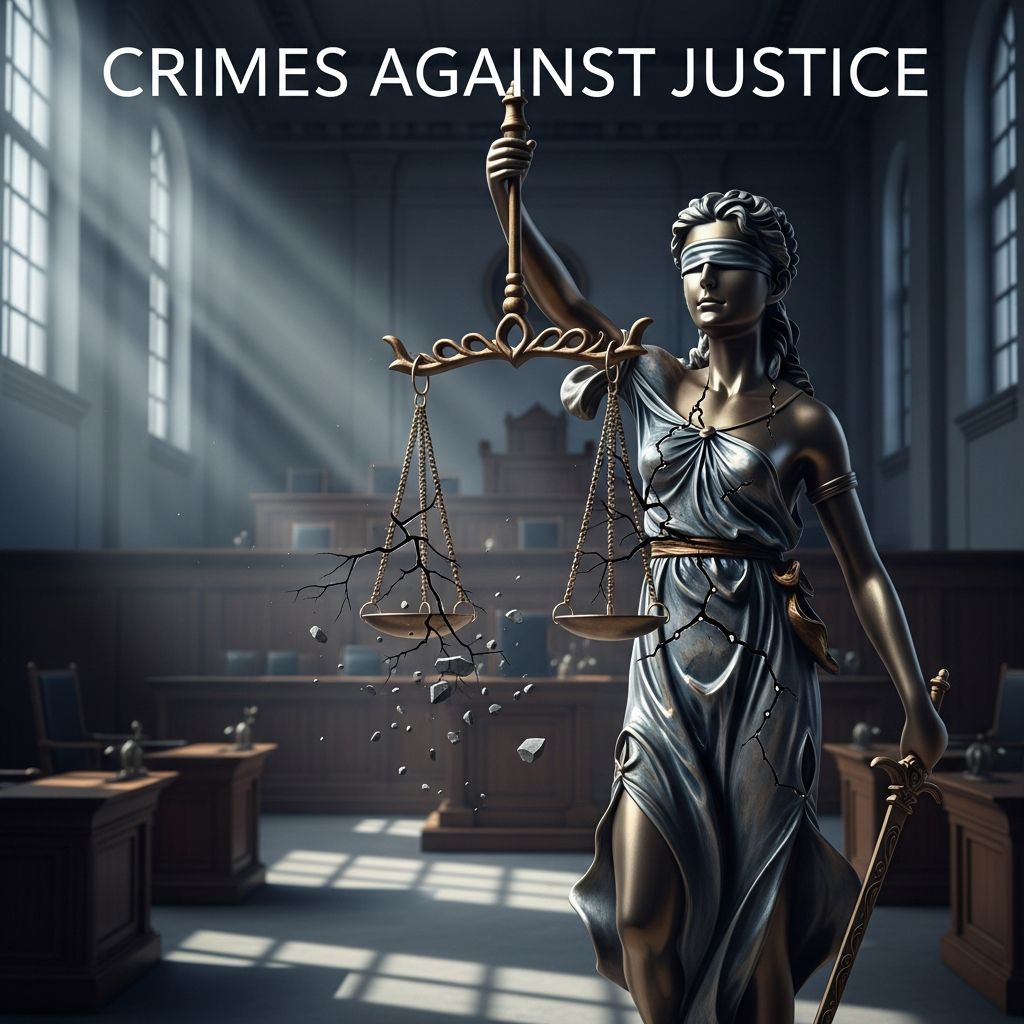
Most criminal laws focus on protecting people and property. Crimes against justice, by contrast, protect something more abstract but equally vital: the fair and effective operation of the legal system itself. These offenses target conduct that corrupts investigations, court proceedings, and the enforcement of laws.
When someone lies under oath, bribes a judge, intimidates a witness, or destroys evidence, they do more than harm a single case. They erode public confidence that courts, juries, police, and prosecutors can uncover the truth and apply the law fairly.
What Are Crimes Against Justice?
Crimes against justice (sometimes called offenses against the administration of justice) are criminal acts that interfere with the way courts, law enforcement, and related institutions do their work. These laws are designed to ensure that:
- Evidence presented in court is honest and reliable.
- Judges, jurors, police, and witnesses can perform their roles free from undue pressure or corruption.
- Court orders and legal procedures are obeyed and respected.
- Investigations can proceed without concealment or destruction of critical information.
Although the details vary by jurisdiction, most legal systems recognize a common group of justice-related crimes, including perjury, making false statements, bribery, contempt of court, obstruction of justice, witness and jury tampering, and public mischief or false reporting.
Major Types of Crimes Against Justice
The table below summarizes several key categories and their core purpose.
| Type of Offense | Primary Harm | Typical Context |
|---|---|---|
| Perjury | Corrupts fact-finding with lies under oath | Court testimony, depositions, sworn affidavits |
| False Statements & False Reports | Misleads investigators or officials outside formal testimony | Police complaints, administrative forms, interviews |
| Bribery of Officials | Buys favorable treatment or decisions | Judges, jurors, police, prosecutors, public officers |
| Contempt of Court | Defies or disrupts the authority of the court | Ignoring orders, disrupting proceedings, refusing to comply |
| Obstruction of Justice | Interferes with investigations or prosecutions | Destroying evidence, tampering, threats, concealment |
| Witness & Jury Tampering | Influences or punishes those who participate in the process | Threats, intimidation, bribes, retaliation |
| Public Mischief / False Reporting | Diverts justice resources through fabricated incidents | False crime reports or misleading complaints to police |
Perjury: Lying Under Oath
Perjury occurs when a person, while legally under oath or solemn affirmation, knowingly makes a false statement about a material fact. Perjury statutes generally require:
- The person was under a valid oath or equivalent legal obligation to tell the truth.
- The statement was intentionally false, not a mistake or misunderstanding.
- The lie involved a material fact – something that could affect the outcome of the proceeding.
Because perjury can cause wrongful convictions or acquittals, many jurisdictions treat it as a serious felony with lengthy maximum sentences. Some legal systems also punish closely related conduct such as giving contradictory evidence on different occasions about the same issue while under oath.
False Statements and False Complaints
Not every lie to authorities qualifies as perjury. Many legal systems separately criminalize false statements made to law enforcement or government officials outside the courtroom.
Common examples include:
- Knowingly providing false information during a police interview.
- Filing a fabricated crime report (for example, falsely claiming a car was stolen to collect insurance money).
- Lying on government forms or declarations.
Some jurisdictions label this conduct as public mischief or false reporting, and penalties can include imprisonment, especially where public resources are wasted or others are wrongly suspected.
Bribery and Corruption of Officials
Bribery involves offering, giving, soliciting, or accepting something of value in order to influence the actions of a public official or a person in a position of trust. In the justice context, bribery can target:
- Judges and magistrates (for favorable rulings or sentencing).
- Police officers (to avoid arrest, charges, or fines).
- Prosecutors (to reduce or drop charges).
- Jurors (to sway verdicts).
- Witnesses (to alter or withhold testimony).
Many legal systems criminalize both the person who offers the bribe and the person who accepts it, recognizing that corruption threatens the perceived neutrality of the justice system. Anti-bribery provisions also appear in international conventions, underscoring their importance in upholding the rule of law.
Contempt of Court: Defying Judicial Authority
Contempt of court covers conduct that disrespects or undermines the authority, dignity, or functioning of the court. Courts often have the power to punish contempt directly to keep proceedings under control.
Common forms include:
- Openly disrupting a hearing by shouting, insulting the judge, or refusing to stop speaking when ordered.
- Ignoring subpoenas or failing to appear when properly summoned.
- Deliberately refusing to obey a court order, such as an injunction or disclosure order.
- Persistently failing to comply with scheduling or procedural directions.
Penalties for contempt vary but may include fines or imprisonment, sometimes imposed immediately to restore order or enforce compliance.
Obstruction of Justice: Interfering with Investigations and Cases
Obstruction of justice is a broad category of offenses that involve corruptly impeding an investigation, prosecution, or other official proceeding. In U.S. federal law and many other systems, obstruction statutes cover a wide range of behavior, such as:
- Destroying, concealing, or altering documents and physical evidence.
- Influencing, intimidating, or misleading witnesses.
- Interfering with jurors or court officers.
- Providing false information to investigators with the intent to derail a case.
High-profile cases have shown how obstruction charges can accompany other alleged misconduct, particularly where officials or corporate actors are accused of covering up wrongdoing. Because obstruction attacks the core functioning of investigations and trials, penalties are often severe.
Witness and Jury Tampering
Witnesses and jurors are essential to fact-finding in many legal systems. Laws therefore specifically criminalize conduct that interferes with their independence or safety.
Examples include:
- Threatening harm to a witness or their family if they testify.
- Offering a benefit to a witness to change their testimony or refuse to appear.
- Contacting jurors outside court to pressure them about their verdict.
- Retaliating against someone because they cooperated with law enforcement or testified at trial.
Training materials for law enforcement emphasize identifying and charging such conduct because intimidation chills cooperation with authorities and weakens public willingness to report crime.
Public Mischief and False Reporting
Some jurisdictions classify knowingly false reports to law enforcement as public mischief or a similar offense. The key idea is that fabricating crime reports:
- Diverts police resources from genuine cases.
- Can unfairly implicate innocent people.
- May be used to commit related frauds, such as insurance scams.
Penalties can be significant, particularly if the false report causes substantial investigation costs or reputational harm.
Why These Crimes Are Punished So Harshly
Crimes against justice are often punished more severely than ordinary dishonest acts because they strike at the foundation of the rule of law. Legislatures and courts regularly emphasize several policy goals:
- Protecting truth-seeking: Courts rely on accurate evidence and orderly proceedings to reach correct results.
- Maintaining public confidence: Perceived corruption or manipulation of the system can reduce willingness to obey laws or cooperate with authorities.
- Deterring interference: Strong penalties send a signal that attempts to manipulate or obstruct justice carry high risk.
- Safeguarding participants: Witnesses, jurors, and officials need protection from threats and retaliation to participate honestly.
Many legal systems therefore classify serious obstruction, perjury, or bribery as felonies with multi-year maximum sentences.
Potential Defenses and Legal Issues
Being accused of a crime against justice does not automatically mean a conviction will follow. Typical issues in these cases include:
- Intent: Most offenses require that the accused acted knowingly or corruptly. Honest mistakes, confusion, or forgetfulness may not meet that standard.
- Materiality: For perjury, the lie must be about an important fact. Minor inaccuracies may not qualify.
- Scope of the statute: Defense counsel may argue that the law does not cover the specific behavior alleged.
- Procedural protections: Constitutional rights such as due process, the right to counsel, and protection against self-incrimination still apply.
Because the legal definitions are technical and penalties can be severe, anyone under investigation for such an offense should seek advice from a qualified criminal defense lawyer in their jurisdiction.
Practical Tips to Avoid Crimes Against Justice
For most people, avoiding these crimes comes down to common-sense precautions when interacting with the justice system:
- Tell the truth when under oath or speaking to law enforcement.
- Do not alter, hide, or destroy documents or objects that could be evidence.
- Avoid any attempt to influence witnesses or jurors outside lawful channels.
- Follow court orders and attend all required hearings on time.
- If you are unsure what you must do, consult a lawyer rather than guessing.
Frequently Asked Questions (FAQs)
Q: What makes an offense a “crime against justice” instead of an ordinary crime?
A: The key feature is that the conduct interferes with the legal system’s ability to investigate cases, hold fair trials, or enforce court orders. The direct victim is the justice process itself, even if individuals are also harmed.
Q: Can I be charged with obstruction just for refusing to talk to police?
A: In many jurisdictions, people have rights to remain silent or decline interviews in the absence of specific legal obligations. Obstruction laws typically target active interference—such as destroying evidence or threatening witnesses—rather than merely exercising constitutional rights. You should seek legal advice about your obligations in your jurisdiction.
Q: Is every lie in court automatically perjury?
A: No. Perjury usually requires a knowingly false statement about a material fact while under a valid oath. Minor inaccuracies, honest errors, or irrelevant misstatements generally do not meet that standard, although they may still undermine credibility.
Q: Are threats against witnesses always a separate crime?
A: Many legal systems have specific offenses for intimidating or retaliating against witnesses and others who assist law enforcement. Depending on the facts, the same conduct may also constitute assault, harassment, or other crimes.
Q: Do these laws only apply in criminal cases?
A: No. Perjury, contempt, obstruction, and related offenses can arise in civil lawsuits, administrative hearings, legislative inquiries, and other official proceedings, not just criminal trials.
References
- Offences Against the Administration of Law and Justice — Éducaloi. 2023-02-01. https://educaloi.qc.ca/en/capsules/offences-against-the-administration-of-law-and-justice/
- Crimes Against Justice — USLegal. 2019-01-01. https://criminallaw.uslegal.com/crimes-against-justice/
- Obstruction of Justice in the United States — U.S. Federal Law Overview (summarized). 2020-06-01. https://en.wikipedia.org/wiki/Obstruction_of_justice_in_the_United_States
- Learning Domain 39: Crimes Against the Justice System — California Commission on Peace Officer Standards and Training (POST). 2022-07-01. https://post.ca.gov/portals/0/post_docs/basic_course_resources/workbooks/LD_39-V6.0.pdf
Similar Articles








Read full bio of Sneha Tete


