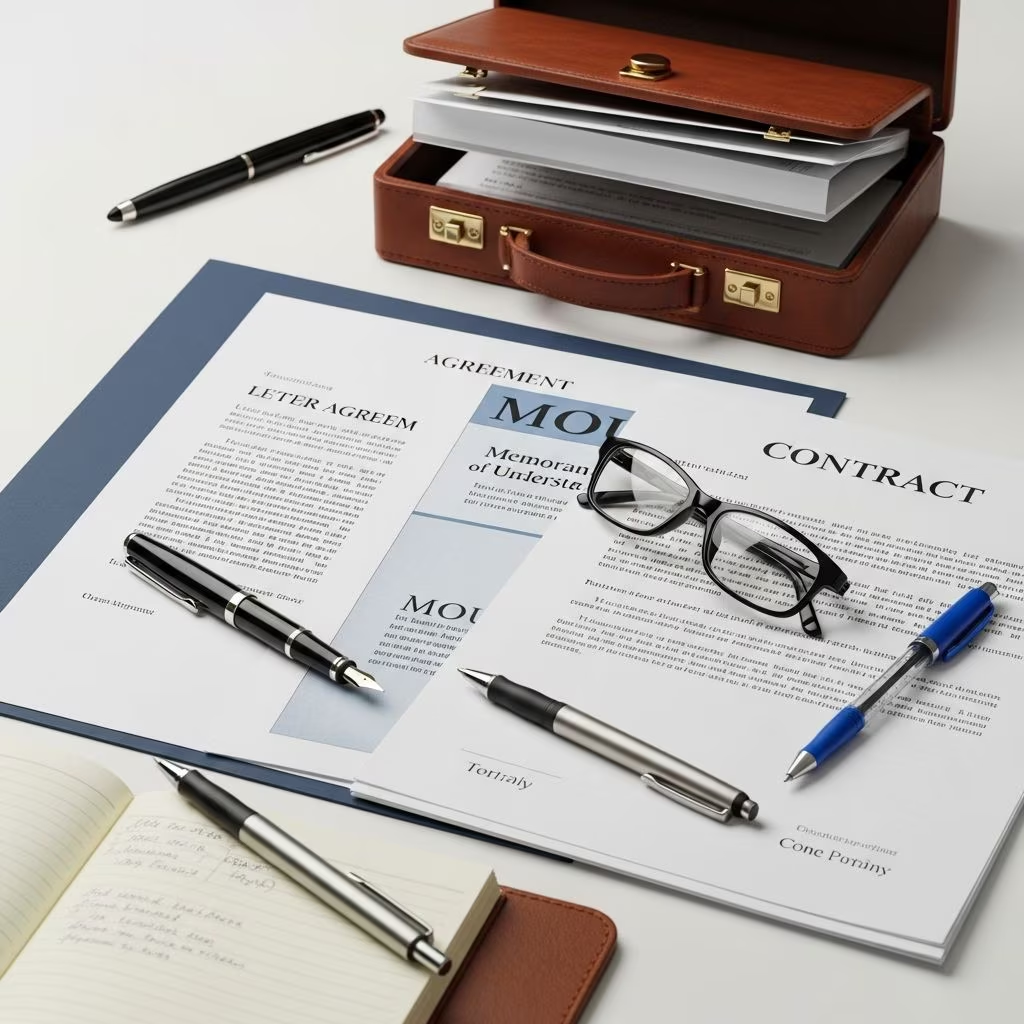
Letter agreements and memorandums of understanding (MOUs) serve as vital tools for outlining business deals without the formality of full contracts. These documents provide a written record of intentions, reducing misunderstandings and offering a foundation for future negotiations or enforcement.
Understanding Letter Agreements vs. MOUs
A **letter agreement** functions much like a simple contract, typically binding when it includes offer, acceptance, and consideration. It is often used for straightforward transactions, such as service provisions or one-off deals. In contrast, an **MOU** is generally non-binding, acting as a preliminary statement of intent to explore collaboration. However, certain clauses like confidentiality can be enforceable.
Choosing between them depends on your goals: opt for a letter agreement for immediate obligations, and an MOU for exploratory discussions. Both promote transparency and professionalism in dealings.
Key Components of a Strong Letter Agreement
To ensure your letter agreement holds up, incorporate these essential elements:
- Parties Involved: Clearly identify all parties with full legal names, addresses, and contact details.
- Purpose Statement: Open with a concise description of the agreement’s objective.
- Obligations and Responsibilities: Detail what each party must do, including timelines and deliverables.
- Payment Terms: Specify amounts, methods, schedules, and late fees if applicable.
- Duration and Termination: Define the agreement’s length and conditions for ending it early.
- Signatures: Require dated signatures from authorized representatives.
Using plain language here prevents disputes; ambiguities are often interpreted against the drafter.
Structuring a Memorandum of Understanding
An MOU should outline mutual intentions without implying full commitment. Start with a title like “Memorandum of Understanding Between [Party A] and [Party B].” Key sections include:
- Background and objectives.
- Proposed terms and scope of cooperation.
- Roles of each party.
- Timeline for discussions or milestones.
- Non-binding disclaimer, except for specified binding provisions like non-disclosure.
Explicitly state the non-binding nature to manage expectations: “This MOU is not intended to create a legally binding obligation except where stated otherwise.”
Best Practices for Clear and Enforceable Drafting
Drafting success hinges on simplicity and precision. Follow these guidelines:
- Use Plain English: Avoid legalese like “herein” or “aforementioned”; write as you would speak in a business meeting.
- Short Sentences and Active Voice: Prefer “Party A will deliver services by June 1” over passive constructions.
- Consistent Terminology: Define terms once (e.g., “Project” means the website development outlined in Schedule A) and use them uniformly.
- Visual Appeal: Employ headings, bullet points, and bold key phrases for readability.
- Specificity: Quantify obligations—e.g., “$5,000 paid in two installments of $2,500 each”—to eliminate vagueness.
| Element | Good Practice | Avoid |
|---|---|---|
| Language | Clear, everyday words | Jargon, Latin terms |
| Sentence Length | Under 25 words | Long, complex run-ons |
| Terms | Defined and consistent | Vague or shifting meanings |
| Structure | Headings, lists | Wall of text |
Incorporating Essential Clauses
Beyond basics, include protective provisions:
- Confidentiality: Protect shared information with NDA-like terms, binding even in MOUs.
- Dispute Resolution: Specify mediation, arbitration, or litigation venue to avoid court battles.
- Governing Law: State which jurisdiction’s laws apply, e.g., “This agreement shall be governed by California law.”
- Force Majeure: Excuse performance for unforeseen events like natural disasters.
- Entire Agreement: Clause affirming the document supersedes prior talks.
Review for compliance with relevant laws, such as consumer protection statutes.
Step-by-Step Guide to Drafting Process
- Preparation: Discuss terms verbally or via email to align expectations.
- Outline: Sketch sections using a template for efficiency.
- Draft: Write in Word or legal software, defining terms as they appear.
- Review: Proofread for errors; have another party read for clarity.
- Negotiate: Share draft, incorporate feedback, track changes.
- Finalize and Sign: Use electronic signatures for speed; retain copies.
This process minimizes revisions and ensures mutual understanding.
Common Mistakes and How to Avoid Them
Pitfalls can undermine your document:
- Oversights in Details: Always specify dates, amounts, and conditions.
- Ignoring Binding Intent: Clearly label if binding or not to prevent misinterpretation.
- No Review: Self-review misses blind spots; consult peers or attorneys.
- Sexist or Inconsistent Language: Use gender-neutral terms and uniform phrasing.
- Neglecting Digital Security: Password-protect files and use secure signing platforms.
Sample Templates and Customization
Adapt these basic templates:
Letter Agreement Template:
[Your Letterhead]
Date: [Date]
[Recipient Name]
[Address]Dear [Name],
This letter confirms our agreement for [describe services]. In exchange, you agree to pay [amount] by [date].
[Detailed terms]
Sincerely,
[Your Signature]
MOU Template:
MEMORANDUM OF UNDERSTANDING
Between [Party A] and [Party B]
Date: [Date]1. Purpose: [State intent].
2. Terms: [Outline proposed cooperation].
3. This MOU is non-binding except for Sections [confidentiality, etc.].
Customize based on specifics, ensuring legal fit.
When to Seek Professional Help
DIY works for simple deals, but consult lawyers for high-value transactions, complex industries, or international elements. They ensure enforceability and compliance.
Frequently Asked Questions (FAQs)
Q: Is a letter agreement legally binding?
A: Yes, if it includes offer, acceptance, consideration, and mutual assent, similar to any contract.
Q: Can an MOU become a full contract?
A: Yes, if parties later execute a definitive agreement referencing the MOU.
Q: Do I need a lawyer to draft these?
A: Not always for basics, but recommended for complexity to avoid enforceability issues.
Q: How do I make it enforceable across states?
A: Include a governing law clause specifying jurisdiction.
Q: What’s the best format for signing?
A: Electronic signatures via platforms like DocuSign are valid and efficient.
Advanced Tips for Professional Documents
For seasoned users, integrate digital tools for version control and automate clauses with software. Always test readability with non-legal readers. Track amendments in appendices to maintain a living document.
By mastering these techniques, you create agreements that foster trust and withstand scrutiny, streamlining business operations effectively.
References
- Legal Writing: Tips for Drafting Clear and Effective Contracts — NBL Top 100. 2023. https://nbltop100.org/legal-writing-tips/
- 5 Writing Tips for Every Contract You Draft — California Lawyers Association. 2022-05-15. https://calawyers.org/solo-small-firm/5-writing-tips-for-every-contract-you-draft/
- Writing Agreements Clients Can Understand — Illinois State Bar Association. 2012-08. https://www.isba.org/sections/corplaw/newsletter/2012/08/writingagreementsclientscanundersta
- How to Write a Legal Contract — People’s Law School. 2024. https://www.peopleslawschool.ca/how-to-write-legal-contract/
- Fifty Tips for Writing the 21st Century Contract — The Florida Bar Journal. 2020. https://www.floridabar.org/the-florida-bar-journal/fifty-tips-for-writing-the-21st-century-contract-that-stays-out-of-court/
- 10 Best Practices for Effective Legal Writing — Injury Board. 2023. https://www.injuryboard.org/10-best-practices-for-effective-legal-writing/
- Tips for Achieving Clarity in Contract Drafting — Georgetown Law. 2018-07. https://www.law.georgetown.edu/wp-content/uploads/2018/07/Tips-for-Achieving-Clarity-in-Contract-Drafting.pdf