
Understanding Court-Imposed Constructive Trusts
Discover how courts use constructive trusts to rectify unjust property gains in legal disputes and personal injury cases.
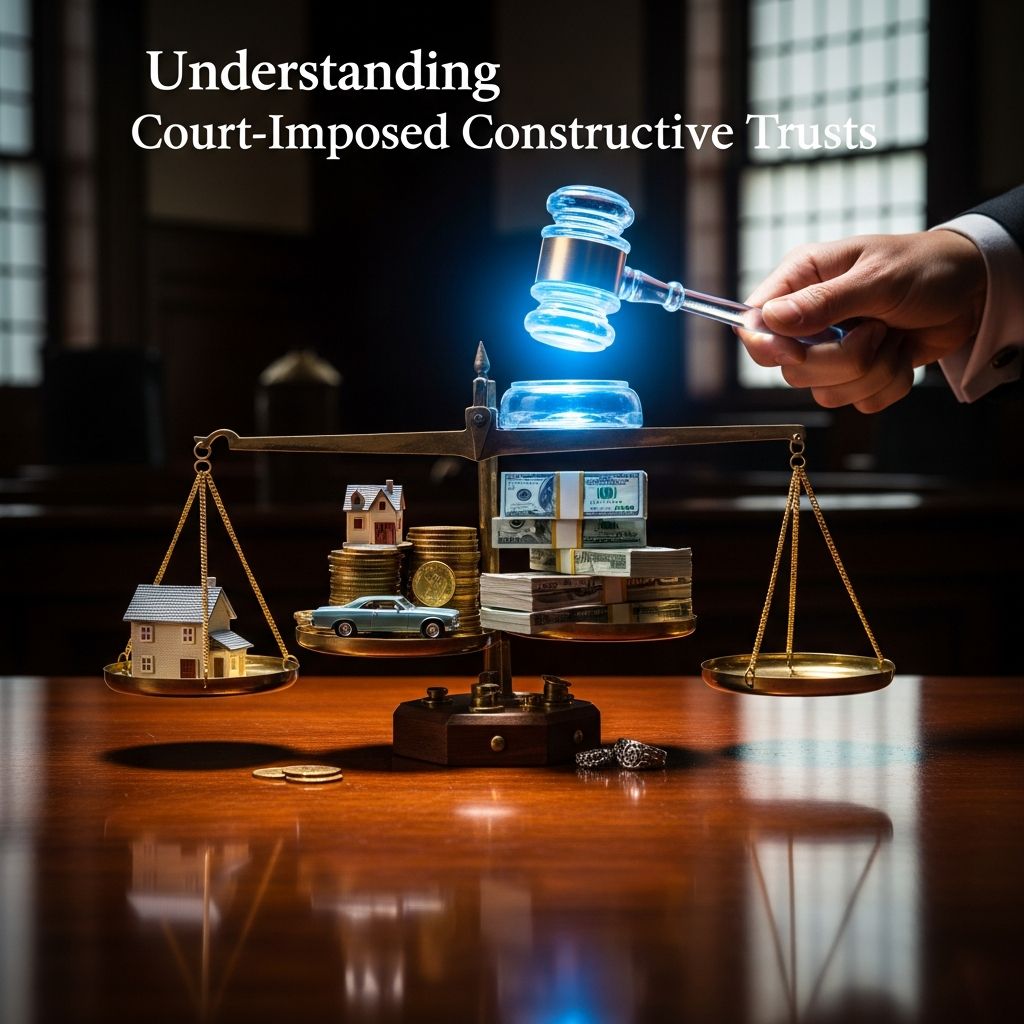
Court-imposed constructive trusts serve as a vital equitable remedy in civil law, compelling individuals who wrongfully hold property to transfer it to its rightful owner. Unlike voluntary trusts, these are judicially created to prevent unfair profit from misconduct or error.
Defining the Constructive Trust Concept
A constructive trust arises when equity demands that a person holding legal title to assets must benefit another party, typically because retention would constitute unjust enrichment. Courts impose this remedy without the need for an express agreement, treating the holder as a trustee obligated to convey the property.
This mechanism addresses situations where traditional legal title fails to reflect true ownership rights. For instance, if property changes hands due to deception or error, the court recharacterizes the holding as fiduciary in nature, ensuring restitution.
Legal Foundations and Equitable Principles
Rooted in common law equity, constructive trusts prevent one party from profiting at another’s expense without justification. Key principles include the need for identifiable property, wrongful acquisition by the defendant, and the plaintiff’s legitimate claim to relief.
Courts require clear and convincing evidence of misconduct, distinguishing this from mere contractual disputes. The remedy prioritizes fairness over strict legal title, often invoked in probate, real estate, and personal injury contexts.
Common Triggers for Imposing a Constructive Trust
Courts typically order constructive trusts in scenarios involving:
- Fraud or misrepresentation: Deliberate deception leading to property transfer.
- Breach of fiduciary duty: Violation by trustees, agents, or guardians.
- Mistake: Erroneous transfers without intent to gift.
- Undue influence or duress: Coercive pressure exploiting vulnerability.
- Embezzlement or theft: Criminal misappropriation of assets.
- Homicide or wrongful death: Preventing killers from inheriting victim property (slayer statutes).
These triggers ensure the remedy targets inequitable conduct, not honest disputes.
The Process of Establishing and Enforcing a Constructive Trust
Initiating a constructive trust begins with the aggrieved party filing a lawsuit alleging unjust enrichment. The plaintiff must prove: (1) res (specific property), (2) their right to it, and (3) defendant’s wrongful acquisition.
Upon finding merit, the judge declares the defendant a constructive trustee. The wrongdoer must then:
- Transfer the asset to the plaintiff or a court-held trust.
- If the property is dissipated, pay its fair market value plus appreciation.
- Hold it without personal benefit until restitution.
Enforcement is discretionary, tailored to achieve equity. Trusts are temporary, dissolving once justice is served.
Constructive Trusts in Personal Injury Contexts
In personal injury litigation, constructive trusts recover assets insurers or third parties wrongfully retain post-settlement. For example, if an attorney misappropriates settlement funds, a court may impose a trust to redirect them to the victim.
They also apply when injury leads to coerced property transfers, such as in elder abuse cases where caregivers exploit incapacitated plaintiffs. This remedy complements damages by tracing and reclaiming specific funds or assets.
Differences from Other Trusts: A Comparative Overview
| Trust Type | Origin | Purpose | Duration | Intent Required |
|---|---|---|---|---|
| Constructive | Court order | Remedy unjust enrichment | Temporary | No (imposed) |
| Resulting | Court (presumed intent) | Failed express trust | Variable | Presumed |
| Express | Agreement | Estate planning | Long-term | Explicit |
Unlike resulting trusts, which presume intent from failed transfers, constructive trusts respond to affirmative wrongdoing like fraud. Both are involuntary, bypassing statutes of frauds.
Real-World Applications and Case Illustrations
Consider a scenario where a business partner embezzles funds to purchase real estate. The court traces the assets and imposes a constructive trust, ordering conveyance to the partnership.
In family disputes, if undue influence sways a will, courts may nullify bequests and impose trusts on ill-gotten inheritances. Personal injury victims have used this to reclaim vehicles or homes transferred under duress during recovery.
Probate litigation often sees constructive trusts correcting fiduciary breaches, restoring estates to rightful heirs.
Challenges and Limitations in Seeking Constructive Trusts
Plaintiffs face hurdles like proving traceability of assets, especially if commingled or sold. Statutes of limitations apply, varying by jurisdiction (often 3-6 years from discovery).
Courts hesitate without ‘clean hands’—plaintiffs must be free of wrongdoing. Equitable defenses like laches (unreasonable delay) can bar relief.
Monetary remedies may substitute if property is irrecoverable, but proprietary interests are preferred for priority over general creditors.
Strategic Considerations for Litigants
Victims should document transactions meticulously and consult probate or injury attorneys early. Tracing software aids in complex financial cases.
Defendants can argue lack of wrongdoing or adequate legal remedies (e.g., damages suffice). Settlements often resolve before imposition.
Frequently Asked Questions About Constructive Trusts
Can a constructive trust be imposed without criminal charges?
Yes, civil courts impose them for equitable wrongs like breach of duty, independent of criminal proceedings.
How long does a constructive trust last?
Typically temporary, until property transfer or compensation completes restitution.
Does it apply to real estate?
Absolutely, especially in fraudulently acquired properties or mistaken title transfers.
What evidence is needed to win?
Clear proof of property, plaintiff’s rights, and defendant’s unjust acquisition.
Is it available in all states?
Yes, as an equitable remedy, though elements vary slightly by jurisdiction.
Conclusion: Empowering Justice Through Equity
Court-imposed constructive trusts exemplify equity’s role in modern law, safeguarding rights against exploitation. Whether in personal injury recoveries or estate battles, they ensure wrongdoers do not profit.
References
- Constructive Trust – LawInfo.com — LawInfo. Accessed 2026. https://www.lawinfo.com/resources/trusts/constructive-trust/
- What Are Constructive Trusts For? | Trust & Will — Trust & Will. Accessed 2026. https://trustandwill.com/learn/constructive-trust
- Constructive Trusts – Triay Law Office — Triay Law. Accessed 2026. https://www.triaylaw.com/probate-litigation/constructive-trusts
- Constructive Trust: Legal Remedy Explained – Estate Mentors — Estate Mentors. Accessed 2026. https://estatementors.com/constructive-trust-legal-remedy-explained/
- What is a Resulting Trust versus a Constructive Trust? — California Lawyers Association. Accessed 2026. https://calawyers.org/real-property-law/what-is-a-resulting-trust-versus-a-constructive-trust/
- Constructive Trust | Wex | US Law | LII — Legal Information Institute, Cornell Law School. Accessed 2026. https://www.law.cornell.edu/wex/constructive_trust
Similar Articles








Read full bio of Sneha Tete


