
Corporate Resolutions: 5-Step Drafting Guide
Master corporate resolutions: essential tools for board decisions, legal compliance, and business governance.
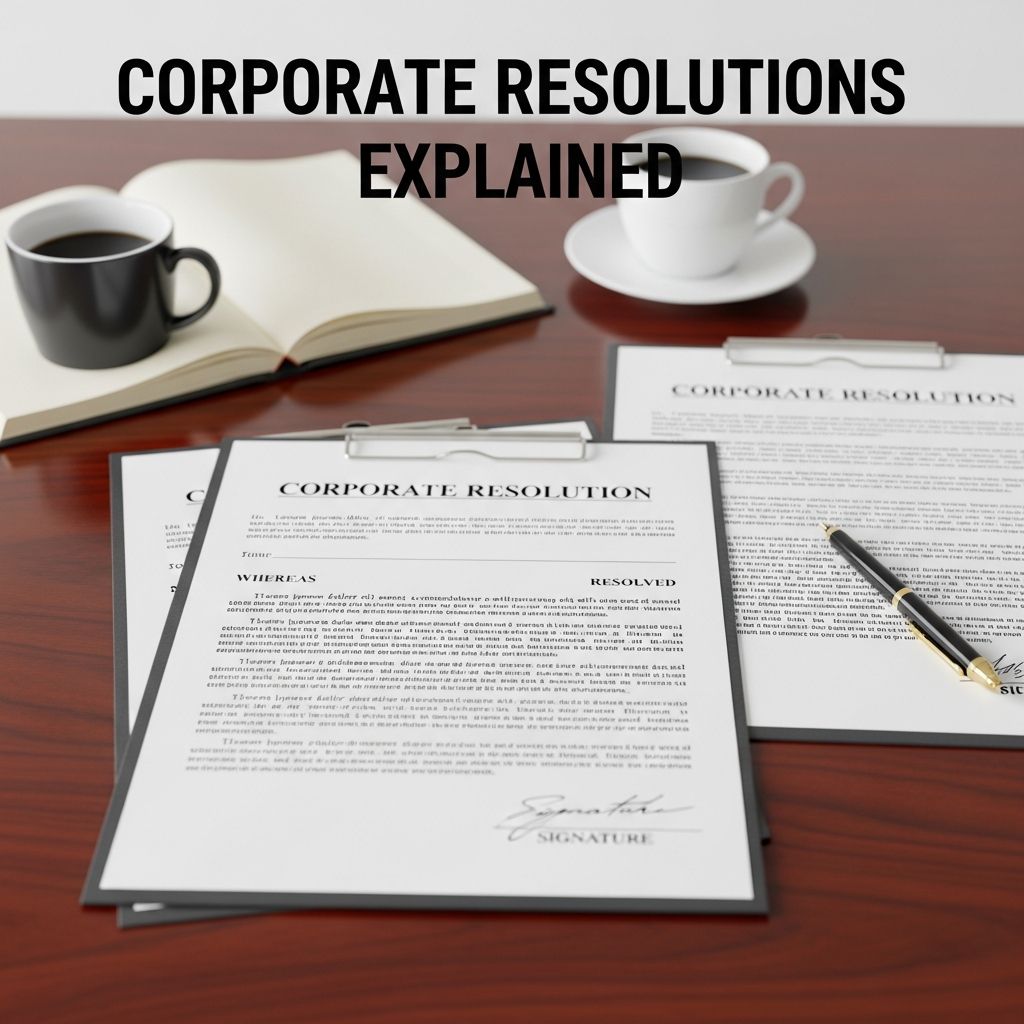
Corporate resolutions are fundamental documents in business governance, formally recording decisions made by a corporation’s board of directors or shareholders. These written records ensure accountability, legal compliance, and clear authorization for major actions.
Understanding the Fundamentals of Corporate Resolutions
A corporate resolution serves as an official written declaration of a board’s or shareholders’ decision, binding the corporation to specific actions. It acts as a legal safeguard, providing a documented trail of governance activities that can be referenced by banks, regulators, or courts.
Unlike informal meeting notes, resolutions carry legal weight because they detail the approval process, voting outcomes, and authorized individuals. This formality protects the corporate veil, maintaining separation between personal and business liabilities.
Boards use resolutions for routine and extraordinary matters alike, from authorizing loans to restructuring operations. Their precision prevents disputes and demonstrates due diligence to stakeholders.
Key Purposes and Advantages in Corporate Operations
Corporate resolutions promote transparency by clearly communicating decisions to all parties involved. They foster accountability, as directors must justify actions in writing, reducing risks of mismanagement claims.
Financial institutions often require certified resolutions to open accounts, process loans, or transfer funds, verifying legitimate authority. In disputes, they serve as evidence of proper procedure, potentially shielding the company from liability.
- Transparency: Keeps shareholders and regulators informed of major moves.
- Compliance: Meets statutory requirements for documenting board actions.
- Authorization: Empowers specific officers to execute decisions.
- Historical Record: Archives governance history for audits or sales.
Distinguishing Types of Corporate Resolutions
Resolutions vary by scope and voting threshold. General resolutions pass with a simple majority and handle everyday operations like appointing officers or approving budgets.
Special resolutions demand higher approval—often two-thirds or unanimous—for fundamental changes such as amending bylaws, mergers, or dissolution. These protect minority interests in pivotal shifts.
| Type | Voting Requirement | Common Uses |
|---|---|---|
| General | Simple majority (>50%) | Bank accounts, contracts, executive hires |
| Special | 2/3 or unanimous | Bylaw changes, mergers, asset sales |
| Unanimous Consent | 100% agreement | Shareholder approvals, dissolutions |
Shareholder resolutions, rarer, address owner-level decisions when bylaws mandate them.
Critical Scenarios Requiring Corporate Resolutions
Banks demand resolutions to designate signatories for accounts or loans, ensuring actions align with board intent. Mergers and acquisitions necessitate them to approve terms and delegate negotiators.
Other triggers include issuing stock, buying real estate, altering compensation plans, or filing patents. Even internal shifts like CEO changes or new branch openings require formal documentation.
- Opening/closing bank accounts
- Authorizing debt issuance or equity sales
- Approving executive pay or benefits
- Mergers, acquisitions, dissolutions
- Real estate transactions
- Bylaw or charter amendments
Step-by-Step Guide to Drafting Effective Resolutions
Drafting begins with identifying the decision’s need and gathering board input. State the resolution’s title, recitals (background facts), the resolved clauses (actions), and signatures.
- Research Requirements: Review bylaws, state laws, and precedents.
- Draft Content: Include purpose, specific authorizations, effective date.
- Circulate for Review: Share with directors for feedback and revisions.
- Vote and Adopt: Hold a meeting or use written consent; record minutes.
- Certify and File: Sign, notarize if needed, and store in corporate books.
Use templates cautiously, customizing to your corporation’s context for validity.
Real-World Applications and Illustrative Examples
For a bank account resolution: “Resolved that [Officer Name] is authorized to open accounts at [Bank] and sign checks up to $X.” This certifies authority to bankers.
In a merger: The board resolves to approve acquisition terms, appoint negotiators, and set closing conditions, detailing financials and contingencies.
Compensation example: “Resolved to set CEO salary at $Y plus bonuses tied to Z metrics,” justifying with performance data.
Legal Weight, Compliance, and Best Practices
Adopted resolutions bind the corporation legally, as they evidence procedural compliance. Courts uphold them if minutes confirm proper adoption, preserving limited liability.
Maintain a secure minute book with all resolutions chronologically. Digitize for access but retain originals. Review annually for relevance.
Common pitfalls: Vague language, missing votes, or poor recordkeeping—avoid by using clear, precise wording and full documentation.
Frequently Asked Questions
What exactly constitutes a corporate resolution?
A written record of board or shareholder decisions, detailing actions and authorizations, adopted via vote or consent.
Is a corporate resolution mandatory for every decision?
No, only for major actions per bylaws or law; minor operational choices may use minutes alone.
Can resolutions be adopted without a meeting?
Yes, via unanimous written consent, if bylaws allow—faster for urgent matters.
How do you revoke or amend a resolution?
Pass a new superseding resolution with similar formality and record it properly.
Do LLCs need corporate resolutions?
LLCs use “member resolutions” analogously, tailored to operating agreements.
Navigating Common Challenges and Risks
Challenges include ensuring quorum, handling dissent, and third-party verification. Mitigate by defining processes in bylaws and training directors.
Risks of neglect: Pierced corporate veil, invalidated contracts, or regulatory fines. Proactive governance minimizes these.
Tools and Resources for Implementation
Leverage board management software for drafting, voting, and storage. Consult attorneys for complex matters to ensure enforceability.
State corporate codes (e.g., Delaware General Corporation Law) provide statutory backing—review for your jurisdiction.
References
- What is a Corporate Resolution? (Overview, Definition, and Examples) — OnBoard Meetings. 2023-05-15. https://www.onboardmeetings.com/blog/what-is-corporate-resolution/
- What Is a Corporate Resolution? Definition, Steps and FAQs — Indeed. 2024-02-10. https://www.indeed.com/career-advice/career-development/corporate-resolution
- What Is a Corporate Resolution and When You Need One — Icon Partners. 2023-11-20. https://www.icon.partners/post/what-is-a-corporate-resolution-and-when-you-need-one
- Corporate Resolutions | Definition, Benefits, Uses, & What to Include — Carbon Collective. 2024-01-05. https://www.carboncollective.co/sustainable-investing/corporate-resolutions
- corporate resolution | Wex | US Law — Legal Information Institute, Cornell Law School. 2023-08-12. https://www.law.cornell.edu/wex/corporate_resolution
- Corporate Resolution Guide: Examples, Tips, and How to Write One — LegalZoom. 2024-03-18. https://www.legalzoom.com/articles/corporate-resolution-basics
Similar Articles








Read full bio of Sneha Tete


