
Corporate Captivity: For-Profit Detention Expansion
Private prison giants are expanding their grip on immigration detention.
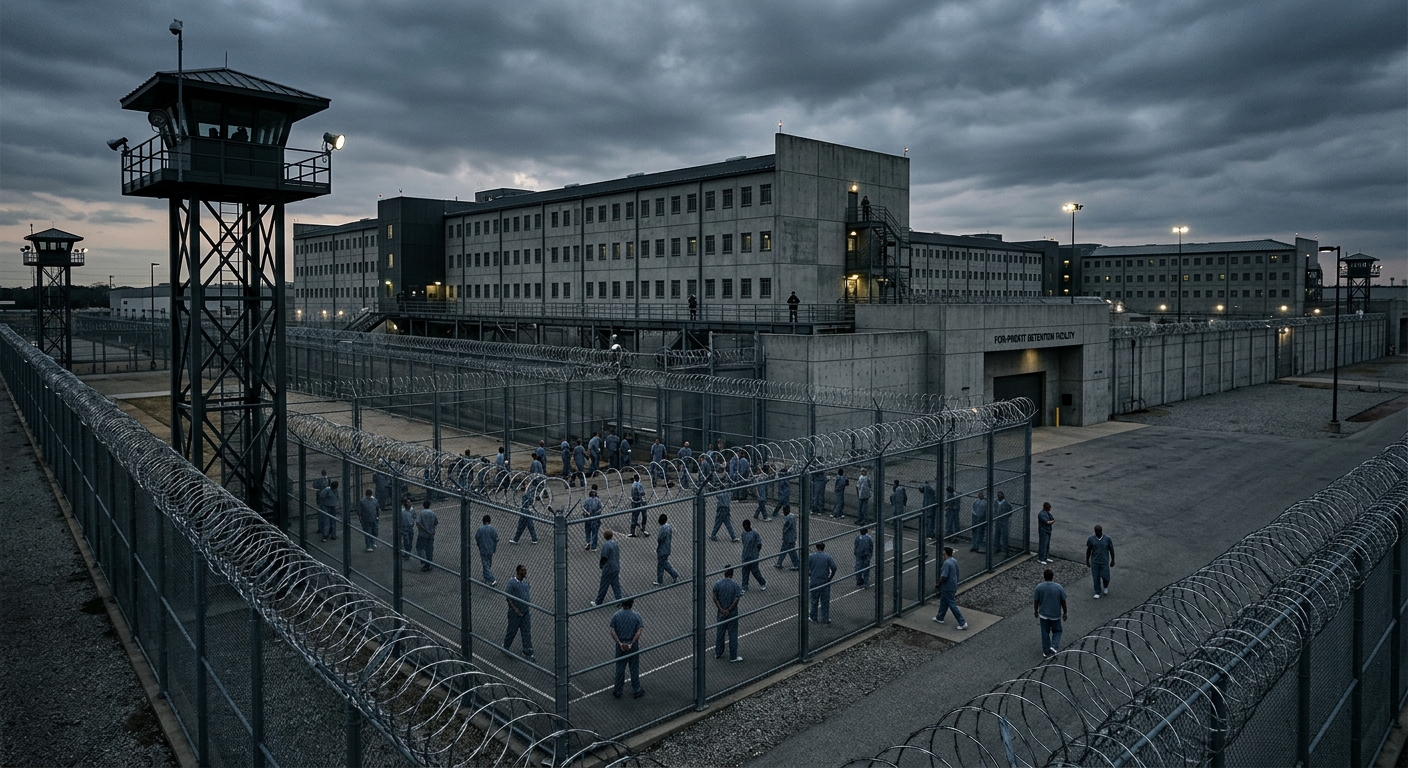
Immigration enforcement in the United States has fundamentally morphed over the past few decades into an incredibly lucrative enterprise. What was once a system primarily handled by direct federal employees has been systematically outsourced, creating a sprawling prison-industrial complex that commodifies human bodies. As global displacement reaches unprecedented levels and border crossings dominate national headlines, the stark reality is that the incarceration of immigrants has transformed into a booming, multi-billion-dollar corporate industry.
Despite repeated political promises, public outcries, and campaigns demanding a more humane, non-punitive approach to civil migration proceedings, private corporations have managed to entrench themselves deeper into the federal apparatus than ever before. The partnership between U.S. Immigration and Customs Enforcement (ICE) and private prison conglomerates is no longer just a temporary administrative convenience; it is a permanent structural fixture of American immigration policy. This unchecked growth raises profound ethical, legal, and humanitarian questions about what happens when the deprivation of human liberty becomes a primary driver for corporate shareholder value.
The Empty Promises of Federal Reform
When the political winds shifted at the dawn of the 2020s, there was a palpable sense of optimism among civil rights advocates. In January 2021, an executive order was signed to ostensibly phase out the federal government’s reliance on private, for-profit prisons. The directive instructed the Department of Justice (DOJ) to decline the renewal of contracts with privately operated criminal detention facilities. To the public eye, it appeared to be a monumental victory against the privatization of incarceration.
However, a massive, deliberate loophole was built into this policy: it conspicuously excluded U.S. Immigration and Customs Enforcement, an agency housed under the Department of Homeland Security (DHS), not the DOJ. This critical omission served as a catalyst for what would soon become an unprecedented boom in corporate immigration detention. Instead of shrinking the private prison industry, the executive order merely forced it to pivot its business model. Federal criminal justice facilities that were slated for closure due to the DOJ directive did not board up their windows. Instead, they quickly rebranded, shifting their operations to secure highly lucrative, long-term contracts with ICE .
The statistical realities of this pivot are staggering. While the average daily detained population experienced a temporary dip during the height of the global pandemic, falling to roughly 15,000 individuals, it has since roared back with a vengeance. Recent legislative budget allocations have authorized funding for tens of thousands of detention beds, transforming former criminal penitentiaries into massive immigration holding centers overnight. The government’s continued infusion of capital into ICE guarantees that the architecture of mass detention remains firmly in corporate hands .
Corporate Consolidation: The Dominance of Mega-Contractors
To grasp the sheer magnitude of the private sector’s grip on the immigration system, one must look at the primary beneficiaries of this governmental outsourcing: publicly traded mega-corporations like the GEO Group and CoreCivic. These industry behemoths, alongside a handful of smaller private operators, have consolidated their power to an astonishing degree. Research indicates that the vast majority of individuals held in civil immigration custody—often hovering around 90 percent of the total detained population—are confined within facilities owned, operated, or managed by these private contractors .
The business model of these corporations inherently demands a steady stream of human capital to generate profit. To protect their financial interests, private prison companies aggressively lobby lawmakers and secure contracts that often feature “guaranteed minimums” or bed quotas. These contractual clauses require the federal government to pay for a specific number of detention beds regardless of whether they are actually filled by migrants. Consequently, ICE is financially incentivized to maintain high arrest and detention rates simply to justify the exorbitant taxpayer funds being funneled into these corporate accounts.
Furthermore, this financial windfall is not limited to physical bed space. The corporate ecosystem surrounding immigration enforcement has expanded to include transportation services, facility maintenance, and private security contracting. Commercial airlines and private aviation companies have even stepped in to execute deportation flights, securing their own slice of the multibillion-dollar enforcement pie .
| Sector of Enforcement | Corporate Involvement | Primary Impact on Migrants |
|---|---|---|
| Physical Confinement | GEO Group, CoreCivic, LaSalle Corrections | Prolonged detention in remote facilities, restricted access to legal counsel. |
| Electronic Surveillance (ATD) | BI Incorporated (GEO Group Subsidiary) | Invasive GPS tracking, continuous psychological distress, and data harvesting. |
| Transportation Logistics | Private Aviation Firms and Transport Contractors | Rapid, opaque deportation processes often occurring under the cover of darkness. |
The Illusion of Accountability and Oversight Failures
When incarceration is tethered to a corporate bottom line, the administrative incentives naturally skew toward extreme cost-cutting. In the private prison industry, minimizing operational expenditures directly translates to maximized shareholder dividends. Tragically, these financial efficiencies are routinely achieved at the direct expense of human welfare, resulting in conditions that advocates and medical professionals have decried as inhumane.
A comprehensive review conducted by the U.S. Government Accountability Office (GAO) has exposed glaring, systemic deficiencies in how immigration facilities are monitored and evaluated. The GAO found that the entities responsible for inspecting DHS and ICE facilities frequently lack clearly defined performance goals and standardized metrics for success. Without these vital benchmarks, it becomes nearly impossible to accurately assess whether private contractors are providing the safe, secure, and humane environments mandated by federal guidelines .
The human toll of this oversight failure is devastating. Investigative journalists and human rights watchdogs have documented rampant medical neglect, insufficient mental health care, and the punitive use of prolonged solitary confinement within corporate-run ICE facilities. Detainees frequently report being ignored by medical staff when complaining of severe pain or chronic illness, sometimes leading to preventable fatalities. Yet, paradoxically, these same facilities consistently pass internal ICE inspections. This disconnect highlights a broken accountability mechanism, where paper compliance is valued over actual human life, allowing private contractors to operate with near impunity while shielding themselves behind a veil of bureaucratic rubber-stamping.
Digital Incarceration: The “Alternatives to Detention” Racket
As public scrutiny over physical cages intensifies, private corporations have engineered a highly profitable, less visible revenue stream: “Alternatives to Detention” (ATD). Marketed as a humane, cost-effective substitute for traditional incarceration, ATD programs rely on digital surveillance technologies, such as GPS ankle monitors, voice recognition software, and facial recognition smartphone applications like SmartLINK, to track immigrants awaiting their court hearings.
While advocates agree that individuals should not be locked in physical cells while navigating civil immigration proceedings, the current iteration of ATD is far from a benevolent solution. It is, in reality, a massive expansion of the carceral state into the digital realm—a phenomenon often referred to as e-carceration. The ultimate irony of this system is that it is administered by the exact same corporate entities that run the physical prisons. For example, BI Incorporated, the dominant player in the ATD market, is a wholly owned subsidiary of the GEO Group.
This vertical integration grants corporate giants a monopoly over the migrant experience. By controlling both the physical cells and the digital tethers, these companies ensure they profit regardless of whether an immigrant is locked in a detention center or living in a community under strict digital surveillance. The psychological burden of e-carceration is profound; migrants report feeling constantly stalked, experiencing deep anxiety over equipment malfunctions that could trigger immediate arrest, and suffering social stigmatization from wearing bulky electronic shackles.
Local Entanglements and Perverse Incentives
The architecture of for-profit immigration enforcement extends beyond the boardrooms of Wall Street mega-corporations; it also deeply infiltrates local governance. ICE routinely subcontracts with county jails and local municipalities to lease bed space for immigrant detainees. For many cash-strapped rural counties, securing an Intergovernmental Service Agreement (IGSA) with ICE represents a highly lucrative financial lifeline.
This financial dynamic creates deeply perverse incentives at the local level. When a county sheriff’s department relies on federal ICE payouts to balance its budget or fund infrastructure projects, local law enforcement becomes financially addicted to mass incarceration. This reliance actively discourages local jurisdictions from implementing progressive criminal justice reforms or decreasing jail populations, as doing so would jeopardize their federal revenue streams. Instead, it aligns local political interests with draconian federal immigration policies, transforming local sheriffs into enthusiastic participants in the deportation machine .
Furthermore, these local county jails are notoriously difficult to monitor. Because they primarily fall under county jurisdiction rather than federal oversight, immigrants held in these facilities often face even more opaque conditions, fewer avenues for legal recourse, and restricted access to immigration attorneys compared to those in dedicated federal or private processing centers.
The Humanitarian Toll and The Road Ahead
The unchecked expansion of private prison corporations within the United States immigration system represents a profound moral crisis. The aggressive commodification of migration strips vulnerable individuals of their inherent humanity, reducing asylum seekers, refugees, and undocumented workers to mere line items on a corporate balance sheet. As long as there is a financial motive to detain, the system will inherently seek out bodies to fill beds.
Addressing this sprawling web of for-profit detention requires immense political will and a fundamental reimagining of immigration enforcement. Incremental reforms and selective executive orders have proven insufficient against an industry with vast lobbying power and deep political entanglements. True accountability demands full transparency, the severing of financial incentives from civil detention, and a pivot toward community-based support systems that uphold the dignity and due process rights of all individuals navigating the immigration process. Ultimately, extracting billion-dollar profits from the deprivation of human liberty is a business model fundamentally incompatible with justice.
Frequently Asked Questions (FAQs)
- What is an ICE detention center?
An ICE detention center is a facility where individuals suspected of visa violations, illegal entry, or those who are subject to deportation are held in civil custody while their immigration cases are processed. They are not intended to be punitive criminal prisons, though the conditions are often indistinguishable. - Why does the government use private prison corporations?
Proponents claim that private companies offer logistical flexibility, faster construction, and rapid scalability that the federal government struggles to achieve on its own. However, critics argue this reliance creates perverse financial incentives that prioritize corporate profits over human rights, leading to severe neglect and systemic abuse. - Did the 2021 executive order end private immigration detention?
No. The executive order specifically targeted Department of Justice (DOJ) contracts, effectively phasing out the federal use of private criminal prisons. It entirely excluded U.S. Immigration and Customs Enforcement (ICE), which operates under the Department of Homeland Security, allowing the private immigration detention industry to continue growing unchecked. - What are Alternatives to Detention (ATD)?
ATD programs utilize electronic monitoring technologies—such as GPS ankle bracelets, telephone check-ins, and facial recognition smartphone applications—to track immigrants awaiting court hearings without physically confining them. While less restrictive than physical detention, these programs are heavily criticized for expanding digital surveillance and are largely run by the same private prison corporations.
References
- ICE Detention Trends — Vera Institute of Justice. 2026-04-02. https://www.vera.org/ice-detention-trends
- Mass Incarceration: The Whole Pie 2024 — Prison Policy Initiative. 2024-03-14. https://www.prisonpolicy.org/reports/pie2024.html
- Immigration Detention: DHS Should Define Goals and Measures to Assess Facility Inspection Programs (GAO-25-107580) — U.S. Government Accountability Office (GAO). 2025-05-21. https://www.gao.gov/products/gao-25-107580
- Budget airline begins deportation flights for ICE with start of Arizona operations — The Associated Press. 2025-05-13. https://apnews.com/article/avelo-airlines-ice-deportation-flights-arizona-489932174
Similar Articles








Read full bio of medha deb




