
Contributory vs. Comparative Negligence Explained
Learn how contributory and comparative negligence rules can limit or reduce compensation in personal injury and accident cases.
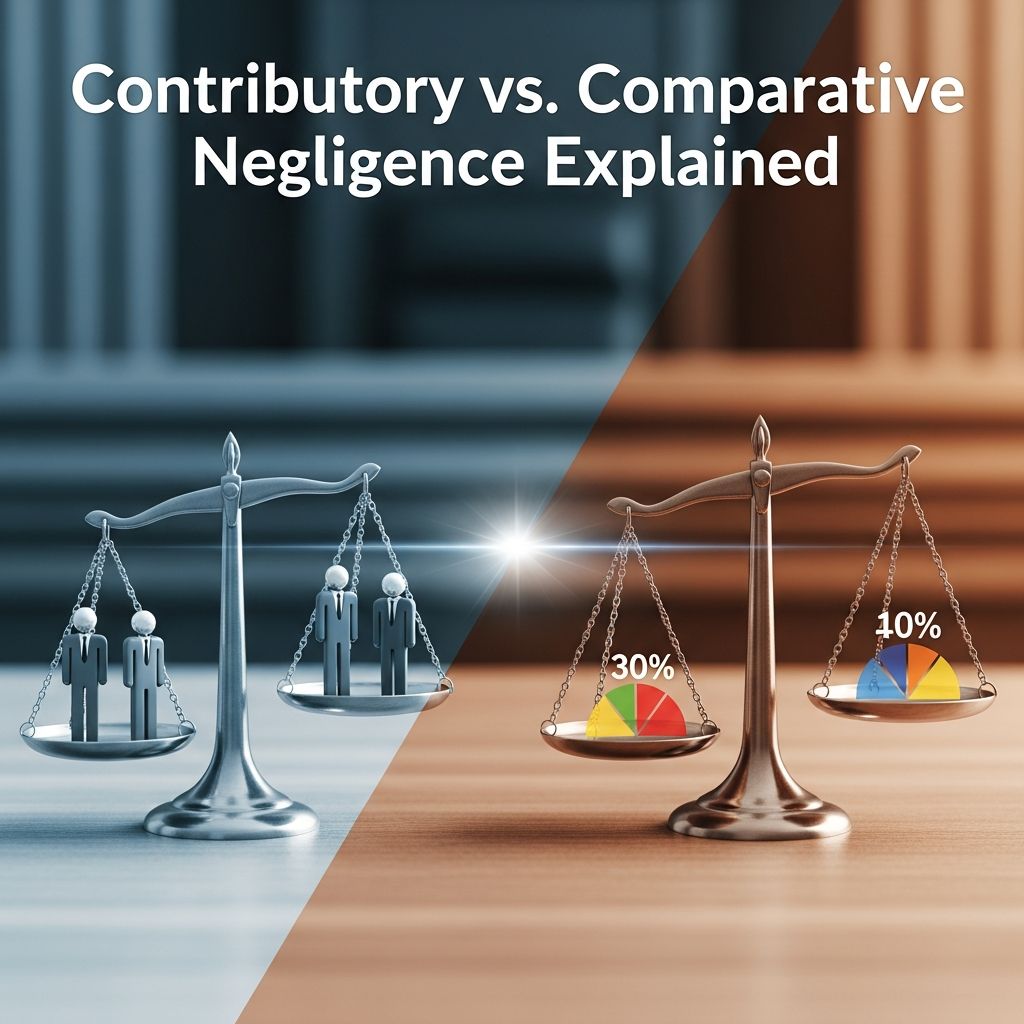
When people are hurt in car crashes, slip-and-fall incidents, or other accidents, the law rarely assumes that one person is 100% to blame. Rules known as contributory negligence and comparative negligence decide what happens when an injured person also shares some fault for what happened.
This guide explains what these doctrines mean, how they differ, and why they can dramatically change the value of a personal injury claim.
Negligence Basics: How Injury Liability Is Decided
Both contributory and comparative negligence operate within the broader law of negligence. Before a court even decides how to allocate fault between people, it must decide whether anyone was negligent at all.
To prove negligence, an injured person (the plaintiff) typically must show:
- Duty of care – The defendant had a legal obligation to act with reasonable care, such as driving safely or maintaining safe property conditions.
- Breach of duty – The defendant failed to meet that standard (for example, speeding, running a red light, or ignoring a spill on a shop floor).
- Causation – The breach both actually caused the harm (cause in fact) and was closely enough connected to the injury that the law treats it as a legal cause (proximate cause).
- Damages – The plaintiff suffered measurable harm such as medical bills, lost wages, pain and suffering, or property loss.
Once these elements are established, the key question becomes: what if the plaintiff also acted carelessly? That is where contributory and comparative negligence come in.
What Is Contributory Negligence?
Contributory negligence is a traditional rule stating that if an injured person is even slightly negligent and that negligence helps cause the accident, they are completely barred from recovering damages from the other party.
In other words, a plaintiff who is found to be 1% at fault cannot recover anything from a defendant who is 99% at fault, in jurisdictions that still use pure contributory negligence. This all-or-nothing approach has been criticized for harsh and sometimes unfair outcomes, especially where the plaintiff’s mistake is minor compared to the defendant’s behavior.
Key Features of Contributory Negligence
- All-or-nothing bar – Any proven negligence by the plaintiff that contributes to the injury can fully block recovery.
- Defendant’s burden – The party being sued typically must raise and prove contributory negligence as a defense, showing the plaintiff failed to take reasonable care for their own safety.
- Focus on plaintiff conduct – Courts examine whether the plaintiff’s own actions fell below the standard of a reasonably careful person and legally contributed to the harm.
Where Contributory Negligence Still Applies
Only a small minority of U.S. states still rely on pure contributory negligence in most personal injury cases. Legal research from state legislative and court materials notes that jurisdictions such as Maryland and a few others retain this common-law rule, meaning any contributory fault completely precludes damages in ordinary negligence cases.
Because of its severity, many states have moved away from pure contributory negligence to some form of comparative fault system.
What Is Comparative Negligence?
Comparative negligence (often called comparative fault) is a more modern system that divides responsibility between everyone who contributed to an accident. Instead of an all-or-nothing result, the plaintiff’s damages are reduced in proportion to their share of fault.
For example, if a plaintiff is found 25% responsible and the defendant 75% responsible, the plaintiff can still recover, but their compensation is reduced by 25%. If total damages are $100,000, the plaintiff would receive $75,000 in a pure comparative fault jurisdiction.
Types of Comparative Negligence
States using comparative fault generally follow one of two main variants identified in legislative and academic analyses:
| System Type | Rule on Plaintiff Fault | Effect on Recovery |
|---|---|---|
| Pure comparative negligence | Plaintiff can recover even if they are up to 99% at fault. | Damages reduced by plaintiff’s exact percentage of fault. |
| Modified comparative negligence (50% bar) | Plaintiff barred from recovery if they are 50% or more at fault. | If plaintiff is less than 50% at fault, damages are reduced in proportion to that percentage. |
| Modified comparative negligence (51% bar) | Plaintiff barred if they are 51% or more at fault. | Recovery allowed only if plaintiff’s share of fault does not exceed the defendant’s. |
Policy Reasons for Comparative Fault
- Perceived fairness – Courts and legislatures have concluded that assigning damages in proportion to fault produces more equitable outcomes than an absolute bar for minor plaintiff negligence.
- Shared responsibility – Comparative systems recognize that accidents often involve mistakes by more than one person, and each should bear their share of the losses.
- Reduced harshness – Comparative fault avoids situations where a slightly careless plaintiff recovers nothing despite a defendant’s far more serious misconduct.
Contributory vs. Comparative Negligence at a Glance
The two approaches answer the same basic question in very different ways: what happens when an injured person is also negligent?
| Feature | Contributory Negligence | Comparative Negligence |
|---|---|---|
| Effect of any plaintiff fault | Any contributing fault can bar all recovery. | Fault reduces damages by percentage but does not automatically bar recovery. |
| Typical jurisdictions | A minority of U.S. states retain pure contributory negligence. | The majority of states use pure or modified comparative fault. |
| Perceived fairness | Criticized as harsh and potentially unjust for minor plaintiff faults. | Viewed as more balanced because each party pays according to their share of blame. |
| Complexity | Simple in theory; no need to calculate precise percentages of fault. | Requires allocation of fault percentages, which can be fact-intensive. |
How Courts Decide Whether a Plaintiff Was Negligent
In both systems, the defendant usually has to prove that the plaintiff was negligent and that this negligence contributed to the injury. Legal analyses describe several required showings:
- The plaintiff failed to take reasonable care for their own safety (for example, ignoring a warning sign or crossing a street against a signal).
- This failure caused or contributed to the injuries suffered.
- It was reasonably foreseeable that this kind of carelessness could lead to harm.
If the defendant meets this burden, the effect depends on which system the jurisdiction follows. In a contributory negligence state, the claim might be dismissed entirely. In a comparative negligence state, the jury or judge assigns percentages of fault and reduces the award accordingly.
Real-World Impact on Personal Injury Claims
The type of negligence system in place can dramatically change the value of a claim, and in some cases determine whether a plaintiff receives anything at all.
Common Situations Where Plaintiff Fault Is Alleged
- Motor vehicle collisions – A driver may be speeding, distracted, or not following traffic signals while another driver makes an improper maneuver.
- Pedestrian and cyclist accidents – Allegations might involve crossing outside crosswalks, failing to obey signals, or not using lights or reflective gear at night.
- Premises liability – Defendants may argue that injured visitors ignored clear warnings, entered restricted areas, or failed to watch where they were walking.
- Workplace incidents – Employers or insurers may claim that employees disregarded safety protocols or misused equipment.
In contributory negligence jurisdictions, even modest findings of plaintiff fault in these scenarios can erase an otherwise strong case. In comparative negligence jurisdictions, the same findings typically lead to a reduction, not elimination, of damages.
How These Doctrines Interact With Other Liability Rules
Negligence systems do not operate in isolation. State law often combines contributory or comparative negligence with other doctrines that affect who pays what share of damages. Legislative research identifies several important interactions:
- Joint and several liability – In some states, even if multiple defendants are at fault, one defendant can be held responsible for paying the full judgment, and then seek contribution from others.
- Multiple tortfeasors – Where several people contribute to a single injury, courts must allocate fault among them and, in comparative systems, reduce the plaintiff’s recovery according to the plaintiff’s percentage of responsibility.
- Statutory exceptions – Certain types of cases (for example, some intentional torts or specific worker protections) may not allow contributory fault defenses at all or may apply special rules.
Why It Matters to Know Your State’s Rule
Knowing whether your jurisdiction follows contributory or comparative negligence is crucial if you have been injured in an accident.
- In a contributory negligence state, even small mistakes can provide powerful defenses to insurers and defendants, making early legal advice especially important.
- In a comparative negligence state, admitting some fault does not necessarily end your claim, but it may significantly reduce the amount you can recover.
- Fault assessments are often negotiated between attorneys and insurers and, if no agreement is reached, decided by juries or judges at trial.
Because these rules are state-specific and can change through legislation or court decisions, it is important to consult current local law or a qualified attorney when evaluating a potential claim.
Practical Tips If You May Share Some Fault
People often worry that if they contributed to an accident, they have no legal options. In many jurisdictions, that is not correct. While this is not legal advice, general steps that may help protect a potential claim include:
- Document the scene – Take photos, gather witness information, and note conditions like weather, lighting, and signage.
- Seek prompt medical care – Having medical records that clearly connect your injuries to the incident is critical in any negligence system.
- Avoid assumptions about fault – Do not assume that being partially at fault automatically ends your case; the effect depends heavily on state law.
- Preserve evidence – Keep damaged property, clothing, and written communications related to the event.
- Get legal guidance – Because contributory and comparative rules are complex and vary by jurisdiction, individualized legal advice can be important.
Frequently Asked Questions (FAQs)
Q1: If I was partly at fault, can I still bring a claim?
In a pure contributory negligence jurisdiction, any contributing fault might bar your claim entirely. In comparative negligence states, you can usually still bring a claim, but your compensation may be reduced in proportion to your share of fault, and in some modified systems you may be barred if you are at least 50% or 51% responsible.
Q2: Do I have to prove I was not negligent at all?
The injured person generally must prove that the defendant was negligent and caused the injury. The defendant, in turn, usually has the burden to prove that you were also negligent and that your negligence contributed to the harm, especially when asserting contributory negligence as a defense.
Q3: Why do some states still use contributory negligence?
Some jurisdictions have retained contributory negligence on the grounds that it is simple to apply and reflects a policy choice that individuals should not recover damages if they contributed to their own injuries, even minimally. Critics argue that this can yield inequitable results, which is why most states have adopted comparative systems instead.
Q4: How is my percentage of fault decided?
In comparative negligence cases, judges or juries typically decide percentages of fault after considering all evidence: accident reports, testimony, expert opinions, photographs, and more. These findings directly affect how much compensation, if any, the plaintiff receives.
Q5: Can these rules change over time?
Yes. Negligence systems are governed by state statutes and court decisions. Legislative studies show that many states moved from contributory to comparative fault through reforms enacted over the past several decades, and further changes remain possible. Because of this, it is important to rely on up-to-date legal information or professional advice.
References
- Contributory Negligence, Comparative Fault, and Joint and Several Liability — Maryland Department of Legislative Services. 2011-01-01. https://dls.maryland.gov/pubs/prod/CourtCrimCivil/Negligence-Systems.pdf
- Contributory Negligence — Legal Information Institute, Cornell Law School. 2020-08-01. https://www.law.cornell.edu/wex/contributory_negligence
- Contributory Negligence (Law) – Research Starters — EBSCO / Salem Press. 2016-01-01. https://www.ebsco.com/research-starters/law/contributory-negligence-law
- What Is Contributory Negligence? — Thompsons Solicitors. 2023-05-01. https://www.thompsons.law/support/legal-guides/what-is-contributory-negligence
- Contributory Negligence — Arnold & Smith, PLLC. 2022-03-01. https://injury.arnoldsmithlaw.com/contributory-negligence.html
Similar Articles








Read full bio of Sneha Tete


