
Constitutional Law Over Profiling in FBI Training
Federal agents need rigorous constitutional training, not biased profiling.
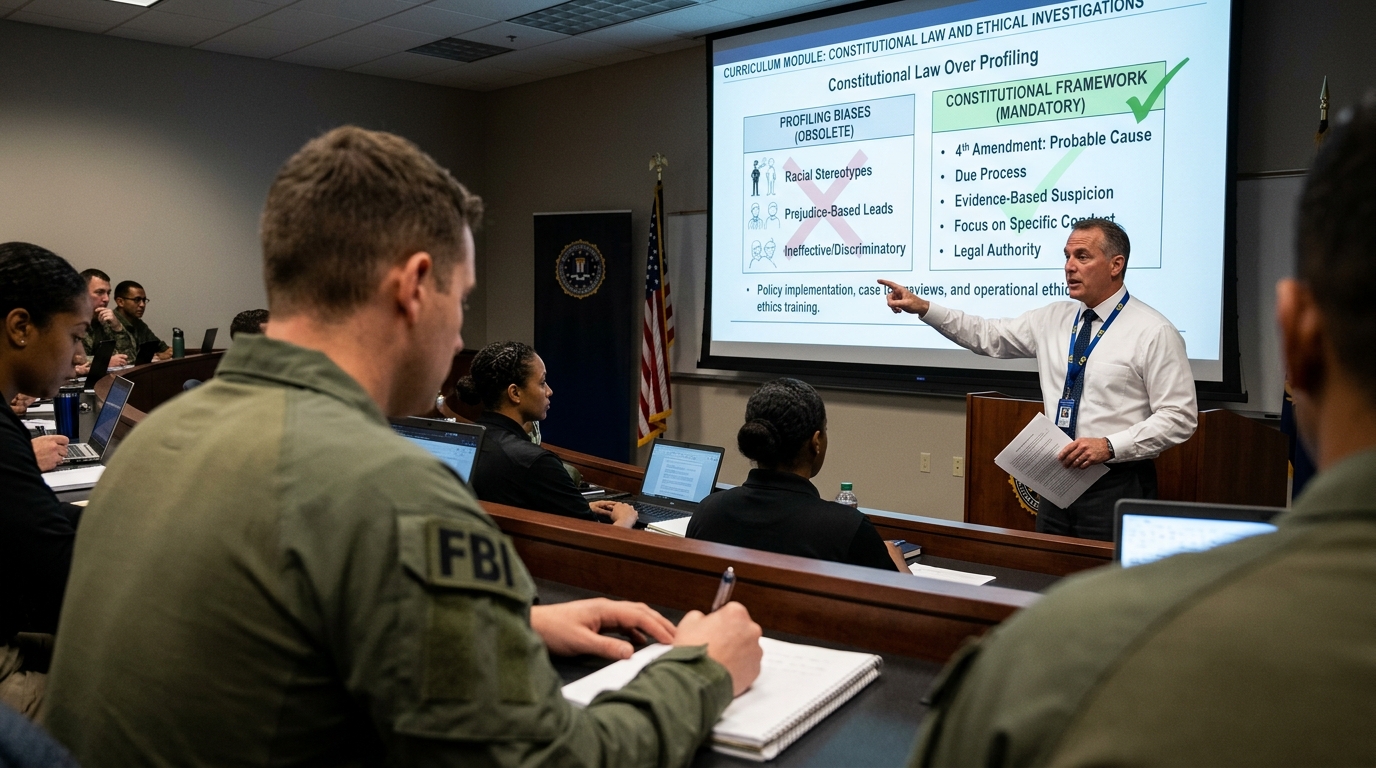
Rethinking Federal Counterterrorism: The Urgent Need for Constitutional Foundations
In the complex and rapidly evolving landscape of federal law enforcement, the methodologies utilized to instruct and prepare agents carry profound implications for the preservation of civil liberties in the United States. Following major shifts in national security priorities over the past two decades, counterterrorism efforts expanded exponentially. In this environment, law enforcement agencies sometimes turned to culturally focused training modules in an attempt to understand international and domestic threats. However, history has demonstrated that when intelligence operations prioritize demographic, cultural, or religious profiling over strict adherence to constitutional principles, the results often undermine both public safety and civil rights.
The fundamental premise of effective, lawful policing is that federal agents do not need to become amateur theologians or cultural anthropologists; rather, they require a deep, unwavering understanding of the United States Constitution. The shift toward proactive intelligence gathering frequently blurred the lines between investigating actionable criminal behavior and monitoring lawful, constitutionally protected activities. When training materials attempt to dissect complex world religions, they inevitably reduce centuries of diverse theological discourse into oversimplified, often inaccurate stereotypes. This approach not only alienates marginalized communities but also distracts agents from identifying genuine, evidence-based threats. To rebuild trust and ensure the integrity of federal investigations, a paradigm shift is necessary: agencies must abandon ideological profiling in favor of rigorous, continuous education in Constitutional Law.
The Inherent Flaws of Religious Profiling in Intelligence
The core danger of integrating cultural or religious instruction into law enforcement training lies in the assumption that religious orthodoxy or cultural practices are inherent precursors to criminal violence. When intelligence analysts and field agents are taught to view a specific demographic as intrinsically suspicious, it institutionalizes bias within the investigative process. This flawed methodology assumes that the outward expression of a specific faith—such as attire, dietary restrictions, or regular attendance at a house of worship—correlates with a propensity for extremism.
Such generalized assumptions are not only analytically defective but also highly damaging to the fabric of a democratic society. When federal agencies define politically or religiously loaded terms without robust legal safeguards, it contributes to an environment where citizens are scrutinized solely based on their identity. The psychological toll on these communities is immense. Individuals who feel unjustly targeted by the very institutions designed to protect them often withdraw from civic participation. This chilling effect suppresses free expression and severely damages the vital relationships law enforcement must cultivate to effectively serve the public.
Furthermore, theological profiling relies on a fundamental misunderstanding of radicalization. Criminological research consistently shows that there is no single, predictable demographic profile for individuals who commit acts of violence. By utilizing training materials that frame an entire religion as a security threat, agencies waste valuable resources monitoring innocent civilians while potentially overlooking actual perpetrators who do not fit the established, biased mold.
The First Amendment: The Ultimate Training Manual
Rather than relying on flawed cultural primers, the cornerstone of all federal investigative training must be the First Amendment of the United States Constitution. The First Amendment unequivocally guarantees the freedom of speech, the free exercise of religion, and the right to peaceably assemble. These are not merely abstract ideals; they are strict legal boundaries that dictate what federal agents can and cannot use as the basis for an investigation.
Agents must be thoroughly trained to understand that holding unpopular political beliefs, expressing strong dissent against government policies, or adhering to strict religious tenets are heavily protected activities. In a democratic society, the expression of an ideology cannot be legally conflated with criminal intent. Effective constitutional policing requires the ability to distinguish between fiery political rhetoric or religious devotion and the actual incitement or plotting of violence.
When training programs bypass comprehensive First Amendment instruction in favor of demographic profiling, they set agents up to violate the civil liberties of American citizens. A robust training curriculum should emphasize historical case studies where First Amendment protections were upheld against government overreach. This ensures that modern agents recognize the historical weight and legal necessity of protecting free expression, even when they find that expression disagreeable.
The Fourth Amendment and Evidence-Based Policing
Equally vital to the protection of civil liberties is rigorous training on the Fourth Amendment, which protects citizens against unreasonable searches and seizures. The Fourth Amendment mandates that law enforcement actions be grounded in reasonable suspicion or probable cause—legal standards that require specific, articulable facts connecting an individual to a crime.
Demographic or religious profiling is the antithesis of the Fourth Amendment. Profiling relies on generalizations about a group, whereas constitutional policing requires individualized suspicion based on evidence. In May 2023, the Department of Justice updated its guidance to prohibit the consideration of race, ethnicity, religion, and other protected characteristics unless specific, stringent conditions are met. This updated policy underscores the federal government’s mandate to rely on reliable, trustworthy information rather than generalized assumptions that lead to discriminatory outcomes.
Training materials must drill these legal standards into the operational tactics of field agents. Before initiating surveillance or deploying informants, agents should be required to articulate behavioral evidence of criminal activity. By anchoring investigative thresholds in Fourth Amendment jurisprudence, agencies can prevent the sweeping, dragnet-style intelligence gathering that disproportionately impacts minority communities and violates constitutional norms.
Moving from Ideology to Actionable Behavioral Threat Assessment
If law enforcement is to abandon cultural and religious profiling entirely, what framework should replace it? The answer lies in behavioral threat assessment. This methodology focuses on what individuals actually do rather than who they are or what they believe. Actionable intelligence is derived from identifying the behavioral precursors to violence and criminal activity.
Federal training should prioritize the identification of specific, illicit activities. These include:
- The illegal acquisition of firearms, explosives, or other dangerous weapons.
- Surveillance of potential targets, such as critical infrastructure, religious centers, or public figures.
- Attempts to recruit individuals for criminal conspiracies or explicit acts of violence.
- Financial transactions linked to known criminal enterprises or designated terrorist organizations.
- Specific, credible threats of violence communicated through digital platforms or physical channels.
By focusing exclusively on these behavioral indicators, law enforcement can conduct effective, proactive investigations without infringing upon constitutional rights. Behavioral threat assessment requires rigorous analytical skills and a deep understanding of criminal methodology, making it a far more demanding—and far more effective—discipline than simply monitoring a community center based on its religious affiliation.
Comparative Approach: Constitutional Framework vs. Discriminatory Profiling
To clearly illustrate the operational and ethical differences between these two methodologies, it is helpful to analyze them side-by-side. The following table outlines the stark contrasts between constitutional policing and discriminatory profiling across several key investigative metrics.
| Investigative Metric | Constitutional Policing Framework | Discriminatory Profiling Approach |
|---|---|---|
| Trigger for Investigation | Specific, articulable behavioral evidence of criminal activity. | Demographic traits, religious affiliation, or cultural practices. |
| Legal Standard | Adherence to Fourth Amendment probable cause and reasonable suspicion. | Reliance on generalized assumptions, often bypassing strict legal thresholds. |
| Treatment of Free Speech | First Amendment activities are rigorously protected and explicitly excluded from predicate. | Protected speech or religious expression is often conflated with radicalization. |
| Impact on Community Trust | Fosters cooperation and respect, as investigations are seen as fair and objective. | Creates fear, alienation, and a chilling effect on civic engagement. |
| Resource Allocation | Highly efficient; resources are directed toward actual criminal conspiracies. | Inefficient; vast resources are wasted monitoring innocent civilians. |
Implementing Effective Oversight and Accountability
Revising training doctrines and establishing new guidelines is only the first step; these changes must be enforced through robust, independent oversight. Without accountability, policy updates risk becoming mere bureaucratic window dressing. Federal law enforcement agencies must implement stringent auditing mechanisms to continually review all training materials, presentations, and operational guidelines.
Independent bodies, such as the Government Accountability Office (GAO) or internal civil liberties officers, must have the authority to inspect these materials for bias and constitutional compliance. For instance, ensuring that agencies maintain up-to-date Privacy Impact Assessments and provide specific training on civil liberties is crucial for mitigating risks associated with new investigative technologies and methodologies. Furthermore, these audits should not be hidden behind classified walls; whenever possible, unclassified summaries of training reforms should be made available to the public. Transparency is the only mechanism through which historically marginalized communities can begin to trust that the systemic biases of the past are actively being dismantled.
When an agent or instructor violates these constitutional guidelines by introducing biased materials or engaging in discriminatory profiling, there must be clear, actionable consequences. Accountability ensures that the Constitution remains the supreme guiding force in federal law enforcement, rather than a mere suggestion to be discarded during times of crisis.
Conclusion: Rebuilding Trust Through Legal Integrity
The intersection of national security and civil liberties is undoubtedly complex, yet the roadmap for navigating it has been laid out since the founding of the republic. When federal law enforcement agencies prioritize the U.S. Constitution over biased cultural primers or religious profiling, they do more than just protect the rights of individual citizens; they enhance the overall efficacy of their security missions. Stereotyping and broad-brush profiling create blind spots, whereas evidence-based, constitutionally grounded policing sharpens the focus on genuine threats. Ultimately, ensuring that every federal agent is an expert in the First and Fourth Amendments is the most patriotic and effective strategy for keeping the nation safe while preserving the fundamental freedoms that define it. Training must reflect this reality, anchoring every investigation in the bedrock of equal justice under the law.
Frequently Asked Questions (FAQs)
What is constitutional policing?
Constitutional policing refers to law enforcement practices that are strictly guided by the principles and limitations set forth in the U.S. Constitution. It ensures that all investigative actions, from surveillance to arrest, prioritize the protection of civil liberties, particularly the First Amendment rights to free speech and religion, and the Fourth Amendment protections against unreasonable search and seizure.
Why is religious profiling considered ineffective?
Religious profiling is ineffective because it relies on the flawed assumption that an individual’s faith is a reliable indicator of criminal intent. This approach wastes law enforcement resources by casting a wide net over innocent populations, alienates communities whose cooperation is vital for public safety, and distracts agents from identifying individuals exhibiting genuine behavioral indicators of violence.
How does the First Amendment protect religious minorities during federal investigations?
The First Amendment guarantees the free exercise of religion and the freedom of speech. In the context of federal investigations, this means that an individual’s religious practices, attire, or attendance at a house of worship cannot legally be used as the sole basis for suspicion or investigative scrutiny. Federal agents must find independent, behavioral evidence of a crime to justify an investigation, regardless of a person’s faith.
What role does independent oversight play in law enforcement training?
Independent oversight bodies, such as Inspectors General or external watchdogs like the GAO, regularly review agency policies and training materials to ensure they comply with constitutional standards and civil rights laws. They serve as a critical check against institutional bias, ensuring that law enforcement agencies do not rely on discriminatory stereotypes or overstep their legal authority when training their personnel.
References
- Justice Department Announces 10 Additional Steps on the One-Year Anniversary of Executive Order 14074 — U.S. Department of Justice. 2023-05-25. https://www.justice.gov/opa/pr/justice-department-announces-10-additional-steps-one-year-anniversary-executive-order-14074
- A Roadmap for Implementing Rules on Racial Profiling — Brennan Center for Justice. 2023-09-05. https://www.brennancenter.org/our-work/analysis-opinion/roadmap-implementing-rules-racial-profiling
- Federal Law Enforcement Agencies Should Take Actions to Implement Training, and Policies for Civil Liberties — Government Accountability Office (GAO). 2023-09-05. https://www.gao.gov/products/gao-23-105607
- The Constitution of the United States: A Transcription — National Archives. 2024-01-01. https://www.archives.gov/founding-docs/constitution-transcript
Similar Articles








Read full bio of Sneha Tete


