
The Illusion of Action: Congress and Civil Liberties
While civil liberties languish, Congress prioritizes performative gestures.
Introduction
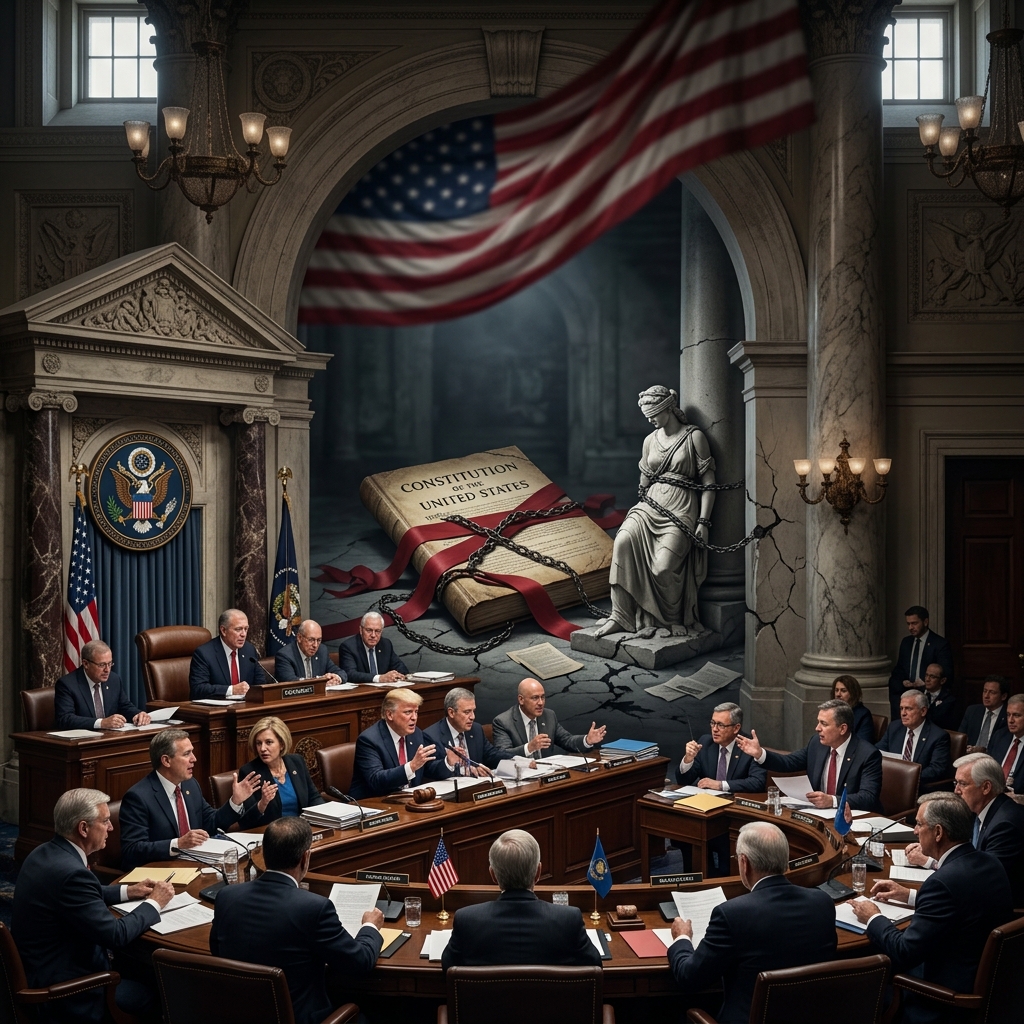
The halls of the United States Capitol are widely romanticized as the epicenter of rigorous debate, where the most pressing issues of American democracy are weighed, measured, and resolved. Yet, observers of modern congressional proceedings are often struck by a stark disconnect between the gravity of national challenges and the triviality of the daily legislative docket. While constitutional rights are tested by rapid technological advancements and expanding executive powers, lawmakers frequently spend their finite time debating and passing performative legislation. This phenomenon—the prioritization of symbolic gestures over substantive policy—has become a defining, albeit disheartening, characteristic of the modern legislative branch.
The illusion of action is a powerful political tool. By dedicating floor time to naming post offices, congratulating sports teams, or honoring celebrities, elected officials project an image of busy productivity. However, this theater comes at a severe cost to civil liberties. Every hour spent on a non-binding resolution is an hour not spent conducting rigorous oversight of intelligence agencies, debating the limits of state surveillance, or drafting robust privacy protections for the digital age. This article delves into the mechanics of performative legislation, the critical civil liberties ignored in its shadow, and the urgent need to realign congressional priorities with fundamental constitutional rights.
The Anatomy of Performative Politics
To understand the depth of this legislative crisis, one must first examine the nature of the resolutions that consume so much of the congressional calendar. Non-binding resolutions—which express the “sense of the House” or “sense of the Senate”—do not create law, allocate funding, or mandate executive action. They are legally toothless. While they have historically served to unify the nation during times of crisis or to formally recognize momentous historical events, their use has proliferated into the realm of the mundane.
Politicians rely on these votes because they are politically safe. In an era of intense hyper-partisanship, recognizing a local hero or a popular musician is a guaranteed bipartisan win. It lets lawmakers tout achievements without alienating their base. Furthermore, performative legislation acts as a smokescreen for legislative gridlock. The modern Congress frequently struggles to pass even basic budgetary measures without resorting to eleventh-hour extensions. By padding the schedule with uncontroversial, symbolic bills, leadership maintains the appearance of a functioning chamber.
This superficial functionality masks deep structural paralysis. Lawmakers avoid difficult votes on complex issues like digital privacy because the political calculus favors inaction over risk. This reliance on safe, symbolic votes represents a dereliction of the legislative branch’s duty to serve as a check on the executive branch and a guardian of the public interest. When political theater replaces rigorous policymaking, the systemic vulnerabilities in our legal and constitutional frameworks are left to fester, often with devastating consequences for marginalized communities and everyday citizens whose rights remain completely unprotected from governmental overreach.
The Plunge in Public Trust
The American public is not blind to the discrepancy between what Congress spends its time doing and the real-world crises citizens face. The proliferation of symbolic legislation is directly correlated with a profound and historic erosion of faith in federal institutions. When voters look to Washington for solutions to systemic inequities, economic instability, or the erosion of privacy, they are instead met with political grandstanding and performative debate.
Long-term empirical data underscores the severity of this disconnect. According to the Pew Research Center, public trust in the federal government has plummeted over the past few decades, currently hovering near historic lows. Recent polling indicates that barely a fifth of Americans trust the government to do the right thing most of the time . This metric is not merely a reflection of partisan dissatisfaction; it is a profound indictment of systemic dysfunction.
When Congress ignores substantive policy in favor of symbolic gestures, it sends a clear message to the electorate: the real concerns of the populace are secondary to political optics. This breeds deep cynicism and political apathy. If citizens believe that their elected representatives are more interested in drafting commendations for athletes than in protecting Fourth Amendment rights against warrantless surveillance, the foundational social contract of representative democracy begins to fray. Restoring this trust requires more than just better political messaging; it demands a radical shift in legislative priorities back to the hard, unglamorous work of actual governance.
The Civil Liberties Deficit: The FISA Section 702 Crisis
Nowhere is the cost of congressional distraction more evident than in the realm of civil liberties, particularly concerning state surveillance and the erosion of digital privacy. Over the past two decades, the expansion of executive power and the intelligence apparatus has created a landscape where constitutional rights are routinely sidelined in the name of national security.
A glaring example of this is the recurring congressional handling of the Foreign Intelligence Surveillance Act (FISA), specifically Section 702. Originally enacted to allow the intelligence community to target the communications of foreign adversaries located outside the United States, Section 702 has morphed into a sprawling apparatus that routinely sweeps up the domestic communications of ordinary Americans. Because digital networks are globally interconnected, the communications of United States citizens are incidentally collected in massive quantities.
The Brennan Center for Justice has extensively documented how intelligence and law enforcement agencies exploit this incidental collection. Through a loophole in the law, domestic agencies like the Federal Bureau of Investigation can conduct warrantless backdoor searches of this massive database to look for the communications of Americans . This practice effectively circumvents the Fourth Amendment’s requirement for a probable-cause warrant, transforming a foreign intelligence tool into a domestic surveillance dragnet.
Despite widespread abuses, Congress has repeatedly failed to implement meaningful reforms. Instead of dedicating floor time to robust oversight hearings, calling intelligence directors to account, and carefully crafting statutory safeguards, lawmakers often wait until the law is on the verge of expiration. They then rush through reauthorizations attached to must-pass omnibus spending bills. The fact that Congress can find hours to debate symbolic commendations while simultaneously rubber-stamping the warrantless surveillance of its own citizens is the ultimate manifestation of misplaced legislative priorities.
A Tale of Two Dockets: Symbolic vs. Substantive
To clearly illustrate the disparity in congressional attention, it is helpful to juxtapose the ease with which symbolic legislation moves through the chambers against the insurmountable hurdles faced by civil rights reforms.
| Legislative Focus | Speed of Passage | Debate Quality | Impact on Civil Liberties |
|---|---|---|---|
| Non-Binding Resolutions (e.g., naming facilities, honoring public figures) | Rapid, often passed by unanimous consent or voice vote. | Minimal to non-existent; highly choreographed. | None. Purely performative and legally weightless. |
| FISA Section 702 Reform (e.g., mandating warrants for backdoor searches) | Stalled for years; frequently bypassed via short-term extensions. | Obfuscated by closed-door intelligence committee meetings. | Critical. Determines whether the Fourth Amendment applies to digital communications. |
| Comprehensive Data Privacy (e.g., protecting consumer data from brokers) | Endlessly trapped in committee; subjected to heavy lobbying. | Highly polarized; focus often shifts from core constitutional rights. | Essential. Protects citizens from unchecked corporate and governmental data mining. |
This table highlights a disturbing reality: the legislative machinery is highly efficient when the stakes are zero, but grinds to an absolute halt when fundamental constitutional principles are on the line. Lawmakers are willing to spend political capital on theater but retreat into partisan gridlock when tasked with holding the intelligence community accountable.
Reclaiming the Fourth Amendment and Legislative Mandate
Reversing this trend requires a multi-faceted approach, beginning with a fundamental reevaluation of what the electorate demands from its representatives. The defense of civil liberties cannot be treated as an afterthought or a niche issue; it is the core responsibility of the federal government.
First, there must be structural reform within congressional procedure. Rules could be implemented to cap the amount of floor time dedicated to non-binding resolutions, forcing leadership to prioritize substantive bills. Furthermore, attaching complex surveillance authorizations to unrelated spending packages must end. Legislation that directly impacts the constitutional rights of Americans deserves standalone debate, recorded votes, and intense public scrutiny.
Second, lawmakers must close the backdoor search loophole in FISA Section 702. The standard should be unequivocal: if the government wants to search the digital communications of an American citizen, it must obtain a warrant based on probable cause from a judge. Additionally, Congress must address the data broker loophole, whereby federal agencies bypass warrant requirements by simply purchasing the location and communication data of citizens from commercial data brokers.
Ultimately, the responsibility also falls on civil society and the voting public. Advocacy groups, privacy watchdogs, and constituents must make it clear that performative politics will no longer be rewarded at the ballot box. Citizens must demand that candidates explicitly outline their positions on domestic surveillance, digital privacy, and executive oversight.
Frequently Asked Questions
- What exactly is a non-binding resolution?
A non-binding resolution is a measure passed by Congress expressing a sentiment or opinion. It does not become law, requires no presidential signature, and lacks legal enforceability. They are mostly used for symbolic purposes, like honoring individuals.
- Why is FISA Section 702 considered controversial?
Designed to monitor foreign threats, Section 702 inadvertently collects massive amounts of data from Americans communicating internationally. The controversy stems from intelligence agencies using this data to conduct warrantless searches on American citizens, which privacy advocates argue violates the Fourth Amendment.
- How does political theater affect real-world policy?
When Congress dedicates excessive time to symbolic gestures, it creates a bottleneck for substantive legislation. Time spent debating commendations is time taken away from drafting complex privacy laws, holding oversight hearings, or reforming the justice system. It creates an illusion of productivity while systemic issues go unaddressed.
- What can ordinary citizens do to change congressional priorities?
Citizens can force a shift in priorities by engaging in targeted advocacy. This includes contacting representatives to demand standalone votes on civil liberties issues, supporting civil rights organizations that litigate against unconstitutional surveillance, and making privacy a primary voting issue during elections.
Conclusion
The spectacle of the modern Congress—where symbolic commendations flow freely while constitutional rights slowly erode—is a testament to a broken legislative priority system. The juxtaposition of endless non-binding resolutions against the deliberate avoidance of critical issues, like the warrantless surveillance under FISA Section 702, reveals a body prioritizing optics over accountability. As public trust continues to wane, the need for a profound course correction becomes undeniable. Congress must abandon the safety of performative politics and embrace the difficult, vital work of protecting the Fourth Amendment in the digital era. True governance is not measured by the volume of symbolic decrees passed, but by the courage to defend the foundational rights of the people against unchecked power.
References
- Public Trust in Government: 1958-2025 — Pew Research Center. 2025-12-04. https://www.pewresearch.org/politics/2025/12/04/public-trust-in-government-1958-2025/
- Section 702 of the Foreign Intelligence Surveillance Act — Brennan Center for Justice. 2026-04-08. https://www.brennancenter.org/our-work/research-reports/section-702-foreign-intelligence-surveillance-act
Similar Articles








Read full bio of medha deb


