
I-130 And I-485 Concurrent Filing: Step-By-Step Guide
Learn when and how to submit Form I-130 alongside green card applications for faster family reunification.
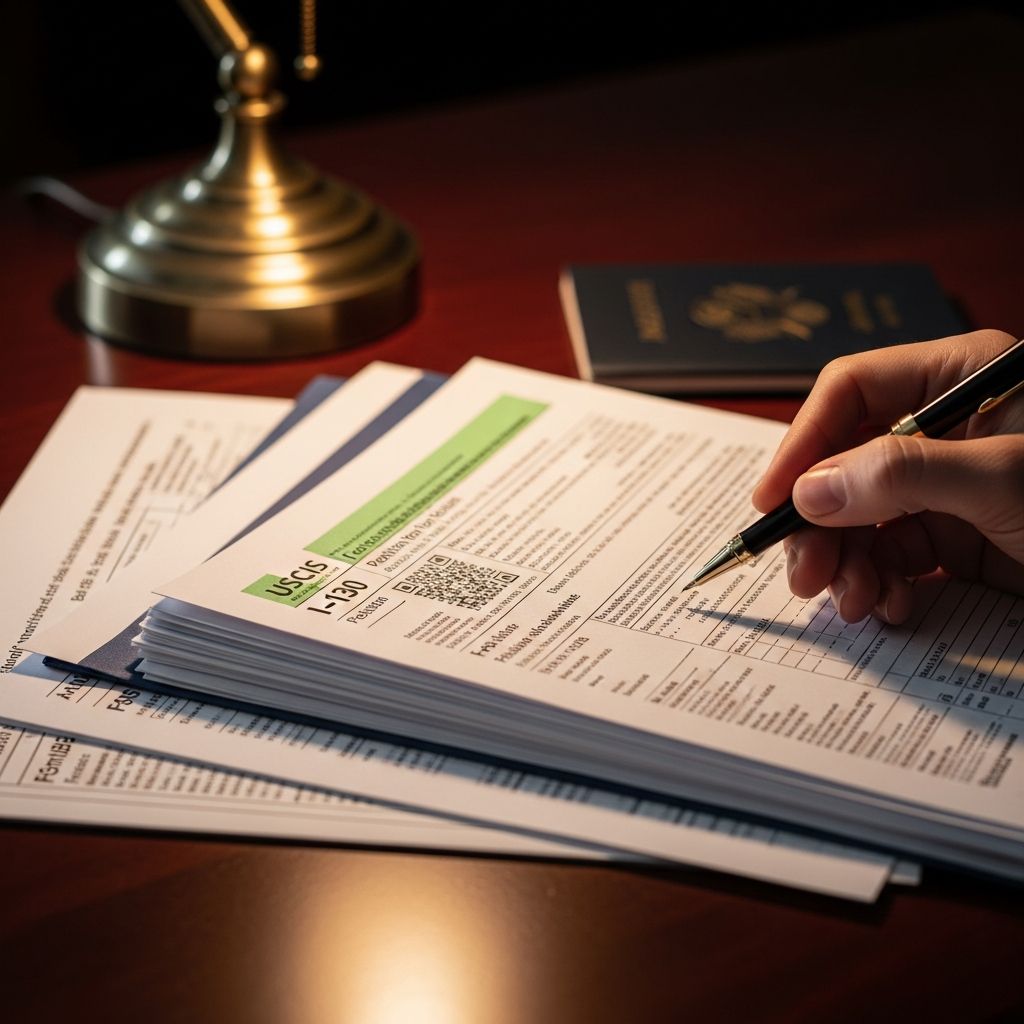
Form I-130, known as the Petition for Alien Relative, serves as the foundational document for U.S. citizens and lawful permanent residents seeking to sponsor family members for green cards. In many scenarios, this petition can be submitted simultaneously with the beneficiary’s green card application, a process called concurrent filing, which accelerates the path to permanent residency.
Understanding Form I-130 and Its Role in Immigration
The I-130 establishes a qualifying family relationship between the petitioner—a U.S. citizen or green card holder—and the beneficiary, who is typically abroad or already in the U.S. This form proves eligibility for an immigrant visa or adjustment of status. U.S. citizens may sponsor spouses, parents, unmarried children under 21, and siblings, while green card holders can petition only for spouses and unmarried children.
Processing times vary: for immediate relatives of U.S. citizens living abroad, it averages 35 months, but drops to 14.5 months if in the U.S. Concurrent filing often shortens overall waits by allowing parallel processing.
Who Qualifies for Concurrent Filing?
Concurrent filing applies primarily when the beneficiary is physically present in the U.S. and eligible for adjustment of status via Form I-485. Key qualifiers include:
- Immediate relatives of U.S. citizens: spouses, parents, and unmarried children under 21, who face no visa quota delays.
- Spouses and unmarried children of green card holders, subject to availability per the Visa Bulletin.
- Beneficiaries with valid nonimmigrant visas or other lawful status allowing I-485 submission.
U.S. citizens’ immediate relatives skip visa lines entirely, making concurrent filing ideal. Green card holders’ petitions enter a queue based on priority date—the I-130 receipt date.
Step-by-Step Guide to Concurrent Submission
To file I-130 and I-485 together:
- Prepare I-130: Gather petitioner status proof (birth certificate, passport, naturalization certificate, or green card copy) and relationship evidence (marriage/birth certificates, photos, joint finances).
- Complete I-485: Include medical exams (Form I-693), affidavits of support (I-864), and passport photos.
- Submit Together: Mail to USCIS lockbox (e.g., Chicago for certain states) or file I-130 online while mailing I-485.
- Pay Fees: I-130 costs $625 online/$675 paper; I-485 adds $1,440 (as of 2026, verify USCIS site).
Online I-130 filing via USCIS account enables status tracking and evidence uploads, even if I-485 is paper-filed.
Required Documentation Breakdown
Comprehensive evidence prevents Requests for Evidence (RFEs), which delay cases. Use this checklist:
| Document Type | Purpose | Examples |
|---|---|---|
| Petitioner Status | Prove U.S. citizen/LPR | Passport, birth certificate, naturalization cert, green card (both sides) |
| Relationship Proof | Validate family tie | Marriage cert, child’s birth cert showing parents, adoption decree |
| Bona Fide Evidence | Show genuine marriage | Joint leases, bank statements, insurance, photos over time, child birth certs |
| Photos | Identity verification | 2×2 inch color photos (2 each), white background, recent (within 30 days) |
| Name Changes | Link records | Court orders, marriage certs |
For fathers petitioning children, include marriage proof to mother and prior marriage terminations. Mothers need only the birth certificate.
Benefits and Risks of Filing Together
Advantages:
- Speed: USCIS processes both forms simultaneously, potentially granting green cards faster without consular processing abroad.
- Work/Authorization: Eligible filers get Employment Authorization (I-765) and Advance Parole (I-131) concurrently, allowing work and travel.
- Priority: Locks in priority date immediately.
Potential Pitfalls:
- Incomplete docs lead to RFEs or denials.
- Visa unavailability for non-immediate relatives halts I-485 approval.
- Public charge inadmissibility requires strong I-864 support.
Processing Timelines and Tracking
Check USCIS processing times tool for current estimates. Post-submission:
- Receipt notices arrive in 2-4 weeks.
- Biometrics appointment follows.
- Interviews for marriage cases assess bona fides.
- Approvals yield green cards; denials allow appeals.
Visa Bulletin tracks category progress; immediate relatives ignore it.
Special Scenarios and Exceptions
Petitioners Abroad
U.S. citizens abroad file I-130 domestically; consular processing follows approval via National Visa Center.
Green Card Holders Sponsoring
Concurrent filing possible only if visa numbers current. F-2A category (spouses/children) often backlogged.
Divorces or Deaths
Post-approval widow(er)s may self-petition within 2 years; divorce before approval invalidates spousal petitions.
Common Mistakes to Avoid
- Missing Evidence: Always include relationship proofs; RFEs add months.
- Wrong Address: Verify lockbox by state and concurrent status.
- Outdated Fees/Forms: Use latest USCIS versions.
- No Cover Letter: Summarize contents for clarity.
Frequently Asked Questions
Can I file I-130 and I-485 at the same time?
Yes, if the beneficiary is in the U.S. in lawful status and eligible for adjustment, especially immediate relatives of citizens.
What if my relative is outside the U.S.?
File I-130 alone; after approval, pursue consular processing.
How long does concurrent filing take?
Varies; I-130 alone: 14.5-35 months. With I-485, total process often 12-24 months for eligibles.
Do I need a lawyer?
Not required, but recommended for complex cases to avoid errors.
What fees apply?
I-130: $625-$675; I-485: ~$1,440; waivers possible for some.
Preparing for Success
Organize documents meticulously, use tabs, and include a detailed cover letter. Track via USCIS account. For marriages, compile years of cohabitation proof. Consult USCIS.gov for updates, as rules evolve.
Concurrent filing streamlines family immigration, but precision is key. By understanding requirements and timelines, petitioners maximize approval odds.
References
- Form I-130, Explained — Boundless. 2026. https://www.boundless.com/immigration-resources/form-i-130-explained
- I-130 Documents Checklist for Spouse & Child — DocketWise. 2026. https://www.docketwise.com/blog/i-130-documents-checklist/
- Form I-130 Immediate Relative: What Is It? — Antonini & Cohen. 2026. https://www.antoniniandcohen.com/post/form-i-130-immediate-relative-what-is-it
- Immigrant Visa Process – Step 1: Submit a Petition — U.S. Department of State. 2026-01-17. https://travel.state.gov/content/travel/en/us-visas/immigrate/the-immigrant-visa-process/step-1-submit-a-petition.html
Similar Articles








Read full bio of Sneha Tete


