
Concealed Carry Reciprocity: 3 State Categories To Know
Understanding how concealed carry permits work across state lines and the ongoing federal debates shaping gun rights nationwide.
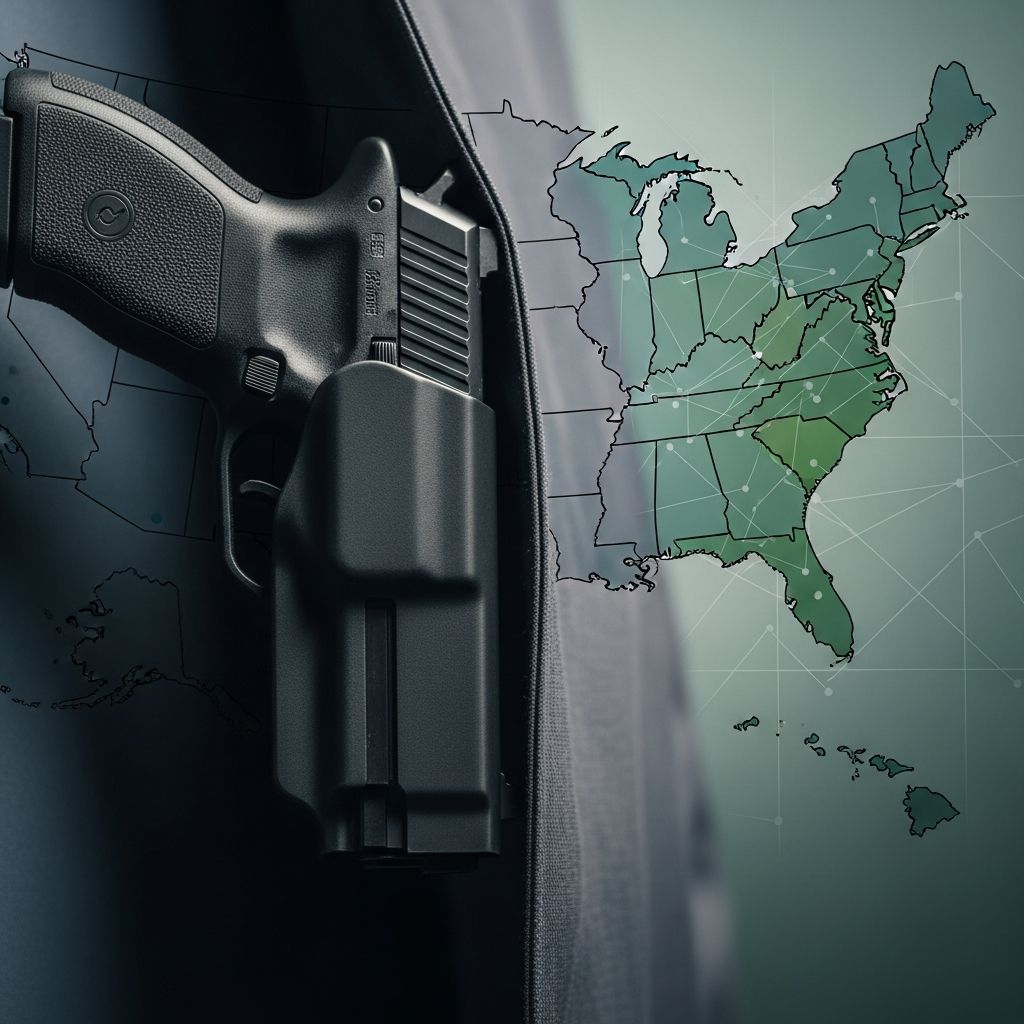
Concealed carry reciprocity refers to the legal recognition by one state of another state’s permit allowing individuals to carry hidden firearms in public. This concept balances Second Amendment rights with state sovereignty, creating a patchwork of agreements across the nation. As of 2026, no nationwide mandate exists, but federal legislation continues to push for standardization.
The Fundamentals of Concealed Carry Permits
A concealed handgun permit (CHP) authorizes eligible individuals to carry a loaded firearm hidden from view, typically on their person or in a vehicle. Eligibility often requires background checks, firearms training, age minimums (usually 21), and no prohibiting convictions like felonies or domestic violence misdemeanors. Federal law sets a baseline, prohibiting possession by felons, fugitives, unlawful drug users, and others under 18 U.S.C. § 922(g), but states impose additional restrictions such as residency proof or mental health evaluations.
Without reciprocity, a permit valid in one state holds no weight elsewhere, potentially leading to arrests for travelers unaware of local laws. This system encourages permit holders to research destinations meticulously, often using state police websites or apps for real-time updates.
Categories of State Reciprocity Policies
States approach reciprocity differently, falling into three primary groups:
- No Reciprocity States: These jurisdictions refuse to honor out-of-state permits entirely, prioritizing local standards. Examples include California, New York, and New Jersey, where strict permitting processes emphasize public safety training tailored to state-specific threats.
- Selective Reciprocity States: Recognition is granted only to permits from states meeting comparable criteria, such as training hours or background depth. Colorado, for instance, honors permits only if the issuing state matches the holder’s residency and meets statutory benchmarks under C.R.S. 18-12-213.
- Full Reciprocity States: These broadly accept permits from all other states, including permitless carry endorsements from constitutional carry states like Arizona or Texas. Louisiana exemplifies this with agreements covering dozens of states since 2004 amendments.
This categorization fosters a web of mutual agreements, with over 30 states often reciprocating with places like Texas, which maintains detailed unilateral and mutual lists via its Department of Public Safety.
Current State-by-State Reciprocity Overview
Reciprocity maps evolve with legislative changes. Colorado recognizes permits from Alabama, Alaska, Arizona, and others up to Wyoming, but excludes California, Hawaii, Illinois, and more. Travelers must verify residency alignment, as non-resident permits from reciprocal states are invalid for locals.
| State Type | Examples | Key Requirements |
|---|---|---|
| Full Reciprocity | Texas, Louisiana | Valid ID, permit; minimal state overrides |
| Selective | Colorado, Virginia | Residency match, training equivalence |
| No Reciprocity | California, New York | Must obtain local permit or comply with state open carry rules |
Texas provides unilateral recognition to many, easing travel for its license holders, while emphasizing that laws vary significantly. Always cross-check via official state agencies to avoid violations.
Federal Legislation: The Push for Nationwide Reciprocity
Congress has repeatedly introduced bills to enforce reciprocity federally. The Constitutional Concealed Carry Reciprocity Act (H.R. 38, 119th Congress, introduced January 3, 2025) amends 18 U.S.C. Chapter 44 to allow non-prohibited persons with a valid home-state permit or constitutional carry eligibility to concealed carry in any state permitting residents to do so.
Key provisions include:
- Preemption of conflicting state/local laws, except for property restrictions by private entities or government sites.
- Prima facie evidence via photo ID and permit presentation, shifting burden to prosecutors.
- Allowance in national parks and wildlife refuges open to the public.
- Private right of action with attorney fee awards for violations.
This framework treats interstate carry like driver’s licenses, arguing constitutional carry under the Second and Fourteenth Amendments. Critics contend it undermines states’ rights and safety by importing lax standards.
Arguments in Favor of Federal Reciprocity
Proponents highlight convenience for the estimated 22 million permit holders, reducing legal risks during travel for work, family, or emergencies. The bill respects state autonomy by applying only where residents can carry concealed, avoiding imposition on strict states entirely. Supporters, including bill sponsors like Rep. Mann, view it as fulfilling the Founders’ intent for a unified national framework, preventing a ‘patchwork quilt’ of laws that confounds law-abiding citizens.
Opposition and Public Safety Concerns
Opponents, including Everytown for Gun Safety, argue that federal mandates override robust state vetting, potentially allowing carriers disqualified locally—such as those under 21, with misdemeanor violence convictions, or multiple DUIs—to cross borders armed. Studies cited show 32% higher gun assaults in states repealing strong permit rules. It could jeopardize urban areas by diluting restrictions on abusive partners or stalkers beyond federal minimums.
Practical Tips for Travelers with Concealed Carry Permits
To stay compliant:
- Verify Reciprocity: Use state attorney general or police sites before trips; apps like USCCA Reciprocity Map provide visuals.
- Currency Check: Ensure permit and ID are unexpired; carry both.
- Local Laws: Note restrictions on schools (though H.R.38 proposes Gun-Free School Zones Act carve-outs), alcohol venues, or posted properties.
- Interactions: Inform officers promptly during stops; know rights under bills like H.R.38’s no-arrest without probable cause clause.
- Transport: For non-reciprocal states, unload and case firearms per FOPA safe passage (18 U.S.C. § 926A).
Residency mismatches void reciprocity in selective states like Colorado.
Legal Implications and Court Challenges
Even if passed, reciprocity faces scrutiny under the Tenth Amendment, as states argue police powers over public safety. Past bills stalled in Senate filibusters; the 2025 version awaits Judiciary Committee action. Successful defenses could award fees, incentivizing compliance, but severability clauses protect the whole if parts fail.
Recent Developments and Future Outlook
As of early 2026, H.R.38 remains pending, with companion S.65 mirroring it. Constitutional carry expansions in 29 states bolster reciprocity claims, pressuring holdouts. Gun rights groups prioritize passage, while safety advocates mobilize against it. Monitor congress.gov for votes.
Frequently Asked Questions
Does Colorado honor my out-of-state concealed carry permit?
Yes, if your residency matches the issuing state and it’s on Colorado’s list (e.g., Texas, Florida); non-resident permits are invalid.
What does H.R.38 change about interstate carry?
It mandates recognition of valid home-state permits across all states allowing resident concealed carry, preempting stricter laws.
Can I carry in national parks under reciprocity?
Federal bills like H.R.38 explicitly allow it in public areas; confirm state overlays.
What if my permit is from a permitless carry state?
Under proposed federal law, eligibility without a permit suffices if you’re lawful there.
How do I prove reciprocity compliance during a traffic stop?
Present photo ID and permit; it’s prima facie evidence per H.R.38, barring probable cause otherwise.
References
- Congress Is Trying to Pass a Dangerous Federal Concealed Carry Mandate — Everytown for Gun Safety. 2025. https://www.everytown.org/concealed-carry-reciprocity-federal-mandate-risks/
- H.R.38 – 119th Congress (2025-2026): Constitutional Concealed Carry Reciprocity Act — Congress.gov. 2025-01-03. https://www.congress.gov/bill/119th-congress/house-bill/38
- H.R.38 Text – 119th Congress (2025-2026) — Congress.gov. 2025-01-03. https://www.congress.gov/bill/119th-congress/house-bill/38/text
- Concealed Handgun Permit (CHP) Reciprocity — Colorado Bureau of Investigation. Accessed 2026. https://cbi.colorado.gov/sections/firearms-instacheck-unit/concealed-handgun-permit-chp-reciprocity
- Reciprocity — Louisiana State Police. 2004 (updated). http://lsp.org/services/concealed-handgun-information/reciprocity/
- State Reciprocity Information — Texas Department of Public Safety. Accessed 2026. https://www.dps.texas.gov/section/handgun-licensing/state-reciprocity-information
Similar Articles








Read full bio of Sneha Tete




