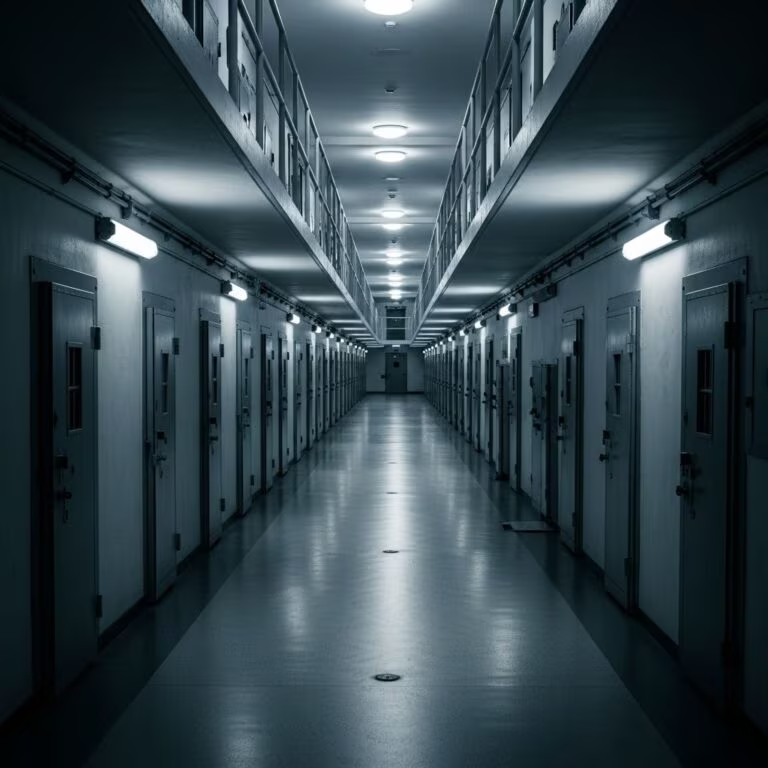
The Commercialization of Confinement: An Invisible Economy
The United States currently houses roughly two million individuals in state, federal, and local facilities. While public discourse frequently focuses on the policies driving mass incarceration, an equally urgent issue often evades the spotlight: the aggressive commercialization of the justice system. Far beyond the walls of entirely private prisons—which hold only a fraction of the incarcerated population—a sprawling network of vendors, contractors, and corporate actors has woven itself into the fabric of publicly run institutions. These entities have effectively transformed human confinement into a highly lucrative industry, monetizing nearly every aspect of an incarcerated person’s existence. From the moment an individual enters a facility, they and their families are thrust into an involuntary consumer market defined by monopolistic practices, hyper-inflated prices, and severe deficiencies in quality. This economic architecture not only drains resources from marginalized communities but also creates perverse incentives that prioritize corporate dividends and government budget balancing over genuine rehabilitation and public safety.
The Telecommunications Monopoly: Profiting from Connection
One of the most widely criticized vectors of carceral profiteering is the prison telecommunications industry. For decades, a small handful of dominant corporations have secured exclusive, highly lucrative contracts with state and county correctional facilities. Because incarcerated individuals cannot simply choose a different service provider, these companies have historically operated unchecked monopolies, charging astronomical rates for basic phone calls.
Maintaining regular contact with family and support networks is widely recognized as one of the most effective ways to reduce recidivism and facilitate successful reentry into society. Yet, the financial barriers erected by these telecom giants have forced many families into debilitating debt just to hear a loved one’s voice. Historically, a simple fifteen-minute phone call could cost upwards of fifteen dollars in certain jurisdictions. These high costs are largely driven by a systemic mechanism known as “site commissions”—effectively kickbacks paid by the telecommunications providers to the contracting government agencies in exchange for the monopoly rights over the captive market.
Recent legislative and regulatory efforts have attempted to curb these predatory practices at the federal level. The Federal Communications Commission (FCC) has consistently pushed to rein in out-of-control rates, culminating in the implementation of the Martha Wright-Reed Just and Reasonable Communications Act. This landmark legislation granted the FCC the explicit authority to regulate both interstate and intrastate carceral communications. In mid-2024, the FCC utilized this authority to cap rates significantly, dropping the maximum allowable per-minute charges in many facilities to mere cents. However, industry pushback remains fierce, and vendors continually seek new avenues for profit. Many providers have pivoted to charging exorbitant fees for video visitation, tablet rentals, and digital messaging services, proving that the corporate exploitation of human connection is a highly adaptable business model.
Privatized Healthcare: A Lethal Trade-Off
The constitutional right to adequate medical care for incarcerated individuals stems directly from the Eighth Amendment’s prohibition of cruel and unusual punishment. Despite this established legal mandate, the delivery of correctional healthcare has increasingly been outsourced to for-profit companies. A substantial number of state prison systems and local county jails have entirely or partially handed over their medical operations to private contractors, often as a desperate measure to curb ballooning public budgets.
However, the intersection of profit motives and medical care in a captive environment creates dangerous, sometimes lethal, trade-offs. Privatized healthcare contracts are typically structured on a capitated, fixed-rate basis. This means the provider receives a set amount of money per incarcerated individual, regardless of the actual medical services rendered or the acuity of the patient’s illness. Consequently, the simplest and most effective way for these corporations to artificially inflate their profit margins is to aggressively limit the delivery of care.
This economic model inherently incentivizes severe understaffing, the hiring of underqualified medical personnel, and the systemic denial or delay of necessary off-site treatments, surgeries, and specialized prescription medications. Independent reports and civil rights lawsuits from across the country have documented harrowing instances of medical neglect: chronic illnesses left unmanaged, severe psychiatric conditions ignored, and preventable deaths occurring simply because a contractor refused to authorize an emergency room transfer. The indemnification clauses often embedded in these government contracts shield local municipalities from direct financial liability, effectively removing the oversight and accountability necessary to protect a highly vulnerable and isolated population.
The Commissary Crisis: Nickel-and-Diming Incarcerated People
While correctional facilities are legally required to provide basic sustenance and hygiene items, the reality of these state-issued provisions is often remarkably grim. Institutional meals are frequently cited by advocates and nutritionists as calorically insufficient, unpalatable, and lacking in fresh ingredients. This engineered scarcity forces incarcerated individuals to supplement their diets and basic hygiene needs through the prison commissary—a retail store operating entirely within the facility walls.
Commissary operations, whether run directly by the state or outsourced to massive private vendors, represent a massive revenue stream built on a captive customer base. Incarcerated individuals are often subjected to staggering markups on everyday necessities. For example, a recent state audit in Nevada revealed that the Department of Corrections was purchasing boxes of tampons for around six dollars but selling them to incarcerated women for over ten dollars. Similar extreme markups exist for basic bar soap, toothpaste, over-the-counter pain relievers, and packaged food items.
Because prison wages are astonishingly low—often amounting to literal pennies per hour—the heavy financial burden of commissary purchases falls disproportionately on the families of the incarcerated outside the walls. These families, many of whom are already struggling economically due to the sudden loss of a primary household breadwinner, must regularly deposit funds into restrictive commissary accounts. Furthermore, the specialized financial platforms used to transfer these funds frequently charge high transaction fees, adding yet another layer of corporate extraction. In many jurisdictions, the profits generated from these commissary markups are not reinvested into rehabilitative or educational programs, but are instead used to plug unrelated budget shortfalls, essentially functioning as a hidden, regressive tax on the families of incarcerated individuals.
The Labor Exploitation Equation: Public and Private Beneficiaries
Discussions of prison profiteering frequently focus solely on private corporations, but state and federal governments themselves are massive beneficiaries of the carceral economy. The Thirteenth Amendment of the U.S. Constitution formally abolished slavery and involuntary servitude, but it included a critical exception: “except as a punishment for crime whereof the party shall have been duly convicted.” This constitutional loophole has allowed the legal preservation of forced, severely undercompensated labor within the modern justice system.
Incarcerated workers form the absolute backbone of the prison infrastructure. They cook the food, clean the cell blocks, launder the uniforms, and perform essential daily maintenance tasks. If correctional departments were forced to pay minimum wage to civilian employees for these operational tasks, the financial cost of mass incarceration would be astronomically higher and entirely unsustainable. By utilizing incarcerated labor—often paying less than a dollar an hour, or nothing at all in states like Texas and Florida—the state quietly saves billions of dollars annually.
Beyond institutional maintenance, incarcerated individuals are frequently deployed for “carceral public works.” This includes dangerous and physically demanding jobs such as fighting raging wildfires, clearing highways of debris, and manufacturing license plates or office furniture for state agencies. While private companies certainly benefit from subcontracting prison labor for manufacturing or packaging goods, the state’s direct financial reliance on this exploitative labor pool creates a powerful administrative resistance to decarceration. When a government relies on an incarcerated workforce to balance its operational budget or provide essential public services, the fundamental, stated goals of the justice system are deeply compromised.
The Economic Ecosystem of Confinement
To truly comprehend the breadth of this systemic issue, one must look at how various sectors intersect to create a comprehensive economy of extraction. The economic architecture of incarceration depends on a few key pillars of extraction. These include:
- Monopolized Communications: Exploiting the fundamental human need for familial connection through exorbitant rates and predatory fees.
- Capitated Health Services: Transforming medical care into a cost-reduction exercise, severely compromising patient health and safety.
- Retail Markups: Passing the cost of basic survival—food, hygiene, and clothing—onto the financially strained families of the incarcerated.
- Coerced Labor: Utilizing a legally captive workforce to bypass minimum wage laws and standard workplace safety protections.
| Sector | Monetization Mechanism | Impact on Incarcerated Individuals & Families |
|---|---|---|
| Telecommunications | Monopoly contracts, per-minute charges, high fees for digital messaging and tablets. | Severe financial strain on families; limits essential contact needed for successful reentry and mental health stability. |
| Healthcare | Fixed-rate, capitated contracts that inherently incentivize denying or delaying medical treatment. | Exacerbation of chronic illnesses, increased mortality rates, and systemic, widespread medical neglect. |
| Commissary & Financial Services | Massive markups on basic hygiene and food items; steep transaction fees for depositing money. | Shifts the cost of basic physical survival onto impoverished families; creates a dangerous pay-to-access environment for necessities. |
| Labor (Public & Private) | Sub-minimum wage labor for facility maintenance, private manufacturing, and high-risk public works. | Exploitation of captive workers without standard labor protections; strongly incentivizes maintaining artificially high incarceration rates. |
Reimagining Justice Over Profit
The pervasive, deeply entrenched commercialization of the American justice system fundamentally undermines the foundational concept of rehabilitation. When every single interaction, basic necessity, and required service is viewed through the lens of a revenue-generating opportunity, incarcerated individuals are no longer treated as citizens requiring intervention, correction, and support. Instead, they are treated merely as raw materials feeding a sprawling industrial complex designed to extract wealth.
Addressing this humanitarian and economic crisis requires substantially more than just piecemeal, surface-level reforms; it demands a structural decoupling of profit from punishment altogether. Policymakers must completely ban the kickback system of site commissions for telecommunications, mandate total public oversight and strict quality-of-care minimums for carceral healthcare, and permanently eliminate the predatory markups on commissary goods. Ultimately, society must recognize that shifting the tremendous financial burden of incarceration onto the backs of marginalized communities only perpetuates the vicious cycles of poverty and disenfranchisement that fuel the justice system in the first place. True justice cannot be achieved as long as human confinement remains a lucrative business endeavor.
Frequently Asked Questions (FAQs)
What is the prison-industrial complex?
The prison-industrial complex refers to the overlapping interests of government and corporate industry that use surveillance, policing, and imprisonment as supposed solutions to economic, social, and political problems. It encompasses private prison companies, service vendors (like healthcare and food providers), and political actors who financially or politically benefit from maintaining exceptionally high incarceration rates.
Why have prison phone calls historically been so expensive?
Prison phone calls have historically been expensive because telecommunications providers operate as strict monopolies within carceral facilities. In exchange for the exclusive right to operate, these companies often pay “site commissions” or direct kickbacks to the local government or correctional department. The financial cost of these kickbacks is passed directly onto the consumers—the families of the incarcerated—through hyper-inflated per-minute rates and hidden connection fees.
How does privatized healthcare in prisons function?
State and local governments frequently outsource medical care to for-profit corporations as a tactic to cut budget costs. These contracts usually pay the medical company a fixed capitated rate per incarcerated individual. Because their revenue is fixed regardless of what happens, the primary way for these companies to generate a larger profit is to spend less money on actual medical care. This economic model often leads to severe medical understaffing and the systemic denial of necessary treatments.
Are incarcerated people legally forced to work?
Yes, in many cases they are. The Thirteenth Amendment to the U.S. Constitution formally abolished slavery, but it explicitly included an exception for those convicted of a crime. Consequently, many incarcerated individuals are required to perform labor for institutional maintenance or public works programs, often earning only pennies per hour or no monetary compensation at all. Refusal to work can result in severe disciplinary action, such as solitary confinement or the loss of earned time off their sentence.
References
- Press Release: FCC Caps Exorbitant Phone & Video Call Rates for Incarcerated Persons & Their Families — Federal Communications Commission. 2024-07-18. https://docs.fcc.gov/public/attachments/DOC-404087A1.pdf
- Public Profiteering of Prison Labor — Carolina Law Scholarship Repository. 2023-01-01. https://scholarship.law.unc.edu/nclr/vol101/iss2/3/
- The Perils of Privatization: Exploring the Side Effects of Privatized Correctional Health Care in Favor of a Public Delivery Model — Washington and Lee Journal of Civil Rights and Social Justice. 2023-03-13. https://scholarlycommons.law.wlu.edu/crsj/vol29/iss2/5/
- eCarrots: Prison Control and Profits from Correctional Tablets — University of Nebraska-Lincoln Digital Commons. 2025-03-26. https://digitalcommons.unl.edu/lawfacpub/