
Colorado Marriage Law: Requirements, Rights & Recognition
A comprehensive guide to Colorado marriage laws, including licenses, common law, and legal rights for couples.
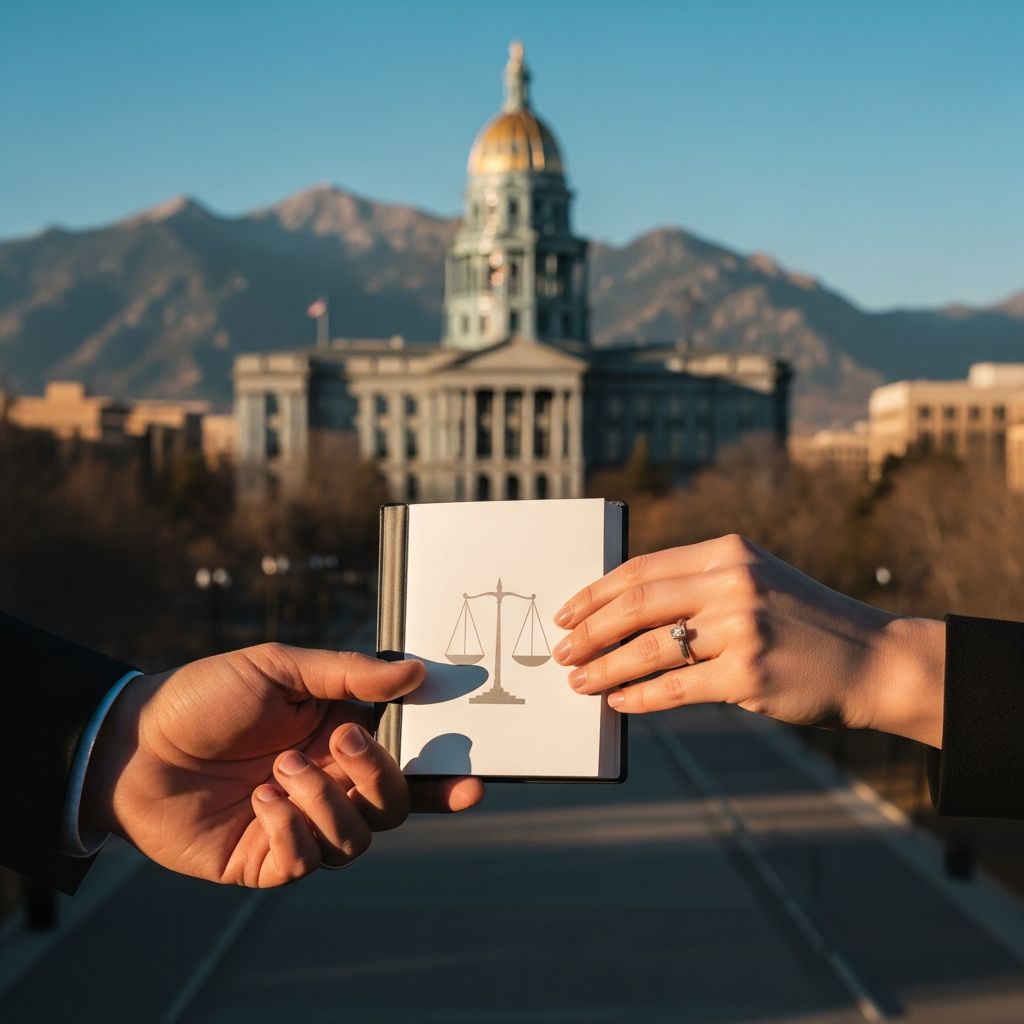
Understanding How Marriage Works in Colorado
Colorado has a distinct legal framework for marriage that blends traditional requirements with unique features not found in many other states. For couples planning to marry in Colorado—whether residents or visitors—it’s important to understand what makes a marriage legally valid, how to obtain a marriage license, and what rights and responsibilities come with being married under Colorado law. This guide explains the core elements of Colorado marriage law in clear, practical terms.
Who Can Legally Marry in Colorado?
Colorado law sets specific eligibility criteria that both individuals must meet to enter into a valid marriage. These rules are designed to ensure that both parties are capable of making a free and informed decision to marry.
- Age: Both parties must be at least 18 years old to marry without restrictions. Individuals who are 16 or 17 may marry with written consent from at least one parent or legal guardian, and in some cases, court approval may also be required.
- Capacity: Each person must be of sound mind, meaning they understand the nature of the marriage contract and the rights and obligations it creates. Marriages entered into by someone who lacks mental capacity may be challenged as voidable.
- Consent: Both individuals must voluntarily agree to the marriage. Consent obtained through fraud, coercion, or duress can make a marriage voidable.
- Not already married: Neither party can be legally married to someone else at the time of the new marriage. A marriage where one person is already married is considered void due to bigamy.
- Not closely related: Colorado prohibits marriage between certain close blood relatives, such as siblings or parent and child. However, marriage between first cousins is permitted.
How to Get a Colorado Marriage License
A Colorado marriage license is required for any marriage to be legally recognized in the state. The process is straightforward and accessible to both residents and non-residents.
Where and How to Apply
Either partner can apply for a marriage license at any County Clerk and Recorder’s office in Colorado. The couple does not need to live in the county where they apply, and out-of-state couples are welcome to obtain a Colorado license as long as they meet the state’s requirements.
Both individuals must appear in person to apply, present valid photo identification (such as a driver’s license or passport), and provide basic personal information, including full names, dates of birth, and places of birth. Some counties allow couples to start the application online, but both parties must still appear in person to finalize it.
License Validity and Timing
Once issued, a Colorado marriage license is valid for 35 days. There is no waiting period, so couples can get married on the same day they receive the license if they choose. However, the marriage must take place within the 35-day window, or a new license will be needed.
Fees and Documentation
Each county sets its own fee for marriage licenses, so costs can vary slightly. Payment is typically required at the time of application. No blood tests or premarital counseling are required under Colorado law.
Getting Married: Solemnization and Self-Solemnization
After obtaining a license, the marriage must be solemnized to become legally binding. Colorado offers flexibility in how this is done.
Traditional Solemnization
Most couples choose to have their marriage solemnized by an authorized officiant. In Colorado, this can include:
- Active or retired judges and magistrates
- Public officials whose duties include performing marriages
- Ordained or licensed members of the clergy
- Designated religious leaders
The officiant completes the marriage license by signing it after the ceremony and returns it to the County Clerk and Recorder’s office for recording.
Self-Solemnization (Self-Uniting Marriage)
Colorado is one of the few states that allows couples to legally marry without an officiant through self-solemnization. This means the couple can perform their own ceremony and sign the marriage license as both the marrying parties and the officiant.
To self-solemnize:
- The couple must first obtain a valid Colorado marriage license.
- They then conduct their own ceremony, during which they declare themselves married.
- Both partners sign the license in the designated officiant section, indicating they are solemnizing their own marriage.
- The completed license is returned to the issuing county for recording.
This option is popular with elopements, intimate ceremonies, and couples who want a more personal or non-traditional wedding experience.
Common Law Marriage in Colorado
Colorado is among the small number of states that still recognize common law marriage. A common law marriage is a legally valid marriage that is established without a formal ceremony or marriage license, based on the couple’s conduct and mutual agreement.
Requirements for Common Law Marriage
To be considered common law married in Colorado, a couple must meet all of the following criteria:
- Both individuals must be at least 18 years old.
- Neither person can be legally married to someone else.
- The relationship must not be incestuous under Colorado law.
- Both parties must mutually agree to be married (present intent to be spouses).
- They must live together in a shared household.
- They must hold themselves out to others as a married couple (e.g., using the same last name, filing joint tax returns, referring to each other as spouse).
Legal Effect of Common Law Marriage
Once established, a Colorado common law marriage has the same legal status as a ceremonial marriage. This means the couple has the same rights and responsibilities regarding:
- Property division in the event of separation
- Spousal support (alimony)
- Healthcare and inheritance rights
- Parental rights and child custody
Other states are generally required to recognize a valid Colorado common law marriage under the Full Faith and Credit Clause of the U.S. Constitution, even if those states do not allow common law marriage themselves.
Same-Sex Common Law Marriage
Colorado courts have held that same-sex couples can establish common law marriages, including relationships that began before same-sex marriage was legally recognized in the state. The same criteria apply: mutual agreement, cohabitation, and holding out as married.
What Makes a Marriage Void or Voidable?
Not every relationship that looks like a marriage is legally valid. Colorado distinguishes between void marriages (invalid from the start) and voidable marriages (valid until challenged in court).
Void Marriages
A void marriage is treated as if it never legally existed. Common reasons a marriage is void in Colorado include:
- Bigamy or polygamy (one party is already legally married)
- Marriage between close blood relatives (e.g., siblings, parent and child)
- Marriage that was invalid in the jurisdiction where it took place (with limited exceptions, such as same-sex marriages now recognized under federal and state law)
Because a void marriage is not legally valid, it can be challenged by either spouse or even by a third party (such as a prior spouse) at any time. No formal divorce is required to end a void marriage, but a court declaration of invalidity may be necessary for legal clarity.
Voidable Marriages
A voidable marriage is legally valid unless one party successfully challenges it in court. Grounds for annulment of a voidable marriage in Colorado include:
- One party was under the legal age to marry and did not have required parental or court consent
- One party lacked the mental capacity to consent to marriage
- Consent was obtained by fraud or duress
- One party was forced into the marriage
Only the affected spouse (or in some cases, a parent of a minor spouse) can seek to annul a voidable marriage. If the marriage continues after the grounds for annulment are discovered, the right to annul may be lost.
Same-Sex Marriage and Constitutional Changes
Colorado now fully recognizes same-sex marriage as a fundamental right. In 2024, Colorado voters approved Constitutional Amendment J, which removed the previous constitutional language defining marriage as between one man and one woman. In 2025, Governor Jared Polis signed legislation formally repealing that outdated provision from the state constitution.
This change ensures that Colorado’s constitution explicitly protects the freedom to marry for all couples, regardless of gender. Same-sex couples have the same rights to obtain a marriage license, marry in Colorado, and have their marriages recognized both within the state and across state lines.
Marriage Rights and Responsibilities in Colorado
Once a marriage is legally valid in Colorado, both spouses gain a range of legal rights and responsibilities. These include:
| Right/Responsibility | Description |
|---|---|
| Property Rights | Colorado is an equitable distribution state; marital property is divided fairly (not necessarily equally) in divorce. |
| Spousal Support | Either spouse may be entitled to maintenance (alimony) based on factors like income, length of marriage, and standard of living. |
| Healthcare Decisions | Spouses generally have the right to make medical decisions for each other if one is incapacitated. |
| Inheritance Rights | Surviving spouses have statutory rights to inherit from the deceased spouse, even without a will. |
| Parental Rights | Marriage creates a legal presumption that both spouses are the parents of children born during the marriage. |
Ending a Marriage: Divorce vs. Annulment
In Colorado, most marriages are ended through divorce (dissolution of marriage). However, in certain cases, a marriage may be annulled instead.
Divorce (Dissolution of Marriage)
Colorado is a no-fault divorce state, meaning neither party needs to prove wrongdoing to end the marriage. The only required ground is that the marriage is “irretrievably broken.” Couples can file jointly or one spouse can file individually.
Divorce addresses issues such as:
- Division of marital property and debts
- Spousal maintenance
- Child custody and parenting time
- Child support
Annulment
An annulment declares that a marriage was never legally valid (void) or is invalid due to specific grounds (voidable). Annulment is appropriate when:
- The marriage was bigamous or incestuous
- One party was underage without proper consent
- One party lacked capacity or consented under fraud or duress
Unlike divorce, annulment treats the marriage as if it never existed, though courts may still address property, support, and child-related issues to ensure fairness.
Frequently Asked Questions
Can non-residents get married in Colorado?
Yes. Colorado allows non-residents to obtain a marriage license and marry in the state as long as they meet all legal requirements, including age, capacity, and not being already married.
Do we need witnesses to get married in Colorado?
No. Colorado does not require witnesses for a marriage ceremony, whether traditional or self-solemnized. The key requirements are the license and proper solemnization.
Can we get married the same day we get our license?
Yes. Colorado does not impose a waiting period. Couples can obtain a license and marry on the same day, as long as the ceremony occurs within the 35-day validity period of the license.
Is a Colorado common law marriage recognized in other states?
Generally, yes. Under the Full Faith and Credit Clause, other states must recognize a valid Colorado common law marriage, even if they do not allow common law marriage themselves.
What happens if one spouse was already married?
If one person was legally married to someone else at the time of the Colorado marriage, that marriage is void due to bigamy. The prior marriage must be legally ended before a new marriage can be valid.
Can a voidable marriage become valid over time?
In some cases, yes. If a marriage is voidable (for example, because one party was underage), but the couple continues to live together as spouses after the underage party turns 18, the marriage may be treated as valid, and the right to annul it may be lost.
Do we need a lawyer to get married in Colorado?
No, a lawyer is not required to obtain a marriage license or get married. However, consulting an attorney is advisable for complex situations, such as prenuptial agreements, same-sex marriage issues, or when one party has significant assets or debts.
References
- Colorado Revised Statutes § 14-2-109.5 – Common Law Marriage — Colorado General Assembly. Accessed 2025. https://leg.colorado.gov/statutes/14-2-109.5
- Colorado Revised Statutes § 14-2-106 – Marriage Licenses — Colorado General Assembly. Accessed 2025. https://leg.colorado.gov/statutes/14-2-106
- In re the Marriage of LaFleur, 479 P.3d 869 (Colo. 2021) — Colorado Supreme Court. 2021. https://www.courts.state.co.us/opinions/summary/cref.cfm?caseid=20200001
- Colorado Governor’s Office – Protecting the Freedom to Marry (SB25-014) — State of Colorado. 2025. https://governorsoffice.colorado.gov/governor/news/colorado-all-governor-polis-signs-bill-law-protecting-freedom-marry
- Denver Clerk and Recorder – Marriages and Civil Unions — City and County of Denver. 2025. https://www.denvergov.org/Government/Agencies-Departments-Offices/Agencies-Departments-Offices-Directory/Denver-Clerk-and-Recorder/marriages-and-civil-unions
Similar Articles








Read full bio of medha deb


