
College Students’ Address Choices on N-400 Citizenship Form
Navigate address reporting for U.S. citizenship applications as a college student with split residences between campus and family homes.
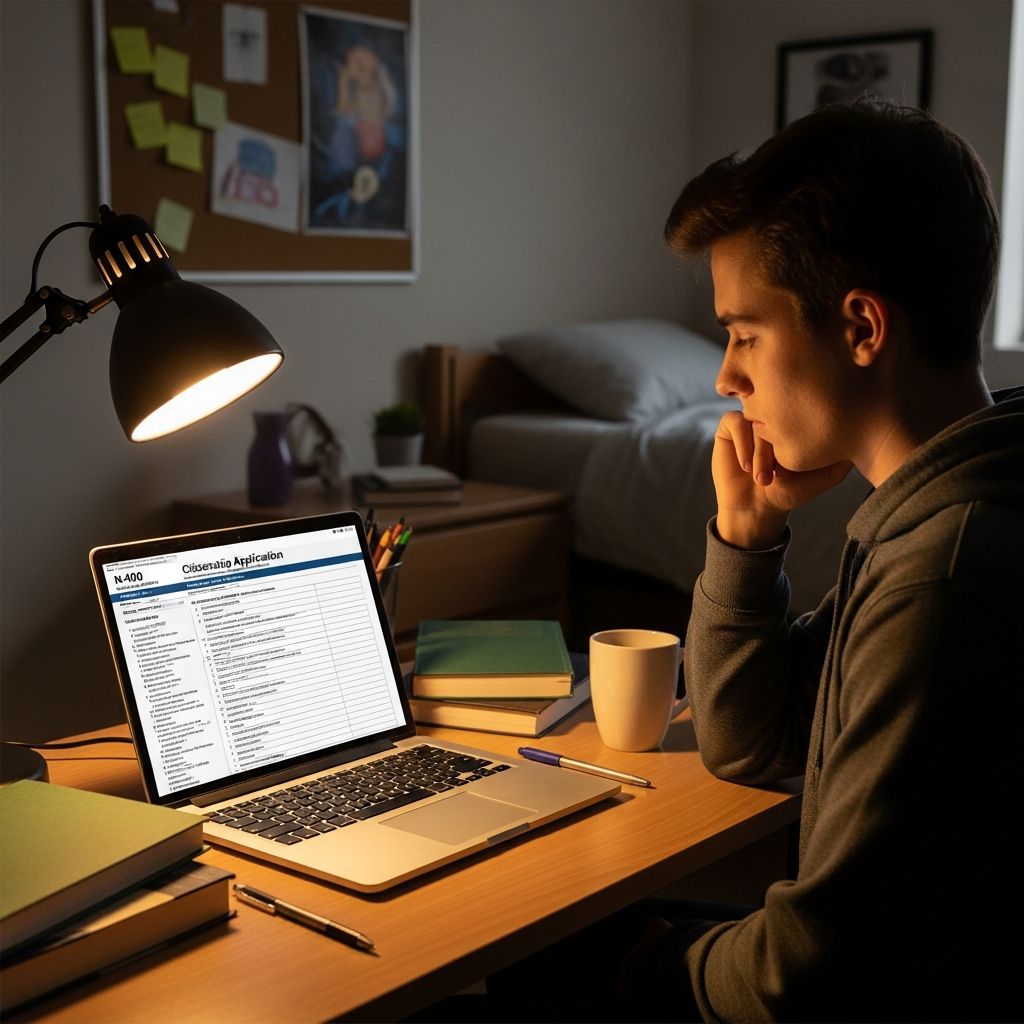
Applying for U.S. citizenship through Form N-400 presents unique challenges for college students who maintain residences both at school and with family. Accurate address reporting is crucial to demonstrate continuous residence and avoid application delays or denials. This guide explores key considerations, USCIS definitions, and strategic options for students.
Understanding Residence in Naturalization Context
USCIS defines ‘residence’ as your principal actual dwelling place, regardless of mailing address or official documents like driver’s licenses. For naturalization, applicants must show they have resided continuously in the U.S. for at least five years (or three if married to a U.S. citizen), with physical presence requirements.
College students often split time between dorms, off-campus housing, and parental homes during breaks. This dual lifestyle requires listing all physical addresses where you lived for 30 days or more in the past five years, in reverse chronological order.
- Physical Residence: Where you actually sleep and maintain daily life most of the time.
- Mailing Address: Where USCIS sends correspondence; can differ from physical address but must be reliable.
- Principal Residence: Determines filing jurisdiction and interview location.
Filing Jurisdiction Options for Students
Form N-400 must be filed with the USCIS service center or field office serving your state of residence. Students can choose based on convenience: family home (if dependent) or school address.
| Option | Pros | Cons | Best For |
|---|---|---|---|
| School Address | Convenient for local interview; reflects current life | Temporary; mail risks if moving post-graduation | Independent students planning long-term stay |
| Parents’ Home | Stable mailing; easier if financially dependent | Travel for interview; may not match daily residence | Dependents returning home frequently |
| Relative’s Address | Used for IDs/banks; familiar to USCIS | Must prove actual living there 90+ days | Students using it as primary during school |
USCIS allows flexibility for students, recognizing split residencies. You typically need 90 days in the jurisdiction before filing.
Completing Part 9: Time Outside the U.S. and Addresses
Part 9 requires detailing all U.S. addresses from the past five years. List from most recent backward, including dates (month/year).
- Enter street address, city, state, ZIP; no P.O. Boxes for physical residence.
- If space insufficient (e.g., multiple dorm moves), attach continuation sheet explaining student status.
- Indicate if mailing and home addresses differ; provide best contact for notices.
Tip: For dorms without street numbers, use official school address or ‘Dorm X, University Name’. Explain moves due to academic housing in an addendum.
Physical vs. Mailing Address Strategies
Your physical address influences interview scheduling by ZIP code. Use school ZIP for local exam or home ZIP for family proximity.
Mailing address receives sensitive documents like interview notices. Prefer a stable location like parents’ home over transient dorms.
- Use parents’ address if you return there regularly and they handle mail.
- School address suits self-reliant students with year-round housing.
- Avoid P.O. Boxes unless no alternative; USCIS prefers verifiable locations.
Special Considerations for Dependent Students
If financially supported by parents, their address may serve as principal residence, even during school. Provide evidence like tax dependency or family support letters.
Students with state IDs/licenses at school (e.g., TX while family in CT) should still list actual living spots, not just official documents.
Supporting Documentation for Address History
Strengthen your application with proofs:
- Lease agreements, dorm contracts.
- Utility bills, bank statements at each address.
- School transcripts/enrollment letters confirming periods.
- Tax returns filed under relevant addresses.
Disclose fully to preempt questions; omissions can flag inconsistencies.
Online vs. Paper Filing Differences
Online N-400 allows easier additions for long address lists via attachments. Paper requires printing extra sheets.
Both demand accurate ZIP for jurisdiction; review ‘Where to File’ on USCIS site.
Potential Pitfalls and How to Avoid Them
Pitfall 1: Listing only parents’ address despite full-time school living – risks denial for inaccurate residence.
Pitfall 2: Incomplete lists – attach explanations for student mobility.
Pitfall 3: Mismatched mailing – ensure it receives mail promptly to avoid missed interviews.
Consult USCIS instructions or an attorney for complex cases like multiple states.
Frequently Asked Questions (FAQs)
Can college students use their parents’ address on N-400 if attending school out-of-state?
Yes, if financially dependent and returning home regularly; otherwise, list school as physical residence.
How many addresses must I list if I changed dorms frequently?
All where lived 30+ days; use attachments for extras and explain student status.
What if my mailing address differs from physical?
Indicate ‘No’ in Part 4, provide both; choose reliable mailing spot.
Does driver’s license state affect N-400 address?
No, list actual residences, not licenses; explain discrepancies if needed.
Where do I file if splitting time between states?
Choose jurisdiction of principal residence (school or home); 90-day rule applies.
Preparing for the Interview
At the naturalization interview, be ready to discuss address history. Bring proofs and explain student lifestyle coherently. Officers verify continuous residence via questions and documents.
Post-filing, update USCIS of address changes promptly via Form AR-11 to maintain contact.
References
- Citizenship Filing Location Options for College Students — Murthy Law Firm. 2016-09-06. https://www.murthy.com/2016/08/24/citizenship-filing-location-options-for-college-students/
- Form N-400, Explained — Boundless Immigration. Recent update (post-2023). https://www.boundless.com/immigration-resources/form-n-400-explained
- Address section on N-400 application? — Avvo Legal Answers. 2014 (timeless advice on residence). https://www.avvo.com/legal-answers/address-section-on-n-400-application–2254400.html
- A Step-by-Step Guide to Completing the New N-400 — Immigrant Legal Resource Center (ILRC). 2024-05. https://www.ilrc.org/sites/default/files/2024-05/A%20Step-by-Step%20Guide%20to%20Completing%20the%20New%20N-400.pdf
Similar Articles








Read full bio of medha deb


