
Close Corporations: Benefits and Drawbacks
Discover the key advantages and potential pitfalls of close corporations for small business owners seeking flexibility and control.
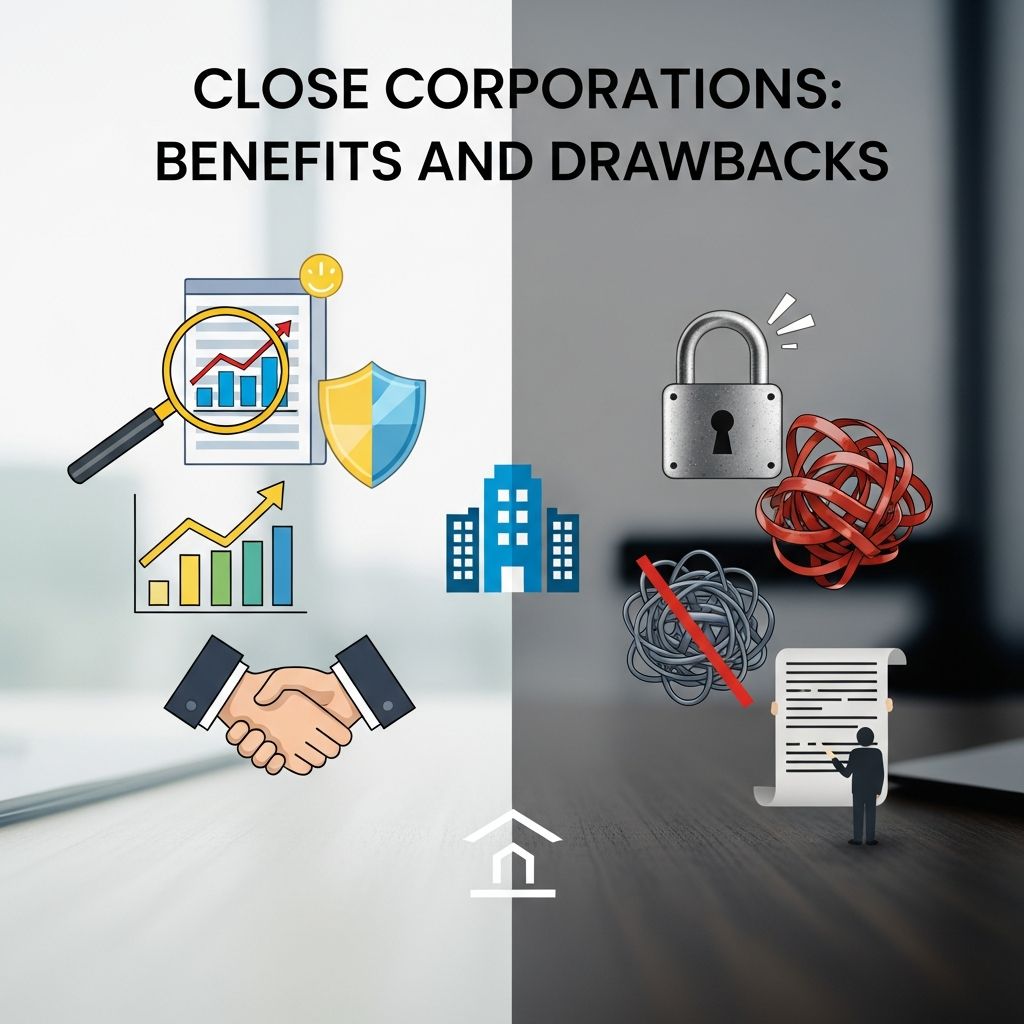
Close corporations offer a specialized business structure tailored for small groups of owners who prioritize direct control and operational simplicity over expansive growth. These entities blend corporate protections with partnership-like informality, making them appealing for family-run ventures or tight-knit teams.
Defining the Close Corporation Model
A close corporation, often termed a closely held corporation, represents a business owned by a restricted circle of shareholders whose shares remain private and non-publicly traded. This setup fosters concentrated ownership, typically among family, friends, or collaborators, enabling streamlined management without the rigors of traditional corporate bureaucracy.
Unlike sprawling public companies, close corporations cap shareholders—frequently at 30 or fewer—and impose barriers to public stock listings. Shareholders often double as managers, bypassing formal boards and routine meetings, provided a robust shareholders’ agreement governs operations.
Core Elements That Shape Close Corporations
Several defining traits distinguish close corporations from standard entities:
- Shareholder Limits: Most jurisdictions restrict ownership to 30-50 individuals, preserving intimacy.
- Non-Tradable Shares: Stocks cannot be sold on open markets, requiring internal buyouts for transfers.
- Flexible Governance: No mandatory board of directors; owners manage directly.
- Shareholders’ Agreement: This document dictates decisions, stock sales, and dispute resolution.
- State-Specific Statutes: Availability varies; states like Delaware and Wyoming offer dedicated laws.
These features create a hybrid model, offering corporate liability shields alongside operational ease.
How Close Corporations Function in Practice
Day-to-day, close corporations operate with agility. Shareholders convene informally to handle strategy, finances, and hiring, guided by their agreement rather than rigid bylaws. For instance, a family nursery might see spouses as sole owners deciding inventory without annual filings.
Share transfers demand approval, often via buy-sell clauses funded by life insurance, ensuring continuity. Taxation mirrors C-corporations but allows S-corp election if criteria like fewer than 100 U.S.-based shareholders are met. IRS rules classify them as closely held if over 50% stock is owned by five or fewer people, excluding personal service firms.
| Aspect | Standard Corporation | Close Corporation |
|---|---|---|
| Shareholder Cap | Unlimited | Typically 30-50 |
| Public Trading | Possible | Prohibited |
| Board Requirement | Mandatory | Optional |
| Meetings | Annual formal | Informal/as needed |
This table highlights governance contrasts, underscoring close corporations’ simplicity.
Key Advantages Driving Popularity
Close corporations shine for small-scale operators valuing autonomy.
Robust Liability Protection
Owners enjoy personal asset safeguards against business debts, akin to larger corporations.
Regulatory Relief
Exemptions from board mandates, annual meetings, and extensive reporting cut compliance costs and time.
Swift Decision-Making
Direct shareholder control accelerates choices, ideal for nimble markets.
Ownership Stability
Transfer restrictions prevent unwanted outsiders, maintaining trusted dynamics.
Tax Versatility
Options for S-corp status enable pass-through taxation, minimizing double levy.
Real-world example: Three software developers form a close corporation, collaborating weekly without board oversight, fueling rapid innovation.
Potential Downsides to Consider
Despite merits, challenges persist.
Share Transfer Constraints
Buy-sell requirements complicate exits, potentially stranding owners.
Dispute Vulnerability
Without formal boards, deadlocks may require court-appointed directors, escalating costs.
Growth Barriers
Shareholder caps and no public funding hinder scaling.
State Availability Limits
Not all states recognize them; formation demands specific statutes.
IRS Scrutiny Risks
Closely held status invites personal holding company tax if passive income dominates.
Family ventures thrive here, but expansion ambitions may necessitate restructuring.
Comparing to Alternative Structures
Close corporations occupy a niche between partnerships and full corporations.
- Vs. LLCs: Both flexible, but close corps offer perpetual existence and easier stock issuance.
- Vs. S-Corps: Similar tax perks, but close corps waive more formalities.
- Vs. Public Corps: Less funding access but superior privacy and control.
For control-focused small groups, they excel; growth-oriented firms may prefer LLCs.
Steps to Establish a Close Corporation
- Verify State Eligibility: Confirm statutory support, e.g., Delaware.
- Draft Articles: Declare close status explicitly.
- Craft Shareholders’ Agreement: Detail management, transfers, exits.
- File and Obtain EIN: Register with state, IRS.
- Consult Attorney: Tailor to needs.
Post-formation, maintain records despite flexibility.
Frequently Asked Questions
What states allow close corporations?
States like Delaware, Wyoming, and select others via special statutes; check local laws.
Can close corporations go public?
No, statutes prohibit public trading to preserve closeness.
How many shareholders are permitted?
Usually 30-50 max, varying by jurisdiction.
Do they need a board of directors?
Not if agreement waives it; shareholders manage directly.
Are annual meetings required?
Often exempt, favoring informal operations.
Strategic Scenarios for Adoption
Ideal for:
- Family enterprises preserving legacy.
- Founder groups guarding vision.
- Professional firms like consultancies seeking privacy.
Avoid if planning IPOs or broad investment.
In summary, close corporations empower small owner-groups with protection and ease, balanced against liquidity and scale limits. Professional advice ensures fit.
References
- Features of a Close Corporation — Advantage Delaware LLC. 2025. https://advantage-de.com/information-center/types-of-business-entities/close-corporation/
- What is close corporation? Simple Definition & Meaning — LSD.Law. 2025-11. https://lsd.law/define/close-corporation
- What is a Close Corporation? Meaning, Structure, and Taxation — Motiva Law. 2025. https://motivalaw.com/what-is-a-close-corporation/
- What Is a Statutory Close Corporation? — CorpNet. 2025. https://www.corpnet.com/blog/statutory-close-corporation/
- close corporation | Wex | US Law — Legal Information Institute, Cornell Law School. 2025. https://www.law.cornell.edu/wex/close_corporation
- Close Corporations: The Advantages and Disadvantages — Corporations Today. 2025. https://corporationstoday.com/our-services/close-corporations/
- Choose a business structure — U.S. Small Business Administration. 2025-02-09. https://www.sba.gov/business-guide/launch-your-business/choose-business-structure
Similar Articles








Read full bio of medha deb




