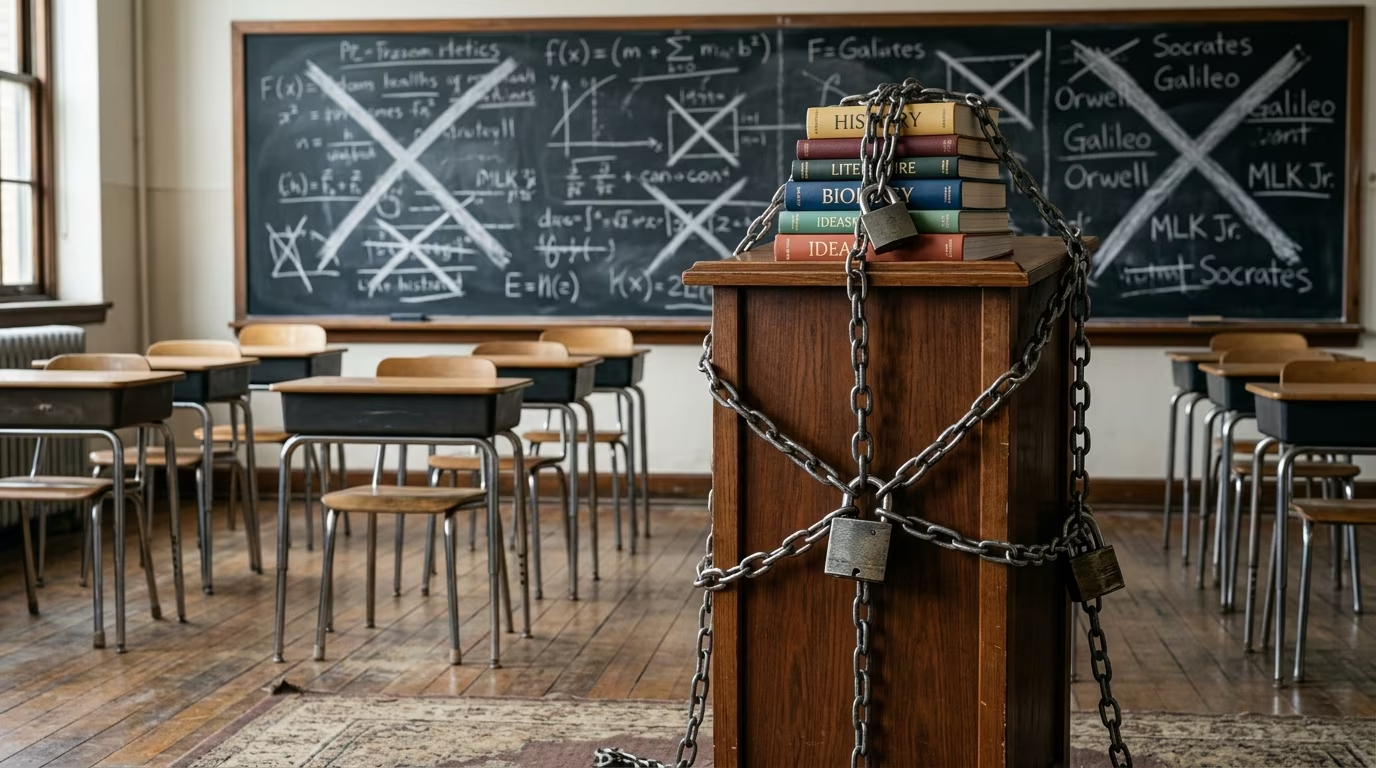
The bedrock of a democratic society lies in its commitment to a robust, open, and intellectually diverse educational system. Public schools are not merely facilities for rote memorization and standardized testing; they function as vital marketplaces of ideas. In these spaces, young minds are meant to encounter varying perspectives, develop critical thinking skills, and prepare for active, informed civic participation. However, a rapidly growing wave of educational censorship threatens to fundamentally alter the landscape of American public education. Across the United States, legislative bodies and local school boards are increasingly imposing severe restrictions on what can be taught, read, and discussed in the classroom.
Recent data paints a stark and alarming picture of this restrictive environment. According to comprehensive research tracking educational censorship, the 2023-2024 school year witnessed an unprecedented surge in restrictions, with over 10,000 recorded instances of book bans in public schools—a figure that more than doubled the statistics from the previous academic year. But the current crisis extends far beyond the removal of controversial library books. It encompasses sweeping legislative efforts designed to strictly control curricula, silence specific historical narratives, and marginalize vulnerable student populations. By understanding the intricate mechanisms of modern educational censorship and the constitutional precedents that protect student and educator rights, society can better grasp the immense magnitude of what is currently at stake in our public school systems.
The Evolution of Curriculum Restrictions and “Divisive Concepts”
Historically, censorship in educational settings often manifested as localized, isolated disputes. A concerned parent or a small community group might challenge a specific novel in a district’s curriculum due to explicit language, violence, or mature thematic elements. Today, however, the strategy has evolved into a highly coordinated, state-level legislative campaign. Lawmakers are passing comprehensive bills that preemptively restrict educators from discussing certain overarching topics, fundamentally shifting curriculum control away from pedagogical experts and deeply into the partisan political arena.
At the heart of many recent state-level censorship campaigns is the targeted prohibition of what legislators term “divisive concepts.” This legislative language often traces its roots back to federal executive orders aimed at combating perceived race and sex stereotyping, which subsequently cascaded into state laws. These sweeping mandates broadly prohibit instruction that implies the United States is fundamentally racist or sexist, or any teaching that might cause an individual to feel “discomfort, guilt, or anguish” on account of their race or sex. While ostensibly framed by their proponents as anti-discrimination measures designed to protect students, the practical application of these laws serves to suppress honest, factual examinations of American history.
Educators find themselves unable to properly teach the legacy of slavery, the intricacies of the Civil Rights Movement, and the ongoing impacts of structural inequality. Furthermore, these legislative maneuvers frequently target discussions related to gender identity and sexual orientation. New policies often outright ban teachers from acknowledging the existence of LGBTQ+ individuals in lesson plans or classroom discussions, creating an environment of exclusion and forced silence.
The Constitutional Foundations of Student and Educator Rights
To truly understand the complex legal battleground surrounding educational censorship, it is absolutely essential to examine the constitutional rights of students and teachers. The First Amendment of the United States Constitution provides a critical, albeit complicated, framework for evaluating the legality of school board actions and state legislation. Though the application of free speech rights in a heavily regulated public school setting is highly nuanced, decades of jurisprudence have established clear boundaries against arbitrary government censorship.
The Legacy of Tinker v. Des Moines
The foundational and most frequently cited case for student speech rights is the 1969 United States Supreme Court decision in Tinker v. Des Moines Independent Community School District. In this landmark ruling, the Supreme Court famously and unequivocally declared that neither students nor teachers “shed their constitutional rights to freedom of speech or expression at the schoolhouse gate.” The case centered on a group of students who were suspended for wearing simple black armbands to school as a silent protest against the Vietnam War.
The Supreme Court ruled in favor of the students, establishing what is now known in constitutional law as the “substantial disruption” test. Under this rigorous standard, school officials cannot lawfully censor student expression unless they can reasonably forecast that the speech will cause a material and substantial disruption to the educational process or the discipline of the school. While Tinker specifically addressed the active expression of students rather than the official curriculum, its underlying philosophical framework affirms that schools must tolerate a certain degree of ideological diversity, open debate, and personal expression. Modern censorship laws that seek to aggressively shield students from controversial, uncomfortable, or complex ideas run directly contrary to the enduring spirit of the Tinker decision.
Library Shelves and Board of Education v. Pico
When the debate shifts from student expression to the removal of educational materials, the 1982 Supreme Court case Board of Education v. Pico remains the pivotal legal precedent. In the Pico case, a local school board attempted to unilaterally remove several books from junior high and high school libraries, claiming the materials were “anti-American, anti-Christian, anti-Semitic, and just plain filthy” based on a list obtained from a politically conservative organization.
The Supreme Court ultimately issued a highly fractured ruling, but the influential plurality opinion held that the First Amendment strictly limits the power of local school boards to remove library books. Crucially, the Court established that students inherently possess a “right to receive information and ideas.” The Justices acknowledged that while school boards possess broad, sweeping discretion in matters of mandatory curriculum, they cross a constitutional line when they remove books from voluntary school libraries simply because they disagree with the ideas, political viewpoints, or social perspectives contained within those pages. If the motivation for removing a text is rooted in partisan or political disagreement, it constitutes unconstitutional censorship. The Pico decision strongly underscores the unique, protected role of the school library as a sanctuary for voluntary, self-guided inquiry.
The Chilling Effect on the Classroom Environment
The vagueness inherent in modern censorship legislation is often viewed by legal scholars as a feature rather than a bug. Because the parameters of what constitutes a “divisive concept” or an “inappropriate” topic are purposefully ill-defined, educators are constantly left guessing where the legal and professional line is drawn. This deliberate ambiguity fosters a profound and widespread chilling effect across the educational ecosystem.
Rather than risk severe disciplinary action, termination of employment, or even criminal prosecution in some jurisdictions, many teachers preemptively self-censor. They strip their daily lessons of necessary nuance, avoid answering direct questions from curious students, and opt for sanitized, incomplete versions of history and literature. The immediate impact is a severe degradation of pedagogical quality. Literature that reflects the diverse tapestry of the American experience is quietly removed from reading lists, and historical events are taught entirely devoid of their underlying causes, systemic contexts, and long-term societal impacts.
Furthermore, educational censorship inflicts significant, documented psychological harm on marginalized students. A vastly disproportionate number of banned books and restricted classroom topics center on LGBTQ+ protagonists or characters of color. When state legislatures or local school boards forcefully mandate the removal of these specific narratives, they send a clear, state-sanctioned exclusionary message to students who share those identities: their personal stories, families, and histories are inappropriate, dangerous, or fundamentally unworthy of academic consideration. This systemic erasure can drastically exacerbate feelings of isolation and negatively impact student mental health, attendance, and overall academic engagement.
Analyzing Educational Environments
To better understand the practical differences between an open educational environment and one restricted by heavy censorship, consider the following comparative analysis:
| Educational Aspect | Open Educational Environment | Censorship-Restricted Environment |
|---|---|---|
| Curriculum Design | Developed by pedagogical experts focusing on critical thinking, diverse viewpoints, and historical accuracy. | Dictated by legislative mandates, avoiding topics deemed politically sensitive or “divisive.” |
| Library Access | Libraries serve as voluntary centers for wide-ranging intellectual exploration and representation. | Books are heavily vetted for ideological purity; titles featuring marginalized groups are frequently targeted for removal. |
| Educator Autonomy | Teachers are trusted to navigate complex discussions and answer student inquiries honestly. | Teachers experience a “chilling effect,” self-censoring to avoid disciplinary action or community backlash. |
| Student Development | Students learn empathy, debate, and resilience by engaging with varied, sometimes uncomfortable, ideas. | Students receive a sanitized, singular narrative, hindering their preparedness for a diverse, globalized society. |
The Legal Pushback and Community Resistance
Despite the formidable and well-funded challenges posed by these sweeping legislative efforts, a robust, nationwide counter-movement is actively fighting to defend the fundamental right to learn. Civil rights organizations, dedicated parent groups, and brave educators are filing high-profile lawsuits challenging the constitutionality of “divisive concepts” laws and large-scale, coordinated book bans.
These legal challenges frequently and persuasively argue that such laws violate the First Amendment by imposing strict content-based and viewpoint-based restrictions on protected speech. Additionally, plaintiffs often invoke the Fourteenth Amendment’s Equal Protection Clause, arguing that laws specifically and disproportionately targeting LGBTQ+ identities or historical narratives concerning racial minorities illegally discriminate against those specific groups. Beyond the formal courtroom setting, grassroots organizations are successfully mobilizing at the local level. Students are independently organizing banned book clubs, parents are speaking out continuously at volatile school board meetings, and national advocacy groups are providing crucial legal and financial support to educators facing unjust termination for teaching prohibited materials.
Frequently Asked Questions (FAQs)
- What is the primary difference between a traditional book ban and a curriculum update?
A curriculum update is typically driven by educational professionals aiming to improve pedagogical outcomes, ensure factual accuracy, or introduce newer academic standards. A book ban, conversely, is usually motivated by ideological, political, or religious objections to the content or viewpoints expressed within the material, often initiated by individuals outside the educational profession. - How do “divisive concepts” laws impact higher education?
While initially targeted at K-12 public schools, divisive concepts laws are increasingly being applied to public colleges and universities. In higher education, these laws severely threaten academic freedom, restricting professors from teaching critical race theory, systemic inequality, or leading diversity and inclusion seminars, thereby undermining the university’s role as a center for unfettered intellectual exploration. - What is the “substantial disruption” test?
Established by the Supreme Court in the landmark 1969 Tinker v. Des Moines case, the substantial disruption test determines whether a school can legally censor student speech. The school must prove that the student’s expression would materially and substantially interfere with the operation of the school or infringe upon the rights of other students. Disagreement with the speech is not a sufficient legal reason for censorship. - Do parents have the absolute right to control what their children are taught in public schools?
Parents have the fundamental right to guide their children’s upbringing, and they can often opt their children out of specific, sensitive lessons (such as sex education). However, courts have consistently ruled that parents do not have the constitutional right to dictate the overarching public school curriculum or demand the removal of library books for all students based on their personal or religious preferences. - What actions can students take if their school board bans a book?
Students have several avenues for pushback. They can organize peaceful protests, speak during public comment periods at local school board meetings, start independent “banned book” reading clubs outside of instructional time, write op-eds for local newspapers, or partner with civil rights organizations to explore potential First Amendment legal challenges.
References
- Banned in the USA: Beyond the Shelves — PEN America. 2024-11-01. https://pen.org/report/banned-in-the-usa-beyond-the-shelves/
- Facts and Case Summary – Tinker v. Des Moines — United States Courts. 1969-02-24. https://www.uscourts.gov/educational-resources/educational-activities/facts-and-case-summary-tinker-v-des-moines
- Board of Education v. Pico, 457 U.S. 853 — Library of Congress. 1982-06-25. https://tile.loc.gov/storage-services/service/ll/usrep/usrep457/usrep457853/usrep457853.pdf
- Exploring Claims of Critical Race Theory, Divisive Topics, and Indoctrination in the Classroom — Education Finance and Policy (MIT Press Direct). 2026-04-07. https://direct.mit.edu/edfp/article/doi/10.1162/edfp_a_00412/119932