
The Shift to Civilian Mental Health Responders
How community programs are revolutionizing mental health emergency responses.
Reimagining the 911 Paradigm
For decades, the standard emergency response to a person experiencing a behavioral health crisis in the United States has been to dial 911, an action that inevitably dispatches armed law enforcement officers to the scene. Whether an individual is suffering from a psychotic break, severe depression, substance-induced delirium, or homelessness-related distress, police have defaulted as the nation’s frontline mental health workers. However, a growing consensus among public health experts, civil rights advocates, and even police departments themselves suggests that this model is fundamentally flawed. Relying on law enforcement to manage psychiatric emergencies often escalates volatile situations, leading to unnecessary arrests, traumatic use of force, and tragic fatalities.
In response to these systemic failures, a transformative movement is taking root across the country: replacing armed police with unarmed, community-based crisis responders. Pioneered by groundbreaking programs in Oregon and supported by federal frameworks, this shift represents one of the most significant changes to public safety and mental health policy in modern history. By treating mental health emergencies as medical events rather than criminal infractions, municipalities are discovering pathways to save lives and preserve human dignity.
The Inherent Risks of Police-Led Interventions
To understand the necessity of alternative response models, one must first examine the inherent risks of sending law enforcement into behavioral health emergencies. Police officers are trained primarily to establish control, enforce the law, and neutralize threats. Their presence—characterized by uniforms, badges, sirens, and visible weapons—can inadvertently trigger or escalate panic in someone experiencing a mental health crisis. When an individual is suffering from paranoia, delusions, or severe distress, the loud commands and physical interventions often used by police can be perceived as direct threats, triggering an overwhelming “fight or flight” response.
The consequences of this mismatch in training and the clinical needs of the individual are frequently dire. According to a landmark study by the Treatment Advocacy Center, individuals with untreated severe mental illness are 16 times more likely to be killed during an encounter with law enforcement than other civilians . This staggering statistic underscores the lethal danger of relying on a criminal justice approach to solve a public health crisis.
Furthermore, even when encounters are non-fatal, they often result in the criminalization of mental illness. Jails and prisons have become the largest de facto psychiatric facilities in the United States, warehousing individuals whose primary offense was exhibiting symptoms of an untreated illness in public. This revolving door of incarceration does nothing to address the root causes of behavioral health crises, wasting municipal resources while failing to provide necessary medical and psychological care.
The Catalyst for Change: Eugene’s CAHOOTS Model
Long before the national discourse caught up to the need for police alternatives, a city in the Pacific Northwest was quietly pioneering a revolutionary approach. In 1989, the White Bird Clinic in Eugene, Oregon, launched CAHOOTS (Crisis Assistance Helping Out On The Streets). Designed as a community-based, non-police response to non-violent crises, CAHOOTS established a framework that prioritized de-escalation, harm reduction, and compassionate care over rigid enforcement.
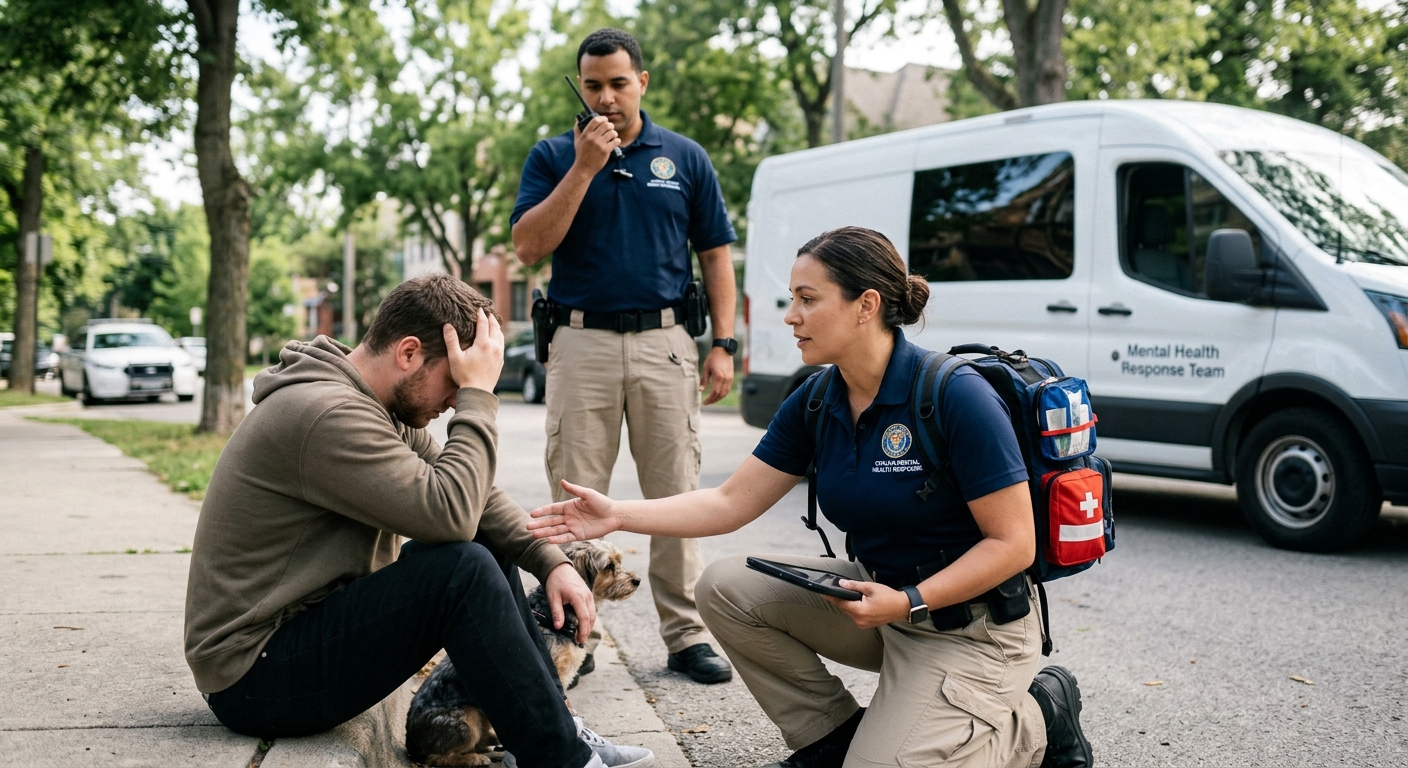
The CAHOOTS model is elegantly simple but profoundly effective. When a call comes into the local 911 dispatch center that involves a non-violent behavioral health issue, intoxication, or welfare check, dispatchers route the call to CAHOOTS instead of the police. A two-person team consisting of a medic—such as a nurse or emergency medical technician—and an experienced crisis worker responds in a designated van stocked with water, blankets, basic first aid, and harm reduction supplies. Unarmed and dressed in casual clothing, the team approaches the individual with an emphasis on building rapport and assessing their immediate medical and psychological needs.
Data from Eugene highlights the immense impact of this program. Annually, CAHOOTS diverts between 5% and 8% of all police calls for service in the city, effectively handling tens of thousands of incidents that would have otherwise consumed law enforcement resources. Most remarkably, these unarmed teams resolve the vast majority of their encounters without ever needing to call for police backup, proving that a medicalized, compassionate approach is highly effective at stabilizing individuals in distress .
Scaling the Solution: Portland Street Response
While the CAHOOTS model proved successful in a mid-sized city, urban planners and public policy experts questioned whether it could be adapted to a larger, more complex metropolitan environment. The answer came from Oregon’s largest city with the creation of the Portland Street Response (PSR). Incubated within Portland Fire & Rescue, PSR was designed to be a co-equal branch of the city’s first responder system, operating alongside police, fire, and ambulance services.
The PSR team composition expands slightly on the Eugene model to address the dense urban landscape. A standard PSR unit deploys a firefighter paramedic, a licensed mental health crisis therapist, and community health workers or peer support specialists. This diverse skill set allows the team to handle complex medical assessments while simultaneously providing high-level psychiatric de-escalation and navigating the individual toward long-term social services, shelter, or addiction treatment facilities.
The results from Portland have been incredibly promising. An independent evaluation conducted by the Portland State University Homelessness Research & Action Collaborative examined the program’s second year of operation and found staggering success metrics. During that period, PSR responded to over 7,400 calls, resulting in a 19% reduction in police responses to non-emergency welfare checks . Most importantly, out of those thousands of encounters, only a single incident resulted in an arrest. The evaluation clearly demonstrated that unarmed civilian responders can safely and effectively manage urban behavioral health crises, ensuring that individuals are treated on-scene or referred to appropriate care rather than being swept into the criminal justice system .
Comparison of Crisis Response Models
| Feature | Traditional Law Enforcement | Civilian Crisis Response |
|---|---|---|
| Primary Responders | Armed police officers | Unarmed medics, clinicians, and peer support specialists |
| Core Objective | Establish scene control and enforce public safety laws | De-escalate distress, perform medical triage, and reduce harm |
| Typical Equipment | Firearms, handcuffs, tasers, and squad cars | Medical kits, water, food, blankets, and standard vans |
| Common Outcomes | Arrest, involuntary ER transport, or citation | On-scene resolution, resource referrals, or voluntary transport |
A National Paradigm Shift: SAMHSA and the 988 Lifeline
The documented success of programs in Oregon has catalyzed a national movement, prompting federal health agencies to rethink crisis intervention on a macro level. A major milestone in this paradigm shift was the nationwide rollout of the 988 Suicide & Crisis Lifeline in July 2022. Championed by the Substance Abuse and Mental Health Services Administration (SAMHSA), 988 is not just an easy-to-remember three-digit number; it functions as the foundation of a completely redesigned behavioral health emergency infrastructure .
The SAMHSA guidelines outline three core pillars for a comprehensive and effective crisis system:
- Someone to Contact: The 988 call centers, staffed by trained behavioral health counselors who can immediately begin verbal de-escalation over the phone.
- Someone to Respond: Mobile crisis teams, akin to CAHOOTS and PSR, that can be dispatched directly to an individual’s location to provide face-to-face intervention.
- A Safe Place for Help: Community stabilization facilities that offer a welcoming, clinical environment alternative to chaotic emergency rooms or intimidating jail cells.
By linking the 988 lifeline directly to local civilian mobile crisis teams, the federal government is actively encouraging municipalities to bypass the traditional 911 police dispatch system for mental health emergencies. This integrated approach ensures that when a person is experiencing the worst day of their life, they are met by a trained counselor on the phone and, if necessary, a clinician at their door—not a law enforcement officer with a firearm.
Overcoming Structural Challenges
Despite the overwhelming evidence supporting civilian response models, scaling these programs nationwide is not without substantial hurdles. One of the most significant challenges is securing reliable and sustainable funding. Many mobile crisis teams currently operate on temporary grants, short-term pilot program budgets, or dwindling federal pandemic relief funds. For these programs to become permanent fixtures of the public safety ecosystem, city councils and state legislatures must commit to reallocating municipal funds, potentially drawing from traditional emergency response budgets or establishing new tax revenues entirely dedicated to public health initiatives.
Another critical challenge lies in the interoperability between legacy 911 dispatch centers and civilian crisis teams. Dispatchers act as the crucial gatekeepers of emergency response. They must be rigorously trained to accurately triage calls, discerning the subtle differences between a violent crime in progress and a harmless behavioral health episode. Without sophisticated decision trees and deep integration into 911 systems, mobile crisis teams cannot effectively intercept the calls they are meant to handle, leaving police to fill the void.
Finally, there is the pressing issue of downstream resources. A mobile crisis team is ultimately a triage unit designed to stabilize an immediate situation. If a community lacks accessible detox facilities, psychiatric stabilization centers, and long-term supportive housing, civilian responders are left with nowhere to take the individuals they assess. Building the “safe place for help” pillar remains the next great frontier in this sweeping public health reform.
The Future of Emergency Dispatch
The transformation of mental health emergency response from a law enforcement duty to a public health initiative is actively saving lives, preserving human dignity, and redefining what community safety looks like. The pioneering efforts of CAHOOTS and the Portland Street Response have irrefutably proven that unarmed, compassionate interventions are highly effective at de-escalating crises in both small towns and major urban centers.
As the federal 988 framework continues to mature and more cities across the nation adopt these evidence-based models, the United States is slowly dismantling the punitive infrastructure that has criminalized mental illness for generations. The future of emergency dispatch is becoming increasingly clear: when a mental health crisis occurs, the response must be fundamentally centered on medical care, psychological support, and compassion, rather than coercion and physical force.
Frequently Asked Questions
What exactly is a civilian crisis response team?
A civilian crisis response team is a specialized unit of unarmed first responders who are dispatched to behavioral health emergencies instead of police. These teams typically consist of mental health clinicians, paramedics or EMTs, and peer support specialists. Their primary goal is to de-escalate crises, provide basic medical care, and connect individuals with social services, housing support, or addiction treatment.
How do these teams ensure responder safety without police presence?
Safety is maintained through rigorous call triage protocols at the 911 dispatch level. Dispatchers are heavily trained to only send civilian teams to situations where no weapons are present and no violent behavior is reported. Furthermore, responders are highly trained in verbal de-escalation techniques. In the rare event that a situation turns violent or unpredictable, these teams carry radios and can immediately request law enforcement backup to secure the scene.
What is the difference between calling 911 and 988?
911 is the traditional emergency number for immediate threats to physical safety, ongoing crimes, fires, and acute medical emergencies. 988 is a dedicated nationwide lifeline specifically for mental health, substance use, and suicidal crises. Calling 988 connects you with a trained counselor who can provide immediate phone support and, depending on the region’s infrastructure, dispatch a mobile mental health crisis team directly to your location.
References
- Overlooked in the Undercounted: The Role of Mental Illness in Fatal Law Enforcement Encounters — Treatment Advocacy Center. 2015-12-01. https://www.treatmentadvocacycenter.org/evidence-and-research/reports/
- National Behavioral Health Crisis Care Guidance — Substance Abuse and Mental Health Services Administration (SAMHSA). 2026-01-22. https://www.samhsa.gov/find-help/988
- Portland Street Response: Year Two Program Evaluation — Portland State University Homelessness Research & Action Collaborative. 2023-06-01. https://archives.pdx.edu/ds/psu/41099
- CAHOOTS Program Analysis — Eugene Police Department Crime Analysis Unit. 2021-01-01. https://whitebirdclinic.org/cahoots/
Similar Articles








Read full bio of Sneha Tete


