
The Bond Between Civil Liberties and Racial Equality
Tracing the inseparable legal history of civil liberties and racial justice.
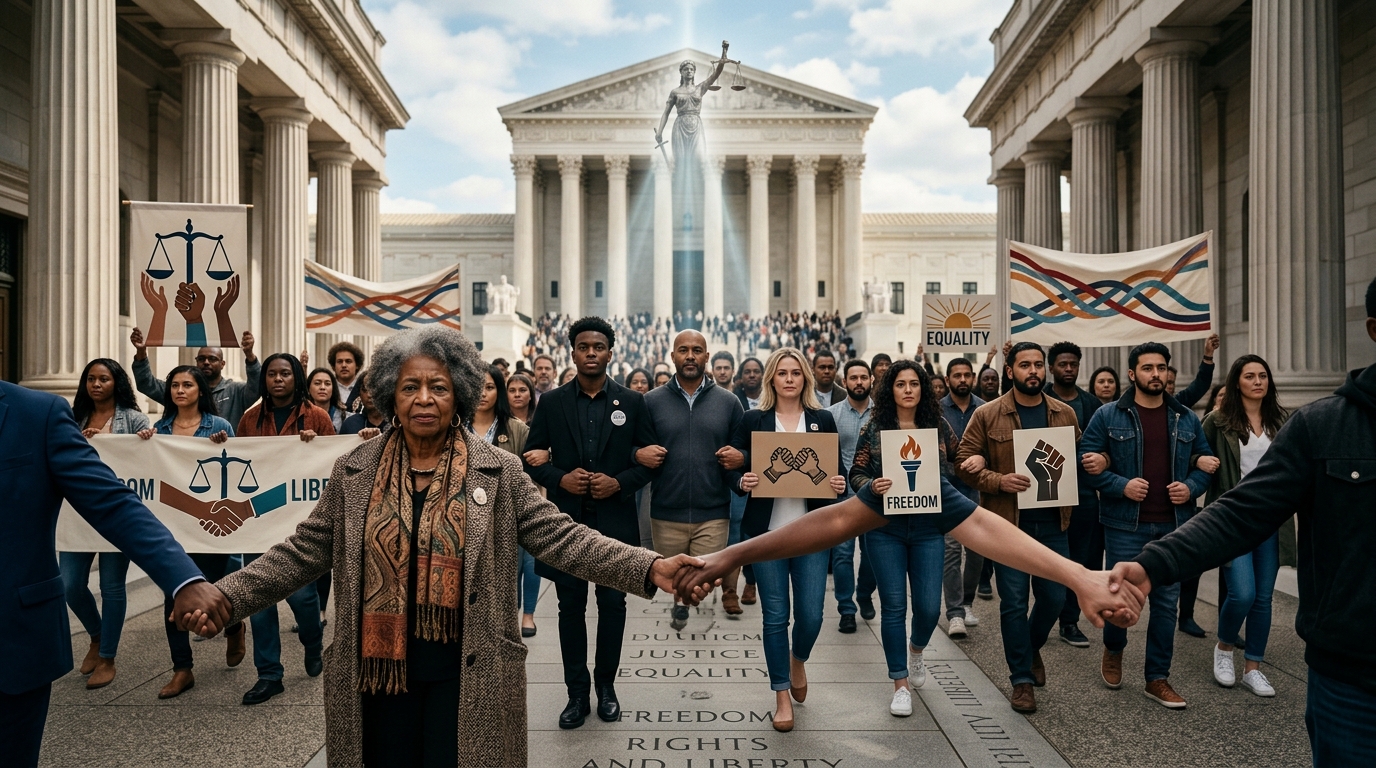
The fight for fundamental civil liberties and the crusade for racial justice in the United States are not distinct legal narratives; they are tightly interwoven strands of the same democratic fabric. For over a century, legal scholars, constitutional advocates, and civil rights organizations have recognized a profound reality: free speech, due process, and equal protection under the law cannot thrive in a society fractured by systemic racism. Conversely, the dismantling of institutionalized discrimination relies heavily on the robust exercise of civil liberties, particularly the First Amendment rights to assemble, petition, and speak freely.
This article explores the historical evolution of this inseparable bond, examining key legal milestones, strategic alliances, and landmark court decisions that defined the modern framework of American civil rights. Understanding this history is crucial for navigating contemporary legal battles, as it reveals that defending the Constitution and fighting for racial equality are, fundamentally, the same endeavor.
The Interconnected Roots of Speech and Justice
During the early twentieth century, the legal landscape for minority populations and political dissidents in the United States was exceptionally hostile. The years following World War I witnessed a massive suppression of anti-war dissent and labor organizing, most notably during the Palmer Raids of 1919 and 1920, where the federal government conducted mass arrests without warrants. However, organizations founded to defend these political dissidents quickly realized that state-sanctioned oppression did not exist in a vacuum.
The same mechanisms used to silence political speech were wielded with even greater brutality against marginalized racial groups. Violence against Black Americans was endemic, as evidenced by horrific events like the Elaine massacre in Arkansas, where hundreds of Black farmers were killed for attempting to unionize. It became increasingly clear that an abstract defense of the First and Fourth Amendments meant very little if those rights were completely inaccessible to citizens based on their race. Early civil libertarians recognized that racial violence and mob rule were the ultimate suppressors of free expression and democratic participation. The realization that protecting the minority voice required protecting the minority body set the stage for a century of integrated legal advocacy.
The Catalyst of the 1930s: Documenting “Black Justice”
The 1930s marked a critical turning point as legal advocates transitioned from philosophical alignment to active, targeted intervention in racial justice matters. In 1931, a comprehensive and damning report titled Black Justice was published by civil liberties advocates, meticulously documenting the pervasive, institutionalized racism embedded within the American legal system. This publication served as a clarion call, illustrating that disparities in the justice system were not anomalies but deliberate features of a discriminatory social order that violated basic constitutional guarantees.
In the same year, the harrowing case of the Scottsboro Boys gripped the nation and the world. Nine Black teenagers were falsely accused of a severe crime on a freight train in Alabama. The trials were a travesty of justice, characterized by rushed proceedings, all-white juries, mob intimidation, and a blatant denial of competent legal counsel. The international outrage surrounding the Scottsboro Boys forced civil liberties advocates to intervene aggressively. The subsequent legal battles, particularly the Supreme Court ruling in Powell v. Alabama (1932), established that the denial of adequate legal representation in a capital case violated the Due Process Clause of the Fourteenth Amendment. This landmark victory explicitly bridged the gap between procedural civil liberties—the fundamental right to counsel—and the substantive fight against lethal racial prejudice in Southern courtrooms.
Forging Alliances: The Mid-Century Legal Triumphs
As the mid-twentieth century approached, the fight for civil liberties expanded through strategic alliances between various legal advocacy groups, most notably partnerships with the National Association for the Advancement of Colored People (NAACP). The World War II era tested the nation’s commitment to civil rights, particularly with the forced incarceration of Japanese Americans. While this era highlighted internal fractures within some advocacy groups regarding national security versus individual rights, it ultimately solidified the understanding that racial scapegoating is a primary weapon of authoritarian overreach.
The post-war era ushered in a more unified and aggressive legal strategy against segregation. The culmination of this allied legal warfare was the monumental 1954 Supreme Court decision in Brown v. Board of Education. By declaring that “separate educational facilities are inherently unequal,” the Court dismantled the legal scaffolding of the Jim Crow South. This victory was not merely a triumph for racial equality; it was a profound vindication of civil liberties, affirming that state-sponsored segregation fundamentally violates the Equal Protection Clause. The Brown decision reinforced the premise that equality is an absolute prerequisite for true liberty.
Expanding the Legal Battleground into the Deep South
Following the victories of the 1950s, the focus shifted to dismantling the entrenched, everyday mechanisms of racial subjugation in the Deep South. Legal advocates established regional outposts to confront discriminatory practices head-on. A primary target was the systematic exclusion of Black citizens from jury service. For decades, the justice system had been weaponized by all-white juries that routinely convicted Black defendants on flimsy evidence while acquitting white perpetrators of racial violence. By challenging discriminatory jury selection processes, legal scholars fought to ensure that the Sixth Amendment right to an impartial jury applied to all Americans, regardless of race.
Simultaneously, the battle for marital freedom emerged as a crucial intersection of privacy rights and racial justice. The abhorrent anti-miscegenation laws that criminalized interracial marriage were directly challenged in the federal courts. This effort culminated in the 1967 Supreme Court ruling in Loving v. Virginia. The Court unanimously struck down state laws banning interracial marriage, ruling that such statutes served no purpose other than “invidious racial discrimination.” By categorizing marriage as a fundamental civil right protected under the Due Process Clause, the Loving decision beautifully illustrated how the expansion of personal liberty inherently drives the advancement of racial equality.
Defending the Franchise: The Voting Rights Act and Beyond
The right to vote is the cornerstone of any democracy, the mechanism through which all other civil liberties are secured and protected. The passage of the Voting Rights Act (VRA) in 1965 was a watershed moment, achieved through the blood, sweat, and tireless advocacy of civil rights leaders. The VRA provided federal oversight of elections in jurisdictions with a history of discriminatory practices, effectively banning literacy tests and other disenfranchisement tactics that had long suppressed minority voices.
| Year | Legislative Milestone | Impact on Civil Liberties and Racial Justice |
|---|---|---|
| 1965 | Voting Rights Act Enacted | Banned literacy tests and implemented federal oversight (preclearance) in jurisdictions with a history of racial discrimination. |
| 1970 & 1975 | VRA Renewals | Extended the ban on literacy tests nationwide and added protections for language minority groups. |
| 1982 | VRA Extension and Amendment | Introduced the “results test” in Section 2, meaning plaintiffs no longer needed to prove intentional discrimination, only a discriminatory impact. |
The passage of the VRA was not the end of the struggle; it marked the beginning of a perpetual defense. In 1982, as key provisions of the Act were set to expire, a massive legal and political mobilization was required to ensure its extension. Despite initial political resistance, civil liberties advocates successfully lobbied for a renewed and strengthened bill. The 1982 amendments were critical, as they clarified that plaintiffs did not need to prove intentional discrimination to invalidate a voting practice; they merely had to show that the practice resulted in a disproportionate, adverse impact on minority voters. This “results test” became a vital tool in combating subtle, modern forms of voter suppression, such as racial gerrymandering and restrictive voter ID laws.
Modern Challenges and the Pursuit of Systemic Equality
Today, the legal battles have evolved, but the fundamental connection between civil liberties and racial justice remains as potent as ever. Modern advocacy focuses heavily on the concept of systemic equality—addressing the deeply rooted policies and practices that continue to disproportionately harm communities of color. True liberty is unattainable when systemic barriers prevent marginalized groups from fully participating in American economic and political life.
To combat these enduring injustices, contemporary legal efforts are heavily focused on several key areas:
- Ending Mass Incarceration: The “War on Drugs” and draconian sentencing laws have devastated minority communities, transforming the criminal justice system into a mechanism of racial control. Legal organizations are fighting to reform cash bail systems, eliminate mandatory minimum sentences, and challenge racially biased policing practices.
- Protecting the Right to Protest: Advocates understand that you cannot protect the First Amendment right to assemble without simultaneously fighting the militarization of police forces that often disproportionately deploy force against racial justice demonstrators.
- Ensuring Economic and Educational Equity: Addressing the racial wealth gap and disparate funding in public education relies on enforcing the Equal Protection Clause to prevent discriminatory resource allocation.
Conclusion
The history of American civil rights is not a linear march toward progress, but a complex, ongoing struggle requiring constant vigilance. The intrinsic bond between civil liberties and racial equality is the defining feature of this legal history. From the early defense of political dissidents and the representation of the Scottsboro Boys in the 1930s, to the monumental victories of Brown v. Board of Education and the vigorous defense of the Voting Rights Act, the legal strategies have always been intricately linked. As society faces new and evolving challenges in the twenty-first century, the unified defense of constitutional rights and racial justice remains the most effective safeguard against tyranny and systemic oppression.
Frequently Asked Questions (FAQ)
What is the connection between civil liberties and racial justice?
Civil liberties and racial justice are deeply connected because constitutional rights, such as free speech and due process, are meaningless if they are not equally accessible to all racial groups. Historically, marginalized communities have relied on civil liberties (like the right to protest) to demand racial justice, while simultaneously fighting against the racial discrimination that denies them those very liberties.
How did the Scottsboro Boys case impact American legal history?
The 1931 Scottsboro Boys case, involving nine Black teenagers falsely accused of a crime in Alabama, led to a landmark Supreme Court decision, Powell v. Alabama. This ruling established that criminal defendants in capital cases must be provided with adequate legal counsel, cementing a critical procedural civil liberty directly out of a battle against racial prejudice.
Why was the 1982 extension of the Voting Rights Act significant?
The 1982 extension amended Section 2 of the Voting Rights Act to include a “results test.” This meant civil rights plaintiffs no longer had to prove that a voting law was created with racist intent; they only had to prove that the law resulted in a discriminatory impact against minority voters, making it significantly easier to strike down subtle voter suppression tactics.
What does “systemic equality” mean in a legal context?
In a legal context, systemic equality refers to the effort to identify, challenge, and dismantle institutional policies, laws, and practices that create or maintain racial disparities, rather than merely addressing individual acts of prejudice. It targets the root legal structures of inequality in criminal justice, housing, education, and voting.
References
- History Of Federal Voting Rights Laws — U.S. Department of Justice. 2017-07-28. https://www.justice.gov/crt/history-federal-voting-rights-laws
- Section 2 Of The Voting Rights Act — U.S. Department of Justice. 2023-04-05. https://www.justice.gov/crt/section-2-voting-rights-act
- Explore | Rosa Parks: In Her Own Words — Library of Congress. 2019-12-05. https://www.loc.gov/exhibitions/rosa-parks-in-her-own-words/about-this-exhibition/
- Guide to the Clippings File of the James Weldon Johnson Memorial Collection — Yale University Library. 2023-12-06. https://archives.yale.edu/repositories/11/resources/1138
- Regulating Racist Speech on Campus: A Modest Proposal? — Duke Law Scholarship Repository. 1990-01-01. https://scholarship.law.duke.edu/cgi/viewcontent.cgi?article=3157&context=dlj
Similar Articles








Read full bio of medha deb


