
Business Entity Types: 5 Options And How To Choose
Navigate the legal and tax implications of sole proprietorships, LLCs, S-corps, and C-corps to build a strong foundation.
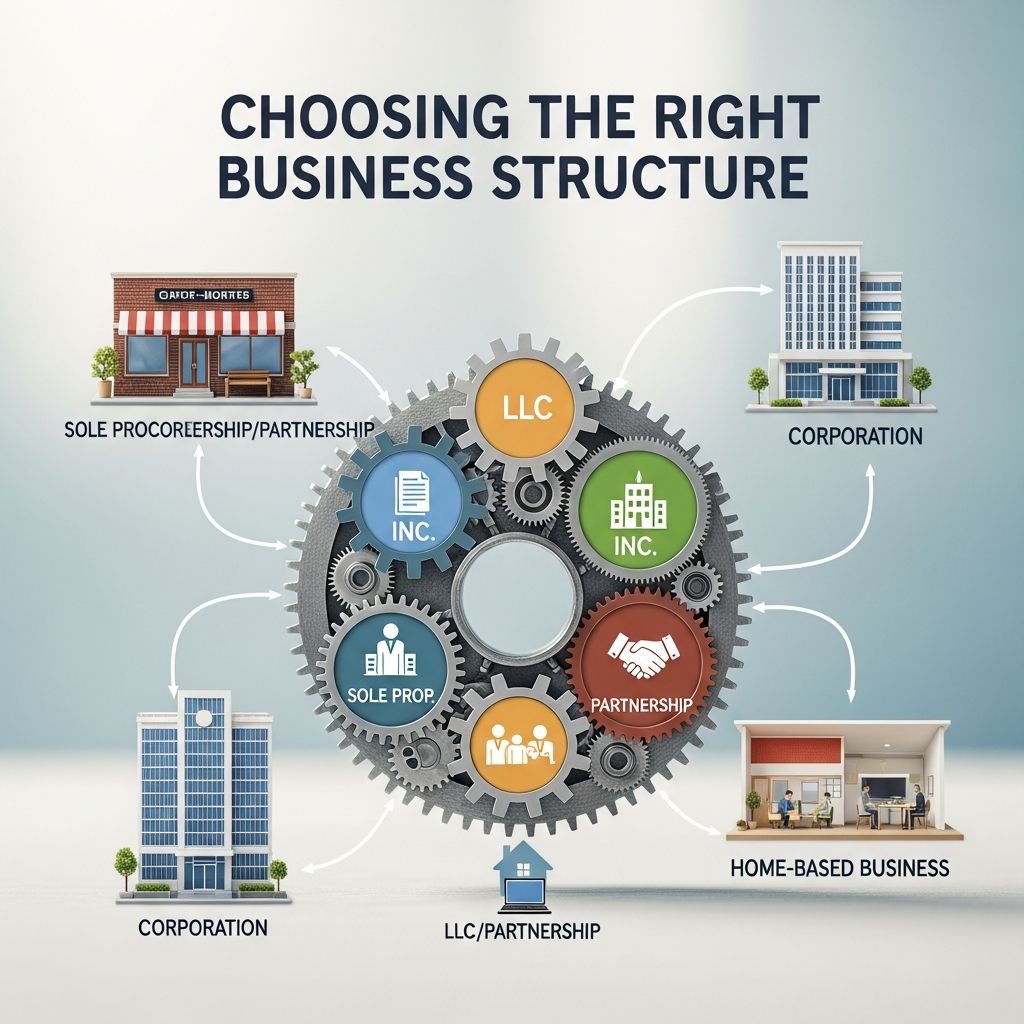
Understanding Business Entity Types
When launching a new venture, one of the most consequential decisions an entrepreneur makes is selecting the appropriate legal structure. This choice shapes how the business is taxed, how much personal liability owners face, how profits are distributed, and how the company can grow over time. While many small businesses begin informally, formalizing the structure early can prevent costly legal and financial complications down the road.
Sole Proprietorship: Simplicity with Risk
A sole proprietorship is the most basic form of business ownership. It is not a separate legal entity; instead, the business and the owner are legally the same. This structure is common among freelancers, consultants, independent contractors, and home-based operators who want to start quickly and with minimal paperwork.
Key Features
- Owned and operated by a single individual.
- No formal registration required in most jurisdictions (though local permits or licenses may be needed).
- Business income and expenses are reported on the owner’s personal tax return (Schedule C in the U.S.).
- Owner has complete control over all decisions.
Advantages
- Simple and inexpensive to start: No incorporation fees or complex filings are required.
- Full control: The owner makes all operational and strategic decisions without needing approval from partners or shareholders.
- Single-level taxation: Profits are taxed only once, at the individual level, avoiding corporate-level taxes.
- Easy tax reporting: Business results flow directly to the owner’s personal return, simplifying annual filings.
Drawbacks
- Unlimited personal liability: The owner is personally responsible for all business debts and legal claims. Personal assets such as homes, vehicles, and savings can be at risk.
- Limited access to capital: Raising funds is typically limited to personal savings, loans, or informal arrangements, as investors are reluctant to invest in an unincorporated entity.
- Business continuity issues: The business effectively ends if the owner dies or decides to stop operating, making succession planning difficult.
- Perception and credibility: Some clients, vendors, and lenders may view a sole proprietorship as less established than a formal entity.
Partnerships: Shared Ownership, Shared Responsibility
When two or more people co-own a business, they may operate as a partnership. There are several types, including general partnerships (GPs), limited partnerships (LPs), and limited liability partnerships (LLPs), each with different liability and management rules.
General Partnership
In a general partnership, all partners share management responsibilities, profits, and liabilities. Like a sole proprietorship, it is relatively easy to form but exposes each partner to personal liability for the actions of the business and the other partners.
Limited Partnership
A limited partnership includes both general partners (who manage the business and have unlimited liability) and limited partners (who contribute capital but do not participate in management and have liability limited to their investment). This structure is often used in real estate, investment funds, and family-owned enterprises.
Advantages of Partnerships
- Shared resources: Partners can pool capital, skills, and networks to grow the business.
- Pass-through taxation: The partnership itself does not pay income tax; profits and losses pass through to the partners’ personal returns.
- Flexibility in structure: Partners can define roles, profit-sharing, and decision-making in a partnership agreement.
Disadvantages of Partnerships
- Joint and several liability (in GPs): Each partner can be held personally liable for the debts and obligations of the business and the actions of other partners.
- Potential for conflict: Disagreements over strategy, finances, or management can disrupt operations and even lead to dissolution.
- Complexity in exit or succession: Adding or removing partners requires careful legal documentation and can trigger tax consequences.
Limited Liability Company (LLC): Flexibility and Protection
The LLC is one of the most popular structures for small and medium-sized businesses because it combines the liability protection of a corporation with the tax simplicity of a partnership or sole proprietorship.
Core Characteristics
- Separate legal entity from its owners (called members).
- Members are generally not personally liable for business debts and legal judgments.
- Flexible management: can be member-managed (owners run the business) or manager-managed (appointed managers run it).
- Flexible taxation: by default, a single-member LLC is taxed as a sole proprietorship, and a multi-member LLC as a partnership. However, an LLC can elect to be taxed as an S-corp or C-corp.
Benefits of an LLC
- Personal asset protection: Members’ personal assets are shielded from business liabilities, provided the business is operated properly and corporate formalities are observed.
- Tax flexibility: Owners can choose the most advantageous tax treatment based on income levels, deductions, and long-term goals.
- Operational simplicity: Fewer formalities than corporations (e.g., no mandatory board meetings or extensive record-keeping in many states).
- Flexible ownership: LLCs can have an unlimited number of members, including individuals, other LLCs, and corporations.
Challenges of an LLC
- Formation and ongoing costs: Setting up an LLC typically requires filing articles of organization and paying state fees. Some states also impose annual franchise taxes or reporting fees.
- Self-employment taxes: In default tax treatment, all net income may be subject to self-employment taxes, which can be higher than corporate payroll taxes.
- State-specific rules: LLC laws vary by state, and some states have additional requirements or restrictions.
- Perceived informality: While LLCs are widely accepted, some investors and institutions may still prefer a corporate structure for larger ventures.
S-Corporation: Tax Efficiency for Small Businesses
An S-corporation is a special tax status available to corporations (and sometimes LLCs) that elect to be taxed under Subchapter S of the Internal Revenue Code. It is designed to provide the liability protection of a corporation while avoiding the double taxation that applies to C-corporations.
How S-Corps Work
- The business is incorporated as a corporation (or an LLC elects corporate taxation).
- It files Form 2553 with the IRS to elect S-corp status.
- Profits and losses pass through to shareholders’ personal tax returns; the corporation itself does not pay federal income tax.
- Shareholders must be U.S. citizens or resident aliens, and there is a limit of 100 shareholders.
- Only one class of stock is allowed.
Advantages of an S-Corp
- Pass-through taxation: Avoids double taxation, as income is taxed only at the shareholder level.
- Reduced self-employment tax: Owners can take a reasonable salary (subject to payroll taxes) and distribute additional profits as dividends (not subject to self-employment tax).
- Liability protection: Shareholders are not personally liable for business debts and obligations.
- Transferability of ownership: Shares can be sold or transferred, subject to shareholder agreements and S-corp rules.
Limitations of an S-Corp
- Eligibility restrictions: Must meet IRS requirements regarding number of shareholders, citizenship, and stock classes.
- Administrative complexity: Requires corporate formalities such as bylaws, shareholder meetings, and minutes, plus payroll processing for owner salaries.
- Less flexibility in raising capital: Cannot issue multiple classes of stock, which may deter certain investors.
- State-level variations: Not all states recognize S-corp status, and some impose additional taxes or fees.
C-Corporation: For Growth and Investment
A C-corporation is a separate legal and tax entity owned by shareholders. It is the traditional corporate structure and is often chosen by businesses planning to raise significant capital, go public, or attract venture capital.
Key Features of a C-Corp
- Separate legal entity with perpetual existence.
- Owners (shareholders) have limited liability.
- Subject to corporate income tax on profits; dividends distributed to shareholders are taxed again at the individual level (double taxation).
- Can issue multiple classes of stock (common and preferred), making it attractive to investors.
- More formal governance requirements, including a board of directors, officers, bylaws, and regular meetings.
When a C-Corp Makes Sense
- Planning to seek venture capital or angel investment.
- Intending to go public or issue stock options to employees.
- Wanting to retain earnings in the business for reinvestment without immediate personal tax consequences.
- Operating in an industry where corporate structure is the norm (e.g., tech, manufacturing, large-scale retail).
Benefits of a C-Corp
- Strong liability protection: Shareholders are generally not personally liable for corporate debts.
- Unlimited number of shareholders: No cap on the number of investors, and foreign ownership is permitted.
- Multiple stock classes: Allows for different rights and preferences (e.g., voting vs. non-voting, preferred dividends).
- Access to capital markets: Easier to raise funds through stock issuance and attract institutional investors.
- Business continuity: The corporation continues to exist regardless of changes in ownership or management.
Drawbacks of a C-Corp
- Double taxation: Corporate profits are taxed at the corporate level, and dividends are taxed again when distributed to shareholders.
- Higher costs and complexity: Incorporation fees, ongoing compliance, and more extensive record-keeping and reporting requirements.
- Less tax flexibility: Cannot use pass-through taxation; all income is subject to corporate tax rates unless distributed as dividends.
- More regulatory scrutiny: Subject to more stringent federal and state regulations, including securities laws if issuing stock.
Comparing Structures at a Glance
| Feature | Sole Proprietorship | Partnership | LLC | S-Corp | C-Corp |
|---|---|---|---|---|---|
| Personal Liability | Unlimited | Unlimited (GP) | Limited | Limited | Limited |
| Taxation | Pass-through (individual) | Pass-through (partners) | Pass-through (default) | Pass-through (shareholders) | Double taxation |
| Formation Complexity | Low | Low–Medium | Medium | Medium–High | High |
| Ongoing Compliance | Low | Low–Medium | Medium | High | High |
| Ability to Raise Capital | Low | Medium | Medium | Medium | High |
| Ownership Flexibility | Single owner | Multiple owners | Flexible | Limited (100 shareholders, U.S. residents) | Very flexible |
How to Choose the Right Structure
Selecting the optimal business structure requires evaluating several factors:
- Size and growth plans: A small, owner-operated business may thrive as an LLC or S-corp, while a high-growth startup aiming for investment may benefit from a C-corp.
- Risk exposure: Businesses with higher liability risks (e.g., construction, consulting, healthcare) should prioritize structures that offer strong personal asset protection.
- Industry norms: Some industries and clients expect certain structures (e.g., corporations for B2B contracts, LLCs for professional services).
- Long-term goals: Consider whether you plan to sell the business, bring in investors, or pass it to family members.
- State and local requirements: Formation costs, annual fees, and tax rules vary significantly by jurisdiction.
Frequently Asked Questions
Can I change my business structure later?
Yes, it is possible to convert from one structure to another (e.g., sole proprietorship to LLC, LLC to corporation). However, this process can involve legal filings, tax implications, and potential costs, so it’s wise to choose the most appropriate structure early if possible.
Do I need a lawyer to form a business entity?
While many states allow online formation without legal assistance, consulting an attorney is strongly recommended, especially for partnerships, corporations, and complex ownership arrangements. A lawyer can help draft operating agreements, bylaws, and shareholder agreements that protect your interests.
What is the difference between an LLC and an S-corp?
An LLC is a legal entity type, while an S-corp is a tax election. An LLC can choose to be taxed as an S-corp, but it must meet IRS eligibility requirements. The LLC provides flexibility in management and ownership, while the S-corp election can reduce self-employment taxes for owner-employees.
Which structure minimizes taxes the most?
There is no one-size-fits-all answer. For many small businesses, an LLC taxed as an S-corp can offer favorable tax treatment by splitting income between salary and distributions. However, the optimal choice depends on income levels, deductions, state taxes, and long-term plans. A qualified tax advisor should be consulted to model different scenarios.
Can a non-U.S. citizen own a U.S. business?
Yes, non-U.S. citizens can own U.S. businesses, but eligibility for certain structures (like S-corps) is restricted. C-corps and LLCs are generally more accessible to foreign owners, though additional compliance and tax considerations apply.
Final Considerations
The decision about business structure is not just a legal formality—it is a strategic choice that affects every aspect of operations, from day-to-day management to long-term growth and exit planning. While cost and simplicity are important, they should be balanced against liability protection, tax efficiency, and scalability.
Before finalizing your choice, consider:
- Consulting with a business attorney to understand state-specific rules and liability implications.
- Working with a CPA or tax advisor to model the tax impact of each structure.
- Reviewing your business plan, funding needs, and growth projections to align the structure with your goals.
By taking the time to evaluate these factors carefully, you can establish a solid legal and financial foundation that supports your business for years to come.
References
- Business Structures: Overview — U.S. Small Business Administration. Accessed 2025. https://www.sba.gov/business-guide/launch-your-business/choose-business-structure
- Publication 334: Tax Guide for Small Business — Internal Revenue Service. 2023. https://www.irs.gov/publications/p334
- Entity Selection and Formation — American Bar Association, Section of Business Law. 2024. https://www.americanbar.org/groups/business_law/resources/entity_selection_and_formation/
Similar Articles








Read full bio of medha deb


