
Choosing Between Judge and Jury: A Practical Trial Guide
Understand how judge and jury trials differ, and how those differences can shape strategy, timing, costs, and case outcomes.
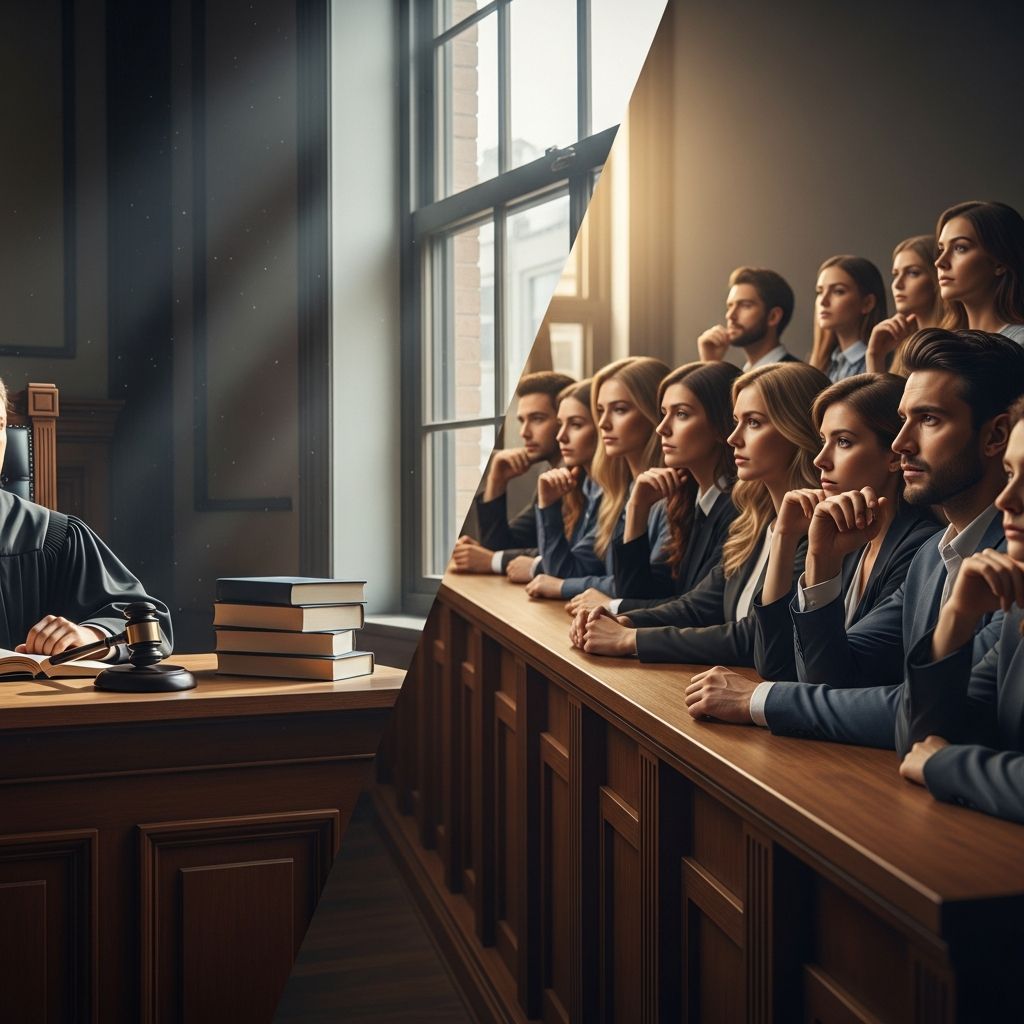
In many civil and criminal cases, one of the earliest and most consequential choices is whether the dispute will be decided by a judge alone or by a jury of laypeople. That decision can affect everything from how long the case takes to how the evidence is presented and how predictable the outcome might be.
This guide explains, in plain language, how judge (bench) trials and jury trials work, what separates them, and what practical issues lawyers and litigants weigh when deciding between the two.
Core Distinction: Who Decides the Facts?
At the heart of the difference is who serves as the primary decision-maker on disputed facts.
- Bench trial: The judge acts as both fact-finder and law-giver. The judge hears testimony, evaluates credibility, finds facts, and applies the law to those facts to reach a verdict.
- Jury trial: A group of citizens (often 6–12, depending on jurisdiction and case type) serves as the fact-finder, while the judge presides, rules on legal issues, and instructs the jury on the law.
In both formats, judges control procedure and evidence. The difference is whether the judge also makes the ultimate decision on liability or guilt, or delegates that fact-finding role to a panel of jurors.
When Do You Have a Right to a Jury Trial?
The availability of a jury is not the same in every type of case and every court. The U.S. Constitution and state constitutions create baseline rights, but statutes and court rules fill in the details.
- Criminal cases: Defendants facing serious criminal charges generally have a constitutional right to a jury trial. Many systems distinguish between more serious offenses, where a jury is available, and minor offenses, which may be tried to a judge by default.
- Civil cases: In the federal system and many states, parties may demand a jury for certain civil claims, particularly those seeking money damages. Equitable claims (injunctions, specific performance) are often tried to a judge.
- Waiver: Even where a jury is available, parties can usually waive that right and proceed with a bench trial. Waiver often must be knowing, voluntary, and sometimes in writing or on the record in court.
- Judge consent: In some jurisdictions, the judge (and sometimes the prosecutor in criminal cases) must also agree to a bench trial, not just the defendant or civil parties.
Procedural Flow: How Bench and Jury Trials Differ in Practice
Both trial types cover the same broad stages—pretrial motions, opening statements, evidence, closing arguments, and judgment—but they unfold differently because of the presence or absence of jurors.
| Stage | Bench Trial | Jury Trial |
|---|---|---|
| Jury selection | Not applicable. | Voir dire to question and select jurors; can take hours or days. |
| Opening statements | Often more concise; judge already knows the law and procedure. | Structured to educate jurors on basic facts and themes in plain language. |
| Presentation of evidence | May proceed faster; less need to pause to excuse jury for legal arguments. | Includes frequent sidebars and jury excusals for evidentiary disputes. |
| Instructions on law | Judge simply applies law; no separate instruction phase. | Judge gives formal written/oral instructions to jurors on legal standards. |
| Deliberation | Judge deliberates privately, often quickly, sometimes with a written opinion. | Jury retires to deliberate; timing is unpredictable. |
Speed, Delay, and Courtroom Efficiency
Time is often a decisive factor. Empirical research suggests that, once a case reaches trial, jury trials usually take longer in court than bench trials, due in part to jury selection, instructions, and deliberation.
- In-court trial time: Studies comparing similar civil cases indicate that jury trials consume roughly twice as much courtroom time as bench trials, although the absolute difference may be modest because most trials are relatively short.
- Overall case lifespan: Interestingly, some research has found that cases tried to a jury may spend less total time on the court’s docket than judge-tried cases, possibly because judges can more easily interrupt bench trials or delay decisions while juggling other responsibilities.
- Scheduling: Courts must coordinate jurors, lawyers, witnesses, and the judge for jury trials, making scheduling complex. Bench trials may be easier to slot into a busy calendar.
- Continuances and interruptions: Judges may be more reluctant to break up a jury trial once jurors are sworn, but may spread bench trial testimony over multiple non-consecutive days.
Cost Considerations
Longer trials generally mean greater expense. Jury trials can cost more for both public and private participants.
- Direct court costs: Courts bear expenses for juror summons, compensation, and administration. Some jurisdictions charge jury fees in civil cases to help offset these costs.
- Attorney time: Extra time for jury selection, more elaborate presentations, and longer trial days increases legal fees.
- Expert and witness costs: Longer trial durations may mean additional days of expert witness and fact witness appearances, which can be expensive.
- Opportunity cost: Delays can tie up business or personal resources, particularly in commercial disputes where uncertainty affects planning and operations.
Bench trials, with their streamlined procedures and shorter duration, often reduce these burdens, though complex bench trials can still be lengthy and costly.
Predictability and Decision-Maker Perspectives
Another key difference lies in how judges and jurors perceive evidence and apply legal standards.
- Legal expertise: Judges are trained to apply statutes, rules, and precedent. They may be better equipped to handle cases that hinge on narrow legal questions, technical defenses, or complex regulatory schemes.
- Lay perspectives: Jurors bring community norms and common-sense judgments to the evaluation of facts. Their reactions to credibility, fairness, or moral blame can differ from those of the bench.
- Agreement rates: Classic studies comparing judge and jury decisions show that, when judges are asked how they would have ruled in the same jury-tried cases, they report agreement with the jury’s verdict most of the time. Meta-analyses have found agreement rates in the neighborhood of 70–75%.
- Outlier outcomes: That remaining portion of cases, where judges and juries would part ways, often involves disputes about close credibility questions, emotional reactions, or how strictly to apply the law.
Strategic Pros and Cons of Bench Trials
Bench trials offer distinctive advantages and risks, which lawyers evaluate in light of the specific case, the assigned judge, and local practice.
Potential Advantages of a Judge Trial
- Faster resolution: No jury selection and a more compact presentation can mean a shorter trial and quicker verdict.
- Technical or legal complexity: Cases involving intricate statutes, regulations, or scientific evidence may benefit from a legally trained fact-finder who can process technical material more readily.
- Reduced evidentiary prejudice: Judges are expected to separate admissible evidence from inadmissible information they may have heard, whereas jurors are shielded from excluded evidence entirely but may be more easily swayed by emotional proof.
- Streamlined presentation: Lawyers may use more legal shorthand and limit rhetorical flourishes, potentially saving time and cost.
Potential Drawbacks of a Judge Trial
- No appeal to community sentiment: Cases that might benefit from moral outrage or community standards—such as certain civil rights or consumer cases—may lose strategic force without a jury.
- Single decision-maker risk: All fact-finding power rests with one person. If that person views credibility or legal standards unfavorably, there is no group deliberation to dilute individual bias.
- Awareness of excluded evidence: In a bench trial, the judge will often hear or know of evidence that is ultimately ruled inadmissible, then must consciously disregard it. Human decision-makers may find that difficult, even with training.
Strategic Pros and Cons of Jury Trials
Jury trials carry their own profile of benefits and limitations.
Potential Advantages of a Jury Trial
- Community input: A jury reflects community values. Plaintiffs or defendants may want ordinary citizens—not just a judge—deciding what is reasonable, fair, or negligent.
- Emotional resonance: Stories with sympathetic parties, compelling narratives, or strong visual evidence can resonate powerfully with jurors.
- Jury nullification risk/benefit: In rare criminal cases, jurors may acquit despite strong evidence because they believe the law is unjust or unfairly applied. Judges are far less likely to disregard the law in this way.
- Group deliberation: Group decision-making can reduce idiosyncratic views of a single decision-maker, though group dynamics create their own challenges.
Potential Drawbacks of a Jury Trial
- Time and cost: Longer proceedings, extensive jury selection, and more elaborate explanations increase expense and delay.
- Unpredictability: Jurors vary in background, attitudes, and life experience. Even with careful selection, outcomes can be harder to forecast than in bench trials.
- Complex evidence: Highly technical or document-heavy disputes may overwhelm jurors, especially if the case depends on nuanced legal doctrines.
- Sensitivity to publicity: In high-profile matters, jurors may be influenced—despite instructions—by media coverage or community pressure, whereas judges are expected to be more insulated from public opinion.
Appeals and Standards of Review
Appeals work differently depending on whether a judge or jury found the facts, but the core principle is similar: appellate courts rarely disturb factual findings.
- Benchmark trial findings: A judge’s factual determinations are usually reviewed for “clear error” or a similar deferential standard. Appellate courts do not re-weigh evidence; they ask whether the findings were plausibly supported by the record.
- Jury verdicts: Juries resolve factual disputes, and appellate courts are even more reluctant to overturn those findings. A party may challenge the sufficiency of evidence or certain legal errors (such as faulty jury instructions), but not simply ask the appellate court to re-decide credibility.
- Legal rulings: In both formats, purely legal questions—such as interpretation of statutes, constitutional questions, or rulings on admissibility governed by law—are reviewed more closely, often de novo.
Key Factors Lawyers Weigh When Choosing a Trial Format
Trial format is a strategic choice. Attorneys consider multiple dimensions before advising clients to choose judge or jury, when a choice exists.
- Nature of the dispute: Is the case primarily about technical legal interpretation, or is it about competing narratives and credibility?
- Client and witness presentation: How will the client and key witnesses likely appear to laypeople versus a judge? Are there concerns about demeanor, background, or prior history?
- Local practice and judge reputation: Lawyers often assess how particular judges handle bench trials, how they rule in similar cases, and how jurors in that jurisdiction tend to respond to certain fact patterns.
- Publicity and community attitudes: In highly publicized or sensitive cases, the perceived risk of juror bias or community pressure may steer parties toward (or away from) a jury.
- Resources and timing: Budget constraints, business timelines, and the need for swift resolution may all push parties to prefer the relatively faster bench trial route.
Frequently Asked Questions (FAQs)
Q: Is a bench trial always faster than a jury trial?
A: Bench trials are generally faster in the courtroom because they skip jury selection and deliberation, and judges can move more quickly through evidence. However, overall case duration can still be affected by court congestion, judicial scheduling, and pretrial disputes.
Q: Who decides the sentence in a criminal case?
A: In most systems, even when a jury decides guilt or innocence, the judge imposes the sentence. In a bench trial, the same judge who determines guilt also sets the penalty, usually within statutory guidelines.
Q: Can I switch from a jury trial to a bench trial after the case starts?
A: It depends on jurisdiction and timing. Many courts allow waiver of a jury right before trial begins, sometimes with court approval and, in criminal cases, prosecutor consent. Once a jury is sworn, switching formats is much less common and typically requires unusual circumstances.
Q: Are jury verdicts more accurate than judges’ decisions?
A: Accuracy is difficult to measure. Empirical studies show that judges report they would have reached the same verdict as the jury in a strong majority of cases, suggesting broad overlap in outcomes. Differences often arise in close, fact-intensive cases or those invoking strong emotional reactions.
Q: Do I always get to choose between judge and jury?
A: No. In some types of cases, the law may require one format or sharply limit options. Even where a jury right exists, procedural rules govern how and when it must be demanded, as well as how it can be waived. Consulting counsel early is important to preserve or intentionally waive that choice.
References
- Trial by Jury or Judge: Which is Speedier? — Theodore Eisenberg. Cornell Law Faculty Publications, 2004-01-01. https://scholarship.law.cornell.edu/facpub/228/
- Jury Trial vs. Bench Trial: How to Choose the Best Option for Your Criminal Case — Pat Brown Law, APC. 2025-10-01. https://www.patbrownlaw.com/2025/10/trial-before-a-judge-or-jury
- What Is the Difference Between a Judge and a Jury? — County Office Law (YouTube). 2025-04-09. https://www.youtube.com/watch?v=UyMhYTBwmdo
- What is the difference between a bench trial and a jury trial? — Peoria County, Illinois. Accessed 2025. https://www.peoriacounty.gov/FAQ.aspx?QID=128
- Evaluating Juries by Comparison to Judges — Jennifer K. Robbennolt. Florida State University Law Review, 2005-01-01. https://ir.law.fsu.edu/lr/vol32/iss2/7/
- Perspective Differences in Trial Process: A Comparison of Judges’ and Jurors’ Views — Jonathan P. Vallano et al. Psychology, Public Policy, and Law, 2019-09-19. https://pmc.ncbi.nlm.nih.gov/articles/PMC6762157/
Similar Articles








Read full bio of medha deb




