
Choosing Between a DUI Blood Test and Breathalyzer
Understand how DUI blood and breath tests work, how accurate they are, and what refusing or submitting can mean for your driving rights.
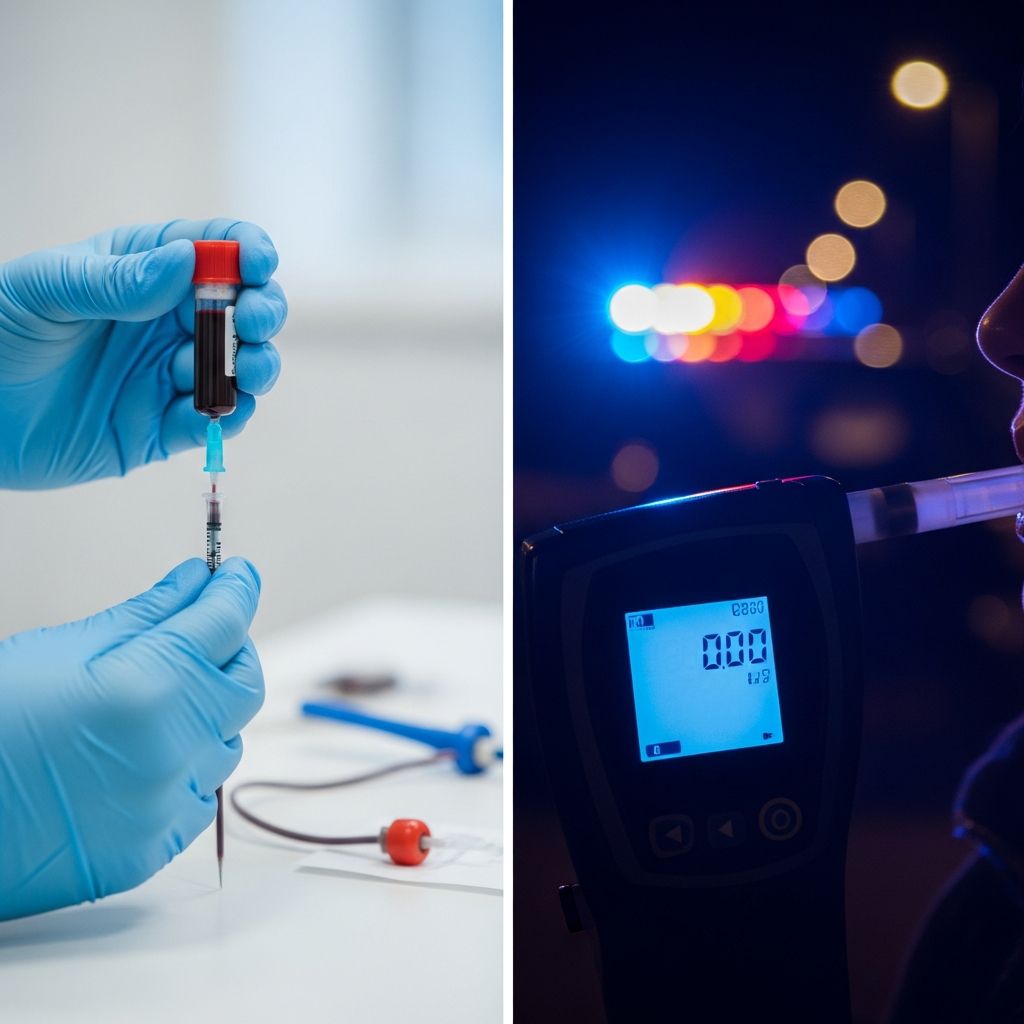
If you are pulled over for suspected drunk driving, the officer will usually ask you to take a chemical test to measure your blood alcohol concentration (BAC). The test most drivers face is a breathalyzer, but in many situations a blood test may also be requested. Understanding the differences between these two tests, how accurate they are, and what the law says about refusing them can help you know which questions to raise with a defense attorney later.
Important: DUI law is highly state-specific. This article provides general educational information and is not legal advice. Always consult a licensed lawyer in your state about your particular situation.
How DUI Chemical Testing Fits Into a Traffic Stop
Most DUI investigations follow a rough sequence. The chemical test request usually comes after several earlier steps:
- An initial traffic stop based on probable cause or reasonable suspicion (for example, speeding, drifting across lanes, or a broken taillight).
- Observation by the officer of possible impairment signs, such as slurred speech, odor of alcohol, glassy eyes, or fumbling with documents.
- Field sobriety tests, like the walk-and-turn or one-leg stand, which are standardized and validated by the National Highway Traffic Safety Administration (NHTSA). These tests help the officer decide whether there is probable cause to arrest for DUI.
- An arrest for suspected DUI, followed by a request for a chemical test (usually breath, sometimes blood, and in some jurisdictions also urine).
In many states, drivers are deemed to have given advance consent to a post-arrest chemical test through so-called implied consent laws. Refusing a lawful test request can trigger separate license suspensions, even if you are never convicted of DUI.
What a Breathalyzer Test Actually Measures
A DUI breath test estimates your BAC by analyzing alcohol in your deep-lung air and converting it to an approximate blood alcohol level. Law enforcement agencies use larger, evidential breath instruments at stations or mobile units, rather than the small, consumer devices sold to the public.
Key features of an evidential breath test include:
- Breath sample collection: You blow into a mouthpiece connected to the device, usually multiple times.
- Chemical or infrared analysis: The machine measures alcohol in the exhaled air using chemical reactions or infrared light absorption, which is then converted to a numerical BAC reading.
- Immediate results: The device outputs a BAC number within minutes, which officers may use to support a DUI charge if it is at or above the per se limit (commonly 0.08% for adults).
Breath tests are widely used because they are relatively quick, non-invasive, and less expensive than blood testing.
Limitations and Potential Issues with Breath Testing
Although breath tests are accepted in courts when properly administered, they do not measure alcohol in the blood directly. Several factors can affect their reliability:
- Device maintenance and calibration: Agencies must follow strict calibration and maintenance schedules to keep readings within acceptable error ranges.
- Administration errors: Failing to observe the driver for a required period, mishandling the device, or not following standardized procedures may undermine the test.
- Residual mouth alcohol: Recent drinking, belching, or certain products (like alcohol-based mouthwash) can temporarily elevate readings because they leave alcohol in the mouth, not just in deep-lung air.
- Medical and physiological factors: Conditions that affect breathing or metabolism may influence test results or how closely breath alcohol tracks blood alcohol.
Many defense strategies focus on whether the breath test was conducted and maintained in full compliance with state regulations.
How a DUI Blood Test Works
A blood test directly measures the concentration of alcohol in a sample of your blood. This method is often referred to as the “gold standard” for BAC determination in scientific and legal contexts because it analyzes the substance (blood) that the law typically uses to define impairment limits.
Typical features of a DUI blood test include:
- Sample collection: A qualified medical professional or trained technician draws blood into vials, following sterile procedures and chain-of-custody rules.
- Laboratory analysis: The sample is sent to a lab where technicians use approved analytical techniques, such as gas chromatography, to determine BAC.
- Delayed results: Unlike a breath test, it may take days or weeks for the final report to be available.
Beyond alcohol, blood testing can also detect the presence of other substances, including many prescription medications and illicit drugs, which is why it is commonly used in cases involving suspected drug-impaired driving.
Possible Problems in Blood Testing
Although blood tests are often more precise than breath tests, they are not immune to challenge. Issues that defense lawyers sometimes explore include:
- Collection errors: Improper cleaning of the draw site, use of incorrect vials, or contamination can affect BAC readings.
- Storage and transport: Samples must be labeled, refrigerated, and transported correctly. Improper handling can cause fermentation or degradation of the sample.
- Laboratory procedures: Failure to follow validated protocols, use of uncalibrated instruments, or incorrect calculations can be grounds for questioning results.
- Chain of custody: The prosecution usually has to show where the blood sample was and who handled it from the moment of collection until testing. Missing links can weaken the evidentiary value.
Breath Test vs. Blood Test: A Side-by-Side Comparison
| Aspect | Breathalyzer Test | Blood Test |
|---|---|---|
| What it measures | Alcohol in exhaled breath, converted to estimated BAC | Actual alcohol concentration in blood |
| Invasiveness | Non-invasive (blowing into device) | Invasive (needle and blood draw) |
| Result timing | Immediate printout or display at station | Lab delay (often days to weeks) |
| Accuracy | Generally acceptable if properly maintained, but subject to more external influences | Typically more accurate and more directly reflective of statutory BAC standards |
| Use in court | Common, but often challenged based on calibration, administration, or physiological factors | Highly persuasive when chain of custody and lab procedures are sound |
| Drug detection | Limited to alcohol | Can detect many drugs and medications |
| Cost to the state | Lower; no lab work for each test | Higher; requires trained staff and laboratory analysis |
Legal Framework: Implied Consent and Refusal Consequences
Every U.S. state has some version of an implied consent law. By driving on public roads, you are typically deemed to consent to a chemical test after a lawful arrest for suspected impaired driving. Refusing such a test can result in:
- Administrative license suspension: Many states impose an automatic, often longer, suspension for refusal than for failing the test, regardless of the outcome of the criminal case.
- Use of refusal as evidence: In some jurisdictions, prosecutors may argue that refusal indicates consciousness of guilt, subject to constitutional and statutory limits.
- Ignition interlock or other conditions: Reinstating driving privileges after a refusal suspension may require ignition interlock devices, substance abuse assessment, or other conditions, depending on the state.
The exact penalties for refusal vary widely by location and by whether the driver has prior DUI convictions or prior refusals. Some states also have separate criminal offenses for refusing a test in certain circumstances.
When Authorities May Require Blood Rather Than Breath
Although breath is often the default method, officers or statutes may require a blood draw in specific situations, such as:
- Serious injury or fatal crashes, where prosecutors anticipate felony charges.
- Suspected drug-impaired driving, where breath testing alone will not reveal non-alcohol substances.
- Inability to provide an adequate breath sample (for instance, due to medical issues or device malfunction).
The U.S. Supreme Court has placed limits on warrantless blood draws. In most routine cases, officers now obtain a warrant before compelling a blood test, absent exigent circumstances.
Strategic Considerations Often Discussed With Defense Counsel
There is no single right answer to whether a driver should prefer a breath test or blood test, and in many situations the driver may have little or no choice. However, defense attorneys commonly examine the following factors after the fact when reviewing a case:
- Estimated BAC level: If a driver believes their BAC is close to, but below, the legal limit, a more accurate blood test might be less likely to overstate the level compared with a breath test that is more vulnerable to small errors.
- Possibility of challenging the test: Breath tests often generate more technical and procedural challenges related to device calibration and proper operation. Blood tests, by contrast, may be more vulnerable to chain-of-custody and lab methodology challenges.
- Presence of drugs: Because blood testing can screen for a wide range of drugs, including legal prescriptions that might still impair driving, some drivers may face additional exposure if a blood test is taken in a drug-involved stop.
- Refusal penalties: In some states, the license consequences of refusal may be severe, especially for repeat offenders, influencing how lawyers later evaluate the decision.
An experienced DUI attorney will review the full record—police reports, video, test logs, and lab documentation—to determine which defenses are realistically available.
Practical Tips for Drivers to Discuss With Counsel
Again, only a licensed attorney can give you legal advice for your situation, but there are general topics many people find useful to understand and discuss with counsel:
- What your state’s implied consent law requires and what penalties apply for refusal.
- What types of chemical tests your state typically offers (breath, blood, urine) and in what order.
- How long administrative deadlines are for challenging a license suspension or requesting a hearing.
- How courts in your jurisdiction typically treat breath vs. blood evidence at trial.
- Whether any medical conditions or medications you have could interact with breath or blood testing.
Because timelines to preserve evidence and request hearings are often short, contacting an attorney quickly after an arrest can be important.
Frequently Asked Questions (FAQs)
Q: Is a blood test always more accurate than a breathalyzer?
A: In general, blood tests are considered more scientifically precise because they measure alcohol directly in the blood, while breath tests infer BAC from exhaled air. However, both can be challenged if they are not performed, stored, or analyzed according to strict standards.
Q: Can I choose between a breath test and a blood test?
A: Some states give drivers a choice between approved test types, while others allow officers to select the method or require blood in specific circumstances. Whether you have a choice depends entirely on your state’s law and the facts of the stop.
Q: What happens if I refuse all chemical tests?
A: Refusing a chemical test after a lawful arrest typically triggers an automatic driver’s license suspension under implied consent laws, often longer than if you took and failed the test. In some states, refusal can also be used as evidence in court or be charged as a separate offense.
Q: Do police need a warrant to take my blood?
A: In routine DUI cases, police now usually obtain a warrant before taking a blood sample unless an exception applies, such as emergencies or voluntary consent. The U.S. Supreme Court has held that the natural dissipation of alcohol in the bloodstream does not by itself create a blanket exception to the warrant requirement.
Q: Can I get an independent blood test?
A: Many states allow a driver to seek an additional, independent blood test at their own expense after completing the official test. Independent testing can sometimes provide evidence to challenge or verify the state’s results, but the exact rights and procedures differ by jurisdiction.
References
- DWI Detection and Standardized Field Sobriety Testing — National Highway Traffic Safety Administration (NHTSA). 2018-01-01. https://www.nhtsa.gov/sites/nhtsa.gov/files/documents/sfst_refresher_training_manual_2018.pdf
- Administrative License Suspension/Revocation: An Assessment of State Laws — National Highway Traffic Safety Administration. 2011-09-01. https://www.nhtsa.gov/sites/nhtsa.gov/files/811464.pdf
- How Is Blood Alcohol Content (BAC) Measured? — Centers for Disease Control and Prevention (CDC). 2022-12-30. https://www.cdc.gov/alcohol/fact-sheets.htm
- Drugs and Human Performance Fact Sheets — National Highway Traffic Safety Administration. 2004-04-01. https://one.nhtsa.gov/people/injury/research/job185drugs/drugs_web.pdf
- Missouri v. McNeely, 569 U.S. 141 — Supreme Court of the United States. 2013-04-17. https://supreme.justia.com/cases/federal/us/569/141/
Similar Articles








Read full bio of medha deb




