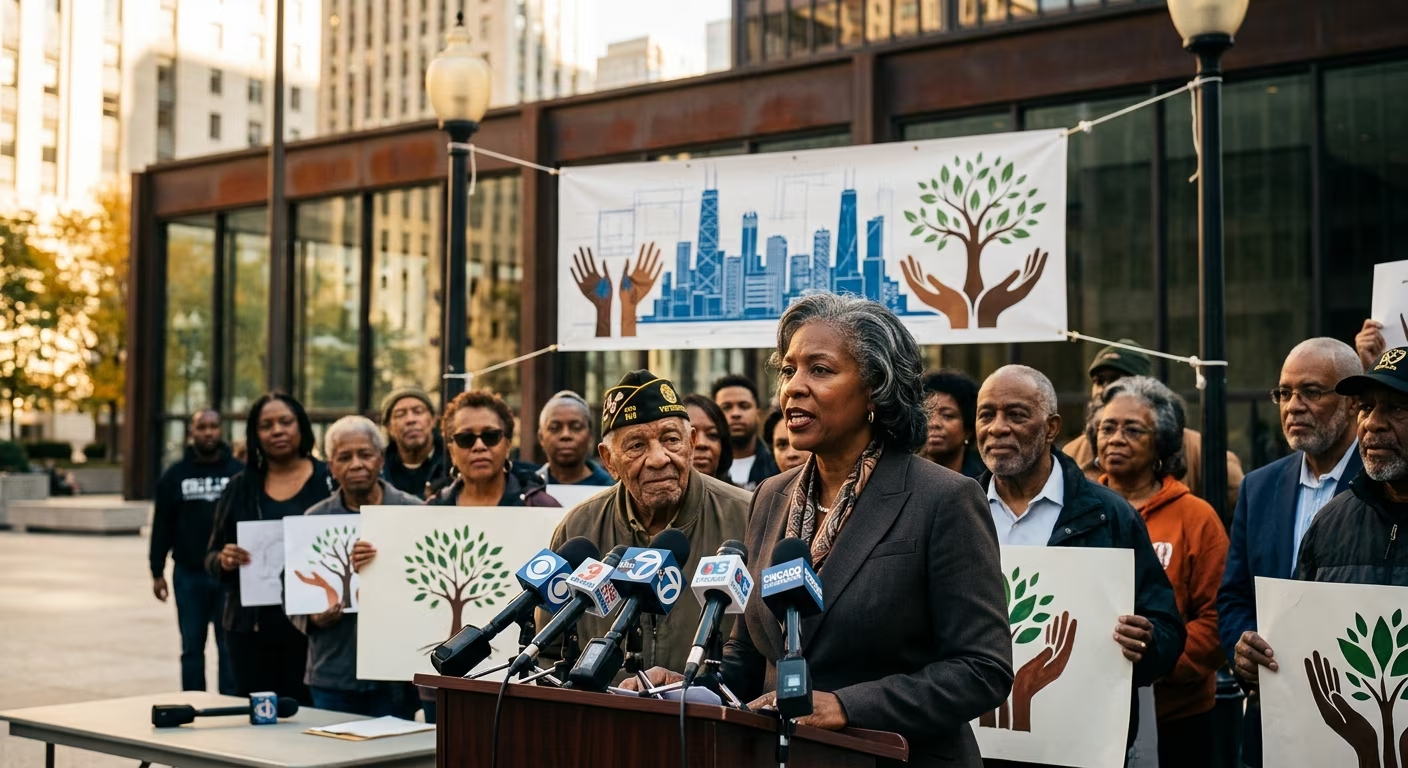
The pursuit of justice for victims of state-sanctioned violence is often fraught with complex legal hurdles, protracted litigation, and intense societal resistance. Historically, when municipalities are forced to confront systemic abuses committed by law enforcement, the resolution typically ends in closed-door civil settlements. These traditional avenues may offer monetary compensation, but they rarely provide public accountability, psychological healing, or structural reform. However, a monumental shift in this paradigm occurred in May 2015 when the city of Chicago enacted an unprecedented legislative package. This legislation was explicitly designed to provide holistic, restorative redress to survivors of a decades-long era of severe police abuse.
By moving beyond the limitations of standard civil litigation, this historic ordinance established a comprehensive model for transitional justice within the United States. It recognized that financial payouts alone are woefully insufficient to mend the deep, generational wounds inflicted by state violence. Instead, the municipal government formally acknowledged its culpability, offering a multifaceted framework designed to address the psychological, educational, and historical dimensions of the trauma. This analysis explores the dark historical context that necessitated such an ordinance, the grueling grassroots movement that brought it into existence, the core pillars of the legislation, and its enduring legacy as a blueprint for other cities grappling with legacies of systemic injustice.
The Dark Epoch of Coerced Confessions
Between the early 1970s and the early 1990s, an egregious pattern of human rights violations unfolded within the confines of specific police precincts in Chicago. During this dark epoch, a specialized group of detectives systematically targeted marginalized communities. Over the course of nearly two decades, more than a hundred predominantly Black and Latino men were subjected to horrific interrogation techniques explicitly designed to extract false confessions.
The tactics employed during these interrogations were not mere instances of excessive force; they constituted clear, premeditated violations of international human rights standards. Survivors reported being subjected to severe physical beatings, psychological terror, mock executions, suffocation, and electrical shocks. The devastating consequence of these coerced confessions was a massive wave of wrongful convictions. Countless individuals were funneled into the criminal justice system, stripped of their freedom, and sentenced to decades in prison—with some even placed on death row—for crimes they did not commit.
For years, the systemic nature of these abuses was shrouded in official denial. Whistleblowers were silenced, and the institutional hierarchy actively worked to protect the perpetrators from accountability. Even when mounting evidence began to corroborate the survivors’ harrowing accounts, the response from the criminal justice system was agonizingly slow. The perpetrators largely evaded direct criminal prosecution for the acts of abuse themselves due to expired statutes of limitations, though the primary orchestrator was eventually convicted in 2010 on federal charges of perjury and obstruction of justice .
The Grassroots Movement for Redress
Securing the 2015 ordinance was not the result of spontaneous political goodwill. It was the culmination of relentless, decades-long advocacy by a resilient coalition of survivors, family members, civil rights attorneys, and community organizers. When the traditional legal system repeatedly failed to deliver comprehensive justice, these advocates pivoted their strategy. They recognized that while individual exonerations were critical, they did not address the broader communal trauma or the city’s complicity in the institutional cover-up.
Grassroots organizations launched widespread educational campaigns, organizing protests, public hearings, and art exhibitions to ensure the survivors’ stories remained in the public consciousness. They successfully elevated the issue from a local scandal to an international human rights crisis. Notably, community organizers and human rights advocates testified before the United Nations, effectively framing the systemic abuse as a violation of international law . This global spotlight applied unprecedented pressure on local political leaders.
The momentum reached a crucial tipping point during the highly contested 2015 municipal elections. Activists strategically capitalized on the political climate, demanding that candidates publicly commit to a comprehensive restorative justice package. By centering the voices of the survivors and reframing the narrative around holistic healing rather than mere monetary compensation, the movement successfully laid the groundwork for an ordinance that would fundamentally redefine municipal accountability in the United States.
A Groundbreaking Legislative Framework
Passed unanimously by the city council, the 2015 ordinance codified a multi-pronged approach to redress. Recognizing that the harm inflicted was multifaceted, the legislative framework was built upon several distinct pillars, ensuring that the response aligned with international standards of transitional justice.
The core components of the legislative package included:
- A Formal Municipal Apology: The legislation mandated an official, public apology from the city’s executive leadership and the city council, permanently placing the government’s acknowledgment of systemic wrongdoing into the historical record.
- Direct Financial Compensation: A dedicated fund of $5.5 million was established to provide direct monetary relief. Eligible survivors who filed claims were granted $100,000 each, offering a measure of financial stability without requiring them to endure the grueling process of a civil trial.
- Educational Benefits: Acknowledging the generational theft of opportunity, the ordinance provided free tuition at city colleges for the survivors, their children, and even their grandchildren, aiming to disrupt the cycle of socioeconomic disenfranchisement.
- Psychological Support Services: The city committed to funding a specialized, community-based center dedicated to providing trauma-informed counseling and mental health services to survivors and their families.
- Mandated Public Education: To ensure the atrocities are never forgotten or repeated, the ordinance required the local public school system to incorporate the history of these systemic abuses into the standardized curriculum for eighth and tenth graders.
- A Permanent Public Memorial: The legislation included a commitment to fund and construct a public monument, serving as a permanent physical reminder of the victims’ immense suffering and the community’s extraordinary resilience.
Restorative Justice Versus Traditional Litigation
To fully grasp the monumental nature of this legislation, it is essential to contrast it with standard legal procedures. In the United States, victims of police misconduct typically seek redress through civil lawsuits. While these suits can result in substantial monetary payouts, they are inherently limited in scope and often serve the administrative interests of municipal risk management rather than the victims’ authentic need for closure.
| Feature | Traditional Civil Litigation | The 2015 Restorative Justice Model |
|---|---|---|
| Focus of Resolution | Strictly monetary compensation; mitigating municipal financial risk. | Holistic healing, historical acknowledgment, and long-term community repair. |
| Admission of Guilt | Rarely included; settlements often explicitly state “no admission of wrongdoing.” | Centered on an official, public apology from the highest levels of local government. |
| Accessibility | Requires lengthy, re-traumatizing court battles; barred by statutes of limitations. | Streamlined claims process accessible to victims regardless of the statute of limitations. |
| Community Impact | Benefits only the individual plaintiff; structural and societal issues remain unaddressed. | Includes mandated educational curriculum, public memorials, and generational college tuition. |
By prioritizing dignity, truth-telling, and rehabilitation over a mere financial transaction, the ordinance aligned closely with the United Nations’ guidelines on the right to a remedy and reparation for victims of gross violations of international human rights law .
The Enduring Impact and Unresolved Challenges
While the passage of the ordinance was a historic legislative triumph, the subsequent years have underscored the complexities of implementing transitional justice. The establishment of the dedicated community counseling center has been a profound success, providing a safe haven where survivors and their families can receive specialized, trauma-informed care. Furthermore, the implementation of the mandated public school curriculum ensures that tens of thousands of students annually learn about the systemic failures of the past, fostering a more informed and civically engaged generation.
However, the journey toward complete justice remains unfinished. Activists and legal scholars have noted that while the ordinance provided critical relief, it could not automatically reverse all the institutional damages. Dozens of individuals remained incarcerated long after the ordinance’s passage, continuing to fight complex legal battles to prove their convictions were based on coerced confessions. The systemic nature of the criminal justice system means that unwinding wrongful convictions requires navigating labyrinthine appellate courts, independent of the municipal reparations package.
Additionally, the promise of a permanent public memorial has faced bureaucratic and funding delays, reminding advocates that political commitments require sustained public pressure to be fully realized. Despite these ongoing challenges, the framework itself remains robust, proving that municipal governments possess the capacity to implement creative, far-reaching solutions when traditional legal avenues fail.
A National Blueprint for Transitional Justice
The broader implications of this restorative framework extend far beyond the city limits where it was enacted. As municipalities across the United States grapple with their own histories of systemic inequality, racial violence, and police misconduct, this ordinance serves as a tangible blueprint for action. It proves that reparations are not merely a theoretical academic concept, but a viable, actionable public policy.
Legal scholars and civil rights advocates increasingly point to this model as a paradigm for addressing other historical injustices, ranging from discriminatory redlining practices to the enduring legacies of forced labor and segregation . By institutionalizing memory through education and memorials, and by providing tangible resources for economic and psychological recovery, governments can move beyond superficial reforms. The true power of this legislative model lies in its fundamental recognition that state-sanctioned harm is a community-wide trauma, and therefore, the remedy must be equally comprehensive, communal, and enduring.
Frequently Asked Questions (FAQ)
What was the primary goal of the 2015 restorative justice ordinance?
The primary goal was to provide comprehensive redress to the survivors of systemic police abuse that occurred between the 1970s and 1990s. Instead of merely offering financial payouts, the ordinance aimed to address the psychological, educational, and historical impacts of the trauma through an official apology, free tuition, specialized counseling, and mandated public education.
How did this approach differ from a standard civil lawsuit?
Standard civil lawsuits typically end in a financial settlement without any formal admission of guilt by the municipality. The 2015 ordinance, however, mandated an official apology, bypassed the strict statute of limitations that barred many victims from pursuing traditional lawsuits, and provided community-wide benefits such as a public school curriculum and a specialized psychological care center.
Did the ordinance automatically free individuals who were wrongfully convicted?
No. The local municipal government did not have the jurisdiction to overturn criminal convictions, which are strictly handled by the state’s judicial appellate system. While the ordinance provided compensation and support, individuals still incarcerated based on coerced confessions had to continue fighting their complex cases through the courts and specialized relief commissions.
Is this legislative model being used in other cities?
While this specific ordinance was the first of its kind in a major U.S. municipality regarding police violence, it has sparked a profound national conversation. Various cities and states are now actively studying its holistic framework as a potential model for providing reparations related to other historical injustices, including systemic housing discrimination, forced displacement, and broader racial violence.
Conclusion
The passage of the 2015 restorative justice ordinance stands as a watershed moment in the history of American civil rights. It represents a rare instance in which a government not only admitted to a dark chapter of systemic violence but also committed to a holistic path of restitution. By intertwining financial compensation with psychological support, educational empowerment, and historical preservation, the legislation radically redefined what it means to make amends. Although immense challenges remain in fully eradicating the lingering shadows of wrongful convictions and bureaucratic delays, the blueprint provided by this historic legislation continues to inspire communities nationwide. It stands as a powerful testament to the fact that while the scars of institutional violence run deep, comprehensive, and compassionate public policy can pave the way for genuine, lasting healing.
References
- Substitute Resolution: Apology and Reparations for Victims of Police Torture — Chicago City Council. 2015-05-06. https://chicityclerk.s3.amazonaws.com/s3fs-public/document_uploads/reparations/Resolution.pdf
- Convention against Torture and Other Cruel, Inhuman or Degrading Treatment or Punishment — Amnesty International / United Nations. 2015-11-26. https://www.amnesty.org/en/documents/amr51/2940/2015/en/
- Dignity Restoration and the Chicago Police Torture Reparations Ordinance — Baer, A., Scholarly Commons @ IIT Chicago-Kent College of Law. 2018-03-06. https://scholarship.kentlaw.iit.edu/cklawreview/vol92/iss3/5/
- The Case for Reparations in Tulsa, Oklahoma — Human Rights Watch. 2020-05-29. https://www.hrw.org/report/2020/05/29/case-reparations-tulsa-oklahoma/human-rights-argument