Introduction
Public education has long been heralded as the great equalizer in American society, an essential institution designed to foster civic engagement, economic mobility, and community cohesion. For over four decades, the United States has operated under the legal consensus that access to a foundational K-12 public education must be universally available to all children residing within its borders, completely independent of their immigration status. This crucial principle was cemented in 1982 by a landmark United States Supreme Court ruling.
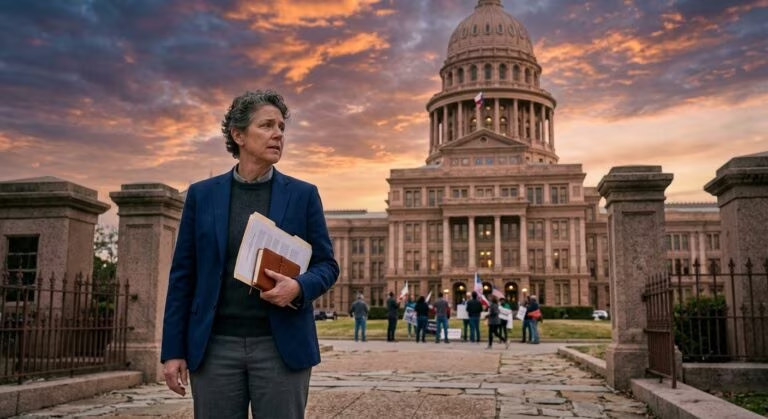
Today, however, that longstanding precedent is facing a fierce resurgence of political and legal hostility. Lawmakers, public officials, and conservative policy organizations are actively exploring legislative maneuvers designed to dismantle this safeguard. This renewed friction threatens to strip vulnerable immigrant populations of basic educational rights, potentially reshaping the demographic and economic landscape of the nation. As legal strategies to reverse this precedent gain momentum, it is vital to analyze the historical context of the ruling, the contemporary political forces seeking to overturn it, and the sweeping implications for children and society at large.
Understanding Plyler v. Doe: The 1982 Landmark Decision
To grasp the weight of the current debate, one must look back to the origins of the judicial precedent that guaranteed these rights. In 1975, the Texas legislature enacted a controversial revision to its public education laws. The state sought to withhold critical funding from local school districts for the education of children who were not legally admitted to the United States. Furthermore, the legislation authorized local school districts to deny enrollment entirely to these undocumented children.
The policy faced immediate and profound legal resistance. A class-action lawsuit was filed on behalf of school-age children of Mexican origin residing in Texas who could not prove legal immigration status. The case steadily escalated through the federal judiciary, culminating in the 1982 Supreme Court ruling known as Plyler v. Doe.
In a narrow 5-4 decision, the Supreme Court struck down the Texas statute. Writing for the majority, Justice William Brennan concluded that the state legislation explicitly violated the Equal Protection Clause of the Fourteenth Amendment, which dictates that no state shall deny to any person within its jurisdiction the equal protection of the laws. The Court notably rejected the argument that undocumented immigrants are not considered “persons” within the meaning of the Fourteenth Amendment.
Crucially, the Court’s rationale hinged on the sheer injustice of penalizing children for the actions of their parents. The majority opinion argued that denying innocent children access to a basic education would impose a lifetime of severe hardship on a discrete class of individuals who hold no accountability for their disabling legal status. The Court warned that barring these children from schools would inevitably create a permanent, disenfranchised underclass, ultimately harming the fabric of American society. Although the Supreme Court had previously established that education is not a fundamental constitutional right, Plyler mandated that if a state provides a free public education, it cannot selectively deny it to a specific marginalized group without demonstrating a compelling and substantial state interest.
The Modern Political Landscape: Renewed Challenges
For more than forty years, Plyler v. Doe has shielded undocumented students, allowing them to legally integrate into American public schools. Yet, the political climate surrounding immigration and border enforcement has become increasingly polarized, catalyzing renewed efforts to undermine this legal foundation.
The assault on the 1982 ruling has been galvanized by a shifting judicial landscape and aggressive political rhetoric from state capitals. In 2022, Texas Governor Greg Abbott suggested during a prominent public interview that he would like to see Plyler v. Doe overturned, arguing that the federal government’s ongoing immigration policies place an unmanageable financial burden on state public school systems. This rhetoric is far from isolated; it reflects a broader, highly coordinated push by conservative think tanks, which have encouraged state legislatures to draft bills designed to directly challenge the Supreme Court’s precedent.
The underlying motivation behind these modern efforts is twofold. First, proponents of restricting educational access argue that local and state taxpayers should not be forced to shoulder the financial responsibility of educating undocumented children, particularly during periods of high border crossings. They contend that the provision of free education acts as an illicit magnet for illegal immigration. Second, the ideological composition of the current Supreme Court—demonstrated by a willingness to overturn long-standing precedents—has emboldened state lawmakers. They believe a carefully constructed legislative challenge could survive appellate scrutiny and reach a sympathetic conservative majority on the high court.
Contrasting Perspectives on Overturning Precedent
| Argument Category | Proponents of Overturning Precedent | Defenders of Educational Access |
|---|---|---|
| Fiscal Responsibility | States bear disproportionate financial burdens and should not fund education for non-citizens without federal reimbursement. | Short-term educational costs are heavily outweighed by the long-term economic gains of an educated workforce. |
| Rule of Law | Providing taxpayer-funded public benefits rewards unlawful entry and inherently incentivizes further illegal immigration. | Children lack agency in their immigration status; penalizing them violates fundamental fairness and equal protection. |
| Societal Impact | Redirecting resources to legal residents will dramatically improve the quality of overcrowded public school systems. | Denying education creates an uneducated subclass, increasing future crime rates and destabilizing public health. |
Evaluating the Economic and Social Impact
If state-level efforts successfully provoke the overturning of Plyler v. Doe, the ripple effects would extend far beyond local school district borders, profoundly impacting the national economy and broad social stability.
From a strict economic perspective, advocates for restricting education point to immediate budgetary savings. Educating millions of undocumented children requires substantial state and local funding, encompassing infrastructure, specialized staffing, and bilingual education resources. However, economic experts and sociologists consistently warn that the long-term societal costs of creating an uneducated populace far eclipse any short-term municipal savings.
Academic research strongly correlates educational attainment with economic productivity, higher taxable income, and dramatically reduced reliance on public social services. For instance, empirical research evaluating the Deferred Action for Childhood Arrivals (DACA) program has demonstrated that access to legal stability and guaranteed educational pathways significantly boosted high school attendance and graduation rates among non-citizen immigrants. This increase in human capital directly correlates to improved community health outcomes and expanded future employment opportunities. If these pathways are severed at the primary education level, the United States economy would lose billions in potential future tax revenue. Undocumented immigrants already contribute heavily to the economy; excluding them from the educational system would stifle future workforce growth, particularly in critical sectors facing ongoing labor shortages.
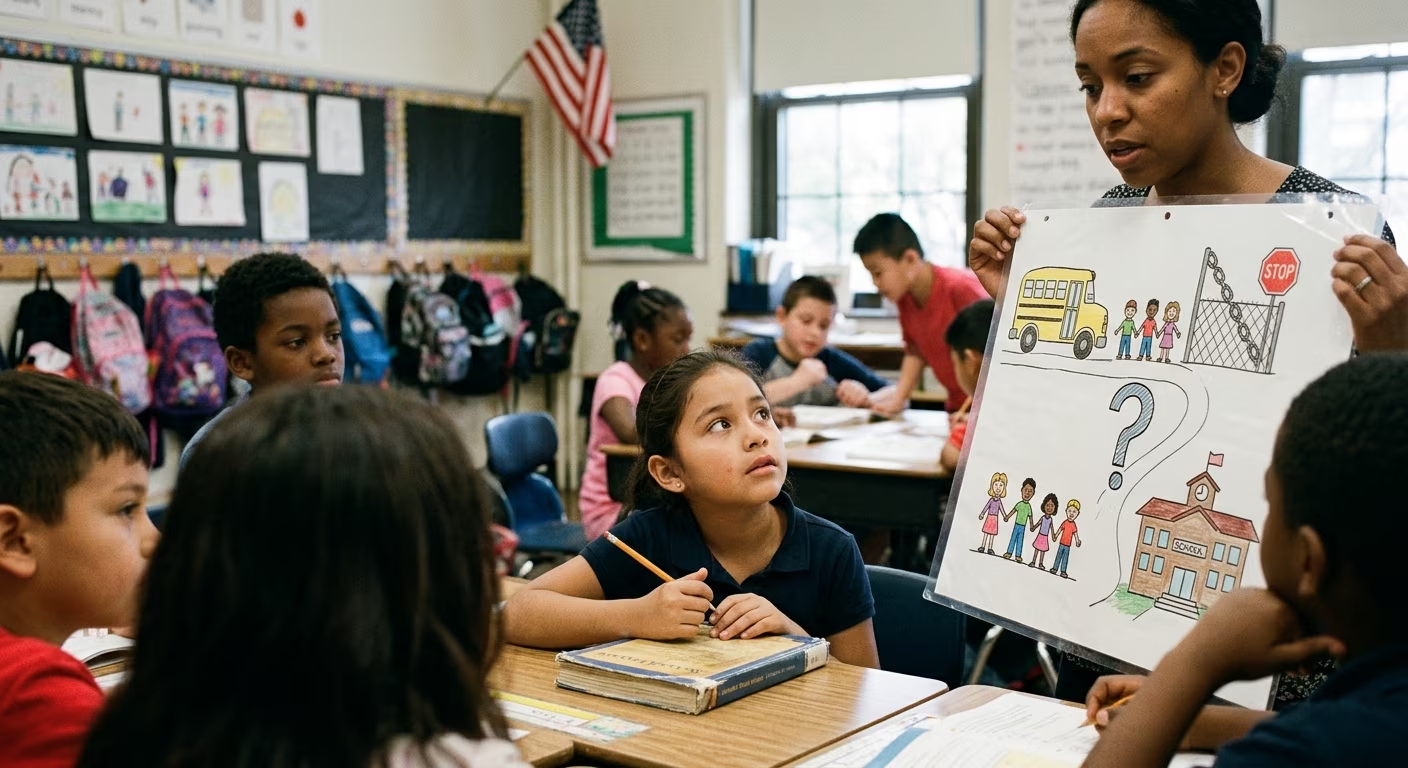
Socially, the consequences of restricting educational access would be catastrophic. Schools serve as primary nodes for basic child welfare, offering essential nutritional programs, developmental health screenings, and a safe, supervised environment. Denying access to these institutions would isolate incredibly vulnerable children, significantly increasing extreme poverty rates and the risk of labor exploitation.
The Real-Life Implications for Immigrant Children and Communities
Beyond the macroeconomic data and constitutional theory, the human toll of challenging basic educational rights is profound. Even the mere threat of restrictive legislative action creates a palpable chilling effect across immigrant communities across the nation. When politicians signal their intent to challenge protections for undocumented children, fear and confusion rapidly proliferate through vulnerable neighborhoods.
Families frequently react to these legislative threats by withdrawing entirely from public life. Parents may preemptively pull their children out of school or refuse to enroll them at all, fearing that school districts might share sensitive demographic or enrollment data with federal immigration enforcement agencies. This environment of surveillance and hostility traumatizes young children who are already navigating the complex, stressful challenges of cultural integration and language acquisition.
Moreover, the psychological burden placed on these youths cannot be overstated. Children who perceive that their presence in a classroom is legally contested, or financially resented by the state, often suffer from heightened clinical anxiety, decreased academic motivation, and a fractured sense of societal belonging. This psychological distress does not only affect undocumented students; it reverberates throughout mixed-status families. Millions of U.S.-born citizens live with undocumented parents or siblings. Policies targeting undocumented children inevitably inflict collateral trauma on citizen children, destabilizing the entire family unit and deeply eroding trust in civic institutions.
State vs. Federal Showdown: The Legal Hurdles Ahead
The journey to officially dismantle the protections of Plyler v. Doe is fraught with significant constitutional hurdles, ensuring that any state attempting this path will face fierce, protracted litigation. The core of the legal battle remains the Equal Protection Clause of the Fourteenth Amendment. To successfully overturn the precedent, a state would need to construct a robust legal framework capable of convincing the Supreme Court that the 1982 judicial analysis was fundamentally flawed.
State lawmakers are currently exploring sophisticated, indirect procedural strategies to achieve this. Rather than passing an outright, blatant ban on enrollment, some states have considered legislation that would mandate school districts to aggressively collect and report data on the immigration status of students and their families, ostensibly for auditing purposes to bill the federal government. While these data-collection laws do not explicitly deny enrollment on paper, civil rights advocates argue they are practically designed to effectively deter immigrant families through systemic intimidation—creating a viable avenue to push the issue back into the federal appellate courts.
Legal experts and established civil rights organizations remain hyper-vigilant. Groups that originally litigated the Texas case stand ready to immediately challenge any state legislation that infringes on the Equal Protection Clause. They maintain that the constitutional foundation protecting immigrant children remains legally unassailable, regardless of ideological shifts on the current bench.
Moving Forward: Safeguarding Educational Equity
As the legal and political tempest gathers momentum, grassroots advocates, educators, and progressive policymakers are mobilizing to safeguard educational equity. Local school districts, particularly in immigrant-dense metropolitan regions, have proactively reaffirmed their unwavering commitment to serving all students. Many districts have adopted official “safe haven” resolutions, explicitly prohibiting the collection of immigration status data and strictly restricting cooperation with federal immigration enforcement on school grounds.
At the state level, progressive legislatures are actively codifying educational protections for undocumented students, ensuring that state-level constitutional guarantees backstop any potential federal vulnerabilities. However, the true resolution to this escalating conflict lies far beyond the classroom doors. The enduring, cyclic debate over public education for undocumented children is a glaring symptom of a broader, unresolved national crisis regarding comprehensive immigration reform. Until the federal government establishes a functional, modernized, and humane immigration system, vulnerable children will remain caught in the brutal crossfire of partisan battles over states’ rights, fiscal responsibilities, and American identity.
Frequently Asked Questions (FAQ)
- What is Plyler v. Doe?
Plyler v. Doe is a landmark 1982 United States Supreme Court decision that struck down a Texas state law allowing local school districts to deny enrollment and withhold state funding for the education of undocumented immigrant children. The Court ruled that this law violated the Equal Protection Clause of the Fourteenth Amendment. - Why is Plyler v. Doe currently under threat?
In recent years, several state politicians and conservative think tanks have expressed a strong desire to challenge the ruling. They argue that educating undocumented immigrants places an unfair financial burden on state taxpayers and believe that the current conservative majority on the Supreme Court might be willing to overturn the 1982 precedent. - Does the U.S. Constitution guarantee a right to education?
No. In the 1973 case San Antonio Independent School District v. Rodriguez, the Supreme Court ruled that education is not a fundamental right protected by the Constitution. However, Plyler v. Doe established that if a state chooses to provide a free public education, it cannot selectively deny it to a specific class of children based on their immigration status without violating the Equal Protection Clause. - How much does educating undocumented children cost, and does it drain state budgets?
While providing K-12 education to immigrant students does require state and local funding allocations, comprehensive economic analyses consistently show that the long-term societal benefits heavily outweigh the initial costs. Educating these children leads to a more productive adult workforce, higher tax contributions, and lower crime rates, whereas creating an uneducated subclass would result in significant long-term economic and social drains. - Can public schools legally ask about a student’s immigration status?
Under current federal law and the Plyler v. Doe precedent, public school districts cannot deny admission based on immigration status. Consequently, schools are generally prohibited from asking for documentation that would reveal a student’s or their parents’ undocumented status, as such practices are deemed to have a chilling effect that unlawfully deters school attendance.
References
- Access to Education – Rule of Law — United States Courts. 2026. https://www.uscourts.gov/educational-resources/educational-activities/access-education-rule-law
- Plyler v. Doe — Legal Information Institute (Cornell Law School). 1982-06-15. https://www.law.cornell.edu/wex/plyler_v_doe
- DACA’s Impact on Educational Outcomes — Department of Economics, Dartmouth College. 2021-08-20. https://economics.dartmouth.edu/news/2021/08/dacas-impact-educational-outcomes
- Are immigrant students disproportionately consuming educational resources? — The Brookings Institution. 2021. https://www.brookings.edu/articles/are-immigrant-students-disproportionately-consuming-educational-resources/