
CFPB v. Walmart and Branch: Gig Pay, Junk Fees, and Workers’ Rights
How the CFPB’s lawsuit against Walmart and Branch highlights the legal risks of steering gig workers into fee-laden digital pay accounts.
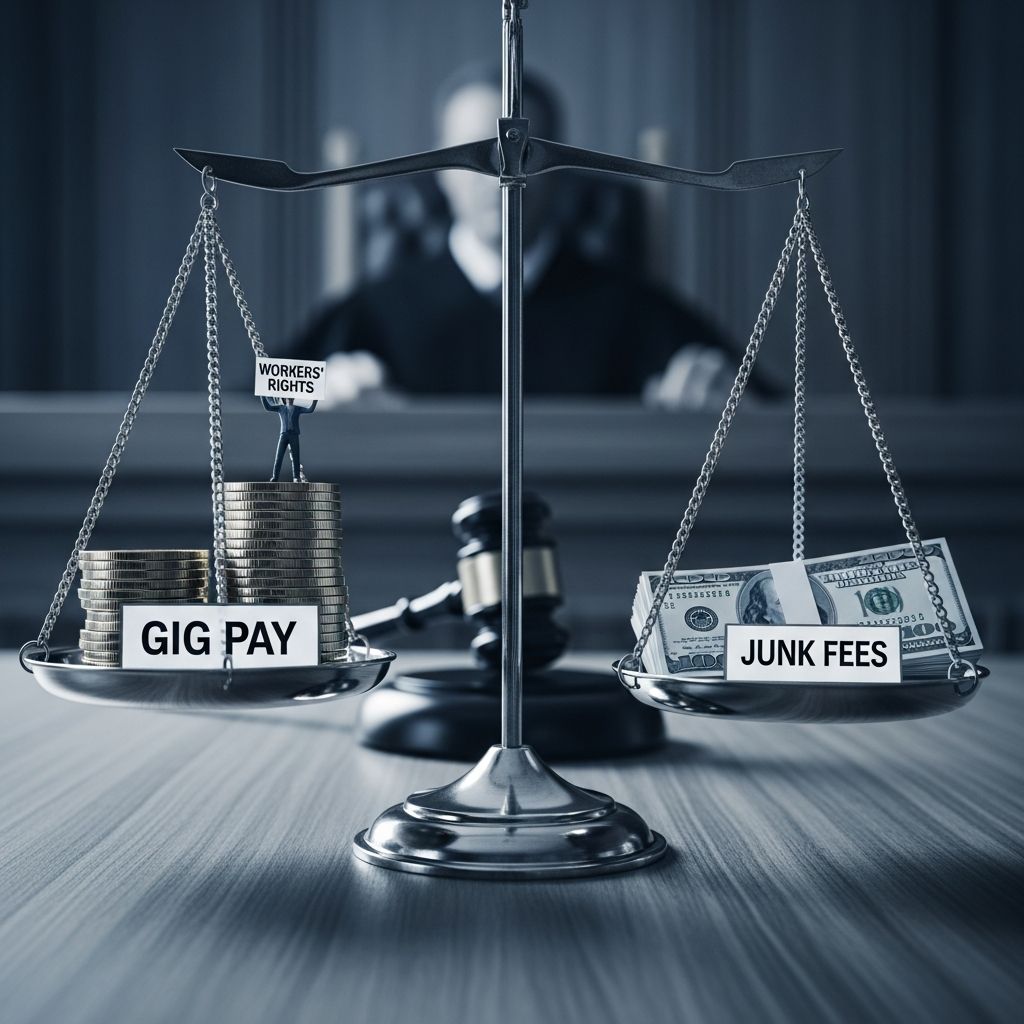
The Consumer Financial Protection Bureau (CFPB) has brought national attention to how large employers and financial technology firms pay gig workers. In a high-profile enforcement action, the CFPB alleged that Walmart and fintech company Branch Messenger illegally opened deposit accounts for delivery drivers, forced those workers to use specific accounts to get paid, and extracted millions of dollars in so-called “junk fees.” This case illustrates how consumer finance laws apply not only to traditional bank customers, but also to gig workers paid through digital platforms.
Background: Who Is Involved and What Is at Stake?
The dispute centers on Walmart’s Spark Driver program, which relies on gig economy workers to provide last-mile deliveries from Walmart stores to customers nationwide. Spark drivers are typically classified as independent contractors rather than employees, but they still depend on payment systems controlled by the companies they deliver for.
Branch Messenger, commonly known as Branch, is a financial technology company that provides digital wallets and deposit accounts, working with a partner bank (Evolve Bank & Trust) to hold consumer funds. According to the CFPB, Walmart and Branch coordinated to route drivers’ earnings into Branch accounts, raising questions about consent, transparency, and fees.
The stakes extend beyond one retailer and one fintech firm. The lawsuit touches on broader issues, including:
- How gig workers receive and access their pay
- When digital accounts become “consumer financial products” subject to federal law
- Whether companies can require workers to accept fee-laden financial terms as a condition of getting paid
- How regulators define and police “junk fees” in the labor–fintech ecosystem
Core Allegations: What the CFPB Claims Happened
According to the CFPB’s enforcement filing and public statements, Walmart and Branch engaged in several categories of alleged misconduct affecting more than one million delivery drivers.
1. Deposit Accounts Opened Without Proper Consent
The CFPB alleges that Walmart and Branch used drivers’ personal information, including Social Security numbers, to open Branch deposit accounts in their names without obtaining valid authorization. Drivers reported discovering that their funds were automatically deposited into Branch accounts they had not knowingly agreed to open or use.
This conduct, if proven, implicates federal consumer finance statutes that prohibit unfair, deceptive, or abusive acts and practices (UDAAP) in offering financial products and services. It also raises privacy and data-use concerns, because sensitive personal information was allegedly repurposed to enroll drivers into unwanted accounts.
2. Forced Use of Specific Accounts to Get Paid
The CFPB claims that Walmart told Spark drivers they had to be paid through Branch accounts and that refusal could result in termination from the platform. In effect, drivers allegedly had no practical way to receive their earnings without first passing through the Branch ecosystem.
Under U.S. labor and consumer protection frameworks, workers must generally be free to choose how they receive their wages, whether via direct deposit to a bank of their choice, a payroll card, or other lawful options. By conditioning continued work and pay on use of a particular account, the Bureau alleges Walmart and Branch removed that choice and leveraged their power over workers to push a specific financial product.
3. Complex Access Path and Delays in Receiving Money
Once funds arrived in Branch accounts, drivers who wanted to move their earnings to a different bank account reportedly had to navigate a multi-step process that involved in-app transfers and waiting periods. The CFPB asserts that this design:
- Made it difficult for drivers to understand the fastest, lowest-cost way to access their pay
- Introduced delays if workers chose the fee-free path
- Created strong incentives to pay for instant transfers to avoid waiting several days
In combination with threats of termination for not using Branch, these barriers allegedly left drivers with a constrained and confusing set of options for accessing their wages.
4. Junk Fees for Instant Access to Earnings
A central focus of the CFPB’s case is the allegation that drivers paid more than $10 million in fees to Branch to immediately transfer their earnings to accounts of their choice. According to media summaries of the Bureau’s claims, Branch charged either a percentage of the transfer amount or a flat fee for same-day access, while fee-free transfers could take up to several days.
CFPB Director Rohit Chopra characterized these charges as “junk fees,” arguing that companies cannot force workers into fee-generating accounts that “drain their earnings.” This framing aligns with the CFPB’s broader initiative targeting excessive or hidden fees across financial markets, including deposit accounts, loans, and payment services.
5. Additional Alleged Violations by Branch
Beyond the wage-access issues, the CFPB also alleged that Branch engaged in unlawful practices in administering consumer accounts, such as:
- Requiring consumers to waive certain legal rights in its account terms
- Failing to properly investigate account errors
- Not honoring valid stop payment requests
- Failing to maintain adequate records related to disputes and transactions
These types of requirements are typically governed by the Electronic Fund Transfer Act (EFTA) and Regulation E, which establish baseline protections for users of electronic payment systems, including dispute rights and error resolution obligations.
How Walmart and Branch Responded
Walmart and Branch have publicly rejected the CFPB’s characterization of their conduct. Both companies have argued that the Bureau:
- “Rushed” its investigation and litigation timeline
- Misstated key facts and misapplied the law
- Failed to give them a fair opportunity to respond before filing suit
Walmart described the Bureau’s complaint as containing “factual errors” and “blatant misstatements of settled principles of law,” and pledged to vigorously defend its practices in court. Branch similarly contended that the case was driven by publicity rather than legal merit, emphasizing that it had cooperated with the investigation and that its services provided “quick and easy access to funds” for drivers.
Subsequently, the CFPB dismissed its lawsuit against Walmart and Branch with prejudice, which means the same claims cannot be refiled in that court. Neither the dismissal order nor the available public statements detailed the underlying reasons, but both companies portrayed the outcome as vindication of their critiques of the case.
Legal and Regulatory Framework
The dispute sits at the intersection of several legal regimes that govern how financial products and pay arrangements must be structured.
| Legal Area | Key Focus | Relevance to the Case |
|---|---|---|
| Consumer Financial Protection Act (UDAAP) | Prohibits unfair, deceptive, or abusive acts or practices in consumer financial products | Used by CFPB to challenge allegedly deceptive account opening and fee structures |
| Electronic Fund Transfer Act & Regulation E | Governs electronic transfers, error resolution, and disclosures | Implicated by claims about account errors, stop payments, and recordkeeping |
| Wage Payment & Payroll Card Rules | Protect worker choice of how they are paid; limit mandatory fee-laden options | Relevant to allegations that drivers were forced to use one account and pay fees |
| Data Privacy & Authorization | Controls use of personal data and consent to open accounts | Raised by claims that drivers’ data was used to open accounts without consent |
Although gig workers may not be treated as employees under all labor laws, they are still “consumers” when they use financial products like deposit accounts, which brings CFPB authority squarely into play.
Implications for Gig Workers and Digital Pay Platforms
Regardless of the litigation’s ultimate outcome, the case underscores several important lessons for gig workers, employers, and fintech providers.
1. Consent and Transparency Are Central
Workers should not have financial accounts opened in their names without clear, informed consent. Platforms that collect identity information to onboard contractors must make it explicit when that data is being used to establish a bank or wallet account, and give workers a genuine choice to participate or decline.
2. Pay Choice Cannot Be Illusory
Regulators have repeatedly signaled that employers and partner platforms cannot trap workers in single, high-fee pay arrangements by conditioning work opportunities on adoption of a specific account or card. Even when a particular financial product is offered as the “default,” workers must retain a meaningful, non-punitive alternative.
3. “Instant Pay” Models Face Heightened Scrutiny
Many gig-pay platforms offer near-real-time access to earnings for a fee, while slower options are free. The CFPB has expressed concern that such pricing structures can function as junk fees when:
- Workers’ only realistic path to timely access involves a paid option
- The free option is excessively slow relative to industry norms
- Disclosures fail to clearly describe trade-offs between speed and cost
Similar concerns have surfaced in other cases involving early-wage access, earned wage access services, and fintech–bank partnerships.
4. Fintech Partners Share Compliance Risks
Branch did not simply provide software; it facilitated deposit accounts via a partner bank and set terms for how drivers moved funds. The case illustrates that fintechs and their bank partners can be held responsible for compliance failures alongside large corporate clients, particularly where consumer accounts and payment flows are concerned.
Practical Takeaways for Companies
Organizations building gig-pay or digital wage products can draw several concrete compliance and governance lessons from this high-visibility dispute.
- Document clear, affirmative consent when opening any account, including electronic consent flows that capture timestamps and disclosures.
- Provide multiple payment options and avoid making work contingent on use of a single, fee-heavy account or card.
- Audit fee structures for wage-access products, especially any separate charges for instant transfers versus standard settlement.
- Align terms and conditions with EFTA and Regulation E, including robust error-resolution procedures and limitations on liability.
- Monitor partner activities—banks, processors, and fintechs must exercise oversight of one another’s compliance practices.
What Drivers and Gig Workers Can Do
Gig workers often have limited leverage, but there are steps they can take to protect themselves when platforms require specific payment tools.
- Carefully read onboarding materials to understand whether a new financial account is being opened in your name.
- Ask about alternatives such as direct deposit to an existing bank, paper checks, or different digital wallets.
- Track all fees charged to access earnings, and keep screenshots or statements that show how and when charges apply.
- File complaints with the CFPB or relevant state regulators if you believe your pay access is unfair, deceptive, or coerced.
- Consider timing needs and choose transfer options (instant vs. standard) based on cost–benefit rather than default prompts where possible.
Frequently Asked Questions (FAQs)
Q1: What did the CFPB accuse Walmart and Branch of doing to drivers?
The CFPB alleged that Walmart and Branch used drivers’ personal information to open deposit accounts without valid consent, forced drivers to use those accounts to get paid, made it difficult to access earnings without delays or extra steps, and charged more than $10 million in fees for instant transfers to other accounts.
Q2: What are “junk fees” in this context?
In this case, “junk fees” refers to charges imposed when drivers tried to quickly transfer their earnings from Branch accounts to another bank, especially where the CFPB believed the drivers had little real choice but to pay in order to access timely pay. The term aligns with the Bureau’s wider campaign against unnecessary or opaque fees in consumer finance.
Q3: Did Walmart and Branch admit wrongdoing?
No. Both companies publicly denied the CFPB’s allegations, arguing that the lawsuit misrepresented facts and law and was filed without giving them a fair chance to respond. They have maintained that their services offered valuable, convenient access to funds for drivers.
Q4: What happened to the lawsuit?
The CFPB ultimately dismissed its lawsuit against Walmart and Branch with prejudice in federal court, meaning the same claims cannot be refiled in that case. The public record does not fully explain why the case was dropped, and the dismissal does not necessarily resolve all policy questions the case raised.
Q5: How does this affect other gig workers using fintech payment apps?
While the specific lawsuit has been dismissed, it serves as a warning signal. Other gig platforms and fintechs can expect continued regulatory scrutiny of how they enroll workers into financial products, what fees they charge for fast access to earnings, and whether workers have fair, fee-transparent alternatives.
References
- Walmart illegally opened costly deposit accounts for one million delivery drivers, CFPB alleges — CBS News. 2024-12-23. https://www.cbsnews.com/news/walmart-delivery-drivers-branch-messenger-deposit-accounts-lawsuit-cfpb/
- Walmart forced delivery workers to pay ‘junk fees,’ CFPB alleges — Payments Dive. 2024-12-27. https://www.paymentsdive.com/news/walmart-CFPB-Branch-lawsuit-last-mile-delivery-drivers/736344/
- Walmart sued for allegedly forcing drivers into paying fees to access earnings — 10News / Scripps. 2024-12-27. https://www.10news.com/business/company-news/walmart-sued-for-allegedly-forcing-drivers-into-paying-fees-to-access-earnings
- Federal consumer watchdog drops lawsuit against Walmart — HR Dive. 2025-10-23. https://www.hrdive.com/news/walmart-branch-messenger-CFPB-lawsuit-delivery-labor-dismissed/748495/
Similar Articles








Read full bio of medha deb




