
Certificate of Authority: Essential for Multi-State Business
Unlock the legal requirements for expanding your business across state lines with a Certificate of Authority—avoid penalties and ensure compliance.
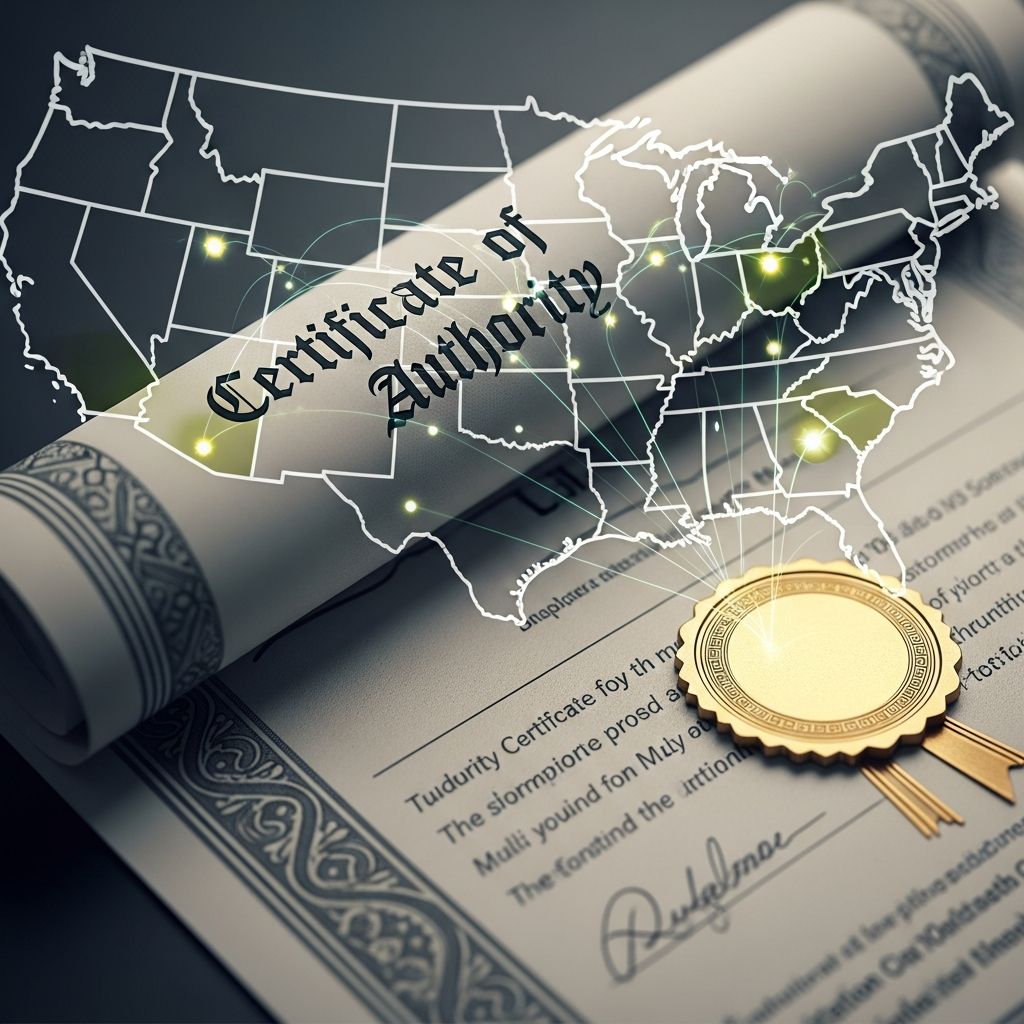
Expanding a business beyond its home state marks a pivotal growth phase, but it introduces complex legal hurdles. A
Certificate of Authority
serves as official permission from a state to allow a company formed elsewhere—known as a ‘foreign entity’—to legally conduct operations within its borders. This document validates your business’s legitimacy and ensures compliance with local regulations.Understanding the Fundamentals of a Certificate of Authority
The term ‘Certificate of Authority’ (COA) primarily refers to a state-issued authorization for out-of-state businesses to transact activities legally. It is part of the foreign qualification process, where ‘foreign’ denotes crossing state lines, not international boundaries. For instance, a Delaware-incorporated LLC seeking to open a warehouse in California must obtain California’s COA to operate without violations.
Alternative names include ‘Application for Authority,’ ‘Foreign Qualification,’ or ‘Application to Transact Business,’ varying by jurisdiction. This certificate confirms your entity is in good standing in its home state and meets the new state’s entry criteria.
No COA is needed in your formation state, as initial registration documents suffice there. However, venturing elsewhere triggers this requirement to maintain records, collect taxes, and oversee activities.
Key Triggers: When Does Your Business Require a COA?
States define ‘doing business’ differently, but common thresholds mandate a COA. Failing to recognize these can expose your company to fines, back taxes, or contract unenforceability. Here’s a breakdown:
- Physical Presence: Maintaining offices, stores, warehouses, or other facilities.
- Employee Hiring: Employing workers residing or performing duties in the state, including remote staff.
- Sales and Revenue: Generating substantial income from in-state sales, often tied to sales tax obligations.
- Client Interactions: Holding regular in-person meetings, negotiations, or service delivery.
- Contracts and Banking: Entering repeated binding agreements or opening local bank accounts.
- Government Bids: Pursuing state contracts or RFPs that demand proof of authorization.
Isolated activities like attending a single trade show or soliciting orders without a physical footprint typically don’t qualify as ‘doing business.’ Always consult state-specific statutes for precise definitions.
| Activity | Likely Requires COA? | Examples |
|---|---|---|
| Physical office/warehouse | Yes | Retail store, distribution center |
| Hiring local employees | Yes | Full-time staff, remote workers |
| One-time sales event | No | Trade show booth |
| Ongoing sales tax collection | Yes | E-commerce with in-state shipping |
| Annual conference attendance | No | Networking without contracts |
Specialized Certificates of Authority Across Industries
Beyond general business expansion, COAs appear in regulated sectors with distinct applications:
Sales Tax Certificate of Authority
In states like New York, businesses selling taxable goods or services must secure a Tax Certificate of Authority. This permits collecting and remitting sales tax, issuing exemptions, and displaying credentials at multiple locations.
Insurance Sector Requirements
Insurance providers file for Primary, Expansion, or Amendment Applications through state insurance departments. These verify organizational fitness, officer trustworthiness, and compliance with sector laws.
Nonprofits expanding operations, such as a Georgia charity opening Tennessee offices, also pursue COAs to establish physical presences lawfully.
Step-by-Step Guide to Obtaining a Certificate of Authority
Applying for a COA demands precision to avoid delays or rejections. Processes differ by state, with fees ranging from $100 to $500 and processing times of 1-8 weeks. Follow these steps:
- Verify Necessity: Review the target state’s Secretary of State website for ‘doing business’ criteria and name availability.
- Gather Home State Documents: Obtain a Certificate of Good Standing (or Existence) from your formation state, dated within 30-90 days.
- Appoint a Registered Agent: Designate a state-resident individual or service to receive legal notices.
- Prepare Application: Complete the state’s form with entity details, officer info, and business purpose.
- Pay and Submit: File online, by mail, or in-person, including fees. Some states require notarization.
- Maintain Compliance: File annual reports, pay franchise taxes, and renew good standing periodically.
Required Documentation Checklist
- Business name (DBA if applicable)
- Formation state, date, and entity type (LLC, Corp, etc.)
- Principal office address and in-state address
- Registered agent name/address
- Officer/member names and addresses
- Authorized signatory signature
- Good Standing Certificate
- Formation documents (Articles of Incorporation/Organization)
Certain states request asset details or expansion rationales for deeper scrutiny.
Risks and Penalties for Operating Without a COA
Non-compliance carries severe repercussions, deterring hasty expansions:
- Monetary Fines: $500-$20,000 per violation, escalating with duration.
- Tax Liabilities: Back taxes, interest, and penalties for uncollected sales tax.
- Legal Barriers: Inability to sue in state courts or enforce contracts.
- Status Loss: Revocation of good standing in home state via interstate reporting.
- Reputational Harm: Damage from publicized penalties.
Proactive compliance via entity management software minimizes these risks for multi-state operators.
Strategic Tips for Multi-State Compliance
For businesses in 5+ states, manual tracking invites errors. Leverage:
- Compliance Services: Firms handling filings, renewals, and monitoring.
- Software Tools: Platforms automating deadlines and document management.
- Legal Counsel: Attorneys specializing in business expansion.
Monitor nexus changes, like post-Wayfair sales tax rules, which lowered thresholds for e-commerce COAs.
Frequently Asked Questions (FAQs)
What exactly is a Certificate of Authority?
A state-issued document authorizing a foreign (out-of-state) business to legally operate within its jurisdiction.
Do sole proprietors or single-member LLCs need one?
Yes, if activities meet ‘doing business’ thresholds; entity type doesn’t exempt.
How long does approval take?
1-8 weeks typically; expedited options available in some states for extra fees.
Can I withdraw a COA if closing operations?
Yes, file withdrawal forms with the state to cease reporting obligations.
Does a COA replace business licenses?
No; it’s for entity authorization—separate industry/local licenses still required.
Conclusion: Secure Your Expansion Path
A Certificate of Authority is indispensable for lawful multi-state operations, bridging home and target state regulations. By anticipating needs, meticulously applying, and upholding ongoing duties, businesses thrive without legal entanglements. Consult state resources or professionals to tailor strategies to your operations.
References
- What Is a Certificate of Authority? State Requirements 2024 — Mosey. 2024. https://mosey.com/blog/certificate-of-authority/
- Certificate of Authority — 501c3.org. Accessed 2026. https://www.501c3.org/kb/certificate-of-authority/
- What Is a Certificate of Authority? — CorpNet. 2024. https://www.corpnet.com/blog/certificate-of-authority/
- Certificate of Authority: What It Is & When Businesses Need It — Filejet. 2024. https://filejet.com/entity-management-software-blog/filejet.com/entity-management-software-blog/certificate-of-authority
- Alabama Code § 27-43-8 (2024) – Filing of Application for Certificate — Justia Law. 2024. https://law.justia.com/codes/alabama/title-27/chapter-43/section-27-43-8/
Similar Articles








Read full bio of Sneha Tete


