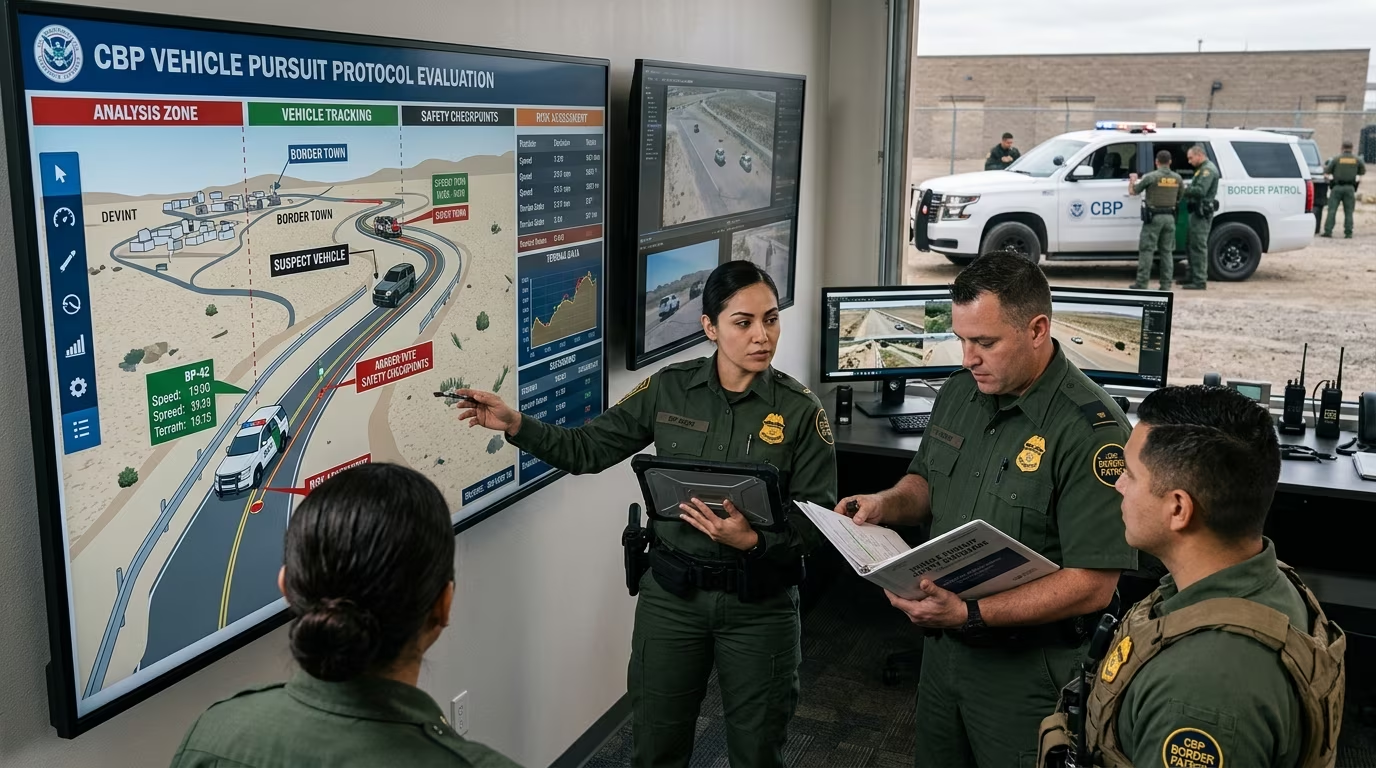
High-speed police chases have long been depicted as thrilling necessities in modern media, but on the rural highways and suburban streets of American border towns, they are recognized as lethal and chaotic events. For residents living along the United States borders, the sudden wail of a siren and the roar of a high-speed pursuit have been common and terrifying occurrences for years. These chases, often initiated over minor infractions or suspicions of smuggling, have historically led to catastrophic property damage, severe injuries, and heartbreaking fatalities involving agents, suspects, and entirely innocent bystanders.
In response to mounting public outcry and devastating internal statistics, U.S. Customs and Border Protection (CBP) enacted a comprehensive revision of its emergency driving and vehicular pursuit directives in early 2023. This overhaul was heralded by agency officials as a modernization of force guidelines intended to prioritize human life over the immediate apprehension of suspects. However, changing a written directive is merely the first step in a much longer journey toward systemic reform. For civil rights advocates, legal scholars, and community members, the critical question remains: will these newly minted protocols effectively alter the deeply ingrained culture of federal border enforcement, or are they simply cosmetic adjustments that will fail to make our roads demonstrably safer?
The Lethal Reality of Border Patrol Pursuits
To understand the necessity of the revised directive, one must first examine the historical toll of CBP vehicle pursuits. For decades, the agency operated under a highly discretionary framework that provided individual agents with immense latitude in deciding when to initiate and maintain a chase. Unlike many municipal police departments that restrict high-speed pursuits strictly to individuals suspected of violent felonies, CBP agents were previously permitted to engage in high-speed driving for virtually any suspected flight from law enforcement, including minor immigration violations or failure to yield at temporary checkpoints.
The results of this broad discretion were objectively tragic. Data compiled by the Southern Border Communities Coalition has tracked over a hundred deaths resulting from vehicle collisions involving Border Patrol over the past decade. A significant majority of these fatal encounters occurred during high-speed chases. When a vehicle packed with individuals—often migrants being smuggled in unsafe conditions without basic safety restraints—is pursued at speeds exceeding 90 miles per hour, the physics of a potential crash guarantee a mass-casualty event. Tires blow out, drivers lose control on unpaved or winding rural roads, and vehicles frequently roll over, ejecting occupants into the unforgiving desert landscape.
The victims of these enforcement tactics are not limited to those fleeing. Innocent motorists commuting to work, pedestrians navigating their neighborhoods, and even the pursuing agents themselves have been caught in the crossfire of these high-stakes maneuvers. Families left behind often faced a wall of bureaucratic silence, struggling for years to obtain basic accident reports or clear explanations regarding why a lethal pursuit was deemed necessary for a non-violent offense.
Decoding the New Guidelines: A Shift in Philosophy
The updated CBP directive, officially implemented after a comprehensive review of over two dozen model policies nationwide, fundamentally attempts to shift the agency’s tactical philosophy from “apprehension at all costs” to a “risk-versus-benefit” analysis. This is a monumental conceptual change for an agency tasked with securing thousands of miles of international boundary.
At the core of the new policy is the requirement that agents continuously weigh the law enforcement benefit of making an immediate apprehension against the foreseeable risk posed to the public, the agent, and the occupants of the fleeing vehicle. If the danger of the chase outweighs the necessity of the arrest, the pursuit must be terminated. This continuous assessment is not meant to be a one-time decision made when the lights and sirens are activated; it is an ongoing mental calculation that must adapt to changing circumstances such as weather conditions, traffic density, and proximity to sensitive areas like school zones or residential neighborhoods.
Furthermore, the directive imposes strict limitations on the use of aggressive offensive driving techniques. Tactics that involve intentional vehicle-to-vehicle contact, such as the Precision Immobilization Technique (PIT maneuver), are now heavily restricted and generally only permissible in scenarios where deadly force is justified. The deployment of vehicle immobilization devices, such as spike strips, also faces tighter regulation to prevent their use in ways that could predictably cause catastrophic rollovers at high speeds.
Crucially, the policy elevates the role of supervisory oversight. Pursuit supervisors are now required to actively monitor ongoing chases via radio communication and maintain the absolute authority to order a pursuit terminated. This structural change aims to remove the decision-making burden from the adrenaline-fueled agent behind the wheel and place it in the hands of a more objective observer.
Comparing Tactical Approaches: Past vs. Present
| Policy Element | Previous Framework | 2023 Revised Directive |
|---|---|---|
| Initiation Criteria | Broad discretion; permitted for almost any failure to yield. | Strict risk-vs-benefit analysis; restricted based on severity of suspected crime. |
| Offensive Tactics (e.g., PIT) | Widespread use with minimal speed restrictions. | Highly restricted; generally treated as a potential application of deadly force. |
| Supervisory Role | Passive monitoring; agents largely self-regulated the pursuit. | Active management; supervisors mandate continuous updates and hold termination authority. |
| Termination Mandate | Vague guidelines on when to abandon a chase. | Explicit mandate to terminate if risk outweighs law enforcement benefit. |
Implementation Challenges and the Culture of Impunity
Despite the robust language of the new directive, civil liberties organizations remain cautiously skeptical. The primary concern is not the text of the policy itself, but the historical difficulty of enforcing top-down cultural changes within the nation’s largest federal law enforcement organization. A policy is only as effective as the accountability mechanisms designed to enforce it.
Historically, CBP has faced intense criticism for a lack of transparency and an internal culture that routinely insulates agents from disciplinary action following controversial incidents. Independent investigations have frequently highlighted the problematic role of internal investigative units—often referred to as Critical Incident Teams—which advocates argue have historically operated to mitigate agency liability rather than to uncover objective truths. If an agent violates the new pursuit guidelines and causes a fatal crash, the public must trust that the agency will conduct an impartial investigation and impose meaningful consequences.
Without robust, independent oversight, the risk-versus-benefit analysis mandated by the new policy could easily devolve into a subjective loophole. An agent might retrospectively justify a dangerous pursuit by overstating the perceived threat of the fleeing suspect, effectively neutralizing the policy’s protective intent. For the revised directive to genuinely save lives, CBP must demonstrate a willingness to transparently audit pursuits, release unredacted data to the public, and discipline personnel who consistently endanger communities.
Intersecting Jurisdictions: The Federal and State Collision
The danger on border roads is further complicated by the intersection of federal and state law enforcement operations. CBP does not operate in a vacuum. In states like Texas, aggressive state-led border initiatives, such as Operation Lone Star, have flooded border counties with state troopers and National Guard personnel. These state entities often operate under entirely different, and sometimes much more permissive, pursuit policies than their federal counterparts.
Human Rights Watch recently documented that vehicle pursuits associated with Operation Lone Star led to dozens of fatalities and hundreds of injuries in a relatively short timeframe. When state troopers initiate a high-speed chase that federal agents subsequently join, or vice versa, the conflicting policies create a chaotic and inherently dangerous environment on the road. The safety benefits of CBP’s modernized guidelines may be severely undermined if local and state partners refuse to adopt similarly restrictive measures. True regional safety requires cooperative agreements that harmonize pursuit protocols across all levels of law enforcement operating in border zones.
Defining the Path Forward for Border Communities
Moving toward a future where border communities do not have to fear the lethal consequences of law enforcement pursuits will require sustained effort beyond the issuance of a single directive. Transparency must become the default operational standard. CBP must commit to publishing regular, detailed statistical reports on all vehicular pursuits, including data on injuries, property damage, the initial reason for the pursuit, and demographic information of those involved. This data is essential for independent researchers and lawmakers to assess whether the policy is working as intended.
Furthermore, training programs must undergo a radical transformation. Traditional emergency driving courses often focus heavily on the mechanics of high-speed vehicle control. While driving skill is important, academy curricula must place an equal, if not greater, emphasis on decision-making under stress, de-escalation techniques, and alternative apprehension strategies. Agents must be taught—and culturally supported—in the belief that letting a suspect escape to be apprehended another day via investigative means is a successful tactical decision if it preserves human life.
Finally, Congress must exercise its oversight authority vigorously. Legislative mandates requiring independent review of all fatal border pursuits by external entities, such as the Department of Justice or independent civilian review boards, would provide the necessary friction to ensure CBP adheres to its own modernized standards.
Conclusion
The revised CBP vehicle pursuit policy represents a vital acknowledgment of the devastating human cost associated with unchecked emergency driving. By demanding a rigorous calculation of risk versus benefit and restricting aggressive tactics, the agency has laid the administrative groundwork for safer border communities. However, the true measure of this policy will not be found in its drafting, but in its daily execution on the dusty roads and busy highways of the borderlands. Only through unwavering commitment to transparency, rigorous supervisory enforcement, and independent accountability can this policy transform from a bureaucratic promise into a tangible reality that protects both officers and the public they are sworn to serve.
Frequently Asked Questions
- Why did Customs and Border Protection revise its vehicle pursuit policy?
CBP updated its policy in early 2023 following years of criticism and mounting fatalities linked to high-speed border chases. The revision was designed to align the agency with modern law enforcement best practices, prioritizing public safety and requiring agents to weigh the risks of a chase against the necessity of immediate apprehension. - What is the “risk-versus-benefit” analysis in law enforcement pursuits?
This is a decision-making framework where an officer must continually evaluate if the danger posed to the public by driving at high speeds is justified by the severity of the crime committed by the fleeing suspect. If the risk to innocent life is too high, the officer must terminate the chase. - Are border agents still allowed to chase vehicles?
Yes. The revised policy does not entirely ban vehicular pursuits. However, it places much stricter conditions on when they can be initiated, how they are conducted, and who has the authority to authorize their continuation. - How do state law enforcement policies impact border safety?
Border regions often see overlapping jurisdictions. If a state agency (like state highway patrol) has more permissive chase policies than federal agents, it can still lead to dangerous high-speed environments, complicating the overall safety of the region despite federal reforms.
References
- CBP Updates Emergency Driving and Vehicular Pursuits Directive — U.S. Customs and Border Protection. 2023-01-11. https://www.cbp.gov/newsroom/national-media-release/cbp-updates-emergency-driving-and-vehicular-pursuits-directive
- Fatal Encounters with CBP Since 2010 — Southern Border Communities Coalition. 2026-05-05. https://www.southernborder.org/fatal_encounters_with_cbp_since_2010
- US: Texas Troopers’ Deadly Vehicle Pursuits — Human Rights Watch. 2023-11-27. https://www.hrw.org/news/2023/11/27/us-texas-troopers-deadly-vehicle-pursuits
- New Documents Reveal Details About Border Patrol’s Deadly High-Speed Pursuits — American Civil Liberties Union. 2022-01-11. https://www.aclu.org/news/immigrants-rights/new-documents-reveal-details-about-border-patrols-deadly-high-speed-pursuits