
Can Schools Take and Search Student Cell Phones?
Understand when schools can confiscate, keep, or search student phones, and how parents and students can protect their rights.
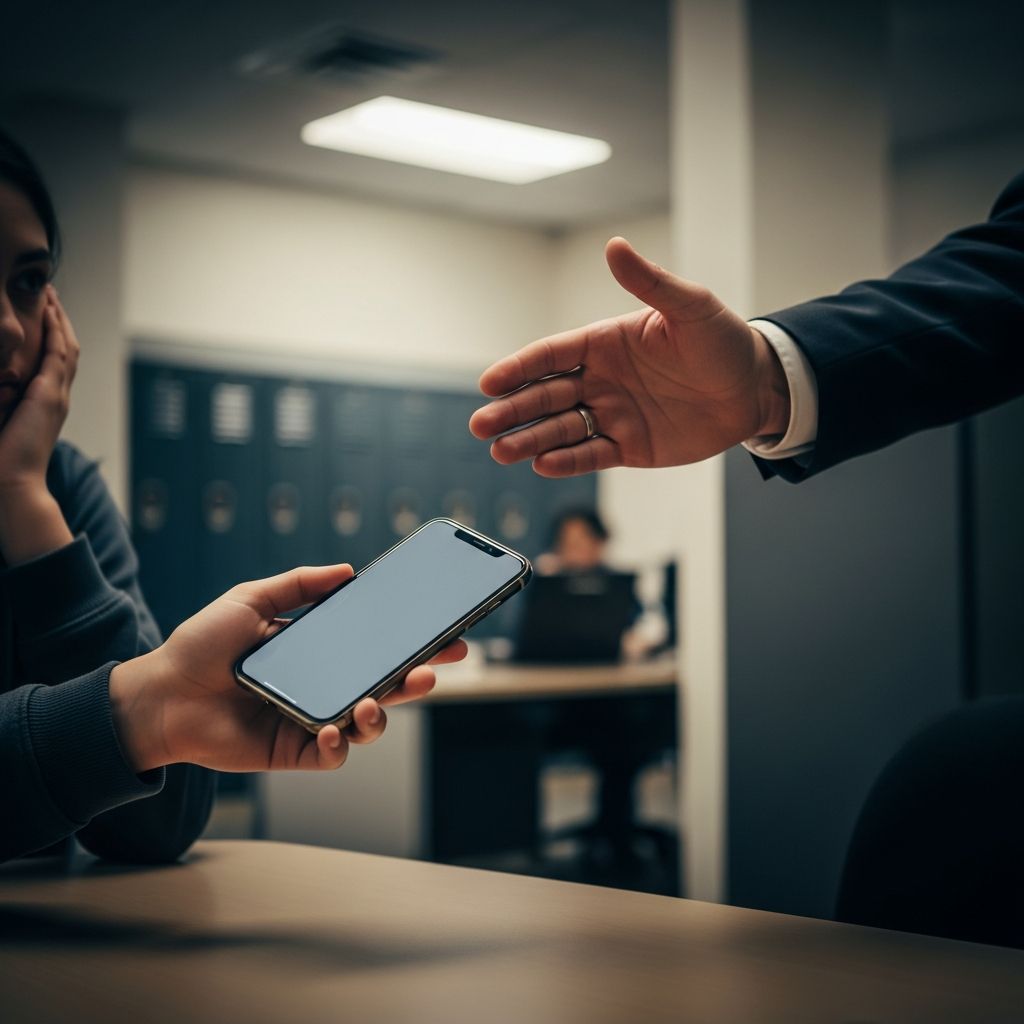
Smartphones are now woven into everyday life, including school. That reality raises a practical question for families: when can a school take, keep, or search a student’s cell phone? This guide explains the legal backdrop, what most school policies allow, and how parents and students can respond when a phone is confiscated or searched.
1. Why Cell Phones Have Become a Legal Issue at School
Cell phones bring both benefits and challenges to classrooms. Many educators and lawmakers worry about:
- Distraction from instruction and learning
- Cheating during quizzes or tests
- Cyberbullying and harassment through messaging and social media
- Recording classmates or staff without consent
- Safety and security issues, including threats made by text or online
In response, states and school districts have adopted increasingly strict policies, including complete bans on use during the school day and even requirements that phones be stored in locked pouches or centralized locations.
2. Do Students Have a Legal Right to Bring Phones to School?
Courts and education agencies generally treat cell phone possession at school as a privilege, not a guaranteed right.
- State laws often give school boards broad power to manage schools, which includes restricting or banning cell phones on campus.
- In at least one case, an appellate court upheld a district-wide ban on student phones as a valid educational policy and rejected a claim that it violated parents’ rights to direct their children’s upbringing.
- Some laws explicitly authorize districts to restrict student possession and use of phones, while requiring them to weigh safety and communication needs of families.
In other words, schools usually can adopt policies that:
- Prohibit use during class
- Allow use only at lunch or after school
- Require phones to be turned off and kept out of sight
- Ban phones from campus entirely
There may be exceptions for students with documented medical needs or disability-related accommodations, but those arise from disability and health laws, not from a general right to carry a phone.
3. When Can a School Confiscate a Student’s Phone?
If a phone policy exists and has been clearly communicated, schools generally can confiscate a device when a student breaks that policy.
Typical school rules allow staff to take a phone if:
- The student uses the phone during class or testing in violation of written rules
- The device is used to record video or audio against school policy
- The phone is involved in bullying, harassment, or threats
- The student refuses to put the phone away after being warned
Some state law and case law support disciplinary confiscation:
- One court found that a student had no legal right to have a phone at school and upheld a policy allowing staff to hold the phone for two weeks after misuse in class.
- State education guidance commonly allows districts to adopt rules that authorize confiscation and impose consequences for violations.
| Action | Common Legal View | What Usually Matters |
|---|---|---|
| Taking a phone for a rule violation | Generally allowed | Clear written policy, notice to students and parents |
| Keeping a phone overnight or longer | Often allowed if policy says so | Reasonableness of the duration and process to get it back |
| Searching texts, photos, or apps | More legally sensitive | Need for reasonable suspicion and narrow scope |
4. How Long Can the School Keep the Phone?
There is no single nationwide rule about how long a school may hold a confiscated phone. Instead, the answer generally depends on:
- The school or district’s written policy
- Whether the time period is reasonable given the violation
- Any state law limiting or guiding discipline
Policies adopted under state laws or board authority often allow escalating consequences, such as:
- First offense: Phone held until end of the school day and released to the student
- Second offense: Phone held until a parent conference or for a set number of days
- Repeated offenses: Phone held for a longer period, or requirement that a parent retrieve the device
A court has upheld a two-week retention of a phone after a misuse violation, emphasizing that the student had no inherent right to possess the phone at school and that the policy had been clearly adopted. However, if a school refuses for an extended period to return a phone or charges excessive fees without clear policy support, parents may raise due process or property concerns through the grievance process or, in extreme cases, litigation.
5. Confiscation vs. Search: Two Different Legal Questions
Parents should distinguish between two separate issues:
- Taking the device as a disciplinary or safety measure
- Looking through its contents (texts, photos, message apps, cloud accounts)
Courts give schools more leeway to confiscate devices than to search them. Confiscation usually involves school discipline and property control, while searching raises constitutional privacy concerns under the Fourth Amendment in public schools.
6. When May a School Search a Student’s Phone?
Public school officials are considered government actors, so searches of a student’s belongings (including a phone) must comply with the Fourth Amendment. The Supreme Court has held that school searches of students’ personal effects must be:
- Reasonable at their inception – there is a concrete, individualized reason to suspect the student violated a rule or law
- Reasonable in scope – the search is limited to what is needed to investigate that suspicion
Phones complicate this standard because of how much personal information they contain. In Riley v. California, the U.S. Supreme Court held that police generally must get a warrant to search the digital contents of a phone taken from an arrestee, emphasizing that modern phones hold vast quantities of sensitive data.[Although Riley involved law enforcement rather than schools, the Court’s reasoning underscores how invasive phone searches can be and has influenced how courts evaluate the intrusiveness of school searches.]
In the school context, many courts and legal experts take the view that:
- Staff should avoid searching a phone unless there is specific evidence that relevant proof of a serious rule or legal violation is on the device.
- Even then, they should limit the search (for example, viewing recent messages with a particular student or photos from a specific time period).
- Fishing expeditions through a student’s entire photo library, social media, or browsing history are more likely to be seen as unreasonable.
Schools also sometimes involve law enforcement when the suspected conduct might be criminal (e.g., violent threats, explicit images of minors). At that point, normal criminal procedure standards, including warrants and consent, can come into play.
7. State Laws and Policies Restricting Student Phone Use
In addition to general school-discipline authority, some states now have specific statutes requiring districts to limit cell phone use at school. For example:
- Texas House Bill 1481 requires all public school systems to adopt a policy that prohibits student use of personal communication devices on school property during the school day (with narrow exceptions).
- The Texas Education Agency explains that covered “personal communication devices” include cell phones, tablets, smartwatches, and similar devices capable of telecommunication, unless supplied by the school itself.
- Nationally, at least 26 states have adopted some form of law or statewide guidance limiting or banning cell phones in K–12 classrooms.
These measures typically:
- Require a written policy adopted by the local school board
- Call for disciplinary consequences when students break the rules
- Allow exceptions for health needs, safety plans, or educational programs
Even in states without such statutes, local school boards often adopt similar restrictions using their general authority over discipline and school operations.
8. Student Speech, Social Media, and Off-Campus Conduct
Phones are also a gateway to social media, raising questions about when schools can discipline students for posts made off campus, on their own devices. In Mahanoy Area School District v. B.L., the U.S. Supreme Court ruled that a public school violated a cheerleader’s First Amendment rights when it punished her for a profanity-laced Snapchat post made off campus and outside school activities.
However, the Court also recognized that schools still have a significant interest in addressing certain types of off-campus digital conduct, including:
- Severe or targeted bullying or harassment of particular students
- True threats against staff or students
- Serious disruptions to school operations or security
That means a student’s off-campus phone use can still trigger school discipline—and may lead the school to seek evidence from the device—if it crosses into bullying, threats, or major disruption of the school environment.
9. Parents’ Rights and Responsibilities
Parents retain important roles, even when schools regulate phones:
- Access to policies: Parents have a right to review student handbooks and board policies that define what is allowed and what consequences apply.
- Participation in discipline: Many districts require parent notification or a conference for repeated phone violations or extended confiscation.
- Health and safety concerns: Parents can ask for exceptions for documented medical or disability-related needs, supported by healthcare or evaluation records.
- Appeals and grievances: If a parent believes a phone was kept unreasonably long or searched improperly, they can use the school or district grievance process to challenge that decision.
Courts have generally rejected broad claims that phone bans violate parental rights, so challenges are more likely to succeed when they focus on how a specific policy was applied (for example, an unreasonable search or a confiscation that turns into an effective permanent taking of the device).
10. Practical Tips for Families and Students
Understanding the law is helpful, but everyday decisions matter most. Parents and students can reduce conflict around phones by planning ahead.
10.1 Before There’s a Problem
- Read the handbook together at the start of the year and highlight the phone policy.
- Agree on expectations at home that align with school rules (when the phone is off, where it’s stored, etc.).
- Discuss emergencies: explain that students should follow staff instructions first; schools typically have landlines and emergency plans.
- Back up important data so that a temporary confiscation doesn’t risk losing contacts or schoolwork.
10.2 When a Phone Is Confiscated
- Stay calm and ask the student to write down what happened while it’s fresh.
- Contact the school to ask what rule was violated and how long the phone will be held.
- Request a copy or link to the written policy that authorizes the confiscation and the length of retention.
- If needed, schedule a meeting with a counselor or administrator to discuss the incident and clarify expectations.
10.3 If You Believe the Phone Was Searched Improperly
- Ask the school directly: Was the phone searched? If so, what exactly was viewed, and why?
- Request that any future access be limited to what is strictly necessary for a specific, explained concern.
- Use the district’s formal grievance or complaint process if you believe your child’s privacy rights were violated.
- For serious concerns (e.g., broad search of intimate photos or private apps), consider consulting an education or civil rights attorney.
11. Frequently Asked Questions (FAQs)
Q: Can my child refuse to hand over their phone to a teacher or principal?
A: Schools can generally enforce reasonable rules requiring students to surrender phones when they are used in violation of policy. Refusal can lead to additional discipline (such as detention or suspension), especially if the policy has been clearly communicated. However, that does not automatically give staff the right to search the phone’s contents; that is a separate legal question involving reasonable suspicion and scope.
Q: Is the school allowed to delete photos, messages, or apps from my child’s phone?
A: Deliberately deleting content on a student’s personal device goes beyond typical school authority and can raise serious legal issues related to property and due process. Most legitimate school responses involve documenting problematic content (for example, by screenshots) rather than erasing it. If you learn that staff deleted material, you may want to file a written complaint and seek legal advice.
Q: Does my permission as a parent allow the school to search the phone?
A: A parent’s consent can influence how some courts view a search, but schools still must act reasonably and in line with student rights. Even with parental permission, a school search that is overly broad or unrelated to a specific concern may be vulnerable to challenge. Many districts prefer to involve law enforcement for serious matters or to seek the student’s own consent when appropriate.
Q: What about phones needed for health conditions or disabilities?
A: Some students legitimately need access to phones or similar devices for medical monitoring, communication related to disabilities, or safety planning. In those cases, parents should work with the school to document the need through health plans, Section 504 plans, or special education plans, so that the phone is recognized as an approved accommodation and not treated as a simple rule violation.
Q: Can private schools make stricter rules about phones?
A: Yes. Because private schools are not government entities, they are not directly bound by the U.S. Constitution in the same way public schools are. They generally have wider latitude to ban phones entirely, impose contractual rules, and discipline or expel students for violations. Parents’ leverage in that context is mainly contractual—what the enrollment agreement and handbook say—rather than constitutional.
References
- The Law & Student Cell Phones — Pullman & Comley LLC for CASCIAC. 2024-02-26. https://www.casciac.org/pdfs/CAS–TheLawandStudentCellPhones–2.26.2024.pdf
- New Texas law requires schools to ban student cellphones — FOX 4 / KDFW. 2025-06-18. https://www.fox4news.com/news/new-texas-law-requires-schools-ban-student-cellphones
- Implementation of Texas House Bill 1481 – Student Use of Personal Communication Devices on School Property — Texas Education Agency. 2025-07-11. https://tea.texas.gov/about-tea/news-and-multimedia/correspondence/taa-letters/implementation-of-texas-house-bill-1481-student-use-of-personal-communication-devices-on-school-property
- Cell Phones – House Bill 1481 — Hays Consolidated Independent School District. 2025-08-01. https://www.hayscisd.net/page/cell-phones
- Do School Cellphone Bans Work? This Teacher Says Yes. — National Education Association. 2024-03-14. https://www.nea.org/nea-today/all-news-articles/do-school-cellphone-bans-work-teacher-says-yes
Similar Articles








Read full bio of Sneha Tete


