
Can a Power of Attorney Ever Change a Will?
Understand when a power of attorney can affect your estate plan, what it cannot legally do, and how to protect your final wishes.
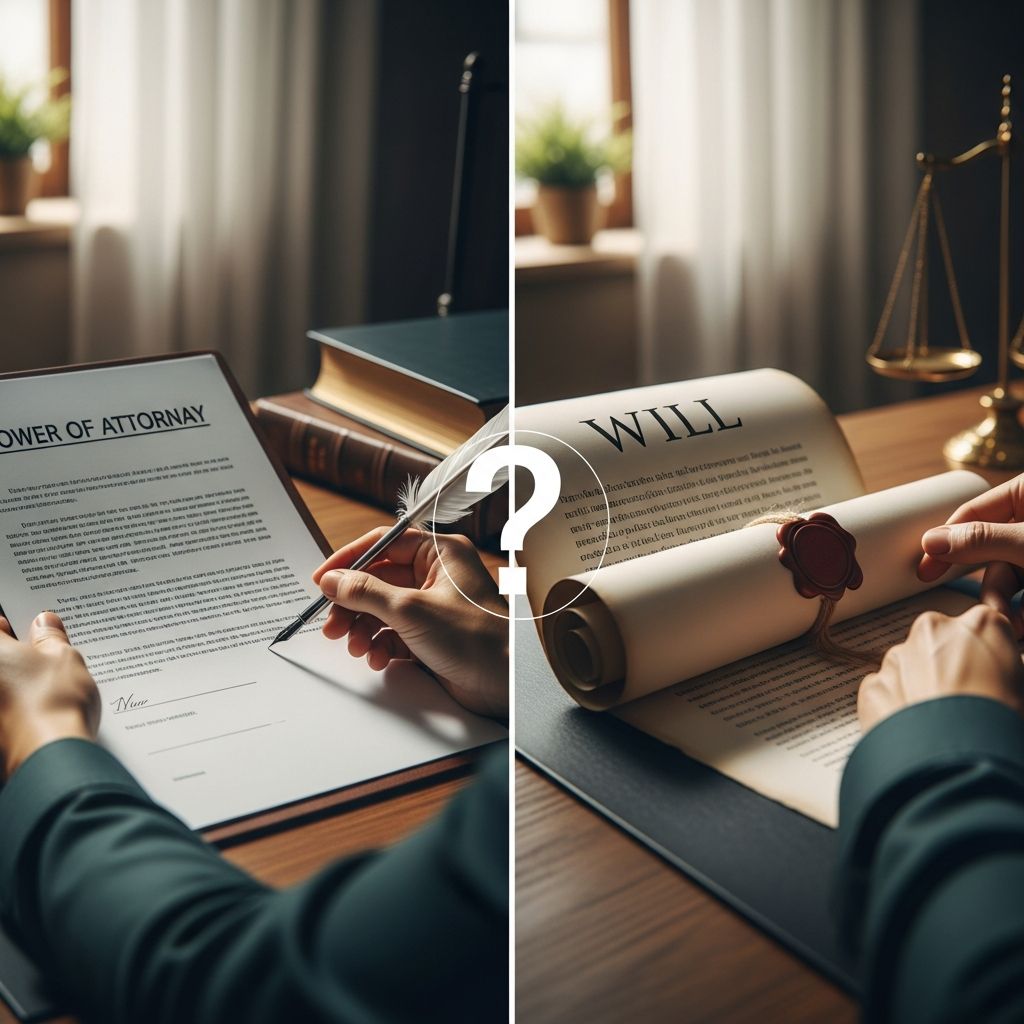
A power of attorney (POA) is a powerful planning tool, but its legal authority stops at a crucial line: your last will and testament. Understanding exactly what an agent under a power of attorney may and may not do is essential if you want your final wishes to be honored and your loved ones protected.
This guide explains, in clear terms, how POA and wills interact, why an agent generally cannot rewrite your will, and the indirect ways an agent’s decisions can still reshape what your beneficiaries ultimately receive.
Power of Attorney vs. Will: Core Differences
Although both documents are part of estate planning, they serve different purposes and operate at different times.
| Feature | Power of Attorney | Will |
|---|---|---|
| When it applies | During your lifetime only (often used if you are incapacitated) | Only after your death |
| Who acts | Agent or attorney-in-fact you appoint | Executor or personal representative named in the will |
| Primary function | Manage your financial, legal, or medical decisions while you are alive | Distribute your property and settle your estate after death |
| When it ends | At your death or revocation | When the estate is fully administered |
| Control over will | Generally cannot make, amend, or revoke a will | Determines who inherits your probate property |
Because a POA is strictly a lifetime document and a will is a death-time document, the law sharply limits any ability of an agent to interfere with the contents of a valid will.
Can an Agent Under a Power of Attorney Change Your Will?
In almost all situations, the answer is no. An agent appointed under a power of attorney generally cannot:
- Write a new will on your behalf
- Sign a will for you
- Modify, revoke, or replace an existing will
- Change who is named as a beneficiary in your will
Many state statutes expressly forbid a POA from authorizing an agent to make, amend, or revoke a principal’s will, even if the POA document itself appears to grant such power. Any will drafted or altered by an agent is typically considered invalid on its face.
Why the Law Limits POA Authority Over Wills
The rules are strict for several reasons:
- Personal nature of a will: Testamentary decisions reflect your own intentions, not someone else’s judgment.
- Capacity protection: The law requires that you be of sound mind when making or changing a will; allowing an agent to do this would bypass that safeguard.
- Abuse prevention: Restricting agents from altering wills makes it more difficult for someone to exploit an elderly or vulnerable person for financial gain.
- Clear division of roles: The executor, not the agent, controls your estate after death. POA authority is designed to end upon your death.
Together, these principles support a bright-line rule: your will is your voice, and a power of attorney does not replace that voice.
What a Power of Attorney Can Do Around Your Estate
Even though an agent cannot directly edit your will, they may still make decisions that affect what is left in your estate when you die.
Common financial powers
Depending on your POA document and state law, an agent might be allowed to:
- Pay bills, taxes, and ongoing living expenses
- Manage bank, brokerage, and retirement accounts
- Buy, sell, or refinance real estate
- Make or adjust certain investments
- Handle insurance and annuity contracts
These actions, if taken in good faith, are part of normal financial management, particularly if you are incapacitated or unable to handle these matters yourself.
Potential indirect effects on your will
Because an agent can move and manage assets, their choices can influence what your heirs ultimately receive, even when the will itself stays the same. For example, an agent may:
- Sell property that was specifically mentioned in the will, leaving cash instead of that asset
- Convert accounts into forms that pass outside the will, such as joint tenancy or payable-on-death designations
- Spend down or gift property under a POA that authorizes gifting, which may reduce or change the estate
These outcomes may be lawful if they are consistent with the agent’s fiduciary duty and the powers you granted, but they can also lead to conflicts with beneficiaries who expected certain assets to remain.
Special Case: Trusts and Powers of Attorney
While agents usually cannot modify a will, some state laws allow a POA to grant an agent limited authority to create, amend, or revoke a trust, but only if that authority is clearly spelled out in the document and in the trust itself. In some jurisdictions, agents may even have narrowly defined authority to affect an irrevocable trust with court supervision or beneficiary consent.
This is highly technical territory and varies significantly by state. Anyone considering giving an agent trust-related powers should seek individualized legal advice.
Does a Power of Attorney Override a Will?
No. A valid will and a valid power of attorney operate at different times and do not override each other.
- While you are alive: Your power of attorney governs what your agent may do; your will has no effect yet.
- After you die: Your power of attorney terminates automatically, and your executor (or personal representative) takes over under the will.
If there appears to be a conflict—for example, an agent transfers property during your lifetime in a way that seems inconsistent with the will—courts will look at state law, the POA document, your intent, and whether the agent honored their fiduciary duty.
Fiduciary Duties of an Agent Under a POA
An agent is a fiduciary, which means they must act in your best interests, not their own. Typical fiduciary duties include:
- Acting loyally and avoiding self-dealing
- Keeping your property separate from theirs
- Following the terms of the POA and applicable law
- Maintaining records and accounting for their actions
- Preserving your estate plan where possible, if the law and POA require it
Self-interested behavior—such as changing account titling or beneficiary designations to favor the agent—may be treated as a breach of duty and can be grounds for litigation.
Protecting Your Will from Misuse of a Power of Attorney
Good planning and careful drafting can significantly reduce the risk of conflicts between your will and your POA.
Draft with your estate plan in mind
When working with a lawyer, consider asking for POA language that:
- Expressly prohibits the agent from changing beneficiary designations or survivorship titling unless clearly necessary
- Limits or clarifies any gifting authority, including who may receive gifts and within what amounts
- States that the agent must, when reasonable, act in a way that is consistent with your known estate planning objectives
These provisions can guide your agent and provide a basis for legal action if they stray from your intentions.
Choose the right agent
In addition to legal wording, your choice of agent is critical. You may want an agent who:
- Understands your values and family dynamics
- Is organized and financially responsible
- Is willing to communicate with your future executor and main beneficiaries
- Can handle complex decisions without letting personal interests interfere
Many people name more than one person, or name a trusted professional, when relationships are complicated or large sums are involved.
Coordinate all your documents
To maintain consistency across your plan, it often helps to:
- Review your will, trusts, POA, and beneficiary designations together
- Confirm that asset titling (joint accounts, transfer-on-death deeds, etc.) matches your wishes
- Update all documents if your family situation, finances, or health change
Some states and professional groups provide general guidance and checklists for aligning POAs with broader estate plans, but the details of your situation should guide your final choices.
If You Suspect Abuse of a Power of Attorney
Family members and other interested parties sometimes discover that an agent has used a POA to move or deplete assets in ways that undercut the person’s apparent estate plan. Available remedies depend on whether the principal (the person who signed the POA) is still alive and mentally capable.
When the principal is still alive and competent
If the person who granted the POA still has decision-making capacity, they may:
- Revoke the power of attorney
- Sign a new POA naming a different agent
- Bring a civil action against a misusing agent, if appropriate
- Consult with an attorney to revise their will or trust to address any damage
Revocation often involves providing written notice to the agent and, where relevant, to financial institutions or others who rely on the document.
When the principal is incapacitated
If the principal is no longer able to act on their own, concerned relatives or friends may need to seek court involvement, which could include:
- Filing a petition to have the POA reviewed or invalidated
- Asking the court to appoint a guardian or conservator for the person or their estate
- Requesting an accounting, ordering the agent to disclose financial transactions
- Later, challenging questionable transfers or will changes in probate court after the person’s death
Court-supervised guardianship and conservatorship are serious steps that can permanently alter the principal’s rights, so judges typically require evidence that the agent has failed in their duties or that the principal truly needs protection.
Practical Tips for Aligning Your POA and Will
To ensure your plan works the way you expect, consider these practical steps:
- Document your wishes: Keep a written summary of your goals and share it with your agent and executor.
- Use one planning team: When possible, have the same law firm or professional adviser handle your will, POA, and trust work to improve consistency.
- Review periodically: Significant life changes—marriage, divorce, births, deaths, business sale, or retirement—are good triggers for review.
- Limit powers you do not need: Avoid granting broad gifting or beneficiary-changing powers unless there is a clear tax or planning reason.
- Educate your agent: Make sure the person you choose understands that their role is to carry out your intentions, not to rewrite your legacy.
These habits cannot guarantee that no disputes will arise, but they reduce confusion and give courts a clearer picture of what you intended.
Frequently Asked Questions (FAQs)
Can my agent under a POA sign a new will for me if I am too sick to do it myself?
No. A will must be executed by you personally while you have the mental capacity required by your state’s law. An agent generally cannot sign a will on your behalf, even if you authorized them to handle other legal documents.
Can a power of attorney change who gets my life insurance or retirement account?
It depends on the wording of the POA and state law. Some documents allow agents to adjust beneficiary designations; others expressly forbid it. Because such changes can dramatically alter who receives assets at death, many lawyers recommend tightly limiting or clearly defining this authority.
If my agent uses the POA to move money, can my heirs challenge it later?
Possibly. Beneficiaries may ask a court to review the agent’s actions, especially if the transfers appear self-serving or inconsistent with your prior pattern of giving. Courts can void improper transactions or order the agent to repay funds if they breached their fiduciary duty.
Does my power of attorney continue after I die if I want my agent to help my executor?
No. A power of attorney automatically terminates at your death. From that point on, only your executor or court-appointed representative has legal authority to manage estate assets, even if your agent is the same person.
How often should I review my POA and will?
Many practitioners suggest reviewing these documents every few years or whenever a major life event occurs—such as marriage, divorce, the birth of a child, a significant inheritance or business change, or a major health diagnosis. Regular updates help keep your plan aligned with your current goals and relationships.
References
- California Probate Code, Division 4.5 (Powers of Attorney) — California Legislature. 2023-01-01. https://leginfo.legislature.ca.gov/faces/codes_displayexpandedbranch.xhtml?tocCode=PROB&division=4.5.
- Uniform Power of Attorney Act (2006) — Uniform Law Commission. 2006-07-07. https://www.uniformlaws.org/committees/community-home?CommunityKey=2c04b76c-2b7d-4399-977e-d5876f7b2e3a
- Restatement (Third) of Agency — American Law Institute. 2006-01-01. https://www.ali.org/publications/show/agency/
- Can a Power of Attorney Change a Will? — SmartAsset. 2022-03-16. https://smartasset.com/estate-planning/can-a-power-of-attorney-change-a-will
- Can Power of Attorney Change a Will or Trust? — Keystone Law Group. 2023-05-01. https://keystone-law.com/when-can-a-power-of-attorney-change-a-will-or-trust
- Last Will & Testament: Requirements — Cornell Legal Information Institute. 2021-10-01. https://www.law.cornell.edu/wex/will
- Can Power of Attorney Override a Will? — Legacy Law Partners. 2023-06-20. https://legacylawpartners.com/can-power-of-attorney-override-a-will/
- Can a Power of Attorney Override a Will or Trust? — Able & Strong Law. 2022-11-10. https://ableandstronglaw.com/blog/can-a-power-of-attorney-override-a-will-or-trust/
Similar Articles








Read full bio of Sneha Tete


