
Navigating Higher Education: The Reality of Campus Racial Profiling
Examining the weaponization of campus security and the path to inclusion.
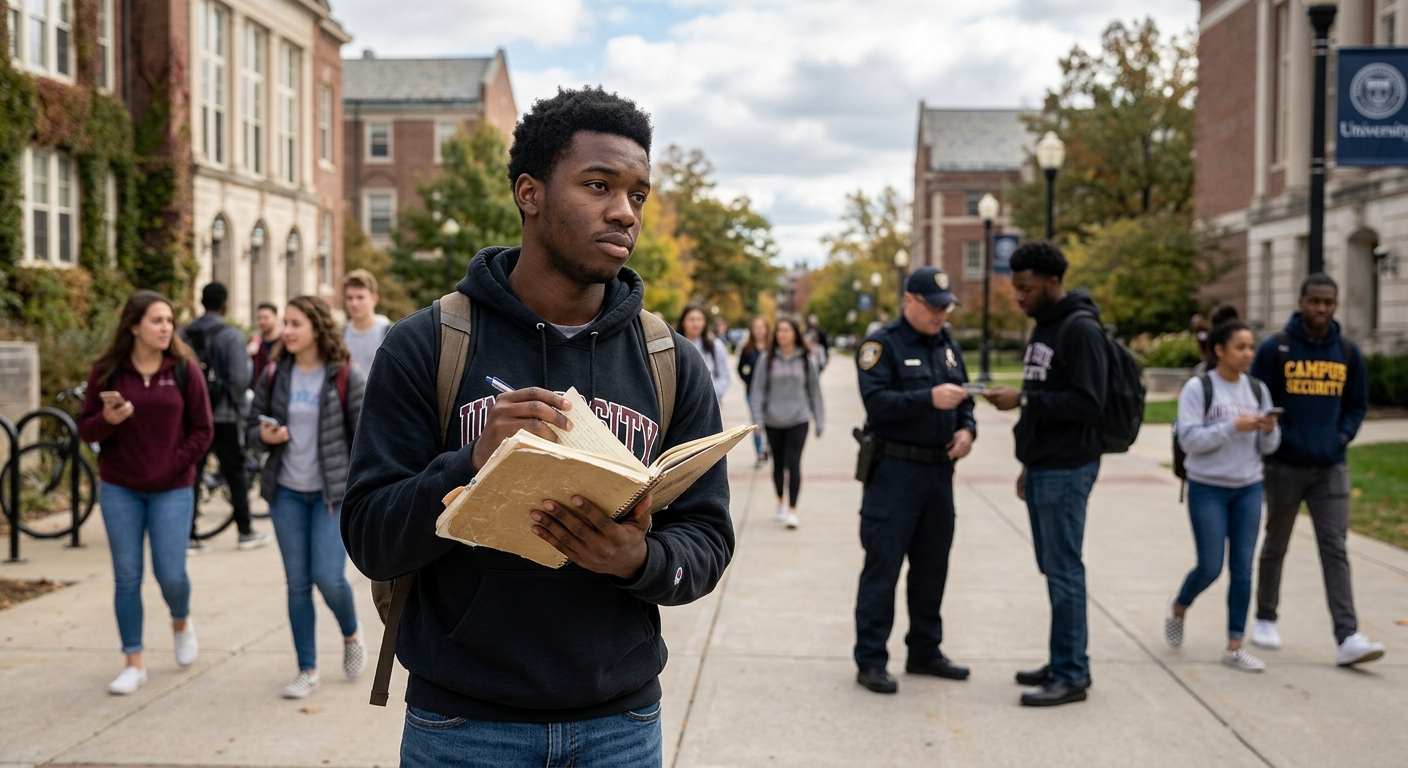
Higher education institutions have historically billed themselves as utopias of intellectual freedom, progressive thought, and unbounded opportunity. Universities invest millions in marketing campaigns designed to project an image of diversity, equity, and inclusion, welcoming students from all backgrounds to collaborate and thrive. Yet, beneath the ivy-draped facades, pristine quadrangles, and carefully curated promotional materials, a deeply troubling phenomenon persists. For many students, faculty, and staff of color, the campus environment is frequently transformed from a sanctuary of learning into a landscape of unwarranted surveillance and suspicion.
The transition to college is inherently challenging, characterized by rigorous academic demands and the profound personal growth that accompanies newfound independence. However, minority students—particularly Black students—are routinely subjected to an additional, invisible curriculum: navigating the pervasive threat of racial profiling. The reality of academic life for these individuals is often punctuated by jarring encounters with campus security or local law enforcement, triggered not by criminal behavior, but by the mere act of existing in academic spaces. This systemic issue not only shatters the illusion of the post-racial campus but also fundamentally undermines the core mission of higher education, demanding urgent, structural intervention.
The Anatomy of Weaponized Campus Security
To fully understand the crisis of campus racial profiling, one must first examine the sociological concept of space entitlement. In predominantly white institutions (PWIs), certain demographics have historically held unquestioned ownership over common areas, libraries, dormitories, and dining halls. When individuals who do not fit the traditional, historically white archetype of a ‘college student’ occupy these spaces, their presence is frequently—and unjustly—perceived as anomalous or threatening.
This dynamic gives rise to the weaponization of campus security. The phenomenon, often colloquially described in broader society as ‘living while Black,’ frequently manifests in academic environments with devastating precision . Activities as mundane as studying in a common room late at night, eating lunch on a campus bench, utilizing a designated nap space, or attempting to enter one’s own dormitory are suddenly interpreted through a lens of inherent suspicion. Bystanders, driven by conscious prejudice or deeply ingrained implicit bias, reflexively utilize emergency dispatch systems to report ‘suspicious persons.’
When community members use law enforcement as a customer service hotline to manage their own racial discomfort, the consequences are profound. Responding officers, operating under protocols that emphasize threat neutralization rather than situational de-escalation, frequently validate the caller’s unwarranted fears. This intersection of civilian bias and institutional force creates a volatile environment. The student of color is thrust into a high-stakes encounter where they must repeatedly prove their right to exist in a space they earned the right to occupy. The trauma of these interactions is cumulative, transforming the campus from a home into a hostile territory where one must constantly remain vigilant.
The Psychological Toll: Understanding Racial Battle Fatigue
The consequences of unwarranted police encounters and chronic racial profiling extend far beyond the immediate humiliation of the incident. To articulate the profound biopsychosocial impact of this persistent marginalization, scholars rely on the theoretical framework of ‘Racial Battle Fatigue’ (RBF), a term originally coined by Dr. William A. Smith . RBF provides a crucial lens for understanding the systemic emotional, psychological, and physiological toll inflicted on racially marginalized groups navigating hostile environments.
Racial Battle Fatigue posits that the constant exposure to racial microaggressions, implicit bias, and overt discrimination acts as a form of chronic stress. For students and faculty of color, the academic environment requires an exhausting degree of hypervigilance. They are forced to expend vast amounts of cognitive and emotional energy anticipating, navigating, and recovering from racial hostility. This invisible labor detracts directly from their academic pursuits, professional development, and overall well-being .
The symptoms of Racial Battle Fatigue are both severe and documentable. Psychologically, it can manifest as chronic anxiety, depression, imposter syndrome, and a profound sense of isolation. Physiologically, the persistent activation of the body’s stress response can lead to tension headaches, elevated blood pressure, insomnia, and a weakened immune system. When universities fail to address the underlying causes of campus racial profiling, they are not merely ignoring a social grievance; they are actively cultivating an environment that deteriorates the health and academic viability of their marginalized students. The expectation that students of color must simply demonstrate ‘resilience’ in the face of structural racism is an abdication of institutional responsibility.
Title VI and the Legal Obligations of Universities
The eradication of racial profiling on campus is not merely a moral imperative or a public relations necessity; it is a stringent legal obligation. Higher education institutions that receive federal financial assistance are bound by Title VI of the Civil Rights Act of 1964. This landmark legislation explicitly prohibits discrimination on the basis of race, color, or national origin in any program or activity receiving federal funds . The mandate of Title VI extends deeply into the operational fabric of the university, encompassing campus climate, security practices, and equal access to educational opportunities.
The U.S. Department of Education’s Office for Civil Rights (OCR) and the Department of Justice are tasked with enforcing Title VI. When a university allows a racially hostile environment to persist—characterized by the unchecked weaponization of campus police against students of color—it risks violating federal law . A racially hostile environment is defined as one where discriminatory conduct is so severe, pervasive, or persistent that it limits or denies a student’s ability to participate in or benefit from the educational program.
Failing to implement equitable security protocols, ignoring patterns of racially biased 911 calls, or subjecting minority students to disproportionate surveillance are actionable offenses. Institutions that neglect their Title VI obligations may face rigorous federal investigations, mandatory compliance agreements, and in severe cases, the suspension or termination of federal funding. Therefore, proactive reform of campus security and the dismantling of implicit bias are critical components of a university’s legal risk management and ethical governance framework. Compliance requires more than just issuing anti-racism statements; it necessitates verifiable, structural reform that guarantees equal protection for all students.
Moving Beyond Performance: Pathways to Authentic Inclusion
If universities are to dismantle the insidious reality of campus racial profiling, they must transition from performative declarations of solidarity to authentic, structural transformation. This requires a comprehensive overhaul of how campus safety is conceptualized and enforced.
Reimagining Dispatch and Emergency Response
The most immediate intervention point is the campus emergency dispatch center. Universities must implement stringent, bias-resistant protocols for handling calls regarding ‘suspicious persons.’ Dispatchers must be trained to interrogate the caller’s premise, asking specific questions to determine if actual criminal activity is occurring or if the caller is merely reacting to a person’s race. If a call lacks a behavioral indicator of a crime, dispatchers should be empowered to deploy non-armed personnel—such as residential life staff or community mediators—rather than armed campus police. Decoupling non-emergency community management from armed law enforcement drastically reduces the potential for trauma and violence.
Comprehensive Accountability and Bias Eradication
While implicit bias training has become a standard corporate and academic response to racial profiling, its efficacy is deeply limited if not paired with strict accountability metrics. Universities must move beyond standard sensitivity workshops. Campus security forces must be subjected to rigorous oversight, including the public reporting of stop-and-identify data disaggregated by race. Officers who engage in racial profiling must face concrete disciplinary action. Furthermore, the broader campus community—including faculty, staff, and students—must be educated on the historical context of space entitlement and the severe consequences of weaponizing emergency services.
Elevating Student Voices and Support Structures
Institutional change cannot be dictated entirely from the top down; it must be informed by the lived experiences of those most impacted by profiling. Universities must create empowered advisory boards comprising students and faculty of color to oversee campus safety policies. Additionally, institutions must invest heavily in mental health resources specifically tailored to address Racial Battle Fatigue. Counselors trained in racial trauma must be readily available, and safe spaces designed for the cultural affirmation of marginalized students must be fully funded and protected.
The Future of the Academic Sanctuary
The persistence of racial profiling on college campuses represents a profound failure of the higher education sector to fulfill its most basic promise: the provision of a safe, equitable environment for intellectual pursuit. When Black and brown students are forced to constantly audit their own behavior to avoid unwarranted police scrutiny, the educational playing field is fundamentally corrupted. The psychological tax levied by these experiences—the exhaustion of Racial Battle Fatigue—robs students of their potential and deprives the academic community of their full contributions.
Addressing this crisis requires an unwavering commitment to structural reform, guided by the legal mandates of Title VI and grounded in a genuine desire for equity. Universities must radically redefine campus security, shifting the paradigm from the surveillance of minority bodies to the cultivation of true community safety. Only by dismantling the deeply ingrained assumptions of space entitlement and holding both individuals and systems accountable can higher education institutions evolve into the inclusive sanctuaries they claim to be.
Frequently Asked Questions (FAQs)
- What is the ‘living while Black’ phenomenon on college campuses?
This phenomenon refers to instances where students, faculty, or staff of color are reported to campus security or local police by peers or colleagues for engaging in ordinary, non-criminal activities, such as studying, sleeping in a common room, or accessing their own dorms. It is driven by implicit bias and the unwarranted perception that they do not belong in those academic spaces.
- How does Racial Battle Fatigue impact college students?
Racial Battle Fatigue is the cumulative psychological and physiological toll resulting from constant exposure to systemic racism and microaggressions. It can lead to chronic anxiety, depression, imposter syndrome, insomnia, and physical health issues, ultimately hindering a student’s academic performance and overall well-being.
- What legal protections exist for students facing campus racial profiling?
Title VI of the Civil Rights Act of 1964 prohibits discrimination on the basis of race, color, or national origin in any program receiving federal funding, which includes the vast majority of colleges and universities. Institutions that allow a racially hostile environment to persist through biased policing or unchecked profiling can face federal investigation and the loss of funding.
References
- Education and Title VI — U.S. Department of Education. 2024. https://www2.ed.gov/about/offices/list/ocr/frontpage/pro-students/issues/pr-titlevi.html
- Racial Battle Fatigue in Higher Education: Understanding the Intersectional Dimensions of Faculty and Staff Experiences — Flowers-Taylor, Candice Nicole. Antioch University Repository and Archive. 2025-07. https://aura.antioch.edu/etds/
- #LivingWhileBlack: Blackness as Nuisance — American University Washington College of Law. 2020. https://digitalcommons.wcl.american.edu/
Similar Articles








Read full bio of medha deb


