Navigating the Complexities of Campus Dissent: Free Expression and Institutional Control
Universities have long served as the primary crucible of social and political transformation in the United States. From the historic civil rights sit-ins and intense anti-war movements of the 1960s to contemporary demonstrations addressing global conflicts, social justice, and systemic inequality, the collegiate environment is inherently designed to foster robust, and often contentious, debate. However, the inevitable collision between passionate student activism and the institutional imperative to maintain order frequently creates a highly complex legal and administrative battleground.
In recent years, higher education administrators have faced intense, microscopic scrutiny regarding their handling of large-scale demonstrations, encampments, and building occupations. The foundational challenge lies in harmonizing the fundamental democratic right to free expression with the absolute necessity of providing a stable, disruption-free educational environment for all enrolled students. This delicate and ever-shifting balance requires administrators, faculty, and students alike to possess a deep understanding of constitutional law, the historical norms of academic freedom, and the overarching ethical responsibilities of higher education institutions in a free society.
Unpacking the “Marketplace of Ideas”
At the very heart of the ongoing debate over campus protests is the deeply rooted philosophical and legal concept of the university as a “marketplace of ideas.” This framework suggests that the ultimate test of any truth is the power of a thought to get itself accepted in the open competition of the market. In the specific context of higher education, this translates to the mandate that students and faculty must be unencumbered to express, debate, and aggressively challenge controversial or deeply unpopular viewpoints without the looming threat of institutional reprisal.
The legal application of this free-market concept depends heavily on the classification of the institution as either public or private. Public universities are recognized as state actors and are therefore directly and inextricably bound by the First Amendment of the United States Constitution. They possess no legal authority to censor speech based on its viewpoint, nor can they arbitrarily ban peaceful assemblies simply because the administration finds the messaging distasteful. The Supreme Court of the United States has unequivocally supported this stance. In the landmark 1972 case Healy v. James, the Court ruled decisively that “the college classroom with its surrounding environs is peculiarly the ‘marketplace of ideas,'” firmly stressing that the protections of the First Amendment apply with full, undiminished force on college campuses.
Private universities, conversely, are not strictly or directly bound by the First Amendment, as they are not government entities. However, the vast majority of prestigious private institutions across the nation explicitly promise robust free speech protections and academic freedom within their student handbooks, faculty contracts, and core mission statements. When private universities consistently advertise themselves as bastions of free inquiry and open thought, they create a legally binding contractual expectation that they will not penalize their community members for engaging in peaceful political dissent. Betraying these foundational institutional promises not only invites complex civil litigation but also severely and sometimes irreparably damages the academic reputation of the university.
The Boundaries of Free Expression: Disruption vs. Dissent
While the right to protest is fiercely protected and historically celebrated in academia, it is by no means absolute. The central legal standard governing student speech was prominently established in the famous 1969 Supreme Court case Tinker v. Des Moines Independent Community School District. In the Tinker decision, the Court famously declared that students do not “shed their constitutional rights to freedom of speech or expression at the schoolhouse gate.” However, the Court simultaneously established a crucial legal caveat: educational institutions retain the authority to regulate speech or conduct that “materially and substantially interferes with the requirements of appropriate discipline in the operation of the school.”
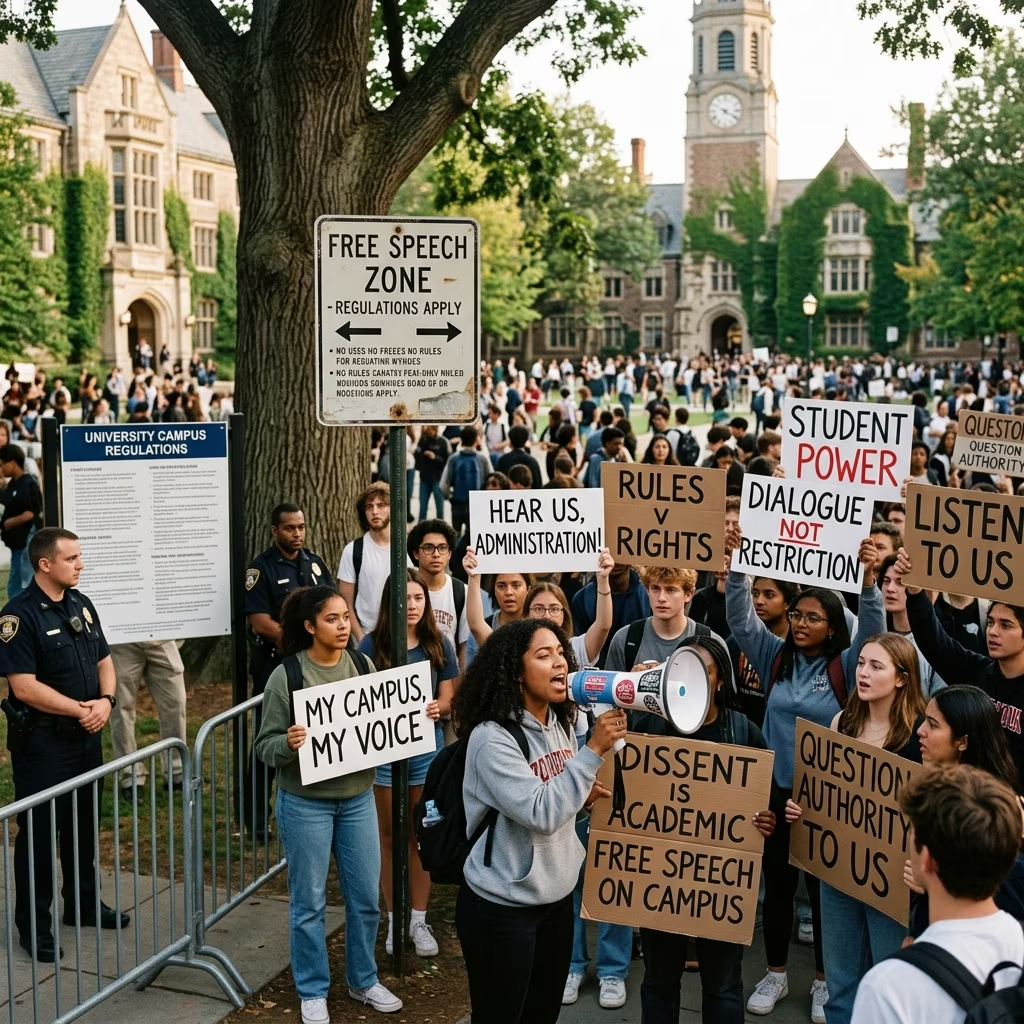
This “substantial disruption” standard serves as the vital fulcrum upon which all modern campus protest policies balance. A group of students silently holding signs in a campus quadrangle, or gathering to chant slogans in a designated free-speech area, is clearly and undeniably protected speech. Conversely, groups of students utilizing bullhorns inside a quiet library, physically barricading access to a crowded lecture hall, or shouting down a guest speaker so that the event cannot proceed would likely meet the legal threshold for a substantial disruption, thus permitting administrative intervention.
Furthermore, it is legally vital to distinguish between protected political speech and utterly unprotected conduct. The First Amendment provides absolutely no safe harbor for true threats, incitement to imminent lawless action, or targeted, discriminatory harassment. The U.S. Department of Education’s Office for Civil Rights has repeatedly clarified in official guidance that while universities must diligently protect their student populations from severe, pervasive, and objectively offensive harassment, broad institutional harassment codes must not be interpreted or applied in ways that suppress protected political speech. Navigating the microscopic line between passionate, even highly offensive, political rhetoric and actionable, unlawful harassment is arguably one of the most difficult and thankless tasks facing modern university administrators today.
The Mechanics of “Time, Place, and Manner” Regulations
To effectively manage the logistical realities of campus life while honoring free expression, universities are legally permitted to draft and enforce “time, place, and manner” (TPM) restrictions. These regulations are fundamentally administrative; they do not target the content of the speech but rather the physical and temporal logistics of the demonstration itself.
For a TPM restriction to be deemed legally valid under strict First Amendment scrutiny, it must adhere to the following core criteria:
- Content and Viewpoint Neutrality: The rule must be applied equally and uniformly to all groups, regardless of their underlying political ideology. A university cannot legally ban a pro-Palestinian rally at noon while permitting a pro-Israeli rally at the exact same time, nor can it selectively impose exorbitant security fees on controversial conservative speakers while waiving them for popular liberal figures.
- Narrow Tailoring: The restriction must be specifically and carefully designed to serve a significant, documented institutional interest. For instance, banning all outdoor protests at all times across an entire campus would be deemed overly broad and unconstitutional, whereas prohibiting amplified sound systems near residential dormitories during final exam week is appropriately narrowly tailored to protect the academic environment.
- Ample Alternative Channels: The institution must always provide protesters with viable, alternative ways to communicate their message to their intended audience. If a specific campus plaza is temporarily closed for a construction project, the university is obligated to designate another highly visible and accessible area for expressive activities.
While TPM restrictions are undeniably necessary for the baseline functioning of campus operations, they are frequently a source of intense friction. Protesters often forcefully argue that administrations intentionally weaponize these technical, bureaucratic rules to stifle political momentum, selectively enforcing them against grassroots movements that the university leadership finds politically inconvenient, highly embarrassing, or financially risky regarding donor relations.
Law Enforcement and Administrative Escalation
One of the most consequential, high-stakes decisions a university president can make during a localized campus dispute is whether to involve external law enforcement agencies. Historically, the deployment of local police forces or campus security in riot gear to forcefully clear student encampments, or physically disperse non-violent sit-ins, has served as a massive escalatory catalyst rather than a calming mechanism.
When universities abruptly shift from utilizing internal dispute resolution mechanisms—such as faculty mediation, student conduct hearings, and open dialogue—to relying on armed law enforcement, the fundamental trust between the student body and the administration inevitably fractures. Arrests, immediate academic suspensions, and potential expulsions cast a long, deeply chilling shadow over the entirety of the campus climate. Scholars of constitutional law and higher education administration frequently warn that utilizing brute force to summarily “solve” a political or expressive dispute not only violates the collaborative spirit of academic freedom but also risks heavily radicalizing the broader student body. What begins as a localized, manageable protest can easily be transformed into a highly publicized national spectacle of administrative overreach.
Instead of defaulting to militarized responses, higher education experts strongly advocate for sustained de-escalation tactics, continuous dialogue with student leaders, and proportionate administrative responses that prioritize the physical safety of all students while deeply respecting their inherent right to dissent.
Safety vs. Speech: Finding the Balance
A recurring and highly debated theme in modern campus discourse is the evolving concept of “safety.” Increasingly, student populations and advocacy groups argue that certain types of deeply offensive or hateful political speech make marginalized students feel “unsafe,” thereby morally and legally justifying the immediate censorship of that speech by the administration.
From a strict constitutional perspective, yielding to this argument is legally fraught with peril. The legal definition of safety is generally confined to physical security and explicit protection from targeted, pervasive harassment or physical violence. Emotional discomfort, psychological offense, and the distress caused by encountering abhorrent, contradictory ideas do not constitute a deprivation of safety in the eyes of established First Amendment law.
Moreover, attempting to shield students from offensive ideas is widely considered intellectually counterproductive. The primary, overriding function of a university is to equip young adults with the critical thinking skills necessary to actively dismantle bad arguments through applied logic, historical evidence, and robust counter-speech. When universities attempt to artificially sanitize the intellectual environment, they actively deprive students of the vital opportunity to build intellectual resilience. A functioning, robust democratic society requires citizens who possess the fortitude to confront and decisively refute offensive ideologies in the public square, rather than reflexively relying on an administrative authority figure to permanently silence them.
Moving Forward: Best Practices for University Leaders
To successfully navigate this legally fraught and highly emotional landscape, university administrators must adopt proactive, fully transparent, and legally sound frameworks well before a crisis emerges.
| Best Practice | Implementation Strategy | Intended Outcome |
|---|---|---|
| Clear Policy Definitions | Draft explicit, unambiguous guidelines detailing exactly what constitutes a “substantial disruption” versus protected expression. Strictly avoid vague, subjective terms like “civility” or “appropriateness.” | Prevents arbitrary enforcement and ensures all students know the exact boundaries of permissible conduct. |
| Consistent Enforcement | Apply all time, place, and manner restrictions uniformly across all student groups, entirely regardless of the specific cause, external political climate, or public pressure. | Builds baseline trust within the student body and legally protects the university from First Amendment lawsuits. |
| De-escalation Protocols | Establish highly trained mediation teams consisting of respected faculty and student life staff to continuously engage with protesters before ever considering law enforcement intervention. | Dramatically reduces the risk of violence, preserves the academic relationship, and completely avoids the chilling effect of police action. |
| Educational Initiatives | Integrate comprehensive First Amendment education into all freshman orientation programs, explicitly teaching the difference between protected speech and unlawful harassment. | Fosters a long-term campus culture that deeply values intellectual resilience and respectful counter-speech over immediate censorship. |
By fully committing to these established legal and administrative principles, universities can successfully fulfill their dual, sometimes conflicting mandate: maintaining a safe, actively functioning educational facility while continually serving as the ultimate proving ground for the democratic exchange of ideas.
Frequently Asked Questions (FAQs)
Do private universities have to follow the First Amendment?
No, private universities are not state actors and are therefore not legally bound directly by the First Amendment. However, most private universities explicitly guarantee free speech and academic freedom in their official institutional policies and student handbooks. State courts have sometimes held private institutions legally liable for breaching these internal contractual promises if they unfairly discipline students for engaging in protected expression.
Can a university punish students for peaceful protests?
Generally, no. If the protest occurs in a designated public campus space and does not substantially disrupt university operations, block physical access to academic buildings, or violate neutral “time, place, and manner” rules, it is legally protected. Punishing peaceful expression blatantly violates constitutional rights at public schools and contradicts institutional policies at the vast majority of private ones.
What exactly constitutes a “substantial disruption” under the law?
A “substantial disruption,” a legal standard derived from the landmark Tinker Supreme Court case, refers specifically to conduct that significantly interferes with the core educational process. Common examples include using loud megaphones inside an academic building during scheduled classes, physically preventing students from attending a lecture, or blocking vehicular traffic. Minor logistical inconveniences or the mere expression of highly offensive ideas absolutely do not meet this high legal threshold.
What is a “time, place, and manner” restriction?
These are purely content-neutral rules that regulate the physical logistics of speech to ensure the institution can function safely. For example, a university can prohibit amplified sound during midnight hours or restrict massive protests to certain outdoor plazas to prevent the dangerous obstruction of pedestrian traffic. Crucially, these rules cannot be used to selectively target specific viewpoints or political ideologies.
References
- Healy v. James, 408 U.S. 169 — U.S. Supreme Court / United States Courts. 1972-06-26. https://www.uscourts.gov
- Tinker v. Des Moines Independent Community School District, 393 U.S. 503 — U.S. Supreme Court / United States Courts. 1969-02-24. https://www.uscourts.gov/educational-resources/educational-activities/tinker-v-des-moines
- Dear Colleague Letter on the First Amendment — U.S. Department of Education, Office for Civil Rights. 2003-07-28. https://www2.ed.gov/about/offices/list/ocr/firstamend.html
- A neo-Nazi in the midst of a protest — Reuters / Shannon Stapleton. 2017-10-23. https://widerimage.reuters.com/story/a-neo-nazi-in-the-midst-of-a-protest