
California Workplace Smoking Laws: Compliance Guide
Understanding California's strict workplace smoking prohibitions and employer compliance requirements.
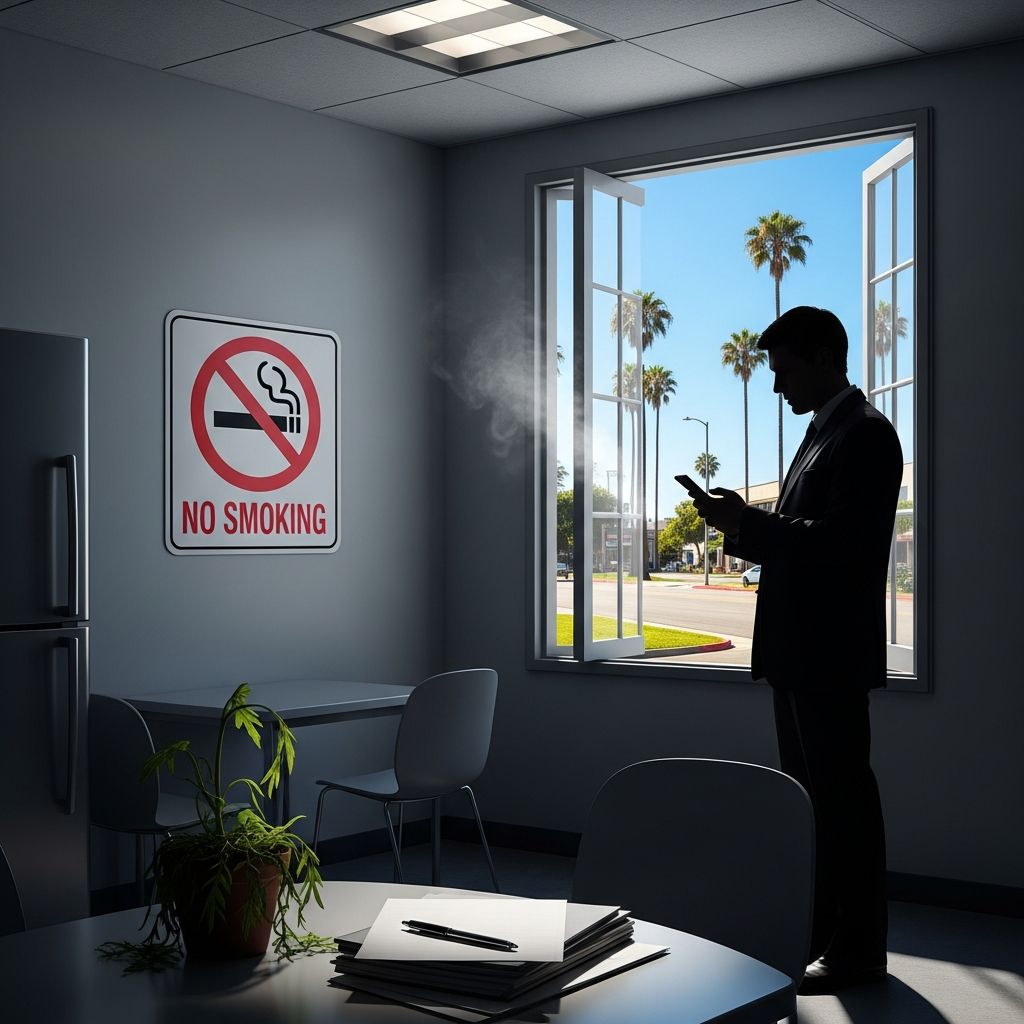
Understanding California’s Comprehensive Workplace Smoking Restrictions
California has established some of the most stringent workplace smoking regulations in the nation, reflecting the state’s commitment to protecting employee health and creating safe work environments. The primary legislation governing these restrictions is Labor Code Section 6404.5, which was most recently updated in 2024 to reflect Senate Bill 626. This comprehensive legal framework prohibits smoking in virtually all enclosed workplaces, with only narrow exceptions permitted under specific circumstances. Understanding these regulations is essential for employers and employees alike, as violations can result in significant penalties and legal consequences.
The foundational principle underlying California’s workplace smoking law is straightforward: no employer may knowingly or intentionally permit, and no person may engage in, the smoking of tobacco products in an enclosed space at a place of employment. This blanket prohibition applies across all industries and business types, unless the specific workplace falls within one of the legally recognized exemptions. The law’s scope is remarkably broad, extending to all forms of tobacco product smoking, including cigarettes, cigars, and pipe tobacco.
The Core Prohibition and Its Application
The heart of California’s workplace smoking regulation centers on the concept of enclosed workspaces. An enclosed space refers to any area where the walls, roof, or other structural elements create a barrier that substantially prevents the dispersal of smoke to outdoor areas. This definition captures traditional office buildings, but it also extends to vehicles used for work purposes when employees share the space. The prohibition applies equally to employees and visitors, meaning that an employer must prevent smoking by anyone within the enclosed workplace, not just its own workforce.
What makes California’s approach particularly protective is that the law does not permit employers to create designated indoor smoking areas, as some states allow. Employers cannot establish a smoking room or lounge within an enclosed workplace and expect to comply with the law. This represents a significant departure from earlier smoking regulations that attempted to balance smoker and non-smoker interests through segregation. Instead, California has chosen complete prohibition as the mechanism for protecting workers from secondhand smoke exposure.
Recognized Exemptions to the General Rule
While California’s smoking prohibition is comprehensive, the law does provide specific exemptions for certain workplaces and situations where smoking is permitted. These exemptions are narrowly construed and require particular circumstances to apply. Understanding which workplaces qualify for exemptions is crucial for both employers and employees, as misapplication of these exceptions can result in compliance violations.
The following workplace categories are exempt from the general smoking prohibition:
- Retail and Wholesale Tobacco Shops: Facilities that sell tobacco products may allow smoking within their establishments, recognizing that tobacco retail spaces have unique characteristics distinct from typical workplaces.
- Private Smoker’s Lounges: Employers may maintain private lounges dedicated exclusively to smoking, provided they meet specific regulatory requirements and do not constitute a work area.
- Truck Cabs and Tractor Units: Commercial vehicle operators may smoke in truck cabs or tractors, but only when no non-smoking employees are present in the vehicle.
- Theatrical Production Sites: When smoking is an integral component of a production’s storyline or narrative, theatrical productions may permit smoking as necessary for authenticity.
- Medical Research and Treatment Facilities: Healthcare settings engaged in research or treatment where smoking is integral to the medical purpose may allow smoking in designated areas.
- Private Residences: Private homes are exempt, with the important exception that homes licensed as family day care facilities must maintain smoke-free environments during operational hours in areas where children are present.
- Patient Smoking Areas in Long-Term Health Care: Long-term care facilities may designate specific areas where patients may smoke, recognizing patient autonomy rights in residential care settings.
Enforcement Structure and Regulatory Agencies
California’s enforcement of workplace smoking restrictions involves a tiered system of agencies with distinct responsibilities. Local law enforcement agencies, particularly local health departments, serve as the primary enforcement mechanism for initial violations. This decentralized approach allows communities to address smoking violations through familiar local regulatory structures. When employers or other parties violate the smoking prohibition, individuals may file complaints with their local health department, which then conducts investigations and issues citations.
The California Division of Occupational Safety and Health, commonly known as Cal/OSHA, enters the enforcement picture only after an employer has accumulated a pattern of violations. Specifically, Cal/OSHA only investigates and addresses workplace smoking complaints after a local agency has found the employer guilty of three separate violations within a twelve-month period. This tiered approach reflects a policy preference for letting local communities address initial compliance problems before state-level involvement.
For workplaces not covered by Labor Code Section 6404.5, such as those falling within recognized exemptions, Cal/OSHA’s response to smoking complaints differs. Rather than conducting investigations and issuing citations, Cal/OSHA directs the employer to investigate the complaint and correct any problems identified. This lighter-touch approach acknowledges that certain workplaces have special circumstances justifying exemptions.
Penalty Structure for Violations
California imposes a graduated penalty system that escalates with repeated violations, incentivizing employers to achieve and maintain compliance. The penalty structure reflects the principle that violations become more serious as they accumulate and demonstrate a pattern of non-compliance or indifference to regulatory requirements.
Local agencies enforce the initial violations with the following maximum fines:
- First violation: $100
- Second violation: $200
- Third violation: $500
After an employer reaches three violations within a twelve-month period, Cal/OSHA becomes authorized to investigate subsequent complaints. Cal/OSHA’s enforcement authority carries substantially higher penalties, reflecting the seriousness of repeated non-compliance. Cal/OSHA may cite violations as general or serious violations, with maximum fines of up to $7,000 for each violation. For violations classified as willful and serious—meaning the employer knew of the violation and deliberately failed to correct it—Cal/OSHA may impose fines reaching $70,000 per violation.
The classification of violations as serious depends on specific circumstances surrounding the violation. For example, if secondhand smoke exposure causes a serious asthma attack that could have been prevented by compliance with the smoking prohibition, the violation may be cited as serious rather than general. This circumstance-based classification system ensures that penalties reflect the actual harm or risk created by non-compliance.
Employer Compliance Obligations and Best Practices
To maintain compliance with California’s workplace smoking laws, employers must implement concrete measures that effectively communicate the smoking prohibition and prevent violations. The law specifies certain mandatory compliance steps that employers must undertake. Additionally, employment law experts have identified best practices that exceed minimum legal requirements but significantly reduce compliance risks.
The minimum compliance requirements include posting clear and prominent signage stating “No Smoking” at all entrances to buildings that constitute places of employment. These signs must be visible and easily readable, serving as notice to all persons entering the workplace of the smoking prohibition. Employers should ensure signs are weatherproof, well-maintained, and replaced if they become damaged or illegible.
Regarding enforcement against non-employee smokers, employers must request that non-employees smoking in prohibited areas refrain from doing so. However, the law recognizes practical limitations on employer authority. Employers are not required to physically remove smoking non-employees from the workplace or to engage in confrontations that might create safety risks. If requesting compliance would expose the employer or employees to physical harm, employers may decline to make the request and instead document the incident for potential complaint to local authorities.
Beyond these minimum requirements, employers should implement comprehensive smoking policies in their employee handbooks and conduct training for management personnel responsible for workplace oversight. Policies should clearly identify any designated smoking areas that comply with the law’s requirements and specify the consequences for violations. Employers should also document compliance efforts and maintain records of any smoking violations and corrective actions taken, as this documentation demonstrates good faith compliance efforts if disputes arise.
Designated Smoking Areas: Requirements and Limitations
While indoor smoking areas are prohibited, California law permits employers to designate outdoor smoking areas where employees may smoke during breaks. However, these designated areas must meet specific requirements to comply with applicable regulations. Understanding these requirements helps employers create compliant smoking areas that do not inadvertently violate the law.
Designated smoking areas must be located in non-work spaces, meaning areas where employees do not ordinarily perform their job duties. An outdoor parking lot, separate from building entrances, might qualify as a non-work space, but an area adjacent to a delivery dock where employees regularly work would not. Additionally, no employee may be required to enter a designated smoking area as part of their employment duties. For example, employers cannot assign non-smoking employees to clean or maintain smoking areas as part of their regular job responsibilities.
For any designated smoking area, employers must provide adequate ventilation to protect nearby employees and visitors. If the designated area is partially enclosed or sheltered, air must be exhausted to the outside through mechanical ventilation rather than recirculating within the building. This ventilation requirement protects employees who work in proximity to smoking areas from secondhand smoke exposure.
Additionally, California law requires that if employers maintain designated smoking areas for employees, they must also provide equivalent or superior facilities for non-smoking employees who wish to take breaks. This parity requirement reflects the policy principle that employers cannot disadvantage non-smokers by failing to provide comparable amenities and facilities.
Smoker Protections and Anti-Discrimination Standards
While California strictly regulates smoking in workplaces, the state also recognizes certain legal protections for employees who smoke lawfully. These protections prevent employers from discriminating against employees based on smoking status when the smoking occurs away from the workplace during non-work hours. This balanced approach regulates workplace conduct while protecting employee autonomy regarding lawful personal activities.
California law prohibits employers from discharging or discriminating against employees for engaging in lawful activity, including smoking tobacco products, provided that such activity occurs away from the employer’s premises and during non-work hours. This protection means employers cannot terminate an employee simply because the employee smokes cigarettes during personal time outside of work. However, this protection does not extend to smoking that occurs during work hours or on the employer’s property, including parking lots and outdoor areas.
The scope of this anti-discrimination protection is important to understand. An employer cannot refuse to hire a candidate because the employer discovers that the candidate smokes, nor can an employer discipline an employee for smoking away from work. However, an employer can enforce smoking policies that prohibit smoking on workplace property or during work time. Additionally, if an employee’s smoking habits demonstrate a pattern of excessive absences or inability to remain on the job, the employer may address these work performance issues through standard disciplinary procedures.
Interplay with Local Ordinances and Stricter Standards
California’s workplace smoking law establishes a state-wide baseline that supersedes and pre-empts local ordinances and regulations that attempt to permit smoking in enclosed workplaces. This pre-emption clause ensures uniform application across the state and prevents local governments from creating patchwork exceptions that would undermine the state’s health and safety objectives. Employers operating across California can rely on knowing that the state law provides the controlling standard.
However, the pre-emption clause does not prevent local governments from enacting stricter smoking regulations that exceed state requirements. Many California cities and counties have adopted local ordinances that extend smoking restrictions beyond what state law requires. Some localities prohibit smoking within a specific distance of building entrances, windows, and doors. Others regulate smoking in outdoor areas or impose additional signage requirements. Employers must review local ordinances in their jurisdictions to identify any requirements that exceed state law and implement policies ensuring compliance with both.
Additionally, the state law does not pre-empt local authority to regulate work environments that fall within the law’s exemptions or to require employers to provide separate breakroom facilities for smokers and non-smokers. This preservation of local authority allows communities to address unique local circumstances while maintaining the statewide smoking prohibition baseline.
Frequently Asked Questions About California Workplace Smoking Laws
Q: Can an employer create a designated indoor smoking room to accommodate smoking employees?
A: No. California law prohibits smoking in any enclosed workplace, and employers cannot create exceptions by designating indoor smoking rooms or lounges. Smoking must occur outdoors or in outdoor areas that comply with applicable regulations.
Q: What should an employer do if a customer or visitor smokes in the workplace?
A: The employer must request that the non-employee refrain from smoking, unless making such a request would create a risk of physical harm to the employer or employees. If the person refuses and the situation poses safety concerns, the employer may contact local law enforcement for assistance.
Q: Are there any circumstances under which employers must accommodate smoker employees?
A: No. California law does not require employers to provide accommodations for smokers. However, employers may choose to designate outdoor smoking areas as a voluntary policy, provided such areas comply with statutory requirements.
Q: Can an employer prohibit all smoking on company property, including outdoor areas?
A: Yes. The law prohibits smoking in enclosed workplaces, but employers may enact more restrictive policies that extend to outdoor areas and company property. State law establishes the minimum standard, and employers can exceed these requirements.
Q: What is the distance requirement for smoking near building entrances?
A: State law does not specify a distance requirement, but many local California ordinances require smokers to remain at least 20 feet from public building entrances and windows. Employers should check their local ordinances for specific distance requirements.
Q: How does the Americans with Disabilities Act interact with smoking prohibitions?
A: Employees with ADA-protected disabilities related to tobacco smoke exposure may request reasonable accommodations, such as work location changes or air quality improvements. Employers must engage in the interactive process to determine appropriate accommodations that do not conflict with smoking prohibitions.
References
- California Workplace Smoking Restrictions — California Division of Occupational Safety and Health (Cal/OSHA). September 2024. https://www.dir.ca.gov/dosh/dosh_publications/smoking.html
- California Labor Code Section 6404.5 — State of California Legislative Counsel. https://leginfo.legislature.ca.gov/faces/codes_displaySection.xhtml?lawCode=LAB§ionNum=6404.5
- Employer Obligations for Smoking Signage Under California Labor Code — Scala Irasmussa. 2026-01-15. https://scalirasmussen.com/insight/2026/01/15/employer-obligations-smoking-signage-under-california-labor-code
- Occupational Safety and Health Standards — U.S. Department of Labor Occupational Safety and Health Administration. https://www.osha.gov/
- Americans with Disabilities Act: Reasonable Accommodations — U.S. Equal Employment Opportunity Commission. https://www.eeoc.gov/reasonable-accommodations
Similar Articles








Read full bio of medha deb




