
Key Legal Ages in California: A Practical Guide
Understand the major age-based rights, limits, and responsibilities that shape life for California minors and young adults.
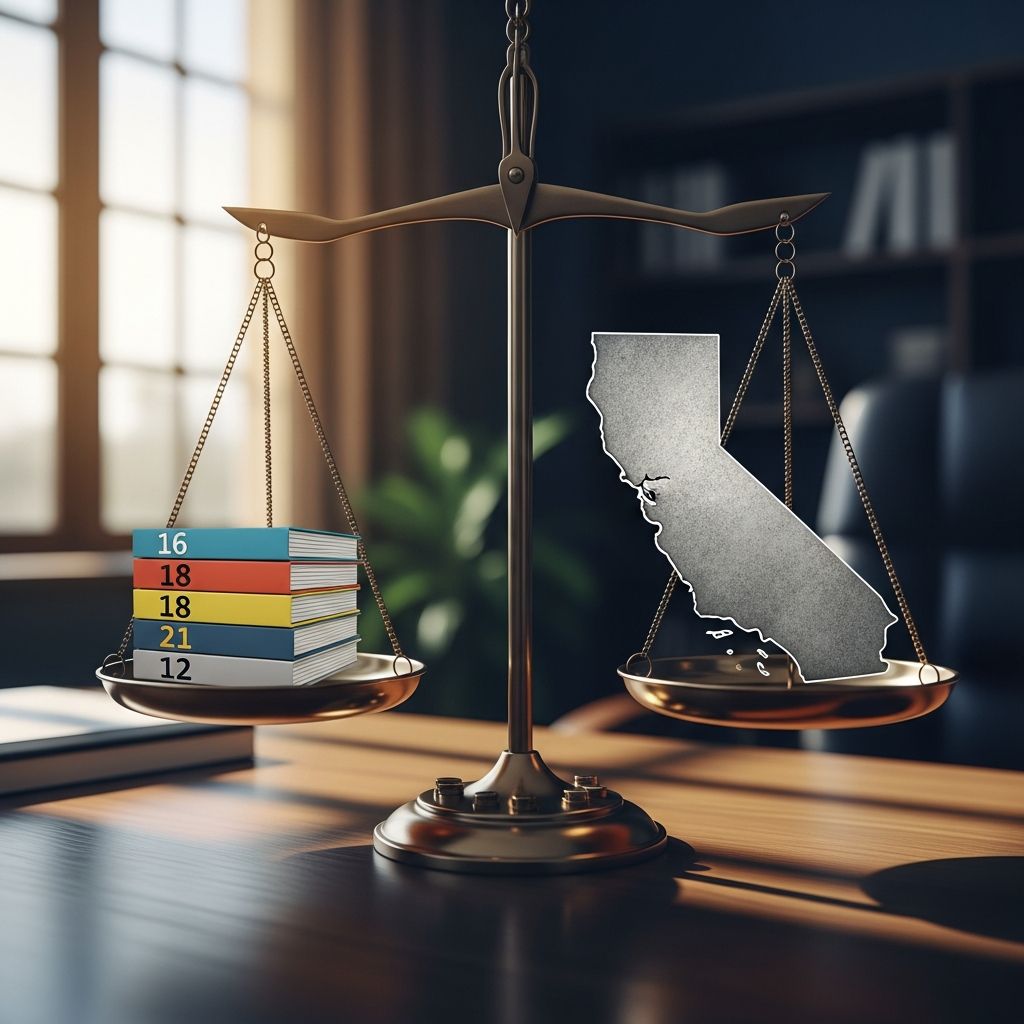
California law uses different ages to decide when a person can drive, consent to medical care, sign contracts, work, drink alcohol, or be tried in court. These rules do not all change on the same birthday, which can make things confusing for minors, parents, and caregivers.
This guide explains the most important age-based rules in California, focusing on how rights and responsibilities change from childhood into adulthood.
1. When Does Someone Become an Adult in California?
The core concept in California is the age of majority. Under California Family Code provisions, a person is generally considered a legal adult at 18 years old, which is when most parental authority and legal restrictions related to childhood end.
| Legal milestone | Typical age in California | What changes |
|---|---|---|
| Compulsory schooling ends | 18 (with some limited exceptions) | No longer legally required to attend school full-time |
| Age of majority | 18 | Person is treated as an adult for most legal purposes |
| Purchase or possession of alcohol | 21 | Legal to buy, possess, and consume alcohol under state law |
| Purchase of most firearms from a dealer | 21 (with some exceptions) | Eligible to buy many firearms, subject to background checks and other rules |
Turning 18 brings several key abilities:
- Signing binding contracts in one’s own name
- Buying, selling, or leasing property
- Marrying without parental or court consent
- Voting in federal, state, and local elections
- Suing and being sued personally
- Consenting to most medical treatment independently
However, some important rights and restrictions still change later, especially around alcohol, firearms, and certain employment or licensing rules.
2. Age of Consent and Sexual Conduct
California has a distinct rule for when a person is old enough to legally consent to sexual activity. The age of consent for sexual relations is 18 years old.
Key points about this rule include:
- Anyone under 18 is considered legally unable to give valid consent to sexual intercourse with an adult.
- Sexual activity between an adult and a minor can be charged as statutory rape, even if the minor agreed in fact.
- Penalties become more serious when the age difference between the adult and the minor is greater, or when the minor is under 16 and the adult is 21 or older.
The exact charge and possible punishment depend on the ages of both parties, prior criminal history, and details of the conduct involved. These cases are governed primarily by the California Penal Code and related case law.
3. Age of Criminal Responsibility and Juvenile Court
California does not treat children and adults the same way in the criminal justice system. Recent reforms have narrowed when very young children can be processed in juvenile court.
Under changes enacted by Senate Bill 439, California law now sets a general minimum age of 12 for juvenile court delinquency jurisdiction. Children younger than 12 are usually not brought into juvenile delinquency court but instead may receive counseling, diversion, or other non-court interventions.
There are, however, narrow exceptions. Children under 12 may still be brought to juvenile court when accused of certain very serious offenses, such as:
- Murder
- Forcible sexual offenses (including certain forms of rape and sodomy)
- Specific violent sexual crimes defined in the Penal Code
- Kidnapping
If a youth is 18 or older at the time of the offense, they are normally processed in the adult criminal system, not juvenile court, unless a specific law provides otherwise.
4. School Attendance and Education-Related Ages
California has compulsory education laws that set both a starting age for mandatory schooling and an age at which that requirement ends. While the exact details are contained in the California Education Code, the general structure is:
- A child must be in school beginning in the early elementary grades, with limited options for private schooling, valid homeschooling, or other lawful alternatives.
- Compulsory education typically continues until around age 18, with specific exceptions for graduation, equivalency programs, or lawful early departure under defined conditions.
In addition, federal and state special education laws provide that when a student with a disability turns 18, educational decision-making rights transfer from the parent to the student, unless a court has determined the student cannot make educational decisions.
5. Working in California: Minimum Age and Limits for Minors
Minors may work in California, but there are rules on minimum ages, work permits, hours, and job types. The California Division of Labor Standards Enforcement (DLSE) provides guidance on these rules.
Basic principles include:
- Most minors must obtain a valid work permit from their school or school district before starting work.
- The younger the worker, the stricter the limits on hours and on the kind of work they can perform.
- Minors in the entertainment industry (from 15 days to 18 years old) must have a state-issued permit to work, and employers also need a permit to employ minors.
| Age group | General employment status |
|---|---|
| Under school age | Very limited roles (primarily entertainment) with strict safeguards |
| 14–15 years | May work in many non-hazardous jobs with limits on hours and times of day |
| 16–17 years | Expanded opportunities but still restrictions on hazardous work and late-night hours |
| 18 and older | Treated as adults for most employment purposes |
Separate federal rules under the Fair Labor Standards Act also apply to young workers, particularly around hazardous occupations.
6. Driving, Licensing, and Age-Based Restrictions
California allows young people to begin the process of driving before they turn 18, using a graduated licensing system. By the mid-to-late teens, a minor may be able to:
- Obtain a learner’s permit after completing or enrolling in driver education and meeting minimum age requirements.
- Drive with a provisional license, subject to limits on nighttime driving and passengers.
- Receive a full, unrestricted driver license around age 18, assuming all other conditions are met.
Even after licensure, underage drivers face stricter standards when alcohol is involved. California’s “zero tolerance” rule makes it illegal for most drivers under 21 to operate a vehicle with a blood alcohol concentration of 0.01% or higher, which is more demanding than the 0.08% limit for many adults.
7. Alcohol and Tobacco: Age 21 and Other Limits
California follows federal policy by setting 21 as the minimum age to purchase or publicly possess alcoholic beverages. Supplying alcohol to someone under 21 is generally prohibited and can lead to criminal penalties.
Highlights of the alcohol rules:
- Retailers may not sell alcohol to anyone under 21.
- Adults are generally barred from furnishing alcohol to minors, with narrow exceptions defined by law.
- Any drink with at least 0.5% alcohol by volume is considered an “alcoholic beverage” for these purposes.
- Under-21 drivers face the very low 0.01% blood alcohol limit mentioned above.
For tobacco products, both federal and state law now set 21 as the minimum age to buy cigarettes, e-cigarettes, and most vaping products from retailers, part of broader public health efforts to reduce youth nicotine use.
8. Firearms and Ammunition: Minimum Ages and Barriers
California has some of the strictest age limits in the country for buying and possessing firearms and ammunition. These rules are spread across the Penal Code and related statutes, and they change periodically as new laws are enacted.
According to analysis by the Giffords Law Center based on California law:
- Licensed dealers generally may not sell any firearm to a person under 21, with certain limited exceptions (for example, some law enforcement or active-duty military).
- It is generally unlawful to sell, loan, or otherwise transfer a firearm of any type to someone under 18, outside of specific exceptions such as supervised use with a parent or guardian.
- Ammunition may not be sold to anyone under 18. Certain handgun ammunition rules are stricter for buyers under 21.
- California also limits young people’s possession of firearms, with narrow exceptions for supervised activities like hunting, target shooting, or training, when properly documented.
New legislation in recent years has further tightened these rules and created civil enforcement mechanisms against illegal sales to underage buyers.
9. Health Care: When Can Minors Consent on Their Own?
While turning 18 usually gives a person complete control over their medical decisions, California allows younger minors to consent to certain kinds of health care without a parent in defined situations. These rules are designed to improve access to sensitive services, especially when involving pregnancy, sexual health, mental health, substance use, or abuse.
According to a 2024 compendium from the National Center for Youth Law, based on California statutes:
- Minors 12 and older may consent to diagnosis and treatment for a drug or alcohol-related problem under California Family Code provisions, with some limits on which programs qualify and how information is shared with parents.
- California law also allows some minors to consent on their own to specific services like pregnancy-related care, prevention and treatment for sexually transmitted infections, and certain mental health counseling, depending on age and circumstances.
- Confidentiality rules often restrict when providers may or must inform parents about these services, though there are exceptions related to safety and mandatory reporting laws.
Because these rules are detailed and updated regularly, anyone with questions about a specific situation should consult the underlying statutes or a qualified legal or health professional.
10. Other Important Age-Related Rules
Beyond the areas above, California ties many other legal topics to age, such as:
- Marriage: Minors may not marry without parental and court approval, and adults may marry freely at 18 and older, subject to standard licensing rules.
- Emancipation: California provides a process for some minors to be legally emancipated before 18, giving them many adult powers (like signing leases or contracts) while also taking on adult responsibilities.
- Gambling: Casinos, card rooms, and state lottery games typically set 18 or 21 as the minimum age to participate, depending on the venue and game.
- Adoption and foster care: Age affects not only when youth exit foster care or become eligible for extended benefits, but also when adults may qualify to adopt or foster.
Each area has its own specific statutes and exceptions, so age should always be treated as a starting point, not the entire answer.
Frequently Asked Questions About California Legal Ages
Q1: Is a 17-year-old considered an adult in California?
No. Under California law, the general age of majority is 18, so a 17-year-old is still considered a minor for most purposes and remains under parental authority, with only limited exceptions such as certain medical consents or emancipation.
Q2: Can someone under 18 consent to sex with another teenager?
California’s age of consent is 18, which means anyone under 18 is legally unable to consent to sexual intercourse with someone who could be charged as an adult. Relationships between teens can still raise legal issues, especially when the age difference is significant or when one party is already 18.
Q3: At what age can a minor work in California?
Many minors begin working in limited roles at 14 or 15, though younger children may work in specific entertainment jobs under strict conditions. Nearly all workers under 18 need a school-issued work permit, and there are detailed limits on hours and job types.
Q4: Does turning 18 automatically allow me to buy alcohol and firearms?
No. Turning 18 makes you an adult for most purposes, but you must be 21 to buy or publicly possess alcohol in California, and generally 21 to buy most firearms from dealers, with limited exceptions.
Q5: Can minors in California see a doctor without telling their parents?
In some situations, yes. California law lets minors—often those 12 and older—consent to certain services on their own, including treatment for substance use, some mental health care, and some sexual and reproductive health services, as detailed in state statutes.
References
- Age of Majority — El Dorado Charter SELPA. 2023-08-01. https://charterselpa.org/Procedural-Guide/Age-of-Majority/
- 2024 California Family Code, Division 11, Part 1 – Age of Majority — Justia / California Legislature. 2024-01-01. https://law.justia.com/codes/california/code-fam/division-11/part-1/
- and the Law: An A-to-Z Guide for Parents — State Bar of California. 2013-01-01. https://www.calbar.ca.gov/portals/0/documents/rfp/2013/2013_AttachA_Kids_Law_PCC.pdf
- Information on Minors and Employment — California Department of Industrial Relations, Division of Labor Standards Enforcement. 2024-06-01. https://www.dir.ca.gov/dlse/dlse-cl.htm
- Minimum Age to Purchase & Possess Laws in California — Giffords Law Center to Prevent Gun Violence. 2023-07-01. https://giffords.org/lawcenter/state-laws/minimum-age-to-purchase-possess-in-california/
- Understanding California’s Age of Criminal Responsibility: Can Young Children Be Charged? — Katie Walsh Law. 2022-03-10. https://www.katiewalshlaw.com/blog/understanding-californias-age-of-criminal-responsibility-can-young-children-be-charged/
- California – Minor Consent and Confidentiality Compendium — National Center for Youth Law. 2024-05-01. https://youthlaw.org/sites/default/files/2024-10/NCYLMinorConsentCompendium2024-California.pdf
Similar Articles








Read full bio of medha deb


