
Where Can California Lawyers Work? A Multistate Practice Guide
A practical, plain-language guide for California attorneys navigating multistate and remote practice without triggering unauthorized practice rules.
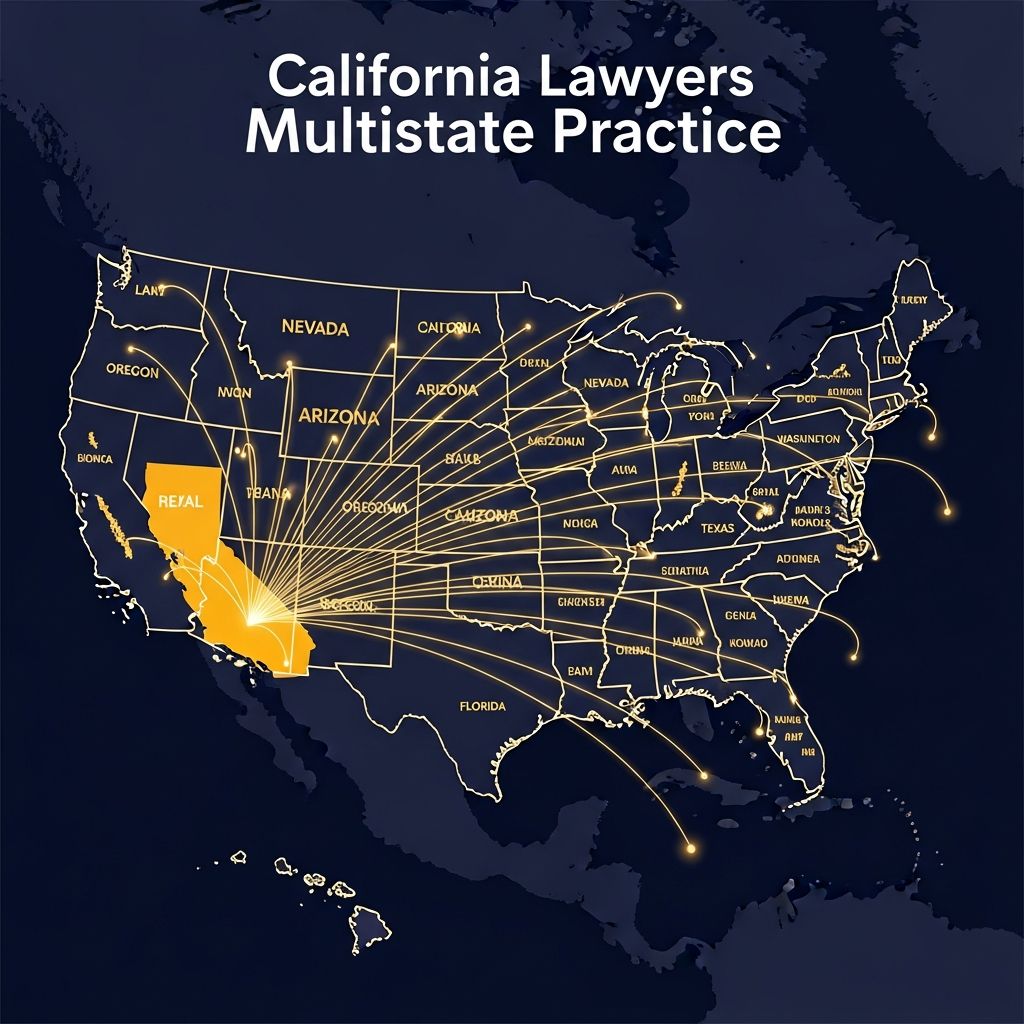
California lawyers are increasingly working with clients, courts, and companies across state lines. Yet, the power of a California law license largely stops at the state border unless very specific rules are followed. This article explains when a California attorney can work in other states, what counts as unauthorized practice of law (UPL), and which lawful pathways exist to expand your reach.
1. Why Practicing Across State Lines Is So Complicated
In the United States, the authority to regulate lawyers rests primarily with individual states, not the federal government. Each state bar or supreme court sets its own licensing rules, ethics codes, and UPL enforcement priorities.
At the same time, the American Bar Association (ABA) publishes model rules of professional conduct, including Model Rule 5.5 on multijurisdictional practice, which many states adopt in whole or in part. However, these ABA rules are not binding unless adopted by a state.
The result is a patchwork:
- California may allow one type of temporary practice that another state forbids.
- Some states recognize each other’s lawyers through reciprocity; others (including California) do not.
- Remote work has blurred the line between “where you live” and “where you practice.”
2. What Counts as Practicing Law in Another State?
To decide whether you are improperly practicing in a state where you are not licensed, regulators look at both what you are doing and where the legal matter is centered.
2.1 Core activities that usually constitute legal practice
While definitions vary, many states treat the following as the practice of law when tied to their jurisdiction:
- Giving legal advice about that state’s substantive or procedural law.
- Drafting or revising legal documents governed by that state’s law.
- Appearing in court, arbitrations, or administrative hearings in that state.
- Negotiating settlements of disputes arising under that state’s law.
- Marketing yourself to the public as authorized to practice in that state.
Importantly, courts have recognized that physical presence is not the sole test. A lawyer can violate a state’s UPL rules without ever setting foot there if they handle matters that are substantially centered in that state.
2.2 Physical location vs. jurisdiction of the matter
Two dimensions matter in multistate work:
| Factor | Key Question | Why It Matters |
|---|---|---|
| Your physical location | Where are you sitting when you work? | The host state may treat your ongoing presence as establishing a local practice, even if you only advise California clients. |
| Nature of the matter | Which state’s law and institutions are involved? | Providing advice on another state’s law or appearing in its courts without a license can be UPL in that jurisdiction. |
3. California’s Position in the Reciprocity and UBE Landscape
One of the biggest constraints for California attorneys is structural: California is not a Uniform Bar Examination (UBE) jurisdiction and does not generally grant admission by motion (reciprocity) to lawyers from other states. Conversely, many states do not reciprocally admit California lawyers either.
That means, in most cases, a California attorney who wants full, ongoing authority to practice in another state must:
- Apply for admission in that state, and
- Either sit for its bar exam or meet its experience and character requirements under a separate admission track.
Where the other state uses the UBE, it may accept transferred UBE scores from prior exams, but California’s exam does not produce a UBE score.
4. Remote Work: Can You Live in One State and Practice California Law?
The rise of remote practice raises a common scenario: a California-licensed lawyer moves to another state (for family or lifestyle reasons) but continues to handle only California matters for California clients. Is that permissible?
Key considerations drawn from multijurisdictional guidance include:
- How you hold yourself out: You generally may not represent that you are licensed in the state where you physically reside unless you are admitted there.
- Nature of your docket: If your work remains limited to California law and California matters, some states are more tolerant of your presence.
- Local UPL rules: Some jurisdictions explicitly allow remote work for out-of-state clients, while others view any regular local presence as a prohibited “office.”
Several bar ethics opinions, including from California-focused organizations, emphasize that lawyers working remotely in a state where they are not licensed must review that state’s multijurisdictional practice and UPL rules carefully and comply with them.
5. Lawful Pathways for California Lawyers to Work in Other States
Despite these constraints, there are multiple legitimate ways for California attorneys to handle work in or related to other states. The most common are summarized below.
5.1 Pro hac vice admission: temporary case-by-case authority
Pro hac vice (“for this occasion”) admission allows an out-of-state lawyer to appear in a particular case with court permission.
- Available in all federal courts and most state courts, but on a discretionary, case-specific basis.
- Typically requires association with local counsel admitted in the host jurisdiction.
- Often involves fees, verified applications, and sometimes limits on how many pro hac vice admissions may be obtained in a given period.
The State Bar of California mirrors this concept for non-California attorneys who wish to appear in California courts, requiring them to seek permission from the court and comply with special admissions rules. When you, as a California lawyer, seek pro hac vice admission in another state, you will be subject to that state’s equivalent rules.
5.2 In-house counsel roles in other states
Many jurisdictions distinguish between lawyers serving the general public and those working solely as in-house counsel for a single corporate employer. Numerous states let out-of-state lawyers work as corporate counsel under:
- An exemption for in-house lawyers, or
- A limited license or registration scheme confined to representation of the employer.
Common features of these in-house frameworks include:
- Registration with the state bar or court.
- Restriction to work for the corporate employer (no side clients).
- Compliance with local ethics rules and continuing legal education requirements.
California has a similar registration system for out-of-state lawyers who wish to act as in-house counsel within California, illustrating how states use limited licenses to manage cross-border corporate practice.
5.3 Federal court and agency practice
Admission to a state bar is distinct from admission to federal courts and administrative agencies. Many federal fora allow lawyers admitted in any U.S. jurisdiction to seek admission, regardless of where they live.
- Federal district courts: Each court has its own admission rules; some require local sponsorship or in-person swearing-in, but most admit any state-licensed lawyer who applies.
- Federal appellate courts: Similar structure—application, fee, and proof of good standing are usually required.
- Administrative agencies: Certain agencies (for example, USPTO for patent practice) maintain separate enrollment systems and examinations.
However, federal authority does not automatically insulate you from state UPL rules. If your federal work is substantially tied to a state where you are not licensed, local UPL statutes and ethics rules can still apply.
5.4 Limited practice and multijurisdictional practice programs
Some states, including California, offer structured multijurisdictional practice (MJP) frameworks that authorize limited forms of out-of-state practice under defined conditions.
California, for example, allows certain out-of-state attorneys to perform limited services—such as representing clients in specific matters or as registered in-house or legal services counsel—after registering with the State Bar and meeting eligibility requirements. When you operate in another state, you will need to confirm whether that state has analogous rules that would cover a California licensee.
6. Common Risk Traps for California Lawyers Crossing Borders
California lawyers often encounter similar pitfalls when expanding beyond state lines. Recognizing these patterns can help you reduce risk.
6.1 Establishing a “virtual office” in another state
Even if you only advise California clients, maintaining a consistent physical presence or marketing a local address in another state can be treated as maintaining an office there. Many ethics authorities caution that this may violate UPL rules if you are not licensed locally, especially if your online profiles suggest a general practice in that state.
6.2 Handling matters with mixed contacts
Modern disputes rarely stay neatly within one state’s borders—contracts involve multiple states; clients move; transactions span several jurisdictions. In such matters, regulators may focus on:
- Which law governs the dispute.
- Where the parties, property, or events are located.
- Where court proceedings are or will be filed.
If another state’s law is central, you may need to partner with locally licensed counsel or seek pro hac vice admission rather than handling the matter solo.
6.3 Aiding and abetting UPL
California does not only penalize unlicensed practice by outsiders; it also disciplines California lawyers who assist non-admitted lawyers in practicing in California without authority. The same concept can apply when you collaborate with out-of-state lawyers on matters centered in their state. You must ensure that everyone’s role is consistent with local licensing rules.
7. Practical Compliance Checklist for California Attorneys
Before you undertake work with any substantial connection to another state, consider the following checklist:
- Identify all relevant jurisdictions: Where are the parties, property, and key events located? Where might litigation arise?
- Confirm your authority: Are you admitted in that state? If not, is there an applicable rule for temporary practice, in-house work, or multijurisdictional services?
- Check for pro hac vice options: If a specific case requires local court access, review that court’s admission rules and whether local counsel is needed.
- Assess how you present yourself: Ensure marketing materials, email signatures, and websites clearly indicate where you are licensed.
- Consult ethics counsel when in doubt: Many state bar associations, including local bar groups, issue ethics opinions you can rely on for guidance.
8. Key Takeaways for California Lawyers Exploring Other States
- Your California license gives you full authority in California, but only very limited authority elsewhere unless supplemented by additional admission.
- Remote work does not eliminate state borders; you must analyze both your physical location and the jurisdiction of the matter.
- Pro hac vice, in-house licenses, MJP rules, and federal admissions are the main lawful vehicles to extend your practice footprint.
- UPL enforcement can reach you even without physical presence if you handle matters substantially connected to another state.
Frequently Asked Questions (FAQs)
Q1: Can I move to another state and continue representing only California clients?
Possibly, but it depends on that state’s UPL and multijurisdictional practice rules. Some jurisdictions permit a lawyer licensed elsewhere to live locally while practicing exclusively the law of the licensing state, provided the lawyer does not claim to be locally licensed or serve local-law matters. Others may treat your ongoing presence as maintaining an unlicensed office. You must review the host state’s ethics rules and advisory opinions before relocating.
Q2: Do I always need pro hac vice status to co-counsel with a local lawyer in another state?
If your role involves appearing in court, signing pleadings, or otherwise acting as counsel of record in that jurisdiction’s courts, pro hac vice admission is typically required. If you function only as behind-the-scenes consulting counsel on California or federal issues, local rules may not require your formal admission. The safest approach is to review the particular court’s admission rules and obtain pro hac vice status when in doubt.
Q3: Can I advertise to clients in other states if I only handle federal law issues?
Many lawyers lawfully practice nationwide in areas dominated by federal law (for example, immigration or certain tax matters). However, states can still regulate advertising and require clear disclosure of licensing jurisdictions. You should ensure marketing materials specify that you are admitted only in California (and any other licensed states) and that your practice is limited to federal law where applicable. Review both California’s advertising rules and those of any state where your marketing is targeted.
Q4: Does California recognize bar reciprocity if I decide to move away permanently?
California does not generally admit attorneys from other U.S. jurisdictions by motion based solely on years of practice. Lawyers seeking admission to the California bar usually must pass the California Bar Examination and meet all moral character and other requirements.
Q5: Where can I find official guidance on multijurisdictional practice rules?
Official, up-to-date information is best obtained directly from state bar and court websites. In California, the State Bar’s special admissions and multijurisdictional practice pages describe available limited licenses and registration programs. Other states publish their own versions, often under headings like “pro hac vice,” “in-house counsel registration,” or “multijurisdictional practice.”
References
- Can California lawyers practice in other states? — One Legal Blog. 2023-03-15. https://www.onelegal.com/blog/can-california-lawyers-practice-in-other-states/
- Sitting Where You Are Not Licensed — Bar Association of San Francisco. 2021-09-01. https://www.sfbar.org/blog/sitting-where-you-are-not-licensed/
- Can You Practice Law in Multiple States? What Lawyers Should Know — Rocket Matter. 2022-05-10. https://www.rocketmatter.com/blog/can-you-practice-law-in-multiple-states/
- Be Warned: CA In-House Corporate Counsel Must Register With the State Bar — O’Rielly & Roche LLP. 2022-08-01. https://oriellyroche.com/ca-in-house-corporate-counsel-must-register/
- An Updated Look at the Unauthorized Practice of Law in California — Orange County Bar Association. 2025-05-01. https://www.ocbar.org/All-News/News-View/ArticleId/6778/May-2025-Ethically-Speaking-When-Crossing-the-Border-Is-Crossing-the-Line-An-Updated-Look-at-the-Unauthorized-Practice-of-Law-in-California
- Special Admissions — State Bar of California. 2024-01-01. https://www.calbar.ca.gov/Admissions/Special-Admissions
- Multijurisdictional Practice (MJP) Program Overview — State Bar of California. 2024-01-01. https://www.calbar.ca.gov/Admissions/Special-Admissions/Multijurisdictional-Practice-MJP-Program
Similar Articles








Read full bio of Sneha Tete


