
California Law on Corporal Punishment in Public Schools
Learn how California bans corporal punishment in public schools, what counts as unlawful force, and the rights of students and families.
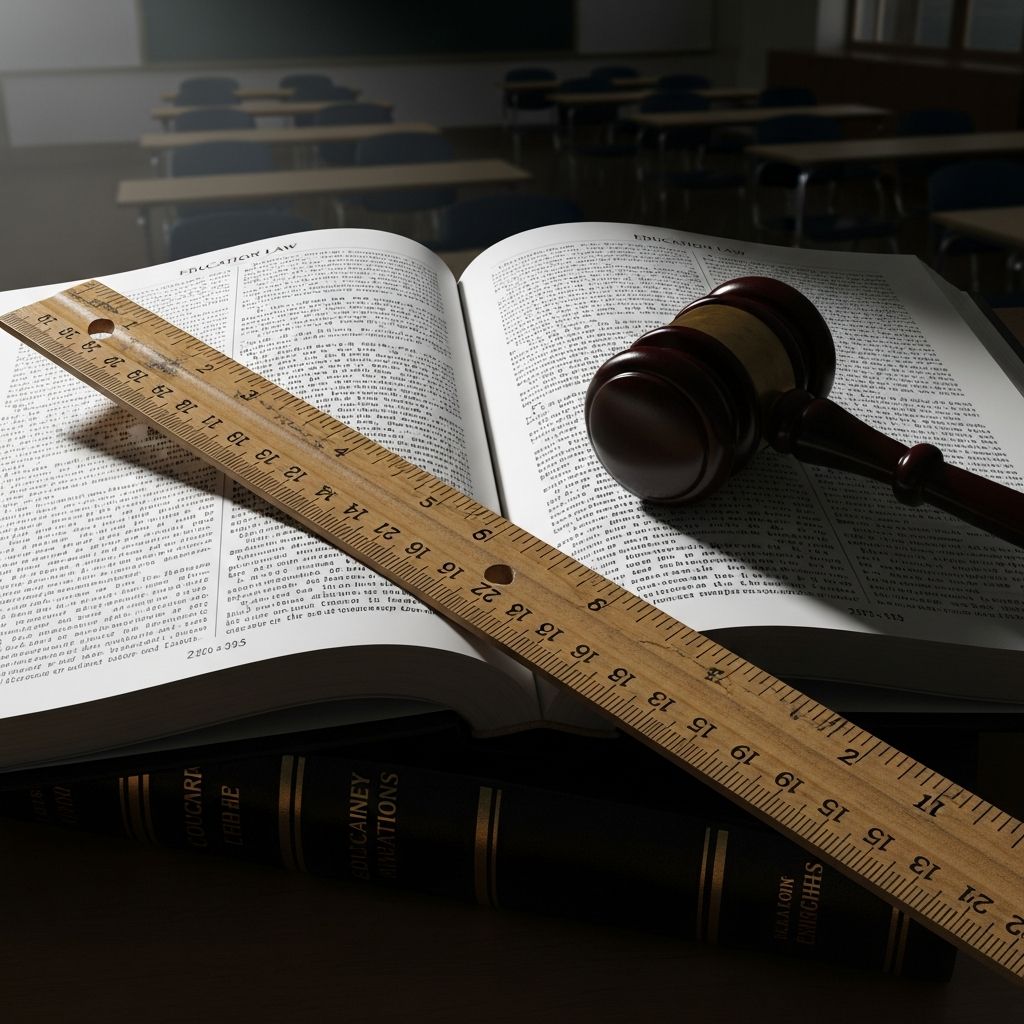
California has adopted one of the strongest positions in the United States against the use of corporal punishment in public schools. State law generally prohibits school employees from using physical force as a form of discipline, while still allowing limited physical intervention when it is truly necessary to protect people or property.
This guide explains what the law means in practice, how it fits into the broader national debate on school discipline, and what students and parents can do if they believe a line has been crossed.
What Is Corporal Punishment in a School Setting?
There is no single nationwide definition of corporal punishment, but both federal and state authorities consistently treat it as a type of physical discipline imposed on a student by school staff.
In everyday terms, corporal punishment in schools typically refers to:
- Hitting or striking a student with a hand (e.g., spanking, slapping) for disciplinary reasons.
- Using an object such as a paddle, belt, or ruler to inflict pain as punishment.
- Any intentional infliction of pain (for example, forcing painful postures, excessive physical drills, or similar acts) used as a penalty for misbehavior.
California law focuses on whether physical force is used for the purpose of punishment. Force that is necessary and reasonable to prevent injury or serious damage is treated differently than force used to penalize or humiliate a student.
California’s Statewide Ban on Corporal Punishment in Public Schools
California is among the states that have completely banned corporal punishment in public schools through statewide legislation. The prohibition has been in place for decades and reflects a broad policy choice that physical pain is not an acceptable method of school discipline.
Key features of California’s approach include:
- Applies to all public schools, including traditional district schools and most public charter schools.
- Covers all school employees and individuals working under the authority of the public school (such as aides and certain volunteers).
- Focuses on discipline: physical force used as punishment is prohibited, regardless of the student’s age or grade level.
The ban places California in contrast to a number of states, mostly in the South, where corporal punishment in public schools is still legally permitted.
How California Compares to Other States
Corporal punishment in schools is not regulated by federal statute, so each state decides whether to allow or forbid it.
| Jurisdiction | Public School Corporal Punishment | General Trend |
|---|---|---|
| California | Explicitly banned statewide in public schools. | Supports non-physical, trauma-informed discipline. |
| Most Western & Northeastern states | Generally banned in public schools. | Gradual policy shift away from physical discipline. |
| Several Southern states | Still legally allow corporal punishment. | Some districts continue to paddle or strike students. |
Research and advocacy reports note that nationwide, more than 30 states have banned corporal punishment in public schools, but it remains lawful and used in a smaller group of states. California’s statute is often cited as a clear example of a state-level prohibition.
Permitted Uses of Force: Safety and Emergency Exceptions
California’s ban on corporal punishment does not mean school staff can never touch a student. State law, consistent with other states’ statutes, recognizes that school personnel may sometimes need to use limited force to keep people safe or to prevent serious property damage.
Under California’s framework, force is generally allowed when all of the following are true:
- The amount of force used is reasonable and necessary in the circumstances.
- The purpose is to prevent injury to students or staff, to protect property from significant damage, or to disarm a student holding a dangerous object.
- The force is not used to punish, intimidate, or retaliate against the student.
Common examples of lawful, non-punitive force can include:
- Separating students engaged in a fight to prevent further harm.
- Physically guiding a student away from a busy street or unsafe area.
- Taking possession of a weapon or dangerous object being held by a student.
The same language that clarifies these exceptions also emphasizes that such safety interventions do not count as “corporal punishment” under California law when they are genuinely aimed at protection rather than discipline.
Corporal Punishment vs. Child Abuse Under California Law
In addition to school-specific provisions, California’s criminal laws address physical abuse of children generally. Under California Penal Code 273d, it is a crime to inflict cruel or inhuman corporal punishment or an injury resulting in a traumatic condition on a child.
Important distinctions include:
- School discipline rules determine what teachers and staff may do in their official roles.
- Criminal child abuse laws apply to anyone, including educators and parents, whose physical conduct toward a child crosses the line into unlawful abuse.
While California law recognizes that some physical discipline by parents may be lawful, using excessive or unreasonable force can lead to criminal charges. In the school context, where corporal punishment for discipline is already banned, it is easier for an incident of severe force to be treated as potential abuse rather than permissible discipline.
Why California Prohibits Corporal Punishment in Schools
California’s ban is in line with a broad body of medical, psychological, and educational research that questions the safety and effectiveness of physical punishment in schools.
Common policy reasons for the ban include:
- Risk of physical injury: Even a single blow can cause bruises, nerve damage, or more serious harm.
- Mental health concerns: Repeated or severe physical discipline may contribute to anxiety, depression, or trauma.
- Ineffective behavior management: Studies suggest that corporal punishment does not reliably improve behavior and may instead increase aggression or defiance.
- Disproportionate impact: National data show that students of color and students with disabilities are often punished physically at higher rates, raising equity and civil rights concerns.
Professional organizations, including pediatric and education groups, have called for an end to corporal punishment in schools nationwide, citing these and other harms.
Discipline Options Schools Can Use Instead
California’s prohibition on corporal punishment does not prevent schools from enforcing rules or holding students accountable. Instead, it encourages districts to rely on non-physical, evidence-informed approaches to student behavior.
Alternatives that align with current best practices include:
- Positive behavioral interventions and supports (PBIS), which emphasize clear expectations, positive reinforcement, and early support.
- Restorative practices, such as restorative circles or conferences, to address harm, repair relationships, and reintegrate students into the school community.
- Social-emotional learning (SEL) programs that help students build skills in emotional regulation, conflict resolution, and empathy.
- Logical and educational consequences, including loss of privileges, re-teaching of expectations, or targeted behavioral interventions.
These models are consistent with trauma-informed approaches that many California districts have begun adopting, especially in the wake of increased attention to student mental health.
Student and Parent Rights When Force Is Used
Even when corporal punishment is banned, disputes can arise over whether a particular use of force was truly “reasonable and necessary” or whether it crossed the line into unlawful physical discipline. California families have several important rights and options.
Information and School Records
- Parents generally have a right to ask for an explanation when their child reports being physically handled or restrained by staff.
- In many cases, parents can request access to relevant incident reports, discipline records, or behavior logs created by the school, subject to student privacy rules.
Raising Concerns and Filing Complaints
- Concerns can often be addressed first by speaking with the teacher or principal.
- Most districts have a formal complaint or grievance process that allows parents to submit written concerns about staff conduct, including use of force.
- Serious allegations may be reported to the school district office, local law enforcement, or child protective services if abuse is suspected.
When to Seek Legal Advice
- If a student suffers a significant injury or medical treatment is required.
- If there is evidence of repeated or excessive use of force by the same staff member.
- If the school’s response appears inadequate or dismissive of documented harm.
Because both education law and child abuse laws may be relevant in serious cases, families often benefit from consulting an attorney familiar with California school law and civil rights protections.
Key Takeaways for Educators and School Staff
Teachers and other school employees in California must navigate both their duty to maintain a safe environment and the strict ban on corporal punishment.
Core practical guidelines include:
- Never use physical pain as a consequence for misbehavior, disrespect, or noncompliance.
- Use physical contact only when safety is at risk, and limit it to what is reasonably necessary in the situation.
- Document safety incidents that involve physical intervention, including what led up to the event and how it ended.
- Participate in training on de-escalation, restorative practices, and trauma-informed care so that non-physical strategies are available and effective.
Understanding the line between permitted safety interventions and prohibited corporal punishment helps protect both students and staff, and reduces the likelihood of legal disputes.
Frequently Asked Questions (FAQs)
Q: Is any form of spanking allowed in California public schools?
A: No. California law prohibits corporal punishment for disciplinary purposes in public schools, and that includes spanking or paddling by school staff.
Q: Can a teacher physically restrain a student who is out of control?
A: A teacher may use reasonable and necessary physical force to protect people from injury, prevent serious property damage, or remove a dangerous object, but not as a way to punish or control minor misbehavior.
Q: Does the ban on corporal punishment apply to private schools?
A: California’s clear, explicit ban is directed at public schools. Some private schools may be governed by separate rules or policies, and general child abuse and assault laws still apply to all adults interacting with children.
Q: What should I do if my child was hit by a teacher?
A: Document what happened, seek medical care if needed, report the incident to school administrators, and consider filing a formal complaint. If the injury is serious or appears abusive, you may also contact law enforcement or child protective services and consult an attorney.
Q: Are schools required to use specific alternatives to corporal punishment?
A: California law does not mandate one single replacement program, but districts are encouraged to adopt evidence-based, non-physical approaches such as PBIS, restorative practices, and social-emotional learning, consistent with broader state and professional guidance.
References
- Corporal Punishment in Public Schools in the United States — Prevent Child Abuse America. 2023-06-09. https://preventchildabuse.org/wp-content/uploads/2023/06/PCA-Corporal-Punishment-One-Pager-June-9-2023-1.pdf
- School Corporal Punishment in the United States — Summary of state bans (public schools). Last updated 2024. https://en.wikipedia.org/wiki/School_corporal_punishment_in_the_United_States
- California Penal Code Section 273d PC: Child Abuse / Inflicting Physical Punishment on a Child — Overview and elements of the offense. Accessed 2024. https://www.losangelescriminallawyer.pro/california-penal-code-section-273-d-pc-child-abuse-inflicting-ph.html
- Corporal Punishment in Schools Still Legal in Many States — National Education Association (NEA). 2024-04-02. https://www.nea.org/nea-today/all-news-articles/corporal-punishment-schools-still-legal-many-states
- Corporal Punishment and the Law — Judge Leonard Edwards, California Judges Association. 2019. http://judgeleonardedwards.com/docs/Corporal-Punishment-CJA-2019.pdf
Similar Articles








Read full bio of medha deb


