
Testing Your Business Growth Capacity: A Practical Assessment Guide
Learn how to evaluate if your business can handle rapid growth while maintaining profitability and quality.
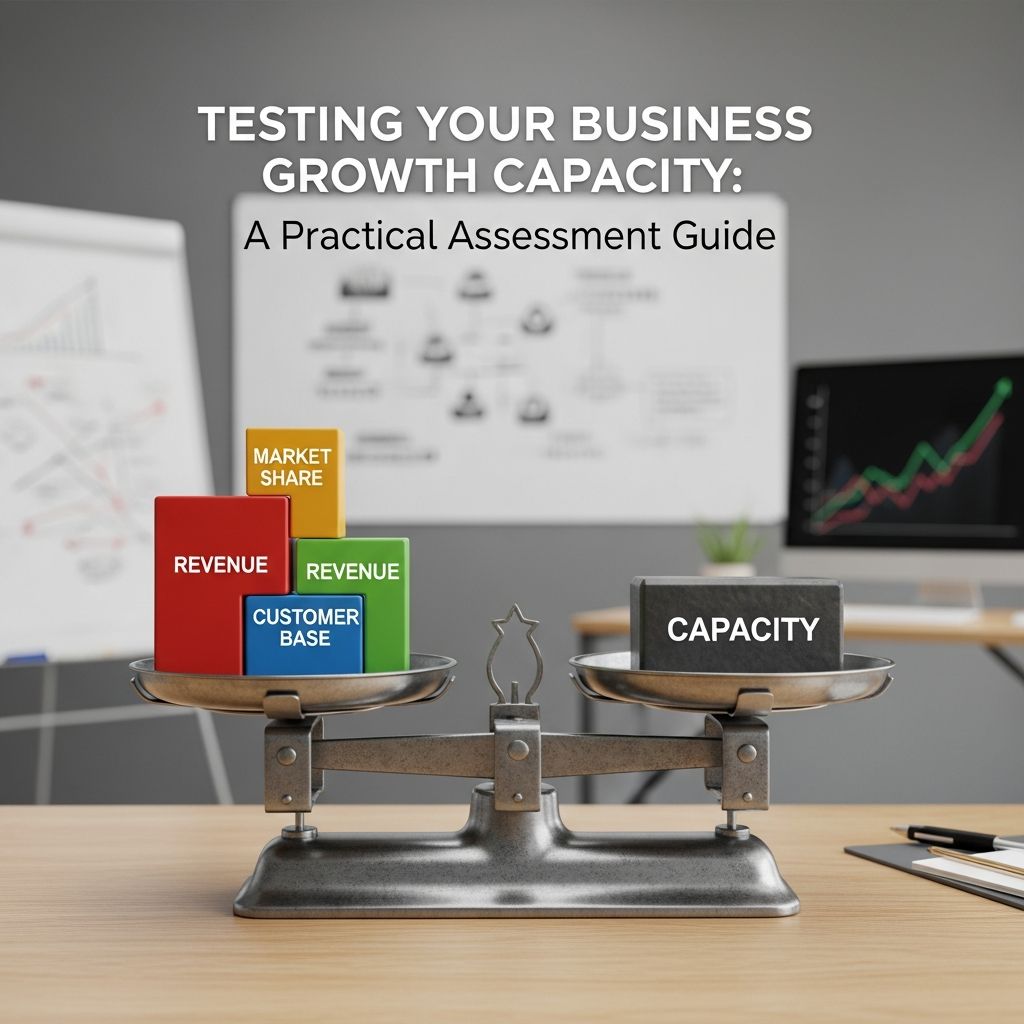
Understanding Business Scalability: Why It Matters
Business scalability represents the capacity of an organization to expand its operations, increase revenue, and serve more customers without experiencing proportional increases in costs or quality degradation. For entrepreneurs and business leaders, understanding whether a business can truly scale is fundamental to long-term success. A scalable business generates greater profits as it grows because the underlying infrastructure, systems, and processes can accommodate increased demand without requiring equivalent resource expansion.
The challenge lies in distinguishing between businesses that can genuinely scale and those that merely appear growth-ready on the surface. Many companies experience temporary revenue increases only to hit operational walls when demand outpaces their capacity. Assessing scalability early—before investing significant capital into growth initiatives—allows business owners to identify gaps and address them strategically rather than reactively.
Financial Health as a Scalability Foundation
The financial dimension of scalability begins with understanding unit economics, which examines the profitability generated from each individual customer or transaction. This analysis reveals whether the fundamental business model can sustain growth profitably.
Key financial metrics to evaluate include:
- Customer Acquisition Cost (CAC): The total expense required to acquire one new customer, including marketing, sales, and related overhead. If this cost remains high as you scale, profitability becomes increasingly difficult.
- Lifetime Value (LTV): The total profit generated from a customer throughout their entire relationship with the business. A healthy ratio of LTV to CAC—typically 3:1 or higher—indicates scalability potential.
- Payback Period: The duration required to recover the investment made in acquiring a customer. Shorter payback periods free up capital for reinvestment and growth.
- Contribution Margin: The percentage of revenue remaining after covering variable costs. Higher contribution margins provide flexibility during scaling phases.
These metrics work together to paint a picture of whether your business model becomes more or less profitable as you grow. A business with weak unit economics might show impressive revenue growth initially but ultimately fails because costs exceed profits at scale.
Evaluating Market Opportunity and Demand
Scalability cannot exist in a vacuum; it requires a sufficiently large market with genuine demand for growth. Understanding your addressable market involves breaking down opportunity into three complementary frameworks:
Total Addressable Market (TAM): This represents the entire potential demand for your product or service without any constraints. TAM provides the theoretical ceiling for your business and helps you understand the ultimate opportunity size. For a software company offering project management tools, the TAM would include every organization globally that might benefit from such a solution.
Serviceable Available Market (SAM): This narrows TAM to the portion your business can realistically target given your current capabilities, geographic presence, and product offerings. SAM accounts for real constraints like distribution channels, language barriers, or regulatory limitations. The same project management software company might focus initially on mid-sized companies in North America, making that their SAM.
Serviceable Obtainable Market (SOM): This represents the realistic market share you can capture in the near term, typically the next 3-5 years, considering competitive dynamics and your execution capacity. SOM provides a grounded goal for your immediate growth phase.
Understanding these three market dimensions prevents businesses from scaling into markets too small to justify the investment or from ignoring expansion opportunities they haven’t yet considered.
Operational Infrastructure and Technological Readiness
A business’s operational infrastructure directly determines its scalability ceiling. As volume increases, systems that worked adequately for smaller operations often become bottlenecks. Assessing operational readiness requires honest evaluation of your current systems and their capacity for expansion.
Consider these operational elements:
- Technology Platform Capacity: Can your current software, servers, and databases handle 10 times your current user volume without significant performance degradation? Cloud-based solutions often provide more scalability than on-premises systems, though they require different management approaches.
- Process Documentation and Standardization: Are your core business processes documented and standardized, or do they depend on individual team members’ knowledge and preferences? Scalable businesses have reproducible, documented processes that new team members can quickly learn.
- Supply Chain and Fulfillment: For product-based businesses, can your suppliers and fulfillment partners handle increased volume? Establishing relationships with scalable partners before growth demands arrive is critical.
- Customer Support Systems: Will your current customer support approach remain viable as customer numbers increase? Scaling often requires moving from personalized support to tiered systems with automation components.
Performance testing and capacity planning provide concrete methods for evaluating these elements. Load testing simulates increased demand on your systems to identify breaking points before they cause customer-facing failures. Capacity planning uses historical data to forecast future resource needs and ensures you’re prepared to meet growing demand.
Team Competence and Organizational Structure
Perhaps the most underestimated scalability factor is team capability. Businesses don’t scale; teams scale businesses. As operations expand, the skills required to lead and manage the organization evolve significantly. A founder who successfully bootstrapped a five-person startup may lack the experience to lead a fifty-person organization.
Evaluate your team across several dimensions:
- Leadership Experience: Have your leaders successfully scaled organizations before? Do they understand the transition from startup culture to more structured operations?
- Functional Expertise: As you scale, do you have or can you recruit individuals with expertise in critical areas like finance, operations, technology, and marketing?
- Cultural Alignment: Will your organizational culture support growth, or does it depend on the tight-knit dynamic of a small team? Strong cultures explicitly articulate values and create systems that maintain them as the company grows.
- Adaptability: Can your team embrace new processes, tools, and organizational structures, or does growth trigger excessive resistance?
Building a balanced founding team with complementary skills and the ability to manage growth challenges ensures your business can handle increased complexity.
Business Model Flexibility and Adaptability
The business model itself must support scaling. A business model demonstrates scalability when it can expand across markets, diversify revenue streams, and maintain operational efficiency without proportional cost increases.
Examine whether your model includes:
- Automation Opportunities: Can key business functions be automated as volume increases, reducing per-unit labor costs?
- Network Effects: Do your customers derive more value from the service as more people use it, creating natural growth momentum? Social media platforms exemplify this dynamic, where each new user increases value for existing users.
- Pricing Power: Does your pricing structure support profitability at scale, or do customers demand discounts for volume commitments that squeeze margins?
- Replicability: Can your product or service be replicated across different markets or customer segments without significant customization or cost increases?
Businesses with strong business model scalability can grow without constantly seeking external capital to fund operational expansion.
Competitive Positioning and Market Dynamics
Your ability to scale also depends on the competitive landscape and your positioning within it. A business with unique value propositions, sustainable competitive advantages, or defensible market positions can scale more successfully than commoditized offerings.
Assess your competitive environment by considering:
- Differentiation: What makes your offering distinct from competitors? Is this advantage sustainable as competitors respond to your growth?
- Barriers to Entry: Do you have intellectual property, network effects, switching costs, or other barriers that prevent new competitors from easily entering your market?
- Strategic Partnerships: Can alliances with complementary businesses expand your reach and capabilities without requiring you to build everything internally? Corporate partnerships and strategic collaborations have become increasingly important, with such arrangements representing 12% of US startup investment in recent years.
- Market Trends: Are broader market trends supporting or hindering growth in your sector?
Creating a Scalability Assessment Framework
Rather than evaluating scalability factors in isolation, employ a structured framework that examines your business across multiple dimensions simultaneously. This systematic approach prevents overlooking critical gaps and provides objective measures for growth readiness.
A comprehensive assessment should evaluate:
| Assessment Dimension | Key Questions | Evaluation Method |
|---|---|---|
| Financial Metrics | Are unit economics healthy? Does profitability improve with scale? | Analyze CAC, LTV, margins, and cash flow projections |
| Market Opportunity | Is your market large enough to justify scaling investments? | Quantify TAM, SAM, and SOM for your business |
| Operational Readiness | Can current systems and processes handle growth? | Conduct capacity planning and performance testing |
| Team Capability | Does your team have the experience to lead a larger organization? | Evaluate leadership experience, expertise, and cultural fit |
| Business Model | Does your model support profitable growth? | Assess automation potential, pricing, and replicability |
| Competitive Position | Can you maintain advantage as you scale? | Analyze differentiation, barriers, and market position |
Startups that use structured scalability assessment frameworks identify bottlenecks early and make strategic decisions based on objective data rather than optimism. This evidence-based approach reduces the risk of failed scaling initiatives and focuses limited resources on highest-impact improvements.
Common Scalability Challenges and How to Address Them
Even well-intentioned businesses often encounter predictable scalability obstacles. Recognizing these challenges allows you to address them proactively:
Premature Scaling: Growing faster than your team, systems, or capital can support creates operational chaos. Instead, grow at a pace your organization can manage while maintaining quality.
Ignoring Operational Efficiency: Businesses that scale successfully do so by improving processes and reducing waste at every level, not simply expanding existing operations.
Underestimating Talent Needs: As complexity increases, your team must expand not just in size but in diversity of skills and experience.
Losing Product-Market Fit: Growth sometimes comes at the expense of the core value proposition. Maintaining what made your business valuable while scaling is critical.
Capital Constraints: Many scalable businesses fail because growth requires investment they cannot fund. Planning for capital needs early prevents this.
Benchmarking Your Growth Against Industry Standards
Understanding how your business’s growth trajectory compares to industry benchmarks provides context for scalability assessment. While growth rates vary dramatically by industry and business model, baseline expectations exist for reference.
Typical growth projections for startups show expected revenue growth of approximately 178% in the first year, declining to around 100% in year two and 71% in year three. These figures serve as a benchmark for evaluating your business’s growth performance. If your growth significantly lags these benchmarks despite favorable market conditions, scalability concerns likely exist.
Implementation: From Assessment to Action
Conducting a thorough scalability assessment provides insights; implementing those insights drives results. After identifying scalability gaps through assessment, prioritize improvements based on impact and feasibility.
Begin with foundational elements: ensure unit economics are healthy, confirm market opportunity exists, and build your team. From this foundation, address operational constraints that would become bottlenecks during growth. Finally, implement systems and processes that enable scaling without sacrificing quality or culture.
Frequently Asked Questions
Q: How often should I reassess my business’s scalability?
A: Conduct formal scalability assessments annually or whenever significant business changes occur, such as entering new markets, launching new products, or experiencing unexpected growth challenges. Market conditions and your business capabilities evolve, making periodic reassessment essential.
Q: Can a business be profitable but not scalable?
A: Yes. A business can be profitable in its current form but lack the ability to grow without proportional cost increases. Many service businesses face this challenge—they’re profitable at current scale but cannot expand without hiring additional staff at similar ratios, limiting scalability.
Q: What’s the difference between scalability and growth?
A: Growth is an increase in revenue or customers; scalability is the capacity to achieve that growth efficiently. A business can grow unsustainably by throwing resources at the problem, but true scalability means growing while maintaining or improving profitability and operational efficiency.
Q: Should early-stage businesses conduct scalability assessments?
A: Yes, particularly before raising significant capital or making major strategic decisions. Early assessment identifies which business model adjustments would most improve scalability potential, allowing you to incorporate these changes while still small and flexible.
Q: How does technology impact scalability?
A: Technology serves as a multiplier for scalability. Cloud infrastructure, automation tools, and software platforms allow businesses to serve more customers with relatively fixed technology costs, creating economies of scale. However, technology alone doesn’t guarantee scalability without solid unit economics and market demand.
References
- Startup Scalability Framework: Evaluate Growth Potential Effectively — Qubit Capital. https://qubit.capital/blog/evaluating-startup-scalability
- Assessing and Enhancing System Scalability — REEA Global. https://reeaglobal.com/assessing-and-enhancing-system-scalability/
- What Is Scalability Assessment? — Business Case Studies. https://businesscasestudies.co.uk/what-is-scalability-assessment/
- The Business Scalability Matrix — HubSpot. https://cdn2.hubspot.net/hub/41408/file-14210436-pdf/docs/an_introduction_to_the_business_scalability_matrix.pdf
- Business Scalability Assessment — EKG Maturity. https://maturity.ekgf.org/pillar/business/business-enablers/scalability-assessment/background-and-intro/
- How to Assess a Startup’s Scalability from the Beginning — Golden Egg Check. https://goldeneggcheck.com/en/how-to-assess-a-startups-scalability-from-the-beginning/
Similar Articles








Read full bio of Sneha Tete


