
Building Safer Schools: Support Over Policing
Replace punitive policing with mental health resources to support all students.
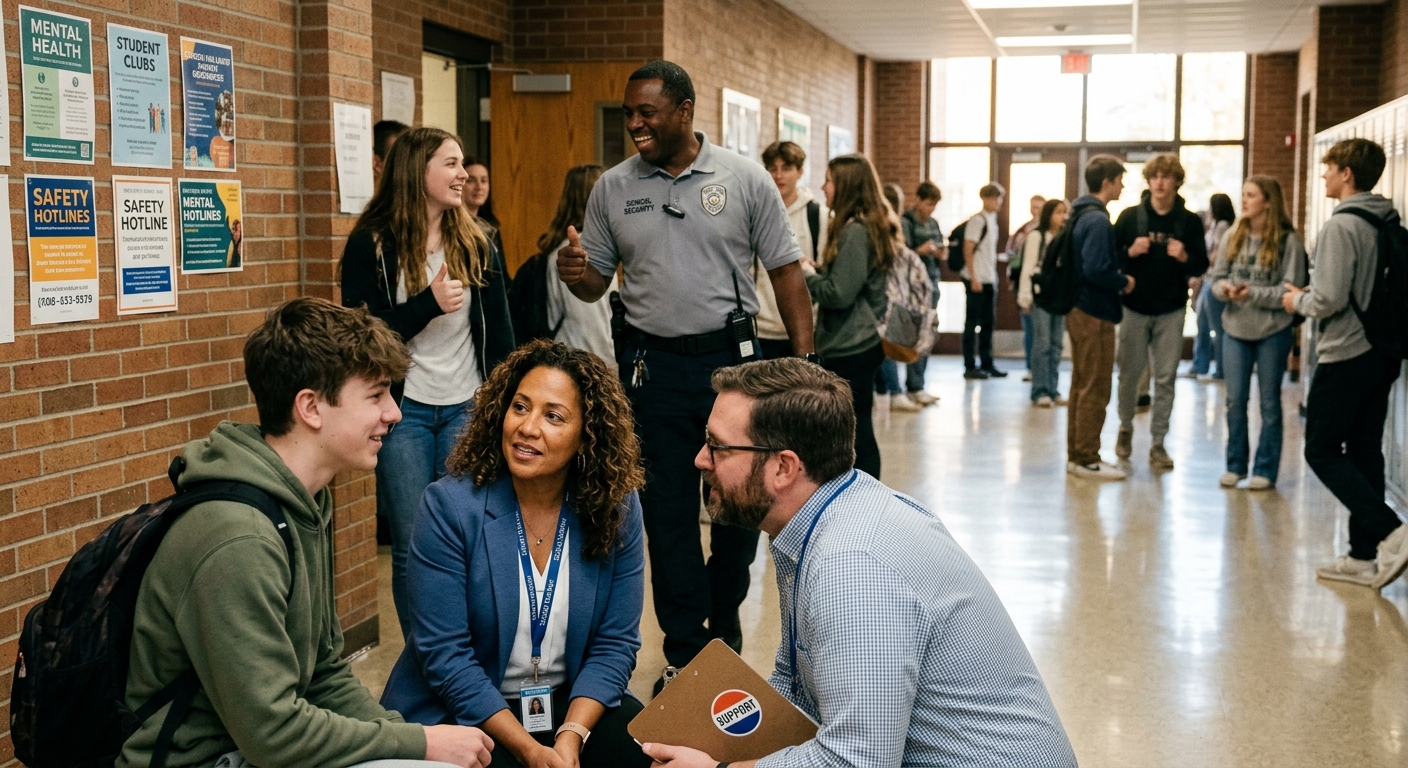
The debate surrounding school safety in the United States has reached a critical juncture. For decades, the default response to rising concerns over campus security, behavioral issues, and community violence was to vastly increase the presence of law enforcement within educational institutions. Armed school resource officers (SROs) became a ubiquitous fixture in school hallways across the country, fundamentally altering the traditional educational environment. However, a robust and growing body of evidence, alongside vocal advocacy from educators, civil rights leaders, and mental health professionals, suggests that this punitive, law-enforcement-first approach is fundamentally flawed. Rather than fostering an atmosphere of safety and academic focus, the militarization and policing of public schools have inadvertently cultivated a hostile climate that disproportionately penalizes the most vulnerable youth in our society.
Transitioning toward a holistic, developmentally appropriate model that prioritizes mental health support, specialized counseling, and restorative practices is not merely an alternative educational strategy; it is an urgent moral necessity. Nurturing a truly safe and healthy school requires communities to invest in trained professionals who understand adolescent psychology, trauma responses, and crisis de-escalation, rather than personnel trained primarily in the enforcement of criminal law. By pivoting from punishment to proactive support, schools can become genuine sanctuaries for learning and personal growth.
The Anatomy of the School-to-Prison Pipeline
Central to the modern critique of school-based policing is the well-documented sociological and educational phenomenon known as the “school-to-prison pipeline.” This term describes the disturbing and systemic trajectory where children are funneled out of public education systems and directly into juvenile and adult criminal justice systems. The pipeline is heavily fueled by “zero-tolerance” policies and the direct involvement of law enforcement in routine disciplinary matters that were historically managed internally by teachers and school administrators.
When an armed police officer is designated as the primary responder to a student’s classroom outburst, insubordination, or minor scuffle, the consequences escalate dramatically. What might have resulted in an after-school detention, a meeting with a school counselor, or a parent-teacher conference a generation ago can now result in an arrest, the creation of a juvenile record, and a devastating disruption to a student’s entire academic journey. Extensive educational research indicates that the mere presence of police in schools actually increases the likelihood that students will be arrested for minor, non-violent offenses. This criminalization of typical, albeit challenging, adolescent behavior shifts the fundamental focus of educational institutions from nurturing and cognitive development to strict surveillance, behavioral control, and legal punishment.
Disproportionate Burdens on Marginalized Youth
The harsh consequences of school policing do not fall equally or randomly across the student population. Empirical data reveals staggering demographic disparities, demonstrating with alarming clarity that students of color and students with diagnosed disabilities bear the absolute brunt of punitive enforcement on school grounds. This dynamic essentially creates a two-tiered educational system where marginalized students are managed by law enforcement, while their peers are managed by educators.
The Criminalization of Disability
For students with disabilities, the presence of police in schools is particularly perilous. Children operating with individualized education programs (IEPs) or those managing behavioral, emotional, intellectual, or developmental disabilities often exhibit behaviors that require specialized therapeutic interventions. When an SRO—who typically lacks extensive training in special education, neurodivergence, or psychological de-escalation tactics—responds to a behavioral crisis, the situation frequently deteriorates. Actions that are direct manifestations of a student’s disability—such as an inability to regulate emotions, sensory overload meltdowns, avoiding eye contact, or difficulty following sudden verbal commands—are routinely misinterpreted as active defiance, disorderly conduct, or even physical assault.
Consequently, students with physical and cognitive disabilities are arrested at vastly disproportionate rates compared to their non-disabled peers. Instead of receiving the emotional, psychological, and behavioral supports explicitly mandated by federal education laws, they are frequently handcuffed, detained, and subjected to the compounding trauma of the criminal justice system. This dynamic not only violates the core spirit of equitable education but also inflicts deep psychological harm, permanently eroding the trust between these students, their families, and the educational system that was designed to serve them.
Racial Inequities in Disciplinary Actions
Similarly, the impact of school policing on Black, Indigenous, and other students of color is profound and deeply systemic. Civil rights data and ongoing studies consistently demonstrate that minority students are significantly more likely to attend schools with a heavy police presence and far less likely to have access to adequate mental health resources, such as school psychologists or social workers. Implicit biases frequently influence the enforcement of highly subjective offenses like “insubordination,” “loitering,” or “disturbing the peace.”
As a direct result of these systemic biases, Black and Hispanic students face exponentially higher rates of exclusionary discipline (such as out-of-school suspensions and outright expulsions) and school-based arrests for behaviors that often go entirely unpunished or are handled quietly and internally when committed by their white classmates. This systemic inequity reinforces historical cycles of disenfranchisement, actively pushing marginalized youth out of the classroom environment and significantly diminishing their long-term prospects for higher education, stable employment, and economic mobility.
The True Cost of Cops in Classrooms
The decision to allocate scarce public educational funding to law enforcement rather than student support services has profound financial, academic, and social implications. Across the nation, public school districts spend billions of taxpayer dollars annually to station police officers on campuses. This massive investment in security apparatuses almost always comes at the direct expense of hiring essential educational support personnel. As a result, many schools operate with glaring deficiencies in their support staff, miserably failing to meet the minimum ratios established and recommended by professional educational associations.
| Essential Support Role | Nationally Recommended Ratio (Staff to Students) | Typical Reality in Policed School Districts |
|---|---|---|
| School Counselors | 1 : 250 | 1 : 400+ |
| School Psychologists | 1 : 500 | 1 : 1,200+ |
| Clinical Social Workers | 1 : 250 | 1 : 2,000+ |
In countless districts where SRO budgets exceed millions of dollars, the severe lack of counselors and social workers is a stark reflection of heavily misaligned community priorities. Students actively grappling with severe trauma, deep poverty, intense bullying, or acute mental health crises are left entirely without a safety net, making them far more susceptible to academic failure and subsequent behavioral issues. By defunding school policing and aggressively redirecting those funds toward comprehensive mental health resources, districts can actively address the root causes of student misconduct rather than merely penalizing the outward symptoms.
Evidence-Based Alternatives: Leading with Support
Reimagining school safety requires the complete implementation of evidence-based alternatives that actively foster a supportive, empathetic, and highly inclusive environment. The transition away from punitive policing necessitates the rapid construction of a robust infrastructure of professionals equipped to handle the complex psychosocial needs of modern students.
- Prioritizing Mental Health Services: Investing heavily in school psychologists, clinical social workers, and behavioral interventionists is absolutely paramount. These highly educated professionals are specifically trained to identify underlying traumas, undiagnosed learning disabilities, and mental health struggles that frequently manifest as disruptive behavior. By providing targeted therapeutic interventions, immediate crisis management, and individualized behavioral support plans, schools can preemptively address personal issues long before they escalate into conflicts requiring drastic disciplinary action.
- Fostering Restorative Justice Practices: Restorative justice offers a powerful, proven alternative to traditional exclusionary discipline. Rather than simply punishing a student for a transgression and isolating them, restorative practices focus intently on open mediation, personal accountability, and repairing the communal harm. When conflicts arise, involved students are strongly encouraged to participate in peer mediation or structured restorative circles, guided by trained facilitators. This empathetic approach helps students deeply understand the impact of their actions, develops vital emotional intelligence, and builds a stronger, more cohesive school community. Research shows that schools fully implementing restorative justice experience significant reductions in suspension rates and marked improvements in overall school climates.
- Implementing Trauma-Informed Care: A trauma-informed approach to public education recognizes that a significant portion of the student body has experienced severe adverse childhood experiences (ACEs), such as physical abuse, emotional neglect, persistent community violence, or extreme poverty. Educators and support staff explicitly trained in trauma-informed care clearly understand how these traumatic experiences directly alter brain development and subsequent behavior. Instead of aggressively asking a disruptive student, “What is wrong with you?” the fundamental paradigm shifts to a place of understanding: “What happened to you?” This empathetic framework actively prevents the re-traumatization of highly vulnerable students and fosters a nurturing environment where all children feel physically and emotionally safe to learn.
Legislative Movements and the Path Forward
Recognizing the deeply detrimental impacts of the school-to-prison pipeline, there is currently a rapidly growing legislative and grassroots movement aiming to permanently untangle law enforcement from public education. Powerful advocacy groups, parents, and major civil rights organizations are enthusiastically spearheading organized efforts to draft and pass legislation that explicitly limits, or entirely removes, police presence in our schools.
Federal proposals seek to decisively divert funding away from the hiring and deployment of school police, instead providing substantial grants to local districts to employ qualified mental health practitioners and implement robust restorative justice programs. At the municipal and district levels, several major metropolitan school districts have already taken the bold, progressive step of formally ending their contracts with local police departments. They are subsequently reallocating those multi-million dollar budgets to hire hundreds of new academic counselors and clinical social workers.
These crucial policy shifts reflect a much broader societal recognition that true, lasting safety is not realistically achieved through armed guards, strict surveillance, and metal detectors, but rather through deep community investment, unwavering emotional support, and a steadfast commitment to the holistic well-being of every single child.
Frequently Asked Questions (FAQs)
What exactly is a School Resource Officer (SRO)?
A School Resource Officer is a fully sworn, armed law enforcement officer who is specifically assigned to provide safety and crime prevention within public schools. While they are sometimes loosely tasked with student mentoring or teaching, their primary, rigorous training is rooted heavily in the criminal justice system, which inherently leads to the criminalization of what is often typical student misbehavior.
How does police presence uniquely affect students with disabilities?
Students with disabilities are significantly and disproportionately arrested in educational settings. Behaviors that are directly linked to underlying conditions like autism spectrum disorder, ADHD, or emotional disturbances are frequently treated as criminal acts—such as “disorderly conduct” or “assault”—by SROs who critically lack specialized de-escalation techniques and special education training.
What does the term “school-to-prison pipeline” mean in practice?
The school-to-prison pipeline is a term that refers to a web of national policies and systemic practices—most notably including zero-tolerance disciplinary policies and the heavy use of police in schools—that actively push students out of the classroom environment and directly into the juvenile and adult criminal justice systems, severely damaging their life prospects.
If police are completely removed from schools, how will physical safety be maintained?
Schools can successfully maintain rigorous physical safety by heavily investing in comprehensive, well-practiced emergency response plans, highly secure building infrastructure, and robust violence prevention programs. By employing an adequate number of mental health professionals and restorative justice coordinators, schools are better equipped to identify, mediate, and diffuse potential threats and emotional crises long before they escalate into actual physical violence.
Conclusion: Investing in Our Children’s Futures
The future of true educational equity in this country depends entirely on dismantling the overly punitive structures that have systematically alienated and criminalized marginalized students for decades. Genuine school safety is found in an environment where absolutely every student, regardless of their race, socioeconomic background, or disability, possesses the vital resources they need to thrive mentally, emotionally, and academically. Replacing school policing with robust, evidence-based student support systems is a critically necessary step toward permanently breaking the school-to-prison pipeline. It is long past time for communities to invest deeply in counselors, social workers, and therapeutic resources, rather than cops, to cultivate a generation of healthy, supported, and ultimately successful learners.
References
- School health predictors of the school-to-prison pipeline: substance use and developmental risk and resilience factors — PubMed Central (PMC). 2022-04-18. https://www.ncbi.nlm.nih.gov/pmc/articles/PMC9014565/
- The School to Prison Pipeline Assessment — Virginia Board for People with Disabilities. 2022-06-30. https://www.vaboard.org/wp-content/uploads/2022/07/2022-School-to-Prison-Pipeline-Assessment.pdf
- “Defund the (School) Police”? Bringing Data to Key School-to-Prison Pipeline Claims — Scholarly Commons, Cornell Law School. 2021-01-01. https://scholarship.law.cornell.edu/facpub/1734/
- The Growing Concerns Regarding School Resource Officers — Education Resources Information Center (ERIC). 2018-01-01. https://eric.ed.gov/?id=EJ1174676
Similar Articles








Read full bio of medha deb




