
Broadcasting, Censorship, and the First Amendment
How FCC rules and the First Amendment shape broadcast censorship.
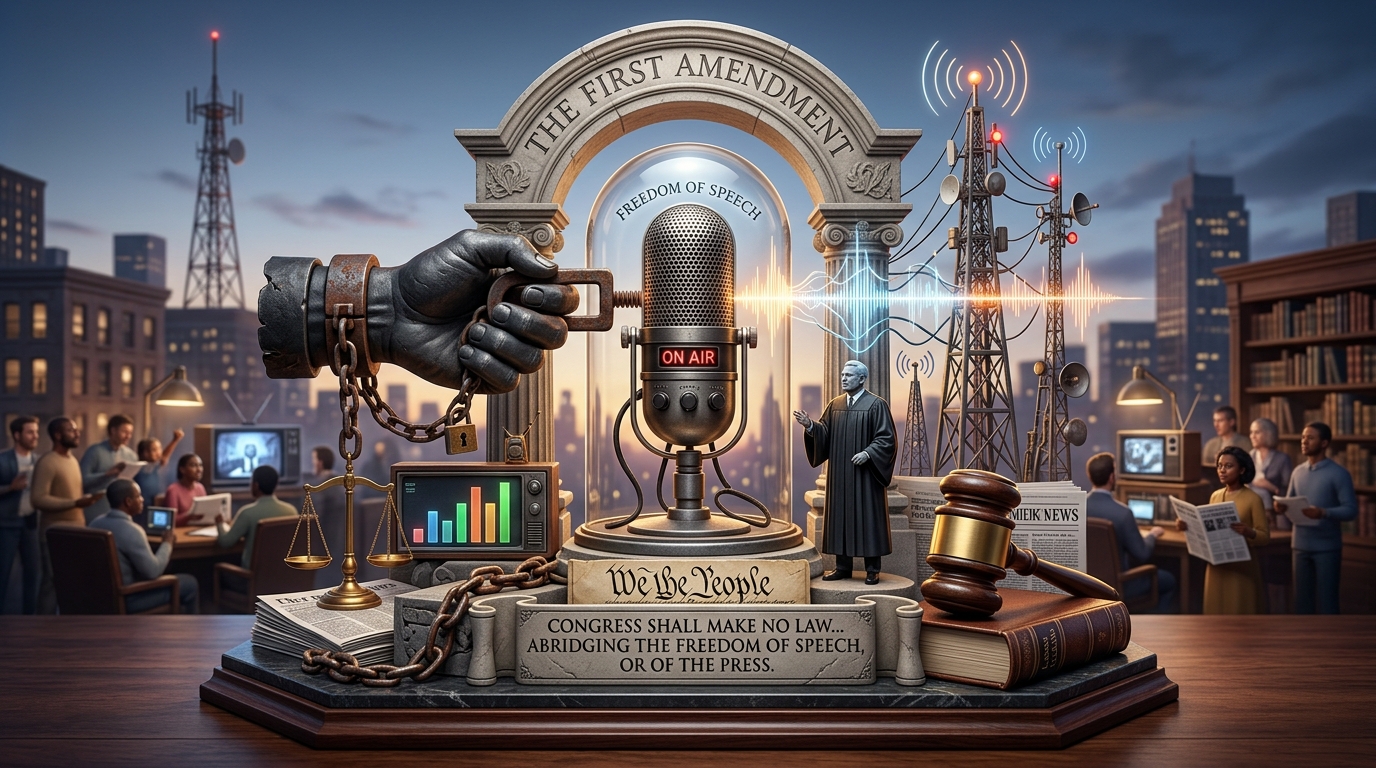
The Intersection of Free Expression and Public Airwaves
Free speech serves as a foundational pillar of democratic society, but its application across different communication mediums remains a highly complex legal terrain. While citizens enjoy robust First Amendment protections when speaking in the public square, the legal parameters shift dramatically when that speech is transmitted across public broadcast airwaves. The inherent tension between preventing offensive material and safeguarding free expression has fueled decades of legal battles and intense philosophical debates about the federal government’s role in policing language. When a live television broadcast is suddenly interrupted by an unexpected, unscripted expletive, the fallout is rarely limited to a momentary shock for viewers; it almost always triggers a cascade of rigorous constitutional inquiries.
Are federal agencies justified in leveling massive financial penalties for a single curse word? Or does this regulatory heavy-handedness violate the core tenets of the First Amendment by creating an atmosphere of fear, timidity, and self-censorship among broadcasters? Navigating these boundaries requires examining the history of broadcast law, the evolution of federal enforcement standards, and the shifting technological landscape that continues to redefine how Americans consume media. In the digital era, traditional television networks face immense pressure to stay relevant, making these regulatory burdens even more controversial.
The Legal Foundation of Broadcast Regulation
To fully grasp the intricate dance between free speech and broadcasting, one must first look at the foundational laws governing the public airwaves. Unlike cable television, subscription satellite radio, or the boundless frontiers of the internetwhich operate on private networks or require direct consumer subscriptiontraditional terrestrial radio and television stations utilize the electromagnetic spectrum. The federal government has long considered this spectrum to be a scarce public resource, meaning broadcasters must obtain federal licenses to use it and agree to serve the broader public interest.
Under 18 U.S.C. 7 1464, it is explicitly classified as a federal crime to utter “any obscene, indecent, or profane language by means of radio communication.” The Federal Communications Commission (FCC) is the primary federal agency tasked with enforcing this statute, which it manages by classifying questionable material into three distinct regulatory categories:
- Obscenity: This category includes material that meets the Supreme Court’s rigorous three-pronged Miller test, which specifically evaluates whether a work appeals to a prurient interest, depicts sexual conduct in a patently offensive way, and lacks serious literary, artistic, political, or scientific value. Obscenity is completely stripped of First Amendment protection and is universally banned from being broadcast at all times.
- Indecency: Indecent material generally depicts or describes sexual or excretory organs or activities in terms that are patently offensive, as measured by contemporary community standards for the broadcast medium. While indecent material retains First Amendment protection, it is heavily restricted to the “safe harbor” hours (between 10:00 p.m. and 6:00 a.m.) when children are deemed significantly less likely to be watching or listening.
- Profanity: This category encompasses language so grossly offensive to members of the public who actually hear it that it amounts to a public nuisance. Similar to indecency, profanity is restricted entirely to the late-night safe harbor hours.
The primary rationale behind these strict restrictions stems from the idea that broadcasting is uniquely pervasive. It enters the home directly and uninvited, making it effortlessly accessible to unsupervised children. However, the exact boundaries defining what constitutes “patently offensive” material have never been permanently fixed, leaving broadcasters to navigate an ever-shifting, highly subjective regulatory landscape.
The Rise of the “Fleeting Expletive”
For many years, the FCC operated with a somewhat restrained and pragmatic enforcement policy. A passing, isolated expletiveoften referred to in legal terms as a “fleeting expletive”was generally tolerated, especially if it was an unscripted moment occurring during a live broadcast. The Commission tacitly recognized the practical realities and chaotic nature of live television, where a delayed tape mechanism or an audio bleep censor might occasionally miss a sudden outburst from an emotional guest.
This relatively lenient approach changed in a dramatic fashion during the early 2000s. Following several high-profile incidents where famous musicians dropped celebratory expletives during live, primetime awards show broadcasts, a wave of public backlash and intense political pressure prompted a swift regulatory reversal. The Commission altered its stance, declaring that certain profane words inherently possessed a sexual connotation regardless of the broader context in which they were used, and established that even a single, isolated use could trigger severe enforcement action.
This aggressive policy shift sent shockwaves throughout the entire broadcasting industry. Suddenly, major networks and local affiliates were put on high alert: any unscripted profanity uttered by an interview subject, an athlete celebrating a victory, or an actor presenting an award could result in devastating financial fines. The FCC’s unprecedented decision to treat fleeting expletives as actionable indecency marked a profound escalation in the federal policing of the airwaves, setting the immediate stage for one of the most significant First Amendment clashes of the modern era.
The Legal Showdown in the Courts
When regulatory agencies begin enforcing vaguely defined standards using the overarching threat of ruinous penalties, intense legal friction is the inevitable result. When the FCC began issuing notices of apparent liability and levying massive fines against networks for isolated swear words, the broadcasters aggressively pushed back. They argued that the new rules were arbitrary, capricious, and unconstitutionally vague, leaving them without clear guidance on how to comply.
The ensuing legal battle ultimately culminated in FCC v. Fox Television Stations, a complex and protracted judicial saga that required multiple trips to the United States Supreme Court. The initial phase of this historic litigation focused strictly on administrative law. In 2009, the Supreme Court ruled that the FCC had not violated the Administrative Procedure Act by changing its longstanding policy on fleeting expletives. The Court held that an agency possesses the authority to reverse its prior precedents, provided it explicitly acknowledges the change and offers a reasoned explanation for the new policy direction.
However, the 2009 Supreme Court decision deliberately left the core constitutional questions regarding free speech completely unanswered. The broadcasters subsequently returned to the lower courts, forcefully arguing that the indecency policy violated both the First Amendment and the Due Process Clause because the standards were incomprehensibly vague. In 2012, the Supreme Court issued a more definitive ruling on the practical application of the policy. The Court determined that the FCC had fundamentally failed to give the networks fair and advance notice that fleeting expletives could be deemed legally indecent under the revised policy before the broadcasts actually occurred. Because the rules lacked clear warning, the FCC’s fines violated the Due Process Clause. Notably, the Court side-stepped issuing a sweeping First Amendment ruling that would strike down the entire indecency regime, leaving the FCC’s underlying regulatory authority technically intact, but strictly demanding unambiguous guidelines for future enforcement.
The Chilling Effect on Free Expression
The true danger of vague regulations backed by steep fines is the resulting “chilling effect” on free speech. Broadcasters, driven by an existential need to protect their valuable operating licenses and profit margins, are often forced to adopt a hyper-cautious, defensive approach to programming. Rather than risking a costly, drawn-out battle with the FCC, networks choose to over-censor, systematically stripping the public airwaves of content that is legally protected but deemed potentially risky. Small, local broadcasters are particularly vulnerable in this dynamic, as they lack the massive legal budgets and corporate backing of national conglomerates.
This culture of self-censorship directly harms the broader public interest by diluting the authenticity and cultural relevance of broadcast media. Consider the grave implications for live news reporting. If a seasoned journalist is interviewing a highly distressed citizen immediately following a natural disaster, the raw, emotional language used by that subject might naturally include expletives. Under a strict, zero-tolerance fleeting expletive policy, networks are compelled to implement overly aggressive tape delays, artificially sanitizing vital news events, or they may simply refuse to cover certain live, unpredictable events altogether.
Furthermore, artistic expression suffers immeasurably when creators are forced to walk on eggshells. Documentaries exploring gritty historical subjects, dramatic portrayals of military life, and live theatrical performances all face an elevated risk of federal censorship. The First Amendment exists specifically to prevent this exact kind of government-induced timidity. When the fear of federal retribution dictates editorial and creative choices, the diversity of thought and expression available to the American public is severely diminished.
Empowering Parents Over Government Mandates
A recurring and highly persuasive theme in the defense of broad free speech rights is the assertion that the federal government should not attempt to serve as a universal surrogate parent to the nation’s children. While the protection of minors is undeniably a compelling and universally recognized societal interest, empowering the FCC to strip the broadcast airwaves of anything deemed inappropriate for children fundamentally results in reducing the adult population to viewing only what is strictly fit for a child’s consumption.
Fortunately, modern technology provides a highly effective alternative to centralized government censorship. Over the past few decades, the development and widespread consumer adoption of parental control technologies have revolutionized how modern families consume media:
- The V-Chip: Mandated by federal law to be included in all television sets 13 inches or larger manufactured after the year 2000, the V-Chip allows parents to effortlessly block programming based on standardized age and content ratings.
- Set-Top Box Locks: Cable providers and satellite networks offer highly customizable, PIN-protected blocks for specific channels, distinct time periods, or specific content ratings.
- Smart TV Profiles: Modern television interfaces allow for the creation of detailed user profiles, ensuring that children can only access carefully curated, age-appropriate content tailored to them.
These technological tools are highly effective, culturally neutral, and deeply respect the autonomy of individual families. Media literacy campaigns heavily complement these tools, helping parents actively discuss mature themes with their children rather than relying on the government to hide them. Relying on parents to thoughtfully monitor their own households is a constitutionally sound approach that honors the First Amendment while successfully protecting vulnerable youth.
The Technological Shift and the Future of Broadcasting
The ongoing legal and cultural debate over the FCC’s broadcast indecency rules is increasingly viewed through the lens of technological obsolescence. The original core justification for broadcast regulationspectrum scarcity and the uniquely pervasive intrusiveness of traditional televisionfeels completely disconnected from today’s expansive modern media landscape.
Contemporary consumers rarely differentiate between watching traditional broadcast networks and streaming content on digital platforms. A viewer watching a major network drama using a digital antenna and then switching to a streaming service like Netflix experiences an utterly seamless technological transition. Yet, the legal standards governing those two platforms reside in entirely different legal universes. Subscription-based streaming services and premium cable networks are generally free to produce and distribute compelling content featuring adult themes, explicit profanity, and nudity without any fear of FCC fines.
As terrestrial broadcasting continues to steadily lose market share to heavily unregulated digital platforms, the strict enforcement of indecency rules against traditional broadcast networks places them at a severe and potentially fatal competitive disadvantage. The major question currently facing policymakers and federal courts is whether the traditional regulatory framework can actually survive in an era defined by infinite media abundance. Many legal scholars persuasively argue that the Supreme Court will inevitably be forced to revisit the foundational precedents that currently allow the FCC to police broadcast content, potentially aligning those outdated broadcast standards with the robust First Amendment protections already enjoyed by the internet and print media.
Conclusion
The complex intersection of traditional broadcasting, profanity regulations, and the First Amendment remains one of the most dynamic, unresolved areas of American constitutional law. While the desire to maintain a baseline level of decorum on the public airwaves is culturally understandable, the specific mechanisms utilized by the government to enforce that decorum must be heavily and continuously scrutinized to prevent the gradual erosion of free speech. The lengthy legal battles over fleeting expletives highlight the inherent dangers of vague regulations and the profound chilling effect that arbitrary enforcement inevitably has on journalists, artists, and independent media companies. Moving forward, a delicate balance must be struckone that fundamentally respects the rights of parents to protect their children using modern technology, without simultaneously allowing the federal government to impose an artificially sanitized reality on the adult public. As advancing technology continues to completely blur the lines between broadcast and broadband, the traditional rationales for federal censorship will undoubtedly face unprecedented constitutional pressure.
Frequently Asked Questions
What is the legal difference between obscenity, indecency, and profanity?
Obscenity refers to an extreme form of explicit material that lacks any serious literary, artistic, political, or scientific value. It is never protected by the First Amendment and is illegal to broadcast. Indecency involves material depicting sexual or excretory activities that is considered “patently offensive” but still possesses basic First Amendment protection; therefore, it can be broadcast during late-night hours. Profanity refers specifically to grossly offensive language, which is regulated similarly to indecency.
Does the FCC regulate streaming services like Netflix or Hulu?
No. The FCC’s indecency and profanity regulations strictly apply only to traditional terrestrial broadcasters that utilize the public airwaves (such as local affiliates for major networks). Subscription-based streaming services and premium cable networks operate on private, opt-in models and are not subject to these content decency rules.
What exactly constitutes a “fleeting expletive”?
A fleeting expletive is a brief, isolated, and most often unscripted use of a profane word during a live television or radio broadcast. The core legal debate surrounding them centers on whether the FCC can legally penalize a broadcaster for a single, accidental utterance that inadvertently slips past network censors.
Why is broadcast television regulated more strictly than print or internet media?
Historically, the Supreme Court justified the stricter regulation of broadcast media due to the concept of “spectrum scarcity” (the finite, limited number of available radio frequencies) and the “pervasive” nature of broadcasting, which enters homes automatically. Print media and the internet do not share these specific operational characteristics and thus receive maximum First Amendment protection from censorship.
Can the FCC fine individuals who swear on live TV?
No. The FCC’s jurisdictional authority over indecency and profanity extends solely to the official broadcast licensee (the specific station or television network transmitting the signal), not to the individual guest, professional athlete, or actor who actually utters the profanity on air.
References
- Obscene, Indecent and Profane Broadcasts Federal Communications Commission. 2021-01-13. https://www.fcc.gov/consumers/guides/obscene-indecent-and-profane-broadcasts
- 18 U.S. Code 7 1464 – Broadcasting obscene language Cornell Law School. 1948-06-25. https://www.law.cornell.edu/uscode/text/18/1464
- FCC v. Fox Television Stations, Inc. Oyez. 2009-04-28. https://www.oyez.org/cases/2008/07-582
- FCC v. Fox Television Stations Oyez. 2012-06-21. https://www.oyez.org/cases/2011/10-1293
Similar Articles








Read full bio of Sneha Tete


