
Breathalyzer Calibration and Your DUI Case
Learn how breathalyzer calibration, maintenance records, and testing procedures can make or break the evidence in a DUI prosecution.
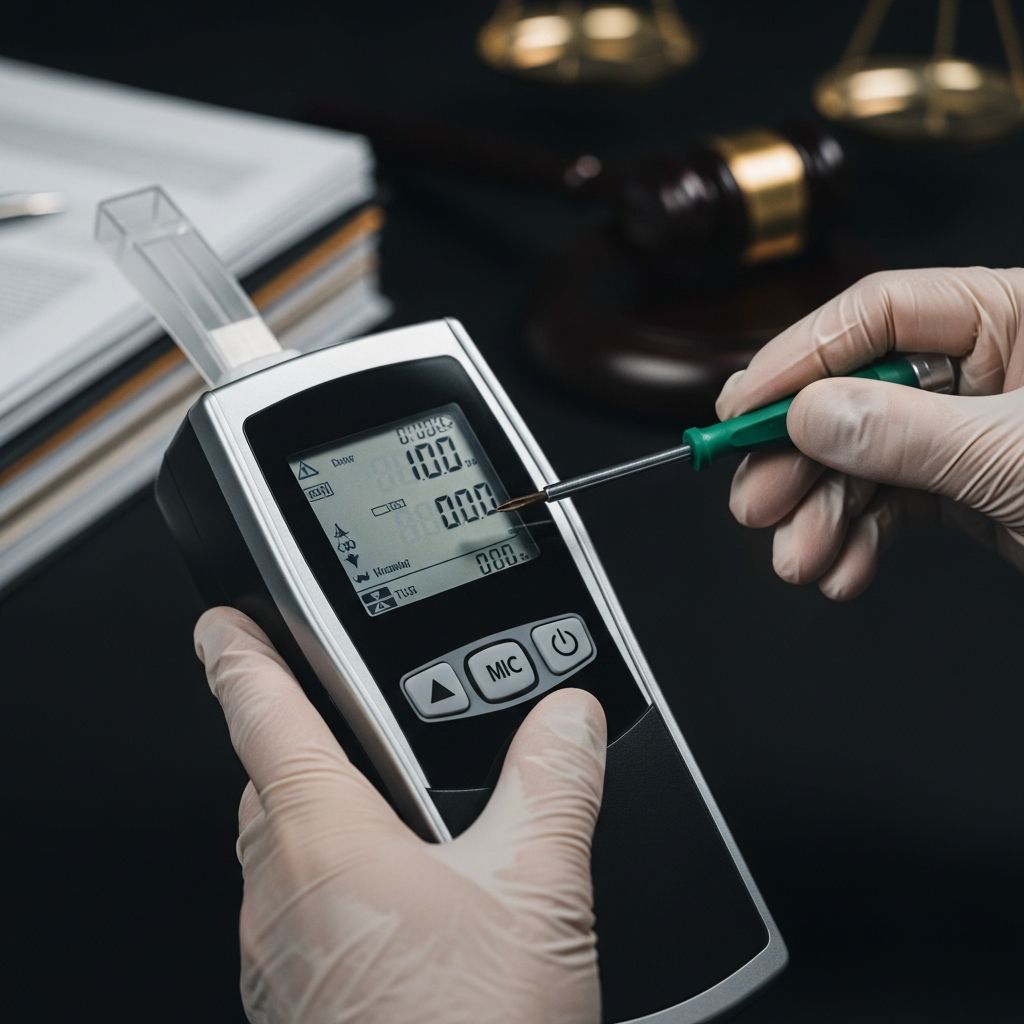
Breathalyzer devices are central to many drunk driving prosecutions, yet their blood alcohol concentration (BAC) readings are only as reliable as the underlying calibration and maintenance. When a device is out of adjustment, used incorrectly, or poorly documented, the test result may be inaccurate and open to legal challenge.
This guide explains what calibration is, why it matters, and how problems with a breathalyzer can affect the outcome of a DUI case.
How Breathalyzers Measure Alcohol
A modern breathalyzer estimates the amount of alcohol in a person’s blood by analyzing a sample of deep-lung (alveolar) air. The device then converts this breath alcohol content (BrAC) into an approximate BAC value using a legally accepted ratio.
Although different models use different technologies, most evidential breath test machines used by law enforcement rely on:
- Chemical reactions that change color or electrical current when exposed to alcohol
- Infrared spectroscopy, where the device measures how alcohol molecules absorb infrared light
- Electrochemical (fuel cell) sensors, which produce an electrical signal proportional to the amount of alcohol
Over time, sensors can drift, electronic components can wear, and software may require periodic adjustment. Calibration is designed to correct these changes so that readings stay within acceptable tolerance ranges.
What Calibration Means in Practice
Calibration is the process of checking and adjusting a breathalyzer so that its readings match known, certified alcohol concentrations. This is usually done using an alcohol reference standard supplied by an approved manufacturer or laboratory.
In a typical calibration procedure, a trained technician will:
- Connect the device to a known alcohol standard (often a gas or solution with a certified concentration)
- Run one or more test cycles to see what BAC the machine reports
- Compare the reported value to the known value
- Adjust the instrument’s internal settings until the readings fall within a legally defined tolerance range
- Document the date, time, technician identity, and results
States generally require that only appropriately trained or certified personnel perform this work, and that law enforcement agencies keep calibration documentation for specified periods.
Legal Standards and Regulatory Requirements
Because breath tests are used as evidence in criminal cases and license suspension proceedings, their use is governed by detailed regulations. These rules vary by state, but they typically cover:
- Approved instruments: Only devices on an approved list may be used for evidential testing in DUI cases.
- Calibration frequency: States specify how often breathalyzers must be checked and recalibrated (e.g., every few days, weekly, or after a number of uses).
- Permitted tolerance: Regulations set allowable deviation between the device’s reading and the known standard (for example, within a small fraction of a percent).
- Maintenance and recordkeeping: Agencies must keep logs showing calibration, maintenance, and any repairs over time.
- Operator training: Officers operating the devices must hold appropriate certifications and follow prescribed testing protocols.
| Regulatory Aspect | Typical Requirement | Why It Matters in Court |
|---|---|---|
| Calibration interval | Recalibration at set time or use intervals | Shows device was accurate on the test date |
| Operator certification | Officer trained and certified on that model | Ensures test followed approved procedures |
| Maintenance logs | Detailed records of checks and repairs | Allows defense to verify reliability history |
| Duplicate breath samples | Two readings within a narrow range | Consistency supports reliability of result |
How Often Must Breathalyzers Be Calibrated?
Calibration schedules are set by state law or agency regulation. Some jurisdictions require recalibration based on:
- Elapsed time (for example, at least once every few days or weekly)
- Number of tests (for example, after a fixed number of uses)
- Events such as repairs, software updates, or sensor replacement
As one example, California requires that evidential breath testing instruments be verified for accuracy at regular intervals and that records of these checks be retained. Other states have similar regimes specifying the maximum time between accuracy checks and who may perform them.
If a device was not calibrated according to applicable regulations at the time of a DUI arrest, the defense may argue that its results are unreliable and should be excluded or given little weight.
Common Calibration and Maintenance Problems
Even when a breathalyzer is on an approved list, it can produce misleading results if it is not maintained correctly. Common issues raised in DUI challenges include:
- Overdue calibration: The machine was not checked within the interval specified by law or policy.
- Failed or questionable accuracy checks: Logs show test results outside acceptable tolerance, without adequate follow-up.
- Incomplete or missing documentation: Gaps in calibration or maintenance records make it difficult to prove the device’s reliability.
- Unqualified technicians: Calibration performed by someone lacking required credentials or training.
- Software or firmware errors: Known issues with particular models that can affect readings if not corrected.
- Lack of routine maintenance: Failure to replace parts, clean components, or update software as recommended by manufacturers and regulators.
In some reported cases, systemic calibration errors have affected large groups of tests before being discovered, leading to reviews or dismissals of multiple DUI cases.
Procedural Requirements During a Breath Test
Calibration is only one part of a larger framework of testing procedures. For an evidential breath test to be considered reliable, officers typically must:
- Observe the subject for a specified deprivation period (often 15–20 minutes) to ensure no eating, drinking, or regurgitation that could affect the sample
- Use a device that is currently in service and shows no error codes
- Follow the manufacturer’s and agency’s step-by-step instructions for operating the device
- Obtain two separate breath samples within a narrow range of each other (such as within 0.02% BAC) to confirm consistency
- Document the time of each sample, the results, and any unusual circumstances
Deviations from these procedures may not automatically invalidate the test, but they often provide grounds for cross-examination and, in some situations, a motion to suppress the results.
Why Calibration Matters So Much in DUI Defense
Breath test numbers can have serious consequences: criminal convictions, license suspensions, fines, and even incarceration. Because of this, courts often scrutinize whether the state complied with calibration and maintenance rules before admitting test results.
Calibration matters in several ways:
- Accuracy of BAC value: A small shift in calibration can be the difference between a result just below or just above the legal limit.
- Admissibility of evidence: If the government cannot prove that its device was properly calibrated, judges may exclude the readings or limit their use.
- Weight of the evidence: Even if admitted, questionable calibration may cause a fact-finder to give less weight to the BAC reading compared to other evidence.
Defense attorneys often investigate calibration issues early in a case, because uncovering a serious problem with the device can significantly change plea discussions or trial strategy.
How Defense Lawyers Challenge Breathalyzer Calibration
Lawyers defending DUI charges frequently use a structured approach to examine and challenge breathalyzer evidence. Common steps include:
- Requesting discovery of calibration, maintenance, and repair records for the specific device used
- Reviewing logs for missed calibration dates, out-of-range checks, or unexplained entries
- Comparing records to statutory and regulatory requirements for that jurisdiction
- Consulting experts in forensic toxicology or breath testing technology to interpret logs and procedures
- Filing motions to suppress the breath test if violations are significant enough to call reliability into question
In some cases, even relatively small deviations from required protocols—such as failing to perform an accuracy check within the specified time frame—have been used successfully to challenge the reliability of test results.
Other Factors That Can Affect Breath Test Accuracy
Calibration and maintenance are not the only issues that can produce a misleading BAC reading. While regulations attempt to minimize error, several additional factors may be relevant in a DUI defense:
- Residual mouth alcohol: Recently consumed alcohol or products like mouthwash can temporarily elevate readings unless adequate observation periods are followed.
- Physiological differences: Certain medical conditions or variations in breathing patterns may influence results.
- Environmental conditions: Temperature, humidity, and interfering substances may affect specific models if not properly controlled.
- Instrument-specific issues: Some models have known idiosyncrasies or manufacturer advisories that may require special handling.
Defense attorneys often examine both device-related issues (such as calibration) and person-specific factors to build a comprehensive challenge to the government’s case.
Practical Steps if You Are Facing a DUI Based on a Breath Test
If you are charged with DUI and the case involves a breathalyzer result, there are practical actions you can discuss with qualified counsel:
- Determine which device model was used and whether it appears on your state’s approved list.
- Request full calibration and maintenance records for that machine over a meaningful period, not just the test day.
- Evaluate whether tests were conducted according to your state’s regulations and agency policies.
- Consider expert review of logs and procedures to identify technical issues.
- Discuss with your lawyer whether to file a motion to suppress or limit the use of the breath test evidence.
Challenging calibration does not guarantee that charges will be dismissed, but identifying weaknesses in breath test evidence can change the legal analysis, potential plea options, or the likelihood of success at trial.
Frequently Asked Questions (FAQs)
Does a calibration problem automatically throw out my DUI?
Not automatically. Courts will look at how serious the problem is and whether it undermines the reliability of your specific test. Some calibration issues may lead to exclusion of the breath result, while others may simply go to the weight the court or jury gives that evidence.
How can I find out if the breathalyzer was properly calibrated?
Your attorney can request device records through discovery or, if necessary, by subpoena. These records typically include dates of calibration checks, test results against known standards, maintenance entries, and any repairs.
Are police officers themselves responsible for calibration?
Procedures vary by state. In some jurisdictions, specialized technicians or health department staff handle full calibration, while officers perform routine accuracy checks before or after subject tests. In all cases, those performing calibration or checks must meet applicable training or certification requirements.
What if my two breath samples were far apart in value?
Regulations often require two test results that are within a small margin of each other (for example, within 0.02% BAC). Large discrepancies between samples may indicate a device, procedure, or subject-related issue and can be used to challenge the reliability of the test.
Can I refuse a breath test if I doubt the calibration?
Refusal laws are strict in many states. Declining a chemical test may carry its own penalties, such as automatic license suspension, regardless of whether the device was properly calibrated. Anyone facing this decision should be aware of their state’s implied consent laws and potential consequences.
References
- Ohio Administrative Code Chapter 3701-53: Alcohol Testing — Ohio Department of Health. 2021-08-01. https://codes.ohio.gov/ohio-administrative-code/chapter-3701-53
- National Highway Traffic Safety Administration (NHTSA) Model Specifications for Evidential Breath Testing Devices — NHTSA, U.S. Department of Transportation. 2013-05-09. https://www.nhtsa.gov/document/model-specifications-evidential-breath-testing-devices
- California Code of Regulations, Title 17, Division 1, Chapter 2, Subchapter 1: Alcohol Testing — California Office of Administrative Law. 2015-01-01. https://govt.westlaw.com/calregs/Browse/Home/California/CaliforniaCodeofRegulations
- Understanding Evidential Breath Alcohol Testing — National Safety Council, Alcohol, Drugs and Impairment Division. 2020-06-15. https://www.nsc.org/getattachment/29331c22-1b70-4d63-9f47-5d4dbe5a2c22/evidential-breath-testing.pdf
- Ensuring Accuracy: The Ins and Outs of Breathalyzer Calibration — Smart Start Inc. 2023-04-20. https://www.smartstartinc.com/blog/breathalyzer-calibration/
- Questioning Breathalyzer Calibration — LawInfo. 2023-02-10. https://www.lawinfo.com/resources/dui/questioning-breathalyzer-calibration.html
- Breath Test Device Maintenance and Calibration Records — Los Angeles Criminal Lawyer. 2022-09-05. https://www.losangelescriminallawyer.pro/breath-test-device-maintenance-and-calibration-records.html
Similar Articles








Read full bio of medha deb




