For most American citizens, returning home from an international trip is a mundane ritual characterized by long lines, a quick passport scan, and a welcoming wave from a customs officer. We live with the comforting assumption that our constitutional rights travel with us, serving as an invisible shield against government overreach. However, the reality at United States ports of entry is far more complex and significantly more perilous for civil liberties. The U.S. border operates under a unique legal framework where the standard protections of the Fourth Amendment are severely diluted. But how far can border agents go in the name of national security?
The tension between protecting the homeland and preserving the very democratic freedoms that define it has sparked intense legal battles. When federal agents exploit broad border authorities to subject American citizens to unwarranted, aggressive detentions, the psychological toll is profound. This article examines the delicate balance of power at the border, anchored by the harrowing ordeal of one American family who successfully fought back against a system that treated their constitutional rights as optional.
A Nightmare at the Northern Border
The theoretical limits of border authority became terrifyingly real for a Minnesota family in March 2015. Abdisalam Wilwal, Sagal Abdigani, and their four young children were driving back to the United States after visiting relatives in Saskatchewan, Canada. As they approached the border crossing at Portal, North Dakota, they expected a routine check . Instead, they were plunged into a traumatic, hours-long ordeal that shattered their sense of safety.
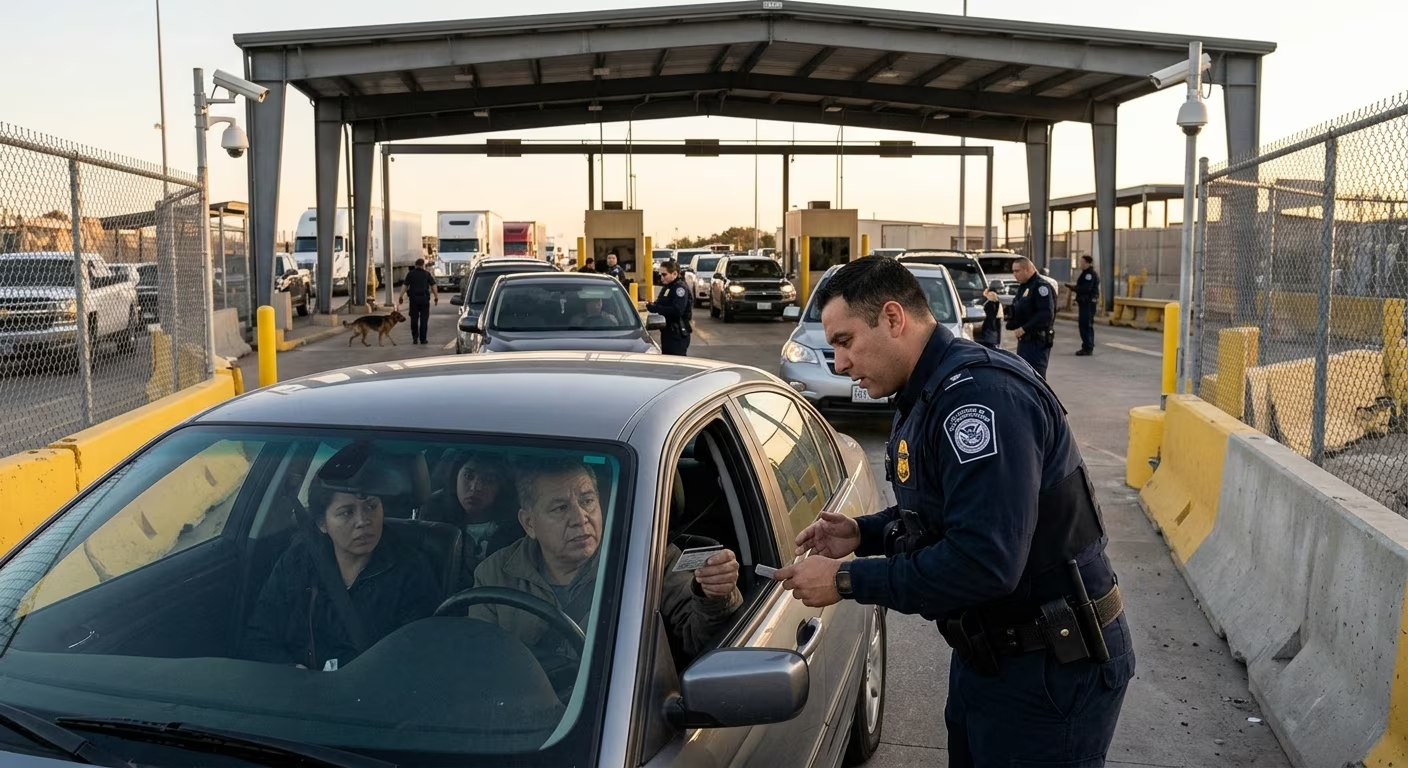
Shortly after handing over their U.S. passports and birth certificates to a Customs and Border Protection (CBP) officer, the situation escalated violently. Multiple agents swarmed the family’s minivan with their weapons drawn. Abdisalam Wilwal was ordered out of the vehicle and immediately placed in handcuffs while his children watched in horror .
For nearly eleven hours, Wilwal was held in a solitary room, handcuffed the entire time. The conditions were so severe that he eventually lost consciousness due to severe dehydration and a lack of food, requiring emergency medical intervention. Meanwhile, his wife and four children were detained in a separate, freezing area of the facility. Desperate and fearing for her family’s lives, Sagal Abdigani used her teenage son’s mobile phone to dial 911. Her attempt to seek outside help was thwarted when agents confiscated the phone, searched it, and informed her that everyone in the building—including the toddlers—were official detainees .
This aggressive response was not triggered by the discovery of illegal drugs, weapons, or any tangible evidence of criminal activity. Instead, it was sparked by a bureaucratic anomaly: Wilwal’s name had been flagged on a secretive government watchlist.
The “Border Search Exception” Explained
To understand how CBP agents can legally justify detaining citizens without a warrant, one must examine the “border search exception.” The Fourth Amendment of the U.S. Constitution strictly prohibits unreasonable searches and seizures, generally requiring law enforcement to obtain a warrant based on probable cause. However, the Supreme Court has long recognized that the government holds a sovereign right to protect its territorial integrity.
Under the border search exception, federal agents are permitted to conduct “routine” searches of individuals, luggage, and vehicles entering the country without a warrant or even individualized suspicion . The original intent of this exception was practical: to prevent the entry of contraband, undeclared merchandise, and individuals attempting to cross the border illegally.
The problem arises when the definition of “routine” is stretched to its absolute breaking point. While asking a traveler to open their suitcase is widely accepted as a routine border function, drawing firearms on a family and handcuffing a U.S. citizen for almost half a day crosses into the realm of a non-routine, deeply intrusive seizure. The courts have consistently maintained that while expectations of privacy are lowered at the border, they are not entirely extinguished.
The Digital Frontier: Searching Smartphones and Laptops
The complexities of the border search exception have been magnified by the digital age. Today, a traveler’s smartphone contains an unfathomable amount of deeply personal data—emails, financial records, medical histories, and intimate photographs. Recognizing this, the Supreme Court ruled in 2014 that police generally need a warrant to search a cell phone during a domestic arrest. Yet, at the border, CBP operates under older, broader mandates.
Recent statistics highlight the sheer volume of digital scrutiny at ports of entry. In Fiscal Year 2025, CBP conducted tens of thousands of electronic device searches . These range from basic manual searches—where an officer simply taps through an unlocked phone—to advanced forensic searches, where agents connect the device to external hardware to extract and analyze hidden data . Legal scholars and civil rights organizations continue to litigate these practices, arguing that applying a century-old luggage exception to modern electronics represents a catastrophic loophole in Fourth Amendment protections .
The Invisible Trap of the Terrorism Watchlist
The catalyst for the Wilwal-Abdigani family’s detention was not a suspicious item in their vehicle, but a silent trigger deep within a federal database. Following the September 11 attacks, the U.S. government rapidly expanded its intelligence-gathering apparatus, leading to the creation of massive, consolidated databases managed by entities like the FBI’s Threat Screening Center .
These terrorism watchlists currently contain over a million names. While the vast majority of individuals listed are foreign nationals with no connection to the United States, thousands of American citizens have found themselves ensnared in this digital dragnet. The criteria for inclusion are notoriously opaque, often relying on circumstantial associations, travel patterns, or unverified intelligence rather than concrete evidence of criminal intent .
The most egregious aspect of the watchlisting system is the almost total lack of due process. Individuals are not notified when they are placed on a watchlist, nor are they provided with the specific reasons for their inclusion . For Americans like Abdisalam Wilwal, the first indication of their watchlist status is usually a terrifying encounter with armed border agents. Furthermore, the administrative pathways to challenge and remove one’s name from these lists are complex, secretive, and frequently ineffective, leaving innocent travelers in a state of perpetual limbo.
The Legal Reckoning: Striking Back at CBP
Refusing to accept the trauma inflicted upon them as an unavoidable consequence of travel, the Wilwal-Abdigani family sought legal recourse. Supported by civil liberties advocates, they filed a lawsuit against the Department of Homeland Security and CBP leadership. The lawsuit argued that the extreme duration and conditions of their detention violated their Fourth Amendment rights, while the father’s placement on the watchlist without a mechanism to challenge it violated his Fifth Amendment right to due process .
In response, government attorneys deployed a familiar defense: they argued that because the incident occurred at an international port of entry, the officers’ actions were shielded by the border search exception. They essentially claimed immunity from constitutional scrutiny based purely on geography.
The federal judiciary firmly rejected this premise. The presiding judge issued a ruling making it unequivocally clear that the U.S. border is not a constitutionally hollow zone. Acknowledging the government’s interest in security does not grant federal agents a blank check to subject citizens to terrifying, marathon detentions without substantial justification .
The ensuing legal settlement forced significant concessions from CBP. The government agreed to provide financial compensation for the emotional and physical harm inflicted on the family. Crucially, the settlement also included institutional mandates, requiring CBP to clearly document that the family’s detention records would not be readily accessible in a manner that would hinder their future travel. This outcome served as a powerful judicial rebuke of unchecked border authority, establishing vital precedent for future travelers.
Protecting Yourself: A Traveler’s Guide
While the courts have affirmed that rights exist at the border, asserting them in the face of federal authority requires preparation and knowledge. Here is a breakdown of how your protections differ depending on your location:
| Legal Protection | Within the U.S. Interior | At the U.S. Border / Port of Entry |
|---|---|---|
| Physical Searches | Requires a warrant or probable cause of a crime. | Subject to “routine” warrantless searches of bags and vehicles without suspicion. |
| Device Searches | Warrant generally required to search phone contents. | Officers can demand unlocked phones for manual basic searches; forensic searches face growing legal pushback. |
| Detention | Cannot be held indefinitely without being formally charged. | Brief delays for questioning are standard; prolonged, punitive detention requires cause. |
| Right to Remain Silent | Fully protected under the Fifth Amendment. | Protected, but refusing to answer basic customs questions can lead to severe delays or secondary screening. |
Practical Steps if Stopped
- Stay Calm and Clarify: Do not escalate the situation physically. Ask the officer clarifying questions such as, “Am I being detained, or am I free to leave?”
- Password Protections: Understand that while CBP cannot deny a U.S. citizen reentry into the country, refusing to unlock your electronic devices can result in the temporary confiscation of your phone or laptop.
- Request Documentation: If your belongings are seized, demand a detailed receipt. Note the badge numbers and names of the agents involved.
- Seek Legal Counsel: If you are subjected to an unusually long detention, aggressive interrogation, or find yourself repeatedly pulled into secondary screening on subsequent trips, consult with an attorney specializing in civil rights or immigration law.
Frequently Asked Questions
Can CBP legally force me to provide my phone password?
If you are a U.S. citizen, CBP cannot deny you entry into the country for refusing to provide a password. However, they can seize your device, hold it for weeks or months to attempt to bypass the encryption, and cause significant delays to your journey. For non-citizens and visa holders, refusing to comply can result in denial of entry.
How do I find out if I am on a government watchlist?
The U.S. government does not publicly confirm or deny whether an individual is on the Terrorist Screening Database. Most people only discover they are likely on a list due to constant, severe delays at airports and borders. You can submit inquiries through the Department of Homeland Security’s Traveler Redress Inquiry Program (DHS TRIP), though the process is notoriously opaque.
Do I have the right to an attorney during a border screening?
Unlike a standard police interrogation where the right to counsel attaches immediately, border agents frequently deny travelers access to an attorney during primary and secondary customs screenings. If the questioning shifts from routine immigration/customs status to a criminal investigation, your right to counsel becomes stronger.
Are all non-routine searches considered illegal at the border?
No. While routine searches require no suspicion, agents can conduct non-routine, highly invasive searches (such as a destructive search of property or a forensic phone extraction) if they possess “reasonable suspicion” that a border-related crime is occurring. However, they cannot do so arbitrarily.
Conclusion
The ability to travel freely and return to one’s homeland without fear of government harassment is a cornerstone of a free society. The ordeal of the Wilwal-Abdigani family exposes the dark underbelly of a border security apparatus that frequently operates with minimal oversight and profound disregard for constitutional boundaries. While the government undeniably bears the critical responsibility of protecting the nation, this mandate cannot be fulfilled by sacrificing the due process and civil liberties of its citizens. As surveillance technologies evolve and digital databases expand, the fight to ensure that the U.S. border does not devolve into a permanent rights-free zone remains one of the most vital legal battles of our time.
References
- Wilwal v. Kelly – ACLU of Minnesota — ACLU of Minnesota. 2017-07-13. https://www.aclu-mn.org/en/cases/wilwal-v-kelly
- Crossing Borders with Electronics: Know Your Rights and Risks — Womble Bond Dickinson. 2025-04-22. https://www.womblebonddickinson.com/us/insights/alerts/crossing-borders-electronics-know-your-rights-and-risks
- EFF to Third Circuit: Electronic Device Searches at the Border Require a Warrant — Electronic Frontier Foundation. 2026-03-03. https://www.eff.org/press/releases/eff-third-circuit-electronic-device-searches-border-require-warrant
- Threat Screening Center — Federal Bureau of Investigation. 2023-01-01. https://www.fbi.gov/investigate/terrorism/tsc