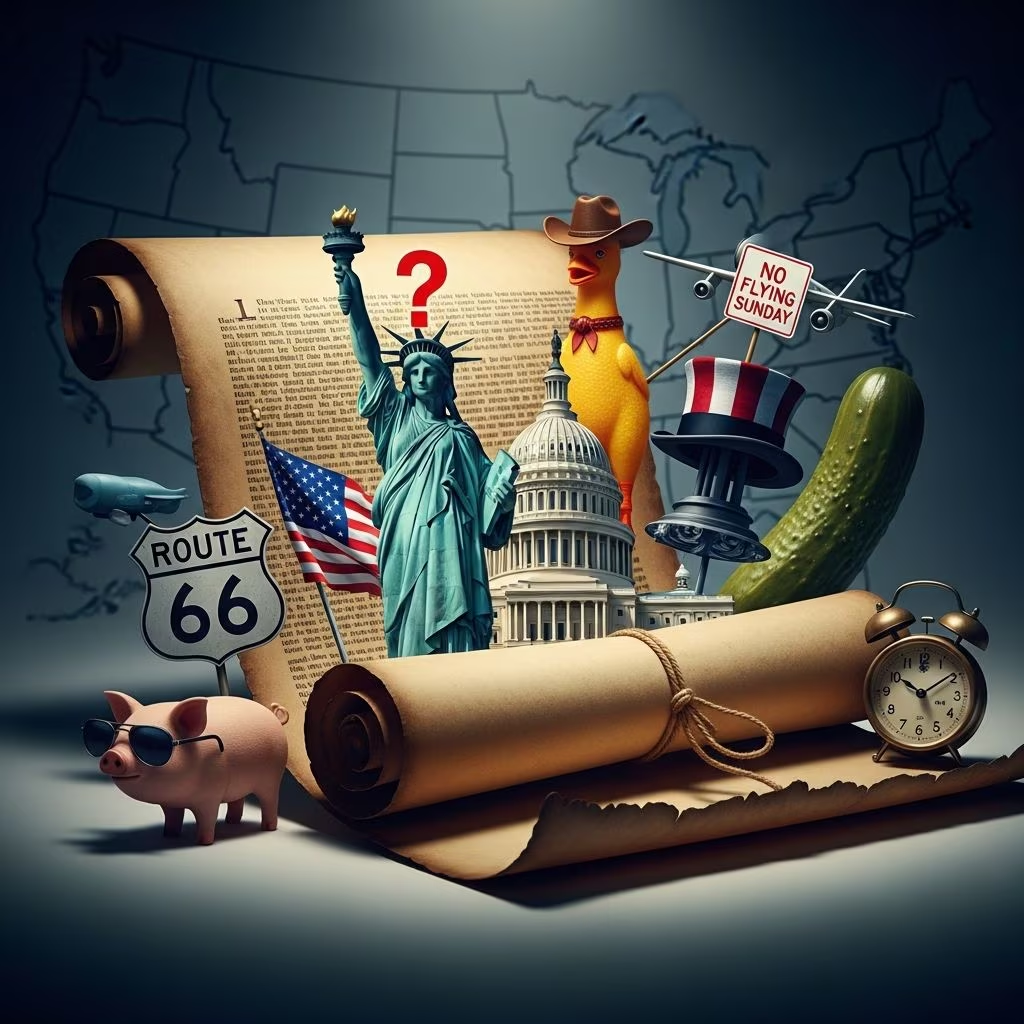
Across the United States, each state has built its own legal system over centuries. Alongside serious rules about crime, contracts, and civil rights, there is a curious collection of odd, outdated, and unintentionally funny laws that still sit in the statute books. Some were passed for very practical reasons at the time; others have unclear origins and survive mostly as legal trivia. Together, they offer a window into how culture, technology, and local concerns shape lawmaking.
Why So Many Weird Laws Exist
Strange rules rarely appear out of thin air. Most of them emerged in response to specific events, social anxieties, or economic pressures in a particular era.
- Targeting a one-time problem: A local disaster or scandal could prompt a city council or legislature to pass a very narrow law aimed at making sure it never happened again.
- Regulating morality and public order: In the 19th and early 20th centuries, many communities adopted laws to enforce prevailing moral standards, often focusing on Sunday activities, public behavior, and alcohol.
- Adapting to new technology: When something new arrived—cars, trains, X-ray machines, vending machines—lawmakers sometimes reacted with overly specific regulations that later became obsolete.
- Protecting animals and property: Rules about livestock, circus animals, and wildlife were often meant to reduce accidents and damage, even if they now sound comical.
Today, many of these laws are technically still on the books but rarely enforced. Legal scholars often cite them as examples when explaining how statutes can linger long after their original purpose disappears.
Animal Antics in the Law Books
Some of the most memorable quirky laws involve animals, because they combine real safety or welfare concerns with highly specific—and sometimes hilarious—scenarios.
Farm animals doing city jobs
American law has a long history of regulating how animals can be used for work, especially when they intersect with transportation or agriculture. For example, one state prohibits using elephants to plow certain types of fields, while leaving other crops untouched. The rule sounds absurd today, but it reflects a long-running concern about how large animals are used in public spaces and on private land.
- Local governments worried about damage to crops and infrastructure.
- Lawmakers wanted to discourage traveling shows or circuses from repurposing animals for cheap labor.
- Rules helped assign liability if property was destroyed.
Contest animals and health rules
Even recreational events have inspired their own micro-laws. A well-known example from the West concerns frog-jumping contests, where health codes regulate what must happen if a competing frog dies. According to commentary by legal scholars, such rules likely developed from a mix of public health concerns and a desire to prevent people from turning contest animals into food.
Wildlife, transportation, and safety
Animal-related laws also intersect with safety around railroads and highways. Some states punish driving animals onto railroad tracks with the intent to damage a train, reflecting concerns about sabotage and accidents in the early days of rail. Others regulate how animals may be transported or handled in unusual settings, a reminder that what sounds ridiculous now may once have been a live political issue.
| Theme | Example Scenario | Likely Original Concern |
|---|---|---|
| Animals in agriculture | Large animals used to plow specific crops | Crop damage, worker safety, labor competition |
| Contest animals | Frog-jumping frogs regulated by health code | Public health, humane treatment, fair competition |
| Railroad mishaps | Driving animals onto tracks to harm trains | Sabotage prevention, property and passenger safety |
Odd Rules About Personal Behavior
Many odd statutes focus on how individuals behave in public, especially with respect to religion, public decorum, and what lawmakers considered good manners.
Humor in sacred spaces
Some states historically prohibited behaviors in churches that might be seen as disrespectful. One long-cited example is a ban on wearing a fake mustache that causes laughter in a place of worship. While the wording is humorous, the underlying idea was straightforward: preserve solemnity in religious services during an era when disruptive pranks were considered a serious affront.
Impersonating religious figures
Elsewhere, statutes criminalize pretending to be a priest, minister, nun, or similar religious leader. The serious intent behind such laws is to prevent fraud—someone posing as clergy could exploit trust to solicit money, gain access to vulnerable people, or conduct sham ceremonies. Although the rule is sometimes listed among “weird” laws, it highlights how closely tied community life once was to religious authority.
Sleeping, sitting, and strolling rules
Public-order regulations can also drift into the strange. Some jurisdictions once regulated seemingly harmless acts like lying down in public with shoes on, strolling aimlessly, or walking in unusual ways. These laws reflected broader efforts to control loitering and vagrancy, often targeting marginalized groups. Modern courts have increasingly scrutinized such rules under constitutional protections for liberty and equal treatment, leading many to fall out of use even if not formally repealed.
Business, Commerce, and Very Specific Bans
As commerce expanded in the 19th and 20th centuries, states tried to control new business practices. Sometimes they passed broad regulations; other times, they wrote rules so specific they now seem comical.
Sunday trading and the law
So-called “blue laws” restricted what could be bought or sold on Sundays. These rules developed from religious traditions that treated Sunday as a day of rest and worship. Over time, many such laws were weakened or struck down as inconsistent with modern commerce or viewed as improperly favoring particular religious beliefs.
- Early blue laws often banned sales of alcohol, meat, or certain luxuries on Sundays.
- Enforcement was uneven, and many businesses quietly ignored them as public attitudes changed.
- Court decisions and legislative reforms gradually removed or narrowed many of these restrictions.
Vending machines, utilities, and safety
Technological advances often triggered hyper-specific regulations. In one northwestern state, for example, attaching a vending machine to a utility pole is illegal without the utility company’s permission. This type of rule makes more sense when you consider the safety issues: unauthorized installations can damage infrastructure, interfere with power lines, or pose electrocution risks for workers.
X-ray shoe-fitting devices
In the early 20th century, shoe stores in some states advertised X-ray fluoroscopy machines to show customers how well shoes fit. As the health effects of radiation exposure became better understood, legislatures banned using such devices outside controlled medical settings. Public health authorities and medical researchers had demonstrated that even low, repeated doses of X-rays could increase cancer risk, leading to a wave of reforms around diagnostic equipment in non-medical environments.
Marriage, Morality, and the Private Sphere
A number of odd-sounding laws revolve around marriage, sex, and the private lives of citizens. These statutes reflect older views on health, gender roles, and social order.
Health-related marriage rules
Some states historically barred people with certain infectious diseases or conditions from getting married, especially sexually transmitted infections. For example, Nebraska law makes it illegal for someone with a venereal disease to marry. Public health historians note that such laws emerged in an era before effective treatments, when regulators leaned heavily on marriage licensing as a screening tool, even though they were often difficult to enforce and stigmatizing.
Restrictions on repeated marriages
Another category of odd rules tries to limit how many times two people can marry each other after repeated divorces. These laws were attempts to discourage what lawmakers perceived as frivolous or unstable relationships, at a time when divorce carried stronger social stigma and states asserted more control over who could wed and under what circumstances.
Unusual definitions of family crime
In modern criminal law, serious offenses like human trafficking are typically prosecuted under broad statutes. However, some states also adopted oddly narrow provisions, such as making the sale or attempted purchase of a baby a specific misdemeanor offense. Although the behavior clearly overlaps with major federal and state crimes, these specific provisions once functioned as a direct moral statement and easier charging option for local prosecutors.
Criminal Law, Comedy, and Legal Myths
The internet is filled with lists of bizarre laws, but not all of them are real, current, or correctly described. Legal scholars have cautioned that many so-called weird laws are misquoted, misunderstood, or long repealed.
How “weird law” lists get things wrong
- Outdated statutes: A law may have existed in the 19th century but has since been repealed or replaced.
- Local vs. state confusion: A quirky city ordinance can be incorrectly described as a statewide rule.
- Myths and embellishments: Some stories start as jokes or misreadings of old legal codes and are then repeated as fact.
One article from a law school faculty blog highlights how stories about California’s frog-jumping rule spread in simplified or exaggerated form, becoming “urban legends” of law despite containing a kernel of truth. For anyone seriously interested in legal history, checking the actual text of statutes and case law is essential.
Why lawyers still talk about them
Despite the inaccuracies, strange laws are useful teaching tools. Law professors and practitioners use them to illustrate:
- How legislative history works and why context matters.
- How courts interpret oddly worded statutes.
- The importance of statutory cleanup—removing outdated rules that clutter legal codes.
These examples also make abstract concepts more memorable for students encountering statutory interpretation, federalism, and constitutional review for the first time.
The Process of Cleaning Up Old Laws
Given the number of obsolete or odd provisions, why don’t legislatures simply remove them all at once? In practice, cleaning up old statutes is slow and politically unglamorous work.
Why outdated laws linger
- Low priority: Lawmakers focus on urgent issues like budgets, public safety, and health policy. Repealing a century-old law about livestock or Sunday sales rarely makes the agenda.
- Path dependence: Legal systems build layer upon layer. Removing one old provision can create technical conflicts with other cross-references.
- Fear of unintended consequences: Legislators may worry that repealing an obscure law could accidentally weaken related, still-useful rules.
Codification and modernization efforts
Many states engage in periodic “recodification,” a process where commissions or legislative committees reorganize, update, and sometimes repeal outdated provisions. These efforts are often guided by model codes and research from academic institutions and bar associations. For criminal law, for example, states have consulted the Model Penal Code, developed by the American Law Institute, to modernize and rationalize their criminal statutes, reducing the number of odd one-off crimes.
What Weird Laws Reveal About American Society
Looking past the humor, quirky laws tell us a great deal about the changing priorities and anxieties of communities across time.
- Religion’s historical role: Rules about Sunday trade, church behavior, and clergy impersonation reflect how intertwined law and religion once were in local governance.
- Rapid technological change: From railroads to X-ray machines and vending devices, new technologies repeatedly pushed lawmakers to improvise sometimes awkward solutions.
- Public health evolution: Marriage restrictions based on disease status and bans on unsafe devices show how early public health policy mixed science, fear, and moral judgment.
- Local identity and culture: Some laws, especially those about animals, contests, and unusual local customs, double as snapshots of what made a town or region distinctive at a particular moment.
By examining these laws in context—who wrote them, what they were trying to fix, and how they were enforced—we gain a richer understanding of how American law has adapted, sometimes clumsily, to social change.
Frequently Asked Questions (FAQs)
Q: Are all the weird laws I see online actually real and enforceable?
A: No. Many widely shared “weird laws” are misquoted, outdated, or based on urban legends. Legal scholars recommend checking the current version of a state’s code or consulting official legislative websites to verify whether a law still exists.
Q: Why would a state keep a clearly outdated law on the books?
A: Removing old statutes requires time, attention, and political will. Since these laws are rarely enforced, they often fall to the bottom of the legislative priority list, even during large recodification efforts.
Q: Can someone really be prosecuted under one of these strange laws today?
A: In theory, if a law is still valid and not unconstitutional, it could be enforced. In practice, prosecutors focus on serious, clearly applicable offenses, and judges may interpret outdated laws narrowly or find them inconsistent with modern constitutional standards.
Q: Where can I check the authenticity of a specific odd law?
A: Look up the relevant state’s statutes through its official legislative or code website (typically ending in .gov). Many states provide searchable databases of current laws, legislative history, and notes on amendments or repeals.
Q: Why do law professors like to talk about these bizarre rules?
A: They make complex legal ideas more accessible. Using memorable examples—like contest animals or Sunday sales—helps students understand how statutes are interpreted, how laws become outdated, and why legislative intent matters in real cases.
References
- Outdated & Weird Laws You Can Still Be Charged With — TheLawDictionary.org. 2021-08-10. https://thelawdictionary.org/article/weird-laws-by-state/
- Weird Washington Laws — Boohoff Law P.A. 2020-06-15. https://www.boohofflaw.com/weird-washington-laws/
- It’s Illegal to Do What? Strange Laws and Why They Exist — Marquette University Law School Faculty Blog. 2018-04-11. https://law.marquette.edu/facultyblog/2018/04/its-illegal-to-do-what-strange-laws-and-why-they-exist/
- Radiation-Emitting Products: Shoe-Fitting Fluoroscopes — U.S. Food and Drug Administration (FDA). 2018-04-09. https://www.fda.gov/radiation-emitting-products/medical-x-ray-imaging/radiation-emitting-products-shoe-fitting-fluoroscopes
- Montana Code Annotated 2023: Title 45 (Crimes), Chapter 6 (Offenses Against Property) — Montana Legislature. 2023-10-01. https://leg.mt.gov/bills/mca/title_0450/chapter_0060/part_0010/section_0160/0450-0060-0010-0160.html