
Beyond the Double Helix: Why DNA Evidence Is Not a Silver Bullet
Exploring the limitations of forensic science and why DNA testing cannot single-handedly fix the criminal justice system.
Introduction
When people think of modern criminal investigations, they often imagine a sterile laboratory where a single strand of hair or a microscopic drop of blood perfectly identifies a perpetrator. In the public imagination, DNA evidence is synonymous with absolute truth—a magical, infallible tool that effortlessly separates the innocent from the guilty. This perception has undoubtedly been shaped by decades of high-profile exonerations where DNA testing successfully cleared individuals who spent years behind bars for crimes they did not commit. However, the reality of forensic science is far more complex, nuanced, and prone to human error than popular culture suggests.
While the discovery of DNA profiling revolutionized criminal justice, treating it as an infallible silver bullet obscures the deep, systemic flaws within the legal system. From the contamination of crime scenes to the highly subjective interpretation of mixed genetic samples, DNA analysis has limitations that are frequently misunderstood by juries, prosecutors, and even some investigators. Recognizing these limitations is crucial for preventing wrongful convictions and ensuring that forensic science serves justice rather than undermining it. Reforming the justice system requires addressing the human and systemic factors governing how evidence is collected, interpreted, and presented.
The "CSI Effect" and the Myth of Scientific Infallibility
The intersection of entertainment and forensic science has birthed a phenomenon widely recognized by legal scholars and practitioners as the "CSI Effect." For decades, television dramas and true-crime podcasts have portrayed forensic analysis as a swift, highly automated, and error-free process. In these fictionalized worlds, a computer screen rapidly flashes a "match," instantly solving a complex murder case. This dramatization has a profound impact on the real-world criminal justice system, particularly concerning jury expectations and the perceived weight of forensic evidence .
The CSI Effect creates a dangerous paradigm in the courtroom. On one hand, prosecutors may struggle to secure convictions when juries demand definitive DNA evidence even in cases where it is irrelevant or impossible to obtain. Conversely, when DNA is presented, juries often view it as ultimate proof, disregarding the context of its discovery. This myth of scientific infallibility puts immense pressure on forensic analysts to deliver clear-cut results, sometimes leading to overconfidence in the courtroom. Forensic evidence is not a standalone truth; it is a piece of a larger puzzle that requires careful contextualization. When the legal system assumes that DNA testing is entirely objective, it fails to account for the cognitive biases that can influence even the most well-intentioned scientists.
Furthermore, this dynamic shifts the burden of proof in subtle ways. Defense attorneys are frequently put in a position where they must educate a jury on the intricacies and potential failures of forensic science, fighting an uphill battle against deeply ingrained media narratives. Understanding that DNA is a tool, rather than an indisputable witness, is the first step toward correcting the imbalance caused by modern media.
The Silent Culprit: The Complexities of DNA Transfer and Contamination
One of the most significant misunderstandings about DNA evidence involves how genetic material arrives at a crime scene. Traditional thinking assumed that if a suspect's DNA was found on a weapon or victim, they must have been physically present and directly involved in the crime. However, forensic science has increasingly recognized the phenomenon of secondary and tertiary DNA transfer.
Humans are constantly shedding skin cells, hair, and saliva. These biological materials can easily be transferred from one person to an object, and then from that object to another person or location. If Person A shakes hands with Person B, who then touches a crime scene doorknob, Person A's DNA might be recovered there despite their absence. Studies on indirect DNA transfer highlight the critical forensic implications of these vectors, demonstrating that under certain conditions, touch DNA can be highly misleading .
The incredible sensitivity of modern DNA testing exacerbates this issue. Today's technologies can generate a genetic profile from just a few microscopic cells. While this heightened sensitivity allows investigators to solve cold cases using minute traces of evidence, it also dramatically increases the risk of contamination. Contamination can occur at the crime scene if first responders are not meticulous, during the packaging and transport of evidence, or even within the sterile environment of the forensic laboratory. When trace amounts of DNA are treated with the same evidentiary weight as a large pool of blood, the risk of implicating an innocent person skyrockets. Recognizing the fluidity of cellular material is essential for investigators when they build a case around microscopic trace evidence.
Decoding the Noise: The Subjectivity of Mixture Interpretation
A common misconception is that a DNA test always yields a clean, single-source profile belonging to one individual. In reality, evidence collected from crime scenes—especially trace or touch DNA—often contains genetic material from multiple people, creating what is known as a DNA mixture. Interpreting these complex mixtures is arguably one of the most challenging and subjective areas of modern forensic science.
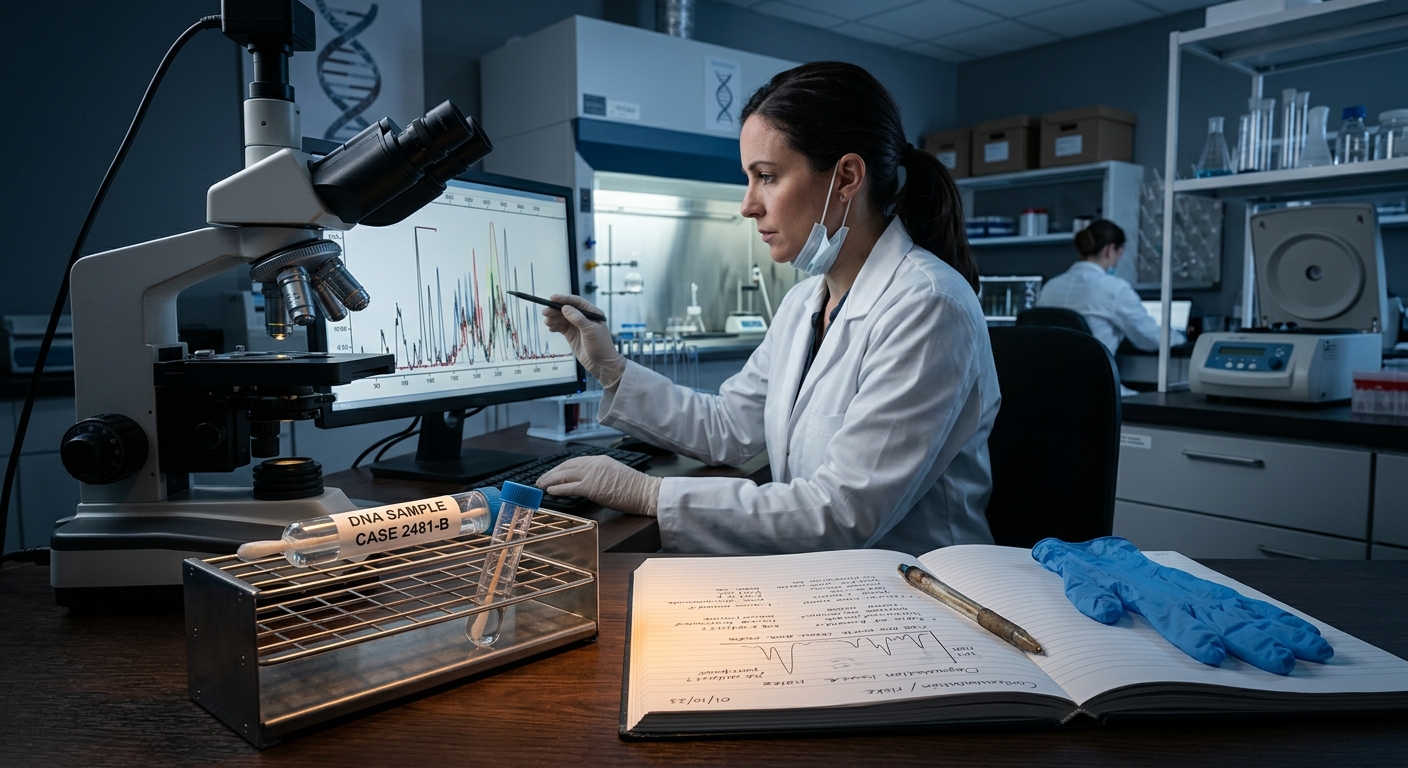
When an analyst looks at an electropherogram (the visual output of a DNA test), they do not see a name or a face; they see a series of peaks and valleys representing genetic markers. In a simple, single-source sample, these peaks are relatively easy to distinguish from background noise. However, in a mixture involving three or more contributors, the peaks overlap, vary in height, and degrade at different rates. Determining how many people contributed to the mixture, and isolating a specific individual's profile from the tangled web of data, requires significant human judgment.
The National Institute of Standards and Technology (NIST) has explicitly highlighted the subjectivity involved in DNA mixture interpretation. Their scientific foundation reviews point out that different analysts, looking at the exact same complex DNA mixture, can sometimes reach entirely different conclusions depending on the protocols and statistical approaches they apply . Some analysts might confidently declare a match, while others might deem the sample too degraded or complex to interpret accurately. This subjectivity is often hidden from juries, who are usually presented with a definitive statistic rather than an explanation of the nuanced guesswork that went into generating it. As probabilistic genotyping software becomes more prevalent to handle these calculations, the algorithms themselves remain a point of debate, underscoring that machine assistance does not entirely erase the subjective nature of the foundational data.
Wrongful Convictions and the Illusion of Infallibility
The tragic paradox of forensic science is that the very tools designed to uncover the truth can, when misapplied, cement a lie. Overreliance on flawed, exaggerated, or misunderstood forensic evidence is a leading contributor to wrongful convictions in the United States. While DNA testing has famously been used to exonerate innocent people, flawed DNA evidence—and the misapplication of older forensic disciplines like hair microscopy or bite mark analysis—has also sent innocent people to prison.
Data compiled by the National Registry of Exonerations and analyzed by the National Institute of Justice reveals that false or misleading forensic evidence is a factor in a significant percentage of wrongful convictions . Errors in forensic science range from simple laboratory mistakes and the use of unvalidated techniques to outright fraud and testimony that miscommunicates the certainty of results. When a prosecutor stands before a jury and declares that the suspect's DNA was on the murder weapon, without disclosing that it was a complex mixture or a microscopic trace potentially caused by secondary transfer, they create an illusion of infallibility.
This illusion is particularly damaging because it forces the defense to try and disprove "science," a monumental task when juries are predisposed to believe the forensic expert. Without access to independent forensic experts—which many underfunded public defender offices cannot afford—the accused is left virtually defenseless against highly technical, yet potentially flawed, scientific claims. True justice requires that scientific findings be rigorously cross-examined, emphasizing that a DNA match in a vacuum is not synonymous with criminal guilt.
Beyond Forensics: The Need for Holistic Criminal Justice Reform
Addressing the limitations of DNA evidence requires a fundamental shift in how the criminal justice system operates. We cannot simply rely on better technology to fix a broken system; we must enact comprehensive legal and procedural reforms that hold forensic science to the highest possible standards.
First, forensic laboratories must be independent from law enforcement agencies. When forensic analysts work directly for the police or prosecutors, cognitive bias can inadvertently seep into their work. Analysts may be exposed to extraneous information about the suspect, which can subconsciously influence their subjective interpretations of complex DNA mixtures. Establishing independent, blind testing protocols ensures that scientific analysis remains objective and untainted by investigatory theories.
Furthermore, the criminal justice system must demand greater transparency in the courtroom. Forensic experts must be required to communicate the limitations of their findings clearly. If a DNA sample is a complex mixture or involves trace amounts susceptible to secondary transfer, the jury must be explicitly informed of these facts. The use of probabilistic genotyping software, which uses algorithms to interpret complex mixtures, must also be subjected to rigorous, open-source scrutiny rather than hidden behind proprietary corporate walls.
Finally, holistic reform means ensuring that the defense is adequately equipped to challenge scientific evidence. Public defender offices must receive the funding necessary to hire independent forensic experts who can review the state's evidence, identify methodological flaws, and present alternative interpretations to the jury. Justice is not served by unquestioning acceptance of scientific authority; it is served by rigorous, balanced, and fully informed adversarial scrutiny.
Conclusion
DNA profiling is undeniably one of the most powerful tools in modern forensic science, but it is not magic. It is a human endeavor, subject to the same vulnerabilities, biases, and errors that plague all human systems. From the risks of secondary transfer and laboratory contamination to the highly subjective nature of interpreting complex mixtures, DNA evidence requires careful contextualization and rigorous scrutiny to be used fairly.
The CSI Effect has conditioned society to view forensic science as a provider of absolute certainty, but true justice requires us to acknowledge the inherent uncertainties in the data. By advocating for independent laboratories, greater transparency in courtroom testimony, and adequate resources for defense attorneys, we can ensure that DNA testing is used responsibly. We must stop viewing DNA as a silver bullet that can cure the ailments of the criminal justice system and start viewing it for what it is: a valuable, yet fallible, tool that must be wielded with caution, expertise, and a steadfast commitment to the truth.
Frequently Asked Questions (FAQs)
- What is touch DNA?
Touch DNA refers to the microscopic biological material (often skin cells) left behind when a person makes physical contact with an object. Because modern DNA testing is highly sensitive, forensic scientists can extract a genetic profile from these minuscule traces, though they are highly susceptible to contamination. - What is secondary DNA transfer?
Secondary DNA transfer occurs when a person's DNA is deposited onto an object or another person, and then subsequently transferred to a new location or object without the original person ever making direct contact with the final destination. - How does the CSI Effect impact criminal trials?
The CSI Effect refers to the phenomenon where television shows and media create unrealistic expectations among jurors regarding forensic science. Jurors may expect definitive DNA evidence in every trial or overvalue scientific evidence without questioning its potential flaws. - Why is interpreting a DNA mixture difficult?
A DNA mixture contains genetic material from multiple individuals. Interpreting it requires subjective judgment and statistical models to differentiate the contributors, determine the number of people involved, and separate background noise from actual genetic peaks. - Can DNA evidence lead to wrongful convictions?
Yes. While DNA is often used to exonerate the innocent, flawed interpretations, laboratory errors, contamination, and secondary transfer can incorrectly link an innocent person to a crime scene, contributing to a wrongful conviction if not properly scrutinized.
References
- The 'CSI Effect': Does It Really Exist? — National Institute of Justice. 2008-03-16. https://nij.ojp.gov/topics/articles/csi-effect-does-it-really-exist
- A systematic analysis of secondary DNA transfer — PubMed / J Forensic Sci. 1999-11-01. https://pubmed.ncbi.nlm.nih.gov/10582367/
- DNA Mixture Interpretation: A NIST Scientific Foundation Review — National Institute of Standards and Technology. 2024-12-17. https://nvlpubs.nist.gov/nistpubs/ir/2024/NIST.IR.8351.pdf
- The Impact of False or Misleading Forensic Evidence on Wrongful Convictions — National Institute of Justice. 2023-11-28. https://nij.ojp.gov/topics/articles/impact-false-or-misleading-forensic-evidence-wrongful-convictions
Similar Articles








Read full bio of medha deb


