
The Battle for Nonbinary Passports and Identity Rights
The legal fight and global standards behind nonbinary passport gender markers.
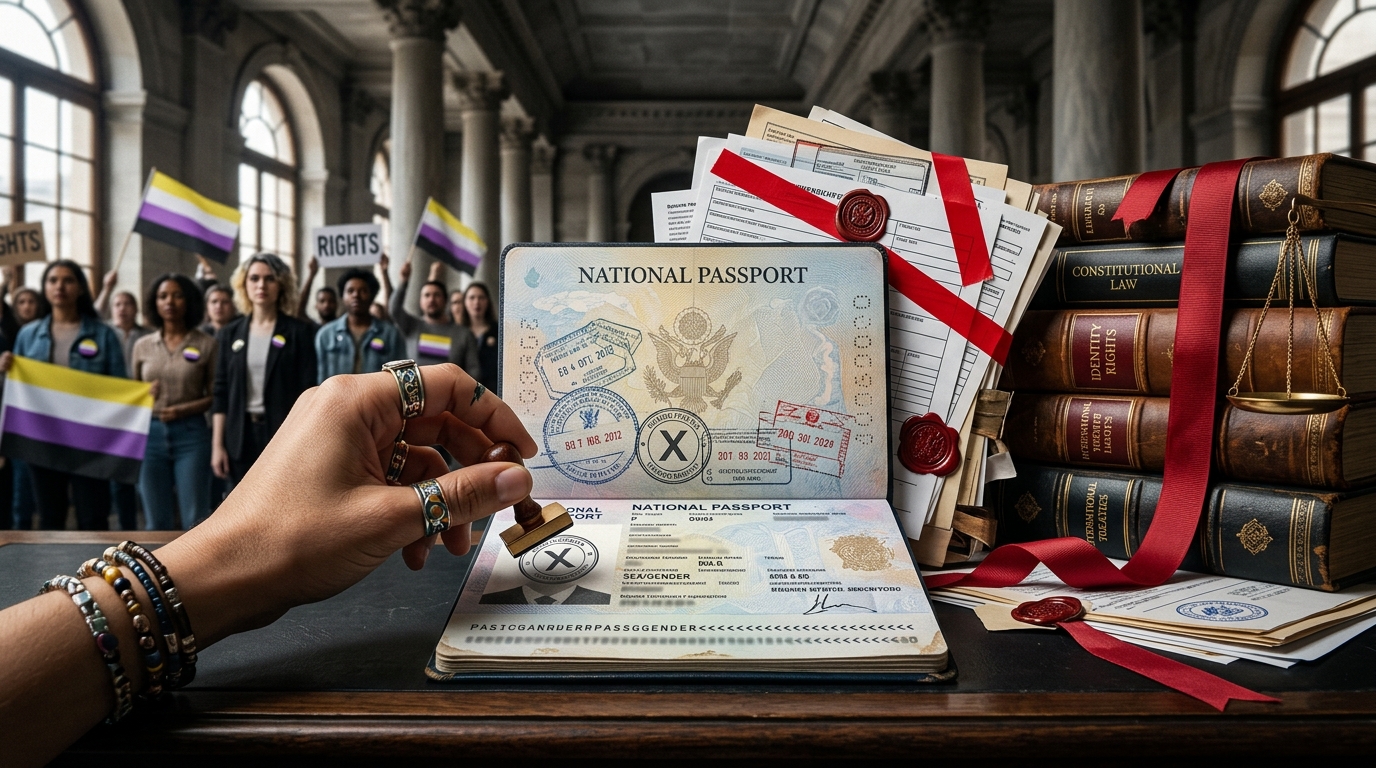
Passports are more than mere travel booklets; they are a government’s ultimate acknowledgment of a citizen’s identity on the global stage. For the vast majority of the population, glancing at the biographical page of a passport evokes no second thought. The printed name, the photograph, and the tiny “M” or “F” next to “Sex” align seamlessly with their lived reality. But for millions of nonbinary, intersex, and gender-nonconforming individuals, that tiny letter is a source of profound invalidation and practical danger.
The push for an “X” gender marker—representing “unspecified” or another gender identity—has become one of the most visible frontiers in the modern fight for LGBTQ+ civil rights. It is a battle that pits personal autonomy and international travel standards against fluctuating domestic political landscapes. Over the past several years, the trajectory of legal recognition for nonbinary Americans has resembled a rollercoaster, marked by historic administrative victories, abrupt executive rollbacks, and intense courtroom showdowns. To understand why the “X” marker matters so deeply, one must look beyond the bureaucracy of the federal government and examine the daily, lived realities of those who are forced to carry documents that fundamentally contradict who they are.
The Essential Function of Accurate Identification
At its core, a travel document serves two primary purposes: to facilitate international mobility by proving citizenship and to accurately verify the identity of the bearer. In a highly securitized global travel network, border agents, airline personnel, and security officers rely heavily on the data encoded within passports. When a discrepancy exists between a person’s physical presentation and the information printed on their identification, the friction is immediate and often hostile.
Historically, governments have categorized citizens strictly into a binary of male and female, operating on the administrative assumption that biological sex at birth is immutable and directly correlates to a person’s lifelong gender expression. However, this rigid bureaucratic framework fails to account for the actual complexity of human identity. When a nonbinary or transgender person hands over a passport with an inaccurate gender marker, they are frequently subjected to heightened scrutiny, invasive questioning, and secondary security screenings. The identification document, rather than facilitating smooth transit, becomes a catalyst for suspicion.
The demand for accurate identification is not merely a symbolic plea for validation; it is a practical necessity. Without an ID that aligns with their identity, nonbinary individuals face pervasive barriers in banking, housing, employment, and travel. A passport is widely considered the gold standard of identification. When a government denies someone the ability to accurately state their gender on this document, it effectively sanctions their erasure from public life, forcing them to choose between remaining grounded or enduring the anxiety of traveling under a state-mandated misclassification.
Erased by the Binary: The Nonbinary and Intersex Experience
The human cost of binary identification systems is staggering, especially when considering the sheer size of the population affected. According to a landmark demographic study by the Williams Institute at the UCLA School of Law, an estimated 1.2 million LGBTQ adults in the United States identify as nonbinary. This demographic is significant, diverse, and increasingly visible in all sectors of society. Yet, when interacting with federal travel authorities, this population has historically been forced into bureaucratic invisibility.
For intersex individuals—people born with variations in sex characteristics that do not fit typical medical definitions of male or female—the binary mandate is especially paradoxical. Many intersex people are assigned a sex at birth through irreversible and medically unnecessary surgeries, only to grow up and find that their legal documents reflect a coercive medical decision rather than their authentic selves. The “X” marker represents a vital acknowledgment that biological and gender diversity naturally exists outside the male-female dichotomy.
The consequences of carrying a mismatched passport are acutely felt at border crossings and airport security checkpoints. Nonbinary travelers frequently report instances of harassment, inappropriate physical pat-downs, and verbal abuse when an agent decides that their gender presentation does not match the “M” or “F” on their document. This phenomenon is commonly referred to as “forced outing.” In an international context, where a traveler might be passing through regions with deeply entrenched anti-LGBTQ+ laws, a forced outing at a border control booth can escalate from a humiliating inconvenience to a severe safety threat. Federal travel advisories routinely warn that consensual same-sex relations and gender nonconformity are criminalized in over 60 countries, making the accuracy and safety of travel documents a matter of life and death.
The International Standard vs. Domestic Policies
While the debate over gender markers often feels highly localized to American political cycles, the global framework for travel documents has long accommodated broader definitions of sex and gender. Passports and other machine-readable travel documents are standardized globally by the International Civil Aviation Organization (ICAO), a specialized agency of the United Nations. The guidelines that dictate what a passport must look like are outlined in ICAO Document 9303.
Crucially, ICAO Document 9303 does not require sovereign states to restrict gender markers exclusively to male and female. The standard explicitly permits three specific characters in the mandatory sex field: “F” for female, “M” for male, and “X” for unspecified. The inclusion of the “X” allows individual nations the operational flexibility to issue gender-neutral passports without running afoul of international aviation security protocols.
Recognizing this flexibility, several nations pioneered the adoption of the “X” marker long before the United States. Countries such as Australia, New Zealand, Canada, and Argentina updated their internal policies to allow citizens to self-attest their gender and select an “X” on their federal documents. These international precedents clearly demonstrated that expanding gender categories does not compromise national security or disrupt the global travel infrastructure. Instead, it aligns administrative systems with modern human rights principles, proving that the bureaucratic inclusion of nonbinary identities is both technologically feasible and socially beneficial.
The American Rollercoaster: From Recognition to Rollback
In the United States, the trajectory toward inclusive passports has been exceptionally volatile, driven by grassroots activism, protracted litigation, and shifting executive administrations.
| Year | Policy Event | Impact on LGBTQ+ Travelers |
|---|---|---|
| 2021 | State Department issues first ‘X’ marker | Groundbreaking recognition for nonbinary and intersex citizens following years of civil rights litigation. |
| 2022 | ‘X’ marker available to all routine applicants | Broad access via self-attestation is rolled out, eliminating the need for invasive medical documentation. |
| 2025 | Executive Order restricting gender markers | Federal mandate forces a reversion to the M/F binary based strictly on biological sex assigned at birth. |
| 2025 | Federal injunctions block the EO temporarily | Lower courts provide a brief legal reprieve, allowing some applicants to continue securing accurate documents. |
| 2026 | Supreme Court stay allows EO enforcement | ‘X’ markers are officially halted; mandatory M/F requirements are fully reinstated by the State Department. |
The initial breakthrough arrived in late 2021 and early 2022, following years of legal pressure from intersex and nonbinary plaintiffs who successfully sued the federal government for violating their constitutional rights. During this period, the State Department officially updated its policies to allow U.S. citizens to select an “X” gender marker on passport applications. Furthermore, the policy was grounded in self-attestation, meaning applicants were no longer required to submit invasive medical documentation to validate their gender identity.
For a brief window, this policy provided profound relief to hundreds of thousands of Americans. However, the legal and political landscape shifted dramatically with a change in presidential administrations. In January 2025, a sweeping executive order titled “Defending Women from Gender Ideology Extremism and Restoring Biological Truth to the Federal Government” was issued. This directive fundamentally altered federal identification policies, mandating that the State Department require government-issued IDs to reflect the holder’s biological sex assigned at birth.
The immediate consequence was the abrupt removal of the “X” marker option from passport application systems. The reversal triggered immediate legal action from civil rights organizations who sought injunctions to protect transgender and nonbinary travelers. While lower courts initially blocked the implementation of the executive order—citing violations of equal protection and due process—the U.S. Supreme Court ultimately issued a stay in November 2025, allowing the rollback to proceed.
As of 2026, the restrictive policy remains heavily in effect. The State Department officially maintains that it will only issue passports with an “M” or “F” marker that matches the applicant’s biological sex at birth, explicitly rejecting attestations for preferred sex markers. This whiplash has plunged the nonbinary community back into an era of administrative uncertainty, processing delays, and heightened vulnerability during international travel.
The Constitutional and Human Rights Arguments
The legal battles surrounding the “X” passport marker hinge on fundamental constitutional rights. Advocates argue that forcing a citizen to identify with a gender that does not match their lived reality is a violation of their First Amendment right to free speech, as it compels them to bear a government document that communicates a falsehood about their core identity. Furthermore, such exclusionary policies face intense scrutiny under the Fifth Amendment’s guarantees of equal protection and due process.
By singling out transgender, intersex, and nonbinary individuals and denying them the same access to accurate identification seamlessly enjoyed by cisgender Americans, restrictive passport policies create a legally sanctioned underclass. Civil rights attorneys argue that an individual’s right to travel—a liberty historically protected by the Supreme Court—is severely infringed when exercising that right requires submitting to state-mandated misgendering.
Moreover, human rights organizations view the denial of accurate identity documents as a clear violation of international human rights norms. The inability to obtain an accurate passport impedes a person’s freedom of movement and fundamentally undermines their dignity. The core argument remains resilient despite recent judicial setbacks: the government’s administrative interest in maintaining a binary classification system does not supersede a citizen’s right to exist truthfully in the eyes of the law.
Looking Ahead: Navigating the Current Landscape
For nonbinary and transgender Americans navigating the deeply polarized 2026 travel landscape, the situation requires immense preparation, legal awareness, and resilience. Under current guidelines, passports that were previously issued with an “X” marker remain valid for travel until their natural expiration dates, standing in compliance with ICAO policy. However, applying for a new passport, renewing an expired one, or replacing a lost document now forces applicants to revert to the binary “M” or “F” designation.
Advocacy groups strongly advise nonbinary travelers to exercise extreme caution when traveling internationally. Because certain global destinations maintain stringent laws against gender nonconformity, individuals holding an “X” passport (issued prior to the rollback) or a passport that contradicts their physical presentation must thoroughly research the immigration regulations of their destination. Carrying additional legal documents, such as name change court orders, health directives, and consular emergency contact information, has become an essential travel practice.
While the current administrative climate is deeply challenging and restrictive, the fight for the “X” gender marker is far from over. The LGBTQ+ community continues to mobilize, utilizing the appellate courts, public education campaigns, and legislative advocacy to reclaim their fundamental right to accurate and safe representation.
Frequently Asked Questions (FAQ)
What is the “X” gender marker on a passport?
The “X” gender marker is a globally recognized designation used on official travel documents to indicate that the holder’s gender is unspecified or represents another gender identity entirely outside the traditional male (M) and female (F) binary.
Is the “X” marker recognized internationally?
Yes. The International Civil Aviation Organization (ICAO), which sets the rigorous global standards for machine-readable travel documents, explicitly allows “X” as a valid, standard gender marker alongside “M” and “F”.
Can I currently get an “X” marker on a U.S. passport?
As of early 2026, following a 2025 executive order and a subsequent Supreme Court stay, the U.S. State Department does not issue new passports with an “X” marker. Passports must currently reflect the applicant’s biological sex assigned at birth.
Are existing U.S. passports with an “X” marker still valid?
Yes. Passports previously issued with an “X” marker remain valid for international travel until their printed expiration date. However, travelers should be aware of varying acceptance policies and potential hostility in different destination countries.
References
- Sex Markers in Passports — U.S. Department of State. 2026-03-16. https://travel.state.gov/content/travel/en/passports/need-passport/selecting-your-gender-marker.html
- Nonbinary LGBTQ Adults in the United States — The Williams Institute, UCLA School of Law. 2021-06-22. https://williamsinstitute.law.ucla.edu/publications/nonbinary-lgbtq-adults-us/
- Doc 9303 Machine Readable Travel Documents — International Civil Aviation Organization (ICAO). 2021. https://www.icao.int/publications/pages/publication.aspx?docnum=9303
- Passport + Identity Document Information for the Transgender Community — Lambda Legal. 2026-03-16. https://lambdalegal.org/passport-identity-document-information-for-the-transgender-community/
- Trump asks the Supreme Court to allow him to enforce transgender and nonbinary passport policy — The Associated Press. 2025-09-19. https://apnews.com/
Similar Articles








Read full bio of medha deb


