
Barriers to Legal Access in US Detention Centers
Systemic hurdles detained immigrants face when seeking legal counsel.
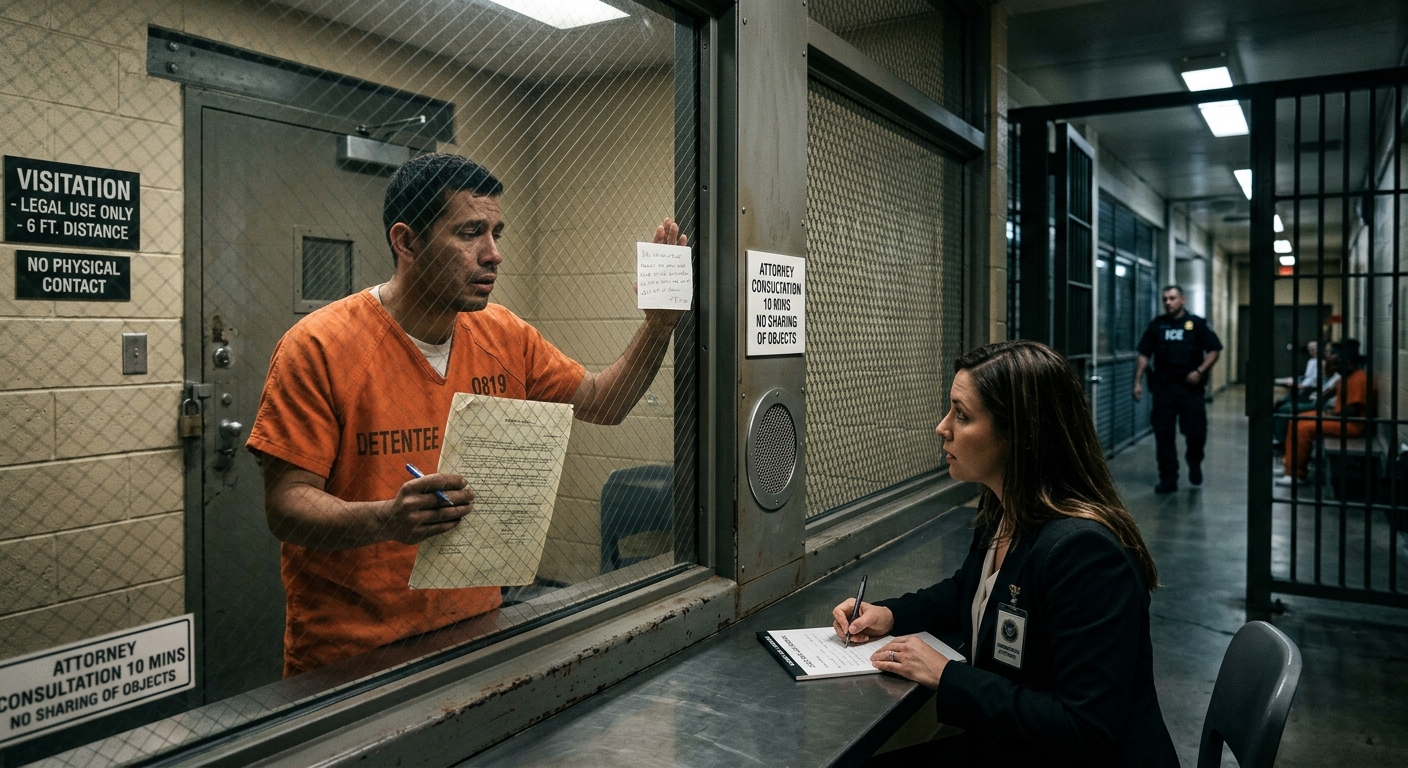
Every year, tens of thousands of individuals find themselves navigating the labyrinthine United States immigration system from behind bars. While the U.S. Constitution guarantees due process, the reality for those held in civil immigration detention facilities often tells a profoundly different story. One of the most critical determinants of an individual’s success in immigration court is access to competent legal representation. However, pervasive systemic barriers routinely isolate detained immigrants, making it extraordinarily difficult, and sometimes entirely impossible, to secure and maintain contact with legal counsel.
Unlike the criminal justice system, where indigent defendants have a constitutional right to a government-funded public defender, the immigration system operates under a civil framework. Individuals facing deportation have the right to an attorney, but strictly at no expense to the government. This distinction effectively places the burden of finding, hiring, and communicating with a lawyer squarely on the shoulders of the detained person 94a task made nearly insurmountable by the very infrastructure of the detention system.
The Fundamental Challenge of Civil Confinement
To understand the depth of the crisis, one must first examine the nature of immigration detention. The U.S. immigration detention network is a sprawling apparatus comprising hundreds of facilities, including dedicated federal processing centers, privately run prisons, and county jails contracted by federal authorities. Because these facilities are often modeled after maximum-security prisons, the environment is inherently restrictive and punitive, despite the civil nature of the confinement.
The lack of guaranteed legal representation means that the vast majority of detained immigrants are forced to represent themselves, a practice known as proceeding pro se. The stakes in these proceedings are arguably as high as those in criminal trials 94deportation can mean permanent separation from family, loss of livelihood, and forced return to countries where an individual may face persecution, torture, or death. Without a legal expert to decipher complex immigration statutes, file time-sensitive applications for relief, and advocate in court, detainees are systematically disadvantaged.
When individuals attempt to exercise their right to find an attorney, they are immediately met with an architecture of isolation. The barriers are not merely abstract legal hurdles; they are physical, technological, and bureaucratic roadblocks engineered into the daily operations of detention centers.
Communication Breakdown: The Telephone Dilemma
The primary lifeline between a detained individual and the outside world is the facility telephone system. Yet, telecommunications within detention centers are plagued by exorbitant costs, structural unreliability, and a severe lack of privacy, effectively crippling the attorney-client relationship.
First and foremost is the issue of cost. Many detention facilities contract with private telecommunications companies that charge highly inflated rates for domestic and international calls. For immigrants who often arrive with little to no financial resources and earn pennies an hour for voluntary labor within the facility, placing a simple phone call to a law firm or a legal aid organization becomes an unattainable luxury. Even when toll-free numbers for pro bono organizations are nominally provided, these systems frequently malfunction or are not properly programmed into the facility’s network.
Moreover, technological failures are ubiquitous. Attorneys frequently report dropped calls, poor audio quality, and arbitrary cut-offs after a set number of minutes. Preparing a complex asylum application requires hours of detailed, trauma-informed interviewing. Attempting to conduct this level of legal preparation in broken fifteen-minute increments over a static-filled line is an exercise in futility.
Privacy is another casualty of the detention communication system. Attorney-client privilege is a bedrock principle of the American legal system, ensuring that individuals can speak candidly with their lawyers without fear of interception. However, telephones in detention centers are almost exclusively located in crowded, noisy common areas. Detainees must often shout to be heard over the din of dozens of other people, exposing sensitive details about their cases, past traumas, and fears of persecution to fellow detainees and passing guards. While facilities are mandated to provide unmonitored calls for legal matters upon request, the reality is that such requests are frequently delayed, ignored, or logistically impossible to accommodate due to staffing shortages.
Geographic Isolation and Physical Barriers
Compounding the communication crisis is the geographic isolation of the facilities themselves. Over the past few decades, there has been a pronounced trend of constructing new detention centers in rural, remote areas, far from major urban centers where the majority of immigration attorneys and legal aid organizations operate. This geographic distance creates an immediate and severe logistical barrier to physical visitation.
For an attorney based in a city, visiting a client in a rural facility might require a multi-hour drive or even a flight. This travel time significantly limits the number of cases a pro bono attorney or a modestly funded nonprofit organization can take on. The remoteness also heavily burdens family members who might otherwise assist the detainee in finding and coordinating with legal counsel.
Even when attorneys manage to physically reach a facility, they are often subjected to unpredictable and arbitrary access restrictions. Legal visitation hours are frequently curtailed without notice due to facility lockdowns, staff shift changes, or purported security concerns. Attorneys have documented instances of waiting for hours in facility lobbies, only to be turned away because a specific visiting room is unavailable or because facility staff cannot locate the client. Furthermore, strict rules regarding the materials attorneys can bring into the facility 94often prohibiting laptops, cell phones, and sometimes even paper documents 94severely hinder an attorney’s ability to review evidence with their client and prepare effectively for hearings.
Navigating the Labyrinth of Language and Bureaucracy
The U.S. immigration detention system holds individuals from all over the world, encompassing a vast array of languages and dialects. Yet, language access remains a critical failure point in the quest for legal representation. While official documents might be translated into Spanish, immigrants speaking Indigenous languages, African dialects, or less common Asian languages face profound isolation.
Without adequate interpretation services provided by the facility for daily operations, these individuals struggle to understand how to use the phone system, how to submit requests for the law library, or how to identify pro bono legal services. When attempting to contact attorneys, the language barrier often stops the process before it begins. Unless an attorney’s office happens to have staff fluent in the caller’s specific language, the call is likely to end in mutual incomprehension.
Bureaucratic roadblocks further entangle the legal process. One of the most disruptive practices is the frequent and unannounced transfer of detainees between facilities. An individual might secure an attorney in one state, only to be transferred in the dead of night to a facility hundreds or thousands of miles away. These transfers routinely occur without prior notification to the attorney of record. Consequently, attorneys spend days frantically trying to locate their clients through disjointed online locator systems, delaying critical case preparation and sometimes causing detainees to miss imminent court deadlines.
Mail correspondence, which should serve as a reliable fallback for communication, is equally fraught. Legal mail is frequently delayed, improperly opened by facility staff under the guise of security checks, or outright lost. For cases requiring original signatures on government forms or the careful review of hundreds of pages of evidence, a dysfunctional mail system effectively paralyzes the legal defense.
The Devastating Impact on Deportation Outcomes
The culmination of these barriers is not merely a matter of inconvenience; it is a structural denial of due process that dramatically skews case outcomes. The data surrounding legal representation in immigration court paints a stark picture. Individuals who manage to secure legal counsel are exponentially more likely to be released from detention on bond and are vastly more successful in securing legal relief, such as asylum, compared to their unrepresented counterparts.
Navigating the adversarial environment of immigration court without a lawyer requires an individual to cross-examine government witnesses, object to complex legal evidence, and articulate nuanced legal arguments based on rapidly shifting case law. Expecting a detained individual 94who may be suffering from trauma, lacks formal legal education, and faces extreme linguistic and logistical barriers 94to successfully perform these tasks is a fundamental failure of justice.
The isolation also exacts a heavy psychological toll. Detained immigrants frequently report feelings of deep despair and abandonment. The inability to reach a lawyer, combined with the stress of impending deportation and the harsh conditions of confinement, often leads individuals to abandon valid legal claims. Many ultimately accept deportation not because their case lacked merit, but simply to escape the agonizing limbo of indefinite detention and isolation.
Policy Recommendations and Paths to Reform
Addressing the crisis of legal access in immigration detention requires comprehensive, systemic reform rather than piecemeal administrative tweaks. Advocates, legal scholars, and human rights organizations have long championed a series of policy shifts designed to dismantle the barriers to due process.
- Guaranteeing Meaningful Communication: Facilities must be mandated to provide free, unmonitored, and technologically reliable telephone and video calling services specifically designated for legal communication. Privacy must be structurally integrated, ensuring private rooms rather than common-area phones.
- Ensuring Physical Access: Detention centers must implement standardized, predictable, and expansive legal visitation hours. Facilities should be prohibited from arbitrarily turning away legal representatives and must establish streamlined protocols for clearing attorneys and necessary legal technology into the facilities.
- Halting Arbitrary Transfers: The practice of transferring individuals who have secured legal representation must be heavily restricted. If a transfer is absolutely necessary, strict protocols requiring prior notification to counsel and ensuring continuity of legal access must be enforced.
- Universal Representation: The most transformative reform would be the implementation of a universal representation model, ensuring that every person facing deportation is provided with a government-funded attorney, mirroring the public defender system in criminal courts.
- Transitioning Away from Mass Detention: Ultimately, the most effective way to ensure legal access is to minimize the use of detention. Expanding community-based alternative to detention (ATD) programs allows individuals to navigate their immigration cases while living with their families, where they can freely communicate with lawyers and gather necessary evidence without the encumbrances of incarceration.
Frequently Asked Questions (FAQs)
Do immigrants in detention have the right to a free lawyer?
No. Under U.S. law, immigration proceedings are classified as civil rather than criminal. While individuals have the right to be represented by counsel, it is “at no expense to the government.” This means they must find and pay for their own lawyers, or secure representation from a pro bono (free) legal aid organization, which is incredibly difficult from inside a detention facility.
Why is it so expensive to make a phone call from a detention center?
Many detention facilities contract with private telecommunications companies. These companies frequently charge high rates for phone calls, and the facilities or local governments often take a commission from these revenues. This system prioritizes profit over the communication needs of detained individuals.
Can family members easily hire a lawyer for a detained relative?
While family members can hire an attorney on the outside, the attorney still needs to communicate directly with the detained individual to gather facts, prepare testimony, and secure necessary signatures. If the detention center’s phone systems are broken, visitation hours are restricted, or the detainee is suddenly transferred to another state, even an attorney hired by family will struggle to provide effective representation.
How does moving detainees affect their legal cases?
Federal authorities frequently transfer detainees between facilities, often across state lines, to manage bed space. These transfers disrupt the attorney-client relationship. An attorney may lose track of their client for days. Furthermore, a transfer might change the jurisdiction of the immigration court handling the case, forcing the detainee to navigate entirely different regional laws and court precedents, often without their original lawyer.
What are community-based alternatives to detention?
Alternatives to detention (ATDs) are programs that allow individuals to remain in their communities while their immigration cases proceed, rather than being locked in a facility. These programs can involve case management, check-ins, or electronic monitoring. They are significantly cheaper than detention and allow individuals to more easily hire attorneys, prepare their cases, and care for their families.
References
- Legal Representation and Due Process — U.S. Citizenship and Immigration Services (USCIS). 2023-08-15. https://www.uscis.gov/administrative-appeals/legal-representation
- Immigration Court Representation Rates — TRAC Immigration, Syracuse University. 2024-01-10. https://trac.syr.edu/immigration/reports/judges/
- Immigration Detention: Actions Needed to Improve Oversight of Facility Conditions — U.S. Government Accountability Office (GAO). 2023-05-18. https://www.gao.gov/products/gao-23-105655
- The Impact of Legal Counsel on Outcomes in Immigration Court — American Immigration Council. 2022-11-04. https://www.americanimmigrationcouncil.org/research/access-counsel-immigration-court
Similar Articles








Read full bio of Sneha Tete


