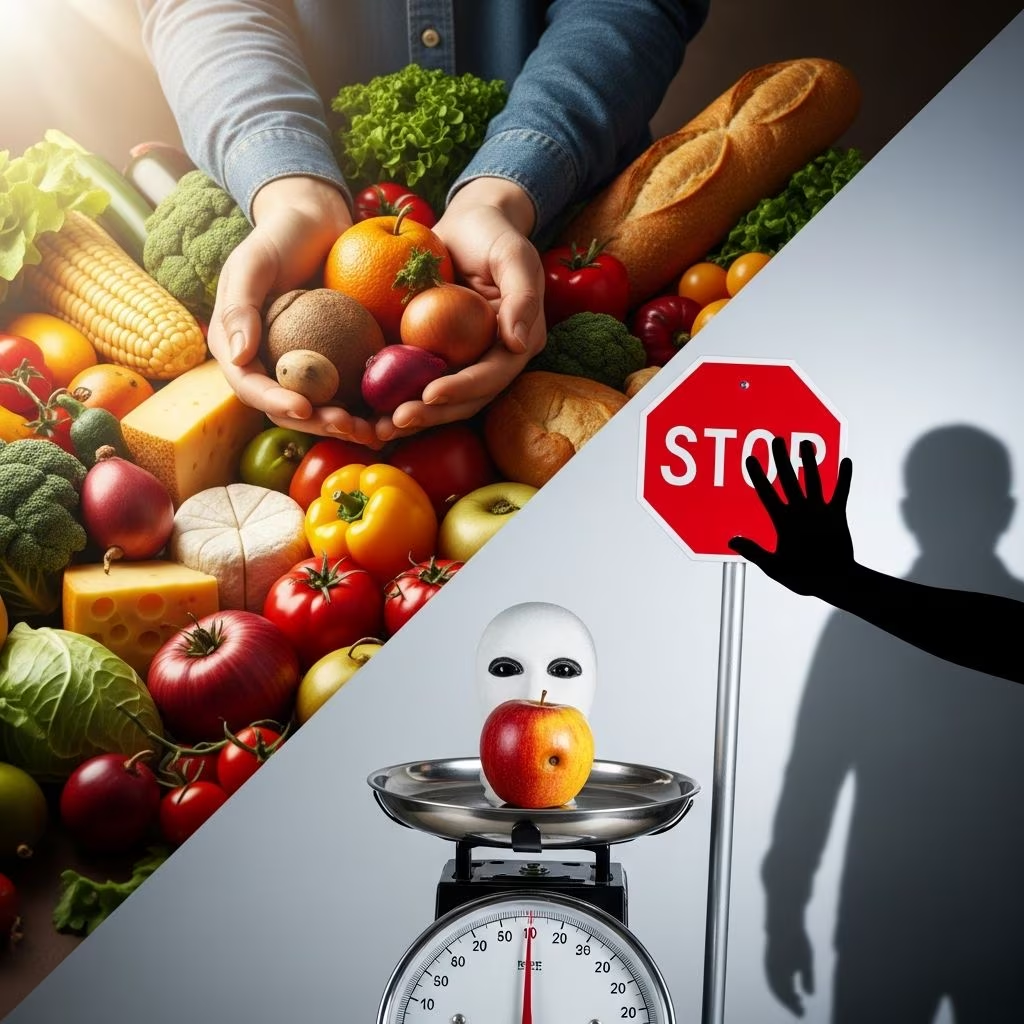
Food waste represents one of the most pressing yet solvable challenges in modern society, squandering resources on a planetary scale while exacerbating hunger and climate change. Each year, vast quantities of edible food end up in landfills, generating potent greenhouse gases and wasting freshwater, energy, and land that could feed millions. As governments grapple with sustainability goals, provocative questions arise: Should discarding edible food be treated as a crime? This exploration weighs the environmental devastation against the practicality of legal prohibitions, drawing on authoritative data to illuminate paths forward.
The Alarming Scope of Global Food Waste
Globally, food waste accounts for a significant portion of anthropogenic environmental damage. In the United States alone, over one-third of produced food—equivalent to billions of pounds—goes uneaten, comprising the largest share of landfilled municipal solid waste at 24% and 22% of incinerated waste. This inefficiency spans the supply chain from farms to households, with American consumers, businesses, and farms collectively spending $218 billion annually on food that is ultimately discarded.
Household waste dominates, responsible for 43% of food discarded by weight in the U.S., totaling 27 million tons yearly. The average family of four tosses out about $1,600 in produce alone, highlighting everyday consumer habits as a primary culprit. Upstream, farms contribute 16%, restaurants and grocery stores 40%, and manufacturers a smaller 2%, often due to overproduction and aesthetic rejections.
- Perishables lead the losses: 80% of surplus food consists of fruits, vegetables, meats, seafood, and dairy, which spoil quickly and demand precise inventory management.
- Supply chain leaks: 13% of food is lost early in production and transport, while 19% is wasted at retail, food service, and home levels.
Environmental Devastation from Discarded Food
The repercussions extend far beyond overflowing bins. Wasted food in landfills is the third-largest source of human-generated methane, a greenhouse gas 25 times more potent than CO2 over a century. In the U.S., this generates emissions equivalent to 50 million gas-powered cars or 170 million metric tons of CO2 annually—6% of national totals.
Globally, food waste drives 8-10% of all anthropogenic GHG emissions, rivaling aviation and shipping combined. If treated as a nation, its emissions would rank third worldwide, behind only the U.S. and China. Decomposing organics also leach nitrogen, fueling algae blooms and oceanic dead zones.
| Resource Wasted (U.S. Annual) | Scale of Loss | Source |
|---|---|---|
| Agricultural Land | 18% of cropland | |
| Freshwater | 21%; $172B equivalent | |
| Fertilizers | 19%; 14B pounds | |
| Pesticides | 778M pounds | |
| GHG Emissions | 170M MTCO2e (excl. landfills) |
Producing uneaten food consumes 21% of U.S. freshwater, with a single kilogram of beef waste equating to 50,000 liters and a glass of milk to 1,000 liters. Runoff from excess fertilizers and pesticides pollutes waterways, while energy for production, transport, and disposal adds to the fossil fuel burden.
Economic Toll: A Hidden Cost to Society
Beyond ecology, the financial drain is staggering. U.S. businesses lose $74 billion yearly to waste, part of the $218 billion national figure. Globally, overproduction inflates costs for fuel, water, and fertilizers, only for products to be discarded due to minor blemishes—retailers reject 19% of supply for non-conformance.
This cycle undermines food security: while nearly one in three people face hunger, land larger than China grows food no one eats, alongside 45 trillion gallons of water. Redirecting just a fraction could alleviate shortages without expanding agriculture.
Current Legal Landscape: Fines, Donations, and Bans
Laws worldwide address waste variably. France mandates supermarkets over 400 square meters donate unsold food or face fines, spurring partnerships with charities. Italy fines retailers for not passing surplus to food banks. In the U.S., states like California, Connecticut, and Vermont require donations of edible surplus from grocers and schools, with tax incentives.
The Bill Emerson Good Samaritan Act shields donors from liability if food is given in good faith. Emerging policies target organics diversion: Massachusetts bans food waste from landfills for large generators, pushing composting. Yet, no jurisdiction criminalizes household waste outright, focusing instead on incentives and infrastructure.
Arguments For Criminalizing Food Waste
Proponents argue bans deter waste at the source. Criminal penalties could normalize conservation, akin to plastic bag fees slashing usage 85% in some areas. With food waste fueling 11% of global emissions, urgency justifies strict measures—reducing it could cut GHGs equivalent to removing 17 million cars.
Equity demands action: subsidizing waste via taxes while food banks struggle is untenable. Fines could fund composting facilities or hunger relief, creating a virtuous cycle. In resource-scarce futures, treating waste as theft from the planet aligns with survival imperatives.
Arguments Against: Practicality and Unintended Consequences
Critics highlight enforcement nightmares. Policing kitchen bins invites privacy invasions and disproportionate fines on low-income families, who waste more produce due to affordability. Small businesses might close under compliance costs, stifling economies.
Criminalization risks black markets or unsafe hoarding, worsening health. Data shows education and apps reduce waste 20-30% without mandates. Overly punitive laws could backfire, as seen in some anti-littering overreaches breeding resentment.
Proven Strategies Beyond Bans
Evidence favors multifaceted approaches. Redistribution via apps like Too Good To Go diverts tons daily. Composting captures methane, turning waste into soil amendment—programs in San Francisco divert 80% of organics.
- Consumer tips: Shop lists, store properly, use imperfect produce.
- Business innovations: Dynamic pricing, AI forecasting to match supply-demand.
- Policy wins: Date label standardization (‘use by’ vs. ‘best by’) cuts confusion-driven toss-outs by 50%.
National goals like the U.S. target to halve waste by 2030 emphasize prevention over punishment.
Frequently Asked Questions (FAQs)
What percentage of U.S. food goes to waste?
Over one-third of produced food is never eaten, making it the top landfilled material.
How much do global emissions from food waste contribute?
Approximately 8-10% of anthropogenic GHGs, third-largest if a country.
Are there laws requiring food donation?
Yes, several U.S. states and countries like France mandate surplus donation with penalties for non-compliance.
Can individuals reduce their food waste footprint?
Absolutely—proper storage, meal planning, and apps can cut household waste by 25% or more.
Is criminalizing food waste realistic?
Unlikely for households due to enforcement issues; incentives and education yield better results.
Pathways to a Waste-Free Future
Achieving zero waste demands collaboration: tech for precision agriculture, policies for clear labeling, and culture shifts valuing all food. While bans spark debate, data underscores voluntary, scalable solutions. Halving waste by 2030 could save billions, feed the hungry, and cool the planet—proving collective action trumps coercion.
References
- Food Waste 101 — Natural Resources Defense Council (NRDC). 2023. https://www.nrdc.org/stories/food-waste-101
- The Environmental Impact of Food Waste — Move For Hunger. 2024. https://moveforhunger.org/the-environmental-impact-of-food-waste
- How Does Food Waste Affect the Environment? — Earth.Org. 2024. https://earth.org/how-does-food-waste-affect-the-environment/
- Food Waste in America in 2026: Statistics & Facts — RTS. 2026. https://www.rts.com/resources/guides/food-waste-america/
- From Farm to Kitchen: The Environmental Impacts of U.S. Food Waste — U.S. Environmental Protection Agency (EPA). 2021. https://www.epa.gov/land-research/farm-kitchen-environmental-impacts-us-food-waste
- Food Waste and its Links to Greenhouse Gases and Climate Change — U.S. Department of Agriculture (USDA). 2023. https://www.usda.gov/about-usda/news/blog/food-waste-and-its-links-greenhouse-gases-and-climate-change