
Balancing Public Health and Civil Liberties in Emergencies
Managing health crises equitably without sacrificing foundational civil rights.
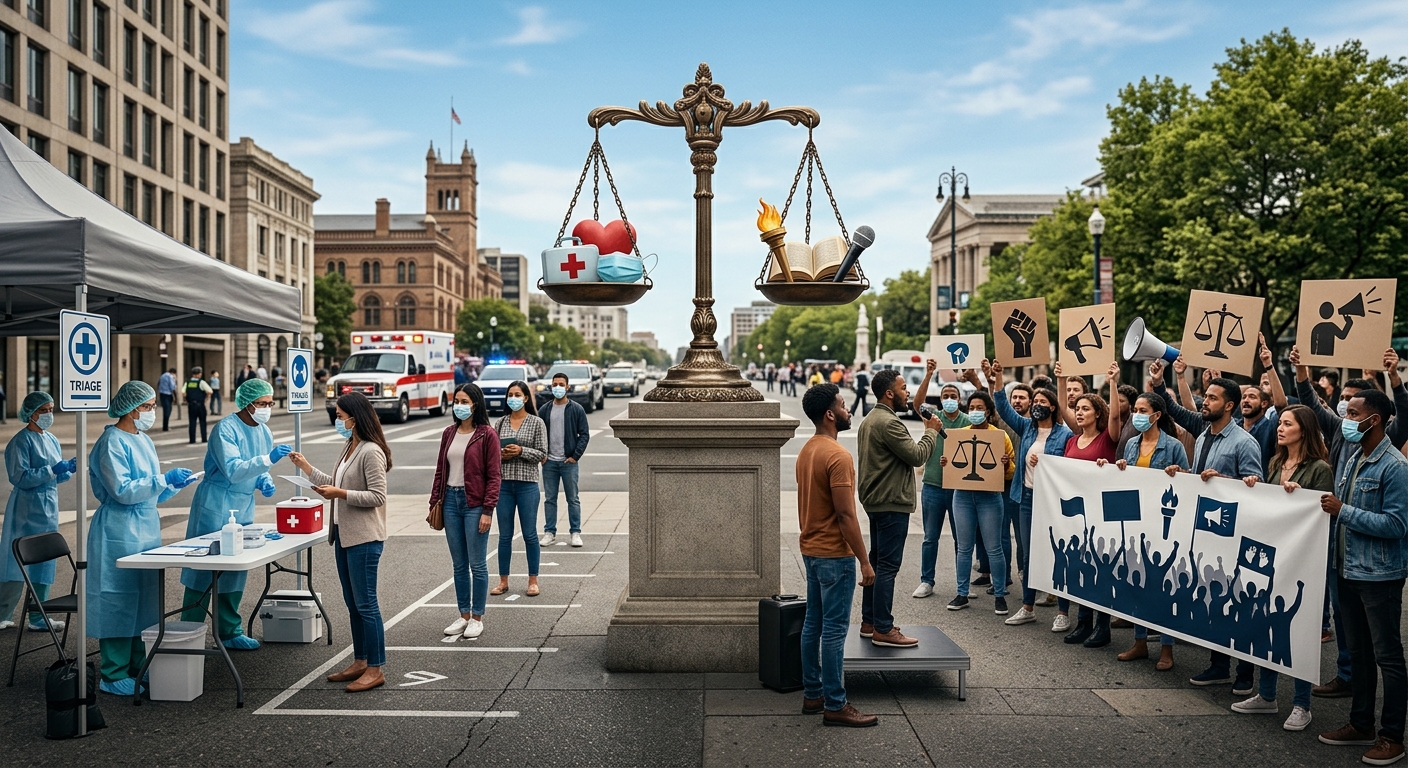
The Delicate Equilibrium of Crisis Management
When a severe public health emergency strikes, the fundamental machinery of daily life grinds to a halt, replaced by a rapid influx of government directives designed to preserve human life. In these critical moments, a profound tension emerges: the friction between the state’s obligation to protect community well-being and its mandate to uphold constitutional civil liberties. The rapid deployment of emergency powers—ranging from mandated quarantines to business closures and digital surveillance—often requires bypassing the sluggish pace of traditional legislative debate. However, relying on sweeping executive action introduces a precarious risk to democratic norms. Understanding how a nation can manage biological threats while fiercely protecting the rights of its citizens is not merely a legal exercise; it is the blueprint for preserving a free society in the face of existential threats.
Historically, the immediate aftermath of a crisis is marked by an initial surge of public cooperation, often followed by deep-seated skepticism if government actions are perceived as opaque, discriminatory, or unnecessarily prolonged. To navigate a pandemic or widespread outbreak effectively, government bodies must construct their responses on a foundation of unshakeable transparency, rigorous adherence to due process, and a commitment to protecting the most vulnerable demographics. Striking this balance ensures that when the emergency eventually subsides, the civic infrastructure of the nation remains fully intact.
The Fragile Ecosystem of Public Trust
The success of any public health mandate relies infinitely less on law enforcement and far more on voluntary public compliance. Citizens must believe that the restrictions placed upon their liberties are medically necessary, temporary, and applied equally across all echelons of society. When trust in government institutions falters, the efficacy of health interventions plummets. Misinformation fills the void left by official silence or contradictory messaging, leading to resistance against vital safety protocols like vaccination drives or isolation orders.
Maintaining this trust is an uphill battle. According to the Pew Research Center, public trust in the federal government has experienced a sustained decline since the 2007-2008 financial crisis, recently dropping to roughly 17% in late 2025 . This historically low metric presents a severe vulnerability during a biological crisis. When fewer than two in ten citizens trust the central government to ‘do the right thing,’ public health agencies must work exponentially harder to prove that their emergency directives are not a guise for permanent power consolidation. Rebuilding and sustaining this trust requires proactive transparency. Governments must openly share their epidemiological data, clearly articulate the benchmarks required to lift emergency restrictions, and admit when early scientific models require adjustments based on new evidence.
Legal Guardrails: Preventing Executive Overreach
The authority of the state to intervene in personal liberties during a health crisis relies heavily on the legal doctrine of police powers. While the courts have historically upheld the government’s right to implement measures for the common good, these powers are not absolute. They must remain tethered to the principles of strict scrutiny and proportionality. An intervention must be the least restrictive means necessary to achieve the public health objective. If a voluntary guideline can achieve the same reduction in disease transmission as a mandatory lockdown, the voluntary measure must take legal precedence.
To prevent the permanent erosion of civil liberties, emergency declarations must be legally bound by strict “sunset clauses.” These are statutory provisions ensuring that emergency powers automatically expire after a set period, usually 30 to 90 days, unless a legislative body actively votes to renew them. This mechanism guarantees that long-term crisis management transitions away from unilateral executive decrees and back into the hands of democratically elected representatives . Furthermore, the suspension of due process is never legally permissible. Individuals subject to specific, targeted isolation or quarantine orders must retain the right to challenge their confinement in a court of law, ensuring that the state’s power is continuously checked by judicial oversight.
Embedding Health Equity into Emergency Frameworks
A universal truth of public health emergencies is that they do not impact society equally; rather, they aggressively expose and exploit preexisting systemic inequalities. Low-income communities, racial minorities, and essential workers frequently bear the heaviest socioeconomic and medical burdens during a crisis. A governmental response that fails to account for these disparities is inherently unfair and ultimately ineffective at halting community transmission.
The Centers for Disease Control and Prevention (CDC) has emphasized the necessity of integrating health equity directly into the operational DNA of emergency preparedness. Under its Public Health Response Readiness Framework, the CDC outlines that modern response strategies must prioritize the cultural, linguistic, and environmental context of historically marginalized populations . Expecting a low-income wage earner to adhere to a strict two-week isolation period without providing financial safety nets, food delivery services, or job protection is an institutional failure, not a personal one. Effective policies mandate that public health interventions are coupled with robust socioeconomic support.
Systemic Disparities and Mitigation Strategies
To visualize the required equity integrations, policymakers often utilize matrices that map specific vulnerabilities to actionable government interventions. The table below illustrates core areas where equity must be enforced during a public health response.
| Target Population | Primary Vulnerabilities During a Crisis | Equitable Policy Intervention |
|---|---|---|
| Essential & Gig Workers | Inability to work remotely; lack of paid sick leave; high daily exposure rates. | Mandatory hazard pay; state-funded paid sick leave; priority access to protective gear and medical countermeasures. |
| Unhoused Individuals | Lack of sanitation facilities; inability to “shelter in place”; high rates of comorbidities. | Procurement of non-congregate housing (e.g., empty hotels); mobile health and testing clinics. |
| Non-English Speakers | Exclusion from critical health messaging; difficulty navigating complex medical systems. | Omnichannel communication in multiple languages; deployment of localized community health liaisons. |
The Ethics of Public Health Surveillance
In the digital age, epidemiological containment often relies on advanced surveillance techniques. Contact tracing applications, wastewater genomic sequencing, and cellular location tracking can rapidly identify outbreak clusters, offering a massive advantage to disease control centers. However, this vast collection of personal data borders on a privacy catastrophe if not properly managed. The surveillance infrastructure built for a pandemic can easily be repurposed for law enforcement or immigration tracking, violating the public’s right to privacy.
The World Health Organization (WHO) explicitly addresses these risks in its guidelines on ethical issues in public health surveillance. The WHO outlines 17 core ethical guidelines emphasizing that any data collection must be justified, proportional, and strictly limited to public health purposes . To align with these ethical mandates, governments must employ aggressive data minimization strategies. Contact tracing apps should rely on decentralized, anonymized Bluetooth handshakes rather than centralized GPS tracking. Furthermore, legislation must dictate that all health surveillance data is permanently deleted once the immediate biological threat is neutralized, preventing the normalization of a digital surveillance state.
Safeguarding the Disenfranchised: Prisons and Immigration Centers
Perhaps nowhere is the government’s duty of care more absolute than in carceral settings. Jails, prisons, and immigration detention centers are highly susceptible to infectious disease outbreaks due to severe overcrowding, poor ventilation, and the physical impossibility of social distancing. Inmates and detainees are wards of the state; because they have been stripped of their ability to protect themselves through voluntary isolation, the government holds total liability for their medical safety.
During a severe respiratory pandemic, maintaining standard incarceration levels often morphs a standard prison sentence into a potential death penalty. A fair and effective government response necessitates immediate structural changes within the criminal justice system. This includes the expedited release of medically vulnerable individuals, non-violent offenders, and those nearing the end of their sentences. For those who remain incarcerated, the state must guarantee an environment equipped with free access to hygiene products, unhindered medical care, and regular, uncoerced testing. Overlooking the human rights of the incarcerated during a public health crisis fundamentally violates the core tenets of civil liberty and basic human dignity.
Science-Driven Communication and Depoliticization
A critical failure in crisis management occurs when public health mandates become tethered to political ideologies. When the use of life-saving interventions—such as wearing a mask or receiving a vaccine—is co-opted as a symbol of partisan allegiance, the public health framework collapses. Governments must vigorously separate their scientific apparatus from their political branches.
Medical directives should be communicated directly by leading epidemiologists, infectious disease experts, and public health officials, rather than elected politicians who may filter the data through the lens of their next election campaign. Clear, consistent, and empathetic communication is vital. Acknowledging the economic and psychological pain caused by emergency restrictions, while firmly standing behind peer-reviewed scientific consensus, helps build a bridge of credibility between the state and its citizens.
Frequently Asked Questions (FAQs)
- How do governments legally justify restricting movement during a pandemic?
Governments invoke “police powers,” a constitutional legal doctrine allowing the state to enact regulations that protect the health, safety, and morals of the community. During a severe outbreak, this permits temporary restrictions on movement, provided they are proportional to the threat and the least restrictive means possible. - What is a sunset clause in the context of emergency powers?
A sunset clause is a legal provision stating that an emergency declaration and its associated powers will automatically expire on a specific date. This ensures that executive powers do not last indefinitely and requires legislative approval for any extensions. - Why is health equity considered a crucial part of pandemic response?
Diseases exploit systemic vulnerabilities. If a government only protects those with wealth or the ability to work from home, the virus will continue to spread rapidly among essential workers and vulnerable populations, ultimately prolonging the crisis for everyone. - Can the government use health surveillance data for criminal investigations?
Ethically and legally, it should not. Strong civil liberty frameworks require that data collected for epidemiological tracking (like contact tracing) be strictly compartmentalized, anonymized, and immune from subpoenas by standard law enforcement or immigration agencies.
Conclusion
Trusting the government to handle a catastrophic health crisis requires a delicate dance between yielding temporary authority to the state and fiercely guarding the civil liberties that define a democratic society. An effective response cannot rely on heavy-handed authoritarianism; it must be built on the pillars of radical transparency, strict legal guardrails, and an unwavering commitment to socioeconomic equity. By planning through the lens of both medical science and constitutional rights, governments can ensure that they protect not only the physical lives of their citizens but also the democratic values that make those lives worth living.
References
- Public Trust in Government: 1958-2025 — Pew Research Center. 2025-12-04. https://www.pewresearch.org/politics/2025/12/04/public-trust-in-government-1958-2025/
- Implementing Public Health Response Readiness Framework — Centers for Disease Control and Prevention (CDC). 2024-04-23. https://www.cdc.gov/orr/readiness/framework.htm
- WHO guidelines on ethical issues in public health surveillance — World Health Organization (WHO). 2017-06-19. https://iris.who.int/handle/10665/255721
- COVID-19 Lessons: Finding the Right Balance Between Public Health and Individual Liberty Tensions — National Center for Biotechnology Information (NCBI) / PMC. 2023-07-11. https://www.ncbi.nlm.nih.gov/pmc/articles/PMC10787508/
Similar Articles








Read full bio of medha deb


