
Balancing Free Speech and Firearm Regulations in Public
How sensible conceal and carry restrictions protect our First Amendment rights.
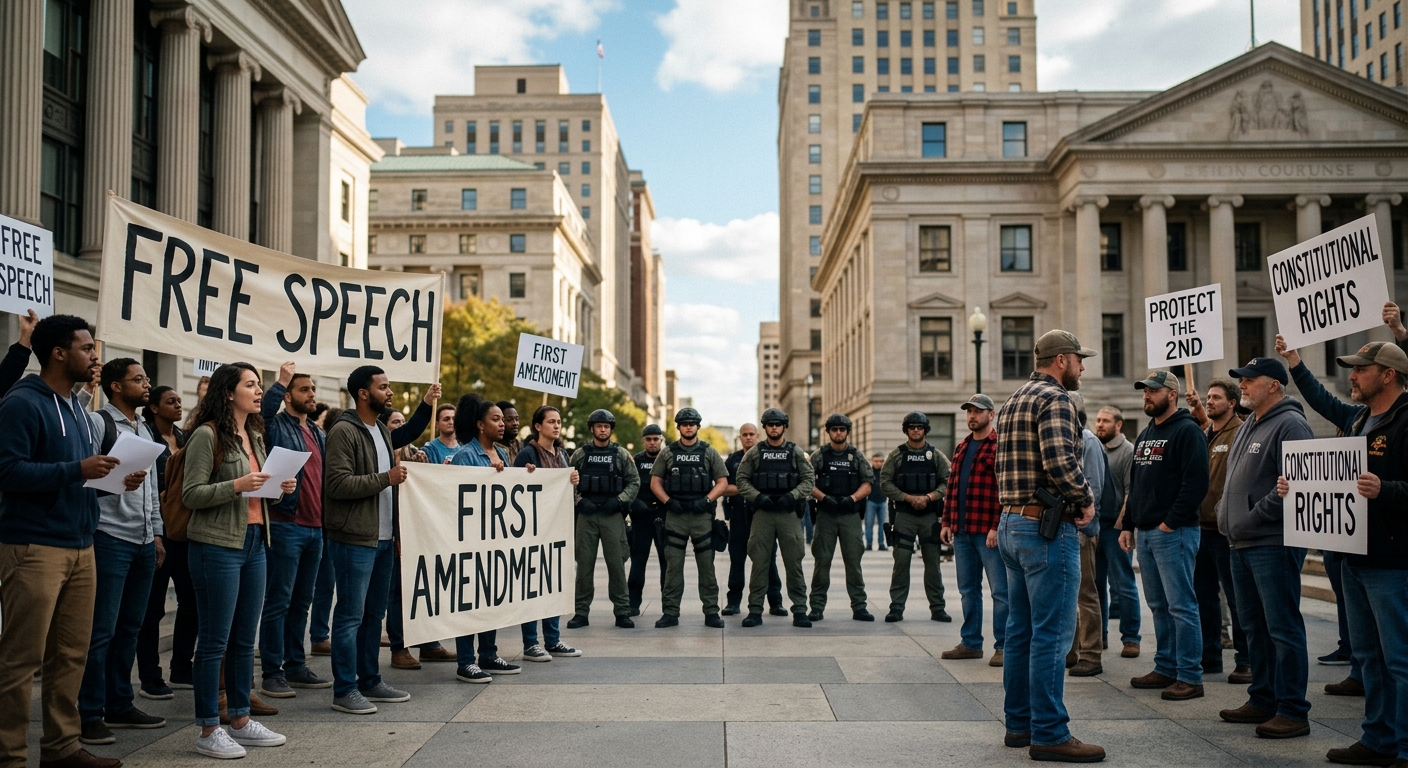
The Intersection of the First and Second Amendments
The delicate balance between the fundamental freedoms granted by the United States Constitution is a recurring and highly debated theme in modern legal jurisprudence. At the forefront of this complex constitutional and social discourse is the intersection between the First Amendment’s absolute guarantee of peaceable assembly and the Second Amendment’s inherent right to bear arms. While the rights of individuals to own, maintain, and carry firearms are fiercely protected under the law, the introduction of lethal weapons into public forums creates a profound web of constitutional friction. Public squares, government buildings, and open streets have historically served as the vibrant heartbeat of democratic discourse. However, when heavily armed individuals attend political rallies, local protests, or civic demonstrations, their presence intrinsically alters the atmosphere. This dynamic creates an environment that can actively discourage unarmed citizens from exercising their fundamental right to speak, assemble, and petition their government freely. Sensible conceal and carry restrictions in these specific civic arenas do not represent an erosion of constitutional liberties; rather, they serve as vital, necessary tools to safeguard the foundational right of every citizen to engage in public discourse without the underlying threat of lethal violence.
Navigating Competing Constitutional Rights
The framers of the Constitution envisioned a holistic system where individual liberties would harmoniously coexist and actively reinforce one another, collectively forming the resilient bedrock of a democratic society. However, the modern implementations and judicial interpretations of these specific rights often find them locked in direct competition. The core, driving purpose of the First Amendment is to cultivate an environment of robust, uninhibited public debate where citizens of all backgrounds can voice their grievances without fear of violent reprisal. Conversely, the Second Amendment guarantees the possession of arms, a right primarily recognized by the courts for the purpose of self-defense. When these two powerful rights collide in a crowded public square, the implicit, undeniable threat of lethal violence can quickly override the peaceful exchange of ideas. Resolving this deep constitutional tension requires a nuanced understanding that no right operates in an absolute vacuum. Rights must be exercised in a manner that does not systematically infringe upon or extinguish the fundamental liberties of others. Implementing balanced, carefully weighed firearm regulations is not an abandonment of Second Amendment principles, but a required step to ensure that the loudest, most heavily armed voices do not monopolize the democratic process.
The Concept of “Sensitive Places” in Legal Precedent
The doctrine of “sensitive places” serves as a critical, foundational legal framework for understanding how localized firearm regulations can legally and peacefully coexist with the Second Amendment. Even the most expansive and conservative judicial interpretations of gun rights acknowledge that practical boundaries must exist. In landmark rulings, including District of Columbia v. Heller and the more recent New York State Rifle & Pistol Association v. Bruen, the Supreme Court of the United States explicitly noted that governments maintain the legal authority to restrict the carrying of firearms in traditionally recognized sensitive locations . Historically, these protected locations have included educational institutions, courthouses, polling centers, and legislative assemblies. Legal scholars and civil liberties advocates compellingly argue that this well-established doctrine should logically extend to areas of organized public protest and dense civic assembly. When a public square or park becomes a temporary venue for civic engagement and emotional political expression, it transforms into a sensitive environment. The introduction of firearms into this highly charged space severely jeopardizes the physical safety and constitutional rights of all participants, justifying temporary regulatory measures.
How Open and Concealed Carry Shapes Public Discourse
The visual and psychological impact of firearms within public spaces fundamentally and irreversibly alters the dynamics of civic participation. A healthy, functioning democracy relies entirely on the willingness of its citizens to gather, debate, and sometimes vehemently disagree in open public forums. However, this democratic process assumes a baseline of mutual physical safety. The introduction of concealed and openly carried weapons into these spaces shatters that assumption, changing the implicit rules of public engagement and introducing an element of profound danger into peaceful assembly.
The Psychology of Intimidation
Firearms are intrinsically engineered as instruments of lethal force; this is their defining characteristic. When individuals deliberately bring weapons to a heated protest or an emotionally charged political rally, the environment is instantaneously charged with the potential for deadly violence. This dynamic is not merely a theoretical concern debated by academics; the psychological effect of seeing armed individuals at a demonstration is visceral and profound. It violently shifts the context of the gathering from a peaceful battle of ideas to a high-stakes physical standoff. Even if a firearm owner has absolutely no intention of discharging their weapon, the mere visual presence of a gun serves as an overwhelming intimidating factor. This visible threat forces unarmed participants to constantly calculate their physical safety, significantly altering how they express themselves. This form of armed posturing can quickly escalate baseline tensions, making productive dialogue and compromise nearly impossible. The pervasive fear of a sudden escalation or a tragic accidental discharge creates an atmosphere of anxiety that forcefully undermines the very essence of what it means to peaceably assemble.
Measuring the Chilling Effect on Civic Engagement
The “chilling effect” is a well-documented legal and sociological phenomenon referring to the active deterrence of the legitimate exercise of free speech out of fear of legal repercussion or physical harm. In the context of armed demonstrations, this phenomenon is deeply concerning for the future of democratic engagement. When citizens know that an upcoming protest, town hall, or rally may be populated by armed individuals, a significant portion will simply choose to stay home to protect themselves and their families. This dynamic systematically silences those who are unarmed, effectively handing a disproportionate megaphone to those who choose to carry weapons. The American Bar Association has forcefully highlighted this emerging threat, passing resolutions that urge lawmakers to strictly prohibit firearms in polling places and public assemblies. Their goal is to ensure that armed intimidation does not disrupt or discourage robust, open debate on critical public issues . The chilling effect creates a dangerous, undemocratic precedent where the terms of civic participation are dictated not by the persuasive strength of one’s political arguments, but by an individual’s willingness to expose themselves to potential gun violence.
The Tangible Risks of Armed Demonstrations
Beyond the undeniable psychological deterrence and the chilling of free speech, the physical realities of combining loaded firearms with emotionally charged, unpredictable political protests present acute, tangible public safety risks. The empirical data surrounding armed demonstrations paints a remarkably troubling picture of how the mere presence of weapons can rapidly escalate otherwise peaceful, standard gatherings into historical tragedies.
Statistical Correlation with Violence
The presence of firearms at public gatherings is not an abstract or hypothetical risk—it is a measurable, statistically proven catalyst for violence. A comprehensive, data-driven analysis conducted by the Armed Conflict Location & Event Data Project (ACLED), in partnership with Everytown for Gun Safety, revealed a staggering and sobering statistic: political demonstrations involving armed individuals are nearly six times as likely to turn violent or physically destructive compared to their unarmed counterparts . This overwhelming data directly undercuts the frequent argument that armed protesters inherently maintain peace and order through a concept of mutual deterrence. Instead, the introduction of lethal weapons into inherently volatile, crowd-heavy situations acts as an aggressive accelerant. Whether through intentional, malicious escalation, the sudden presence of opposing armed political factions, or tragic accidental discharges during a chaotic moment, firearms exponentially increase the likelihood of mass casualties. These concrete statistics provide state and local policymakers with a compelling, undeniable empirical justification for implementing targeted conceal and carry restrictions in public forums.
Impacts on Minority and Vulnerable Voices
It is vital to recognize that the chilling effect and the associated risks of demonstration violence do not impact all demographic groups equally. Historically marginalized communities, who have frequently been the historical targets of systemic suppression, state violence, and political intimidation, are disproportionately affected by the presence of armed groups in public spaces. For these populations, attending a public protest often involves navigating a complex, heavy web of historical trauma and contemporary physical risks. The terrifying prospect of facing armed, organized counter-protesters adds an often-insurmountable barrier to their civic participation and free expression. In this specific way, broad and unrestricted conceal and carry laws can inadvertently function as a highly effective tool of voter and protester suppression. By allowing intimidation to flourish under the guise of Second Amendment rights, society risks disproportionately silencing the vulnerable voices that most desperately need to be heard and protected in a democratic republic.
Legal and Policy Solutions for Democratic Safety
Safeguarding fundamental civil liberties requires proactive, intelligent, and carefully tailored policy solutions. Rather than pursuing overly broad, blanket prohibitions that run afoul of the Constitution, lawmakers must focus on developing nuanced, context-specific regulations that respect established Second Amendment jurisprudence while vigorously defending First Amendment rights to free assembly.
Crafting Narrow and Defensible Firearm Restrictions
The most legally sound and effective policy solutions focus on context-specific geographic restrictions. State and local legislatures have the authority to craft laws that establish temporary “weapon-free zones” strictly around permitted demonstrations, polling places, and active government buildings. These highly targeted regulations do not prevent citizens from owning firearms, nor do they restrict them from carrying weapons in their daily lives; they simply and temporarily restrict the presence of weapons in specific environments where they directly threaten the constitutional rights of others. By clearly defining these civic zones and ensuring they are legally analogous to historical “sensitive places,” policymakers can draft robust legislation that confidently withstands strict constitutional scrutiny .
- Protest Buffer Zones: Establishing specific, well-marked perimeters around legally permitted public assemblies where the carrying of firearms is strictly and temporarily prohibited to ensure crowd safety.
- Polling Place Protections: Guaranteeing that all citizens can cast their ballots without facing armed intimidation by banning all weapons within a specified, reasonable distance of voting centers and ballot drop boxes.
- Enhanced Event Permitting: Requiring explicit, comprehensive security plans and strict weapons protocols for large-scale political events taking place on publicly funded property.
Empowering Local Governments
Because public safety needs and community dynamics vary drastically from one region to another, local municipal governments must be fully empowered to enact regulations that accurately reflect their unique physical environments. A broad policy that makes sense for a sprawling rural county may be entirely inadequate or dangerously permissive for managing public safety in a densely populated, highly trafficked urban center. Granting local municipalities the explicit legal authority to restrict concealed and open carry during specific civic events allows for a much more agile, responsive, and effective approach to protecting civil liberties. Local community leaders and law enforcement are intimately familiar with the physical layout of their public squares, the cultural dynamics of their local populations, and the historical context of political gatherings in their jurisdictions. This localized, community-driven approach ensures that regulations are both highly practical and deeply effective in preserving the fundamental right to peaceable assembly.
Conclusion
The ultimate health and longevity of a democracy are measured by the vitality, safety, and inclusivity of its public discourse. When ordinary citizens are too intimidated by the looming threat of lethal violence to voice their opinions, assemble in peaceful protest, or confidently cast their ballots, the fundamental pillars of civil liberty begin to rapidly crumble. Implementing sensible, legally sound conceal and carry restrictions in specific areas of public assembly is not a violation of constitutional rights, but a desperately needed mechanism to harmonize them. By legally recognizing the chilling effect of firearms on free speech and leveraging the established Supreme Court precedent of sensitive places, modern society can proactively protect both public physical safety and essential democratic participation. Ensuring that our shared public forums remain safe spaces for peaceful, robust debate, rather than tense, armed standoffs, is absolutely essential for the preservation of a truly inclusive and functioning republic.
Frequently Asked Questions (FAQ)
Do conceal and carry restrictions violate the Second Amendment?
No, they do not inherently violate the Constitution. The Supreme Court has repeatedly and explicitly affirmed that the Second Amendment is not an unlimited, absolute right. Governments maintain the legal authority to enact reasonable regulations, which specifically includes prohibiting firearms in historically recognized “sensitive places” to protect general public safety and ensure the uninterrupted functioning of civic institutions .
What qualifies as a “sensitive place” under US law?
While the exact legal definition continues to evolve through ongoing court rulings, sensitive places have traditionally included schools, courthouses, polling places, and legislative buildings. Modern legal experts and civil rights advocates argue that this definition should naturally and logically extend to permitted public protests and dense political assemblies where the inherent risk of armed intimidation is extraordinarily high.
How does the presence of a firearm “chill” free speech?
The visible or known presence of a lethal weapon at a political gathering creates an immediate environment of intimidation and implicit threat. The very real fear of targeted violence or accidental weapon discharge deters many unarmed citizens from participating in protests or debates, which effectively and systematically suppresses their First Amendment right to peaceable assembly .
Are armed protests legally considered peaceful assembly?
This remains a heavily debated and complex legal issue. While individuals unquestionably have the constitutional right to assemble, the First Amendment strictly and specifically protects “peaceable” assembly. The introduction of firearms, especially when aggressively used to intimidate or coerce political opponents, can cross the legal line from peaceable expression into unlawful threat, as armed protests are statistically much more likely to turn violent .
Why can’t more guns at a protest provide better security?
Empirical data and law enforcement consensus indicate that the opposite is true. Introducing multiple loaded firearms into an emotionally charged, chaotic, and densely packed environment drastically increases the risk of violent escalation, accidental discharges, and deadly crossfire. Public safety experts generally agree that armed citizens at volatile protests complicate police security efforts rather than enhance them.
References
- New York State Rifle & Pistol Assn., Inc. v. Bruen — Supreme Court of the United States. 2022-06-23. https://www.supremecourt.gov/opinions/21pdf/20-843_7j80.pdf
- Opposition to Guns in Polling Places — American Bar Association. 2021-07-23. https://www.americanbar.org/groups/crsj/publications/human_rights_magazine_home/voting-rights/opposition-to-guns-in-polling-places/
- Armed Assembly: Guns, Demonstrations, and Political Violence in America — Armed Conflict Location & Event Data Project (ACLED). 2021-08-23. https://acleddata.com/2021/08/23/armed-assembly-guns-demonstrations-and-political-violence-in-america/
Similar Articles








Read full bio of Sneha Tete


