
At-Will Employment: 3 Major Exceptions And Protections
Discover the essentials of at-will employment: rights, exceptions, and state variations for employers and workers.
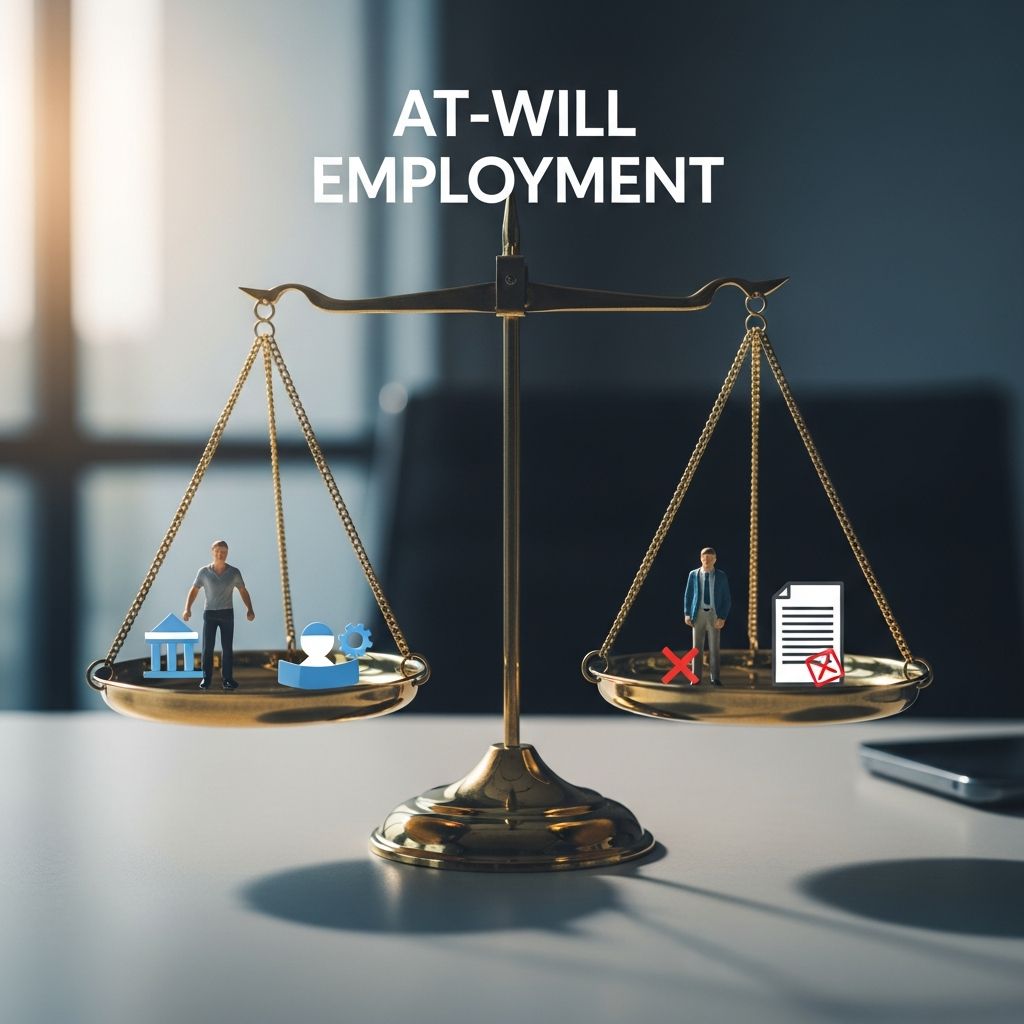
In the United States, the foundation of most employment relationships is the at-will doctrine, which grants both employers and employees significant flexibility to end the working arrangement at any time, for any reason, or no reason at all, provided it does not violate specific legal protections. This principle emerged in the late 19th century as common law and has been upheld by courts across nearly all states, reflecting a balance of freedom in labor markets. However, this freedom is not absolute, with federal and state laws carving out essential safeguards against abusive practices.
The Fundamentals of At-Will Employment
At its core, at-will employment presumes that when no fixed-term contract exists, either party can terminate the relationship without notice or justification. Employers may dismiss workers abruptly, and employees can resign similarly, fostering a dynamic job market but raising concerns about job security. This doctrine is the default in 49 states, with Montana standing alone by requiring just cause for termination after a probationary period.
The rationale stems from mutual freedom: just as employees can leave without cause, employers can adjust their workforce needs freely. Courts have reinforced this, as seen in California Labor Code section 2922, which presumes at-will status unless modified by contract. Employee handbooks often include explicit at-will disclaimers to reinforce this, though the National Labor Relations Board scrutinizes language that overly restricts union activities.
- Key Feature: No requirement for advance notice or stated reasons for separation.
- Mutual Application: Applies equally to quitting and firing.
- Default Status: Assumed unless a contract specifies otherwise.
Historical Development and Legal Foundations
The at-will rule solidified during the Lochner era, when U.S. Supreme Court decisions favored minimal government interference in labor contracts. By the late 1800s, it became the norm, evolving from early common law that sometimes required cause for dismissal. The first exceptions appeared in 1959 via California courts, marking a shift toward employee protections.
Today, federal statutes like the National Labor Relations Act (NLRA) overlay the doctrine, protecting concerted activities such as union organizing. State laws further refine it, creating a patchwork of rules that employers must navigate carefully.
Major Exceptions That Limit At-Will Powers
While at-will offers broad latitude, three primary judicial exceptions—public policy, implied contract, and covenant of good faith—along with statutory protections, prevent terminations that cross legal lines. These ensure fairness without dismantling the doctrine entirely.
Public Policy Exception
The most widespread carve-out prohibits firings that violate clear public policy, such as refusing illegal acts or exercising legal rights. For instance, terminating an employee for filing a workers’ compensation claim or reporting OSHA violations is unlawful in most states. This exception, recognized in over 40 states, upholds societal interests over private agreements.
| Protected Activity | Example | States Recognizing |
|---|---|---|
| Refusing illegal acts | Declining to falsify records | 43+ states |
| Jury duty | Serving on a jury | Nearly all |
| Whistleblowing | Reporting safety hazards | Widespread |
| Family leave | Taking FMLA time | Federal law |
Implied Contract Exception
Courts in about 36 states recognize that employer promises, often in handbooks or oral statements, can create implied contracts overriding at-will status. If a policy outlines progressive discipline (e.g., three warnings before termination), firing after one infraction may breach this. Employees must prove the employer’s intent to be bound, typically through handbook language or consistent practices.
Covenant of Good Faith and Fair Dealing
Applied in 11 states, this exception bars terminations motivated by bad faith, like firing to avoid paying earned commissions. It’s narrower and harder to prove, focusing on employer malice rather than mere disappointment.
Federal and State Statutory Safeguards
Beyond common law, statutes provide robust protections. Title VII of the Civil Rights Act bans discrimination based on race, color, religion, sex, or national origin, extending to pregnancy and sexual orientation via recent rulings. The Americans with Disabilities Act (ADA) protects qualified disabled workers, requiring reasonable accommodations.
Other laws shield against retaliation for wage complaints, FMLA leave, or NLRA-protected union activities. In South Carolina, for example, exceptions include jury duty, OSHA complaints, and disability accommodations. Employers must document decisions to defend against claims.
- Discrimination Laws: Prohibit bias in hiring, firing, pay, and promotions.
- Retaliation Bans: Protect those reporting violations or participating in investigations.
- Leave Protections: FMLA for family/medical needs; state variants for broader coverage.
State-by-State Variations in At-Will Rules
While uniform in principle, implementation differs. Montana’s unique statute mandates good cause post-probation, shifting the burden to employers. States like California emphasize public policy exceptions strongly. Others, like North Carolina, stress contractual overrides.
| State | Key Feature | Exceptions Noted |
|---|---|---|
| Montana | Just cause required | Statutory |
| California | Strong public policy | Judicially expanded |
| South Carolina | Multiple carve-outs | Whistleblower, leave |
| New York | Implied covenant | Good faith dealings |
Employers operating across states should consult local counsel, as nuances affect compliance.
Practical Strategies for Employers
To leverage at-will benefits while minimizing risks, include clear disclaimers in offers, handbooks, and acknowledgments signed by employees. Avoid verbal promises of job security. Document performance issues thoroughly, even without formal discipline, to counter implied contract claims. Train managers on protected categories and maintain consistent policies.
Periodic at-will reaffirmations in performance reviews reinforce the status. Beware NLRB rules against overbroad disclaimers that chill union rights.
Employee Rights and Defensive Measures
Workers should review handbooks for disclaimers but note they don’t waive statutory rights. Document discriminatory remarks, retaliation, or policy deviations as evidence. If suspecting wrongful termination, consult an attorney promptly, as statutes of limitations apply.
Unionized or contracted employees enjoy added layers of protection. For at-will roles, building a paper trail of positive contributions aids negotiations or disputes.
Common Pitfalls and Real-World Scenarios
Mistakes like firing soon after a protected complaint invite lawsuits. Example: Terminating an employee post-OSHA report screams retaliation. Handbook ambiguities can imply contracts, as in cases where “progressive steps” are outlined without at-will caveats. Bad-faith moves, like demoting before firing to skirt severance, trigger covenant claims.
Frequently Asked Questions (FAQs)
Can my employer fire me for no reason?
Yes, under at-will rules, but not for illegal reasons like discrimination or retaliation.
Does signing an at-will acknowledgment limit my rights?
It clarifies the relationship but doesn’t override federal/state protections.
What if my handbook promises progressive discipline?
This may create an implied contract exception in many states.
Is at-will employment nationwide?
Yes, except Montana requires cause after probation.
Can I sue for wrongful termination in an at-will state?
Only if an exception applies, like public policy violation.
References
- At-will employment — Wikipedia. 2023-10-01. https://en.wikipedia.org/wiki/At-will_employment
- What Does “At-Will” Employment Mean in South Carolina? — Bettis Law Firm. 2023-01-15. https://www.bettislawsc.com/what-does-at-will-employment-mean-in-south-carolina/
- employment-at-will doctrine — Cornell Law School Legal Information Institute. 2024-02-01. https://www.law.cornell.edu/wex/employment-at-will_doctrine
- What is at-will employment? Insights for employers — Thomson Reuters. 2024-05-20. https://legal.thomsonreuters.com/en/insights/articles/what-is-at-will-employment
- The employment-at-will doctrine: three major exceptions — U.S. Bureau of Labor Statistics. 2001-01-01. https://www.bls.gov/opub/mlr/2001/01/art1full.pdf
- Hiring or Firing? Know the Basics of At-Will Employment — ICCFA. 2022-10-01. https://iccfa.com/blog/hiring-or-firing-know-the-basics-of-at-will-employment/
- Termination guidance for employers — USAGov. 2024-08-15. https://www.usa.gov/termination-for-employers
Similar Articles








Read full bio of Sneha Tete




