In many situations, you have a constitutional right to record police officers, but that right is not unlimited. Understanding where the law draws the line can help you document police activity without putting yourself at unnecessary risk of arrest or prosecution.
This guide explains the basic legal framework for recording law enforcement in the United States, the common limits on that right, and practical steps to protect yourself before, during, and after you hit “record.” It is general information, not legal advice for any specific case.
1. Why Recording the Police Matters
Smartphones and inexpensive cameras have changed how the public interacts with law enforcement. Video of police encounters can:
- Provide objective evidence in criminal or civil cases.
- Expose misconduct and support accountability efforts.
- Corroborate or contradict witness statements.
- Protect both civilians and officers by clarifying what actually happened.
Because of this growing role, U.S. courts have increasingly recognized that filming public officials performing public duties lies at the heart of modern free speech and press activity.
2. The Constitutional Foundation: Free Speech and Public Oversight
Most legal protection for recording the police comes from the First Amendment, which covers freedom of speech, press, and the right to gather information about government activity.
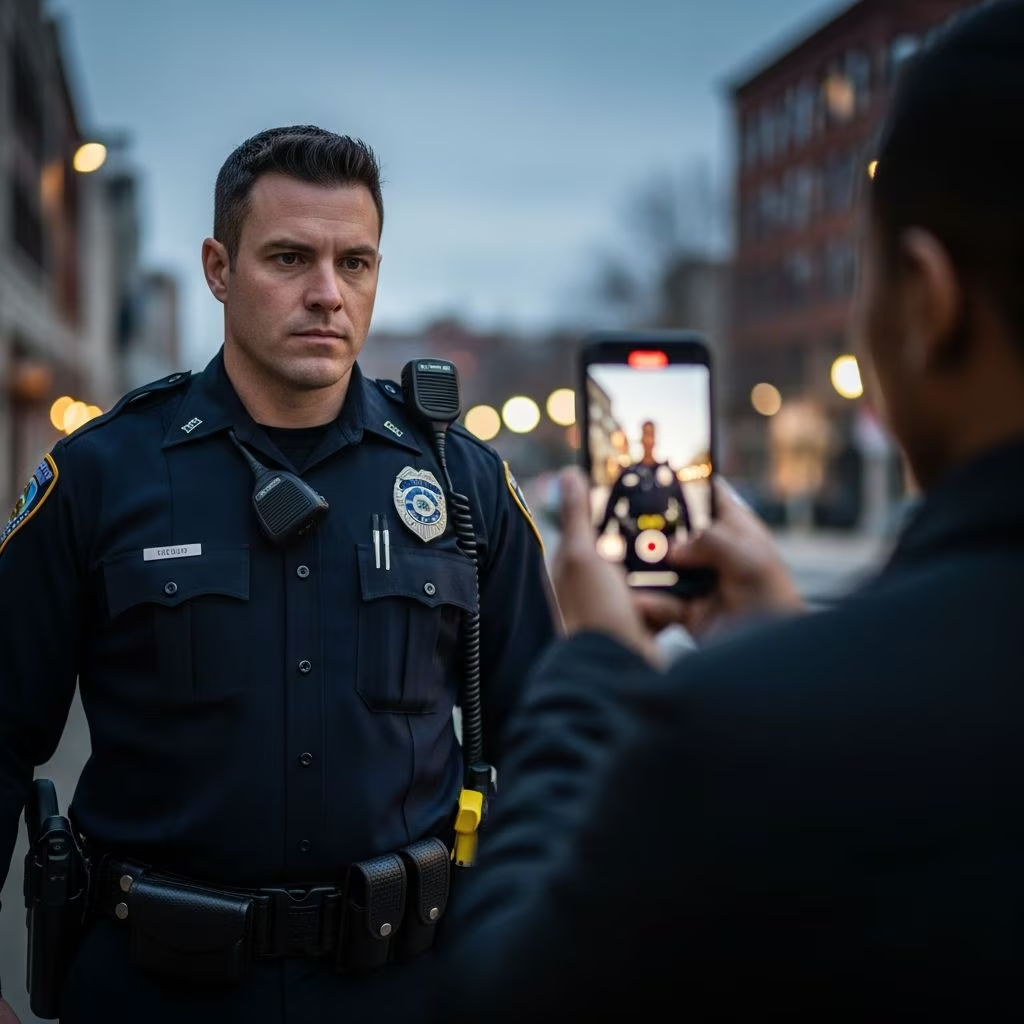
Federal appellate courts have held that members of the public generally have a right to record police officers in public places, subject to reasonable time, place, and manner limits.
| Scenario | Typical Legal Status (U.S.) | Key Conditions |
|---|---|---|
| Filming police on a sidewalk | Often protected | Stay a reasonable distance away; do not interfere with officers. |
| Recording from your own property | Often protected | Officers may impose limits only if your actions obstruct them. |
| Secretly audio-recording in a private setting | May be restricted | Consent and state wiretap laws may apply. |
| Recording inside a courthouse or secured facility | Frequently restricted | Local rules and security regulations can lawfully limit filming. |
3. When Recording the Police Is Usually Lawful
While state laws differ, several common patterns appear in court decisions and policy guidance.
3.1 Public Spaces and Visible Encounters
You are generally on stronger legal ground when you:
- Record openly (not secretly),
- Are in a public place (street, park, public sidewalk, etc.), and
- Document officers performing official duties in those spaces.
Courts often emphasize that citizens may observe and record government officials in public because such activity is essential for public discussion of law enforcement practices.
3.2 Recording Your Own Interaction with Police
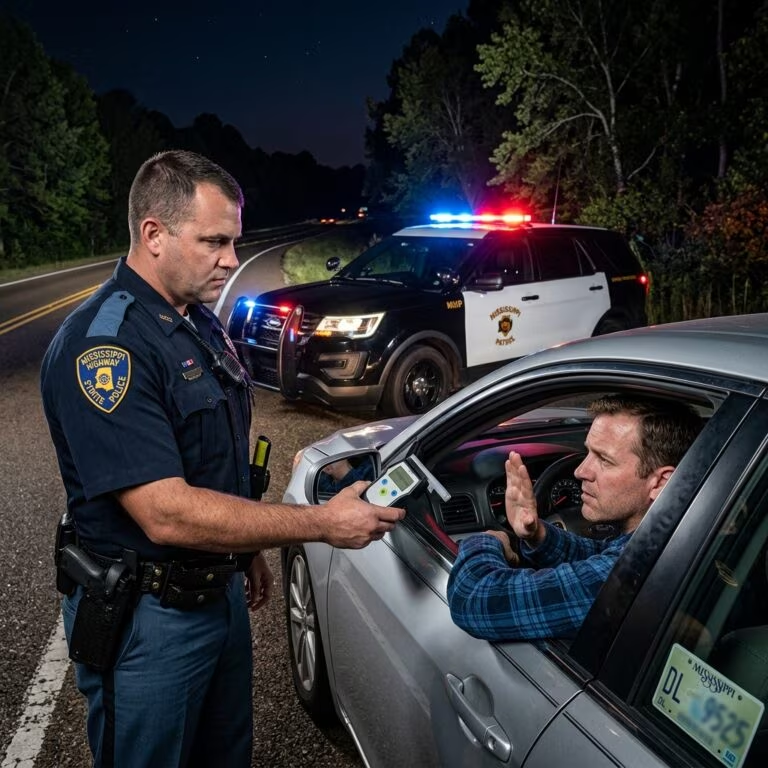
Filming your own traffic stop or street encounter is often protected, assuming you do not interfere with an officer’s safety tasks and you comply with legitimate commands unrelated to the content of your recording (such as stepping out of the vehicle when ordered to do so).
3.3 Sharing or Posting Your Recordings
Once a recording is lawfully made, the First Amendment generally protects your ability to:
- Store and back up the recording.
- Share it with an attorney or advocacy group.
- Publish it online or provide it to journalists.
Courts have found that government retaliation for sharing truthful, lawfully acquired information about public officials often raises serious constitutional problems.
4. Legal Limits: How Recording Can Lead to Arrest
Despite these protections, people are still arrested while recording police. The core reason is that your right to film does not allow you to obstruct or endanger an investigation. Many arrests arise under other laws that officers claim were violated in the course of filming.
4.1 Interference, Obstruction, and Failure to Obey
Most states criminalize conduct that obstructs an officer or interferes with official duties. If you:
- Physically block officers or emergency personnel,
- Ignore repeated commands to step back or move to a safer area, or
- Insert yourself into an arrest or search scene,
you may be arrested for obstruction, even if you claim you are only recording.
Courts usually permit reasonable, content-neutral distance or safety requirements. For example, ordering everyone in a crowd (recording or not) to move behind a barrier is often lawful if it’s genuinely about safety and scene control.
4.2 Disorderly Conduct and Disturbing the Peace
Disorderly conduct laws prohibit certain disruptive behaviors in public. Tense encounters sometimes lead to:
- Shouting profanities or making threats at close range,
- Refusing to stop physically intruding into a scene, or
- Inciting others to rush toward officers during an arrest.
While verbal criticism of police is often constitutionally protected, conduct that causes a genuine safety risk can result in arrest. Courts evaluate the specific facts: the words used, the volume, the distance, and whether there was an actual or imminent disturbance.
4.3 Trespass and Restricted Areas
Your right to record does not erase property and access rules. You can be arrested for:
- Entering a clearly marked restricted zone at a crime scene,
- Refusing to leave private property after being lawfully asked, or
- Crossing police lines or barriers in an emergency area.
Even if the recording itself would otherwise be protected, violating access rules can provide an independent basis for arrest.
4.4 Wiretap and Eavesdropping Laws
Some states have laws regulating audio recording of private conversations. The details vary widely:
- One-party consent states allow recording if at least one participant in the conversation consents (often including you).
- All-party consent states may require consent from everyone in a private conversation.
Courts have increasingly held that using these laws against people who openly record on-duty police in public is unconstitutional, because an officer in a public place has no reasonable expectation that their public statements will remain private. Secret audio recording in non-public settings, however, can still be risky.
5. What Officers Can & Cannot Do with Your Recording
Disputes often arise not only over filming, but over what happens to the footage and the device.
5.1 Deleting or Demanding Your Footage
- Courts and civil rights guidance indicate that officers generally may not order you to delete photos or video, nor may they delete it themselves, without a valid legal process.
- Destroying or altering evidence may violate constitutional rights and, in some cases, evidence-tampering laws.
5.2 Seizing Your Phone or Camera
Police sometimes seize recording devices as evidence. Legal issues include:
- Seizure on the scene: Officers may take a device if they have probable cause to believe it holds evidence of a crime, subject to constitutional limits.
- Searching the contents: The U.S. Supreme Court has held that police generally need a warrant to search digital information on a cellphone seized during an arrest, recognizing the vast privacy interests at stake.
These rules do not always prevent on-the-ground disputes, but they provide a framework for later legal challenges.
6. Practical Safety Tips When Recording Police
Legal rights are important, but so is your safety. During any encounter with law enforcement, your goal should be to protect both your physical well-being and your ability to enforce your rights later.
6.1 Before You Hit Record
- Know your state’s basic laws on public recording and consent.
- Enable automatic cloud backup if possible, so video is saved even if the device is taken or destroyed.
- Use a passcode or strong device lock instead of simple swipe or pattern locks.
6.2 While You Are Filming
- Stay calm, speak clearly, and avoid sudden movements.
- Stand at a reasonable distance; do not cross police lines or crowd officers.
- Keep your hands visible, preferably holding the phone away from your body.
- If asked, calmly state: “I am not interfering; I am recording from a safe distance.”
- Do not physically resist if officers move or arrest you; resistance can escalate charges and danger.
6.3 After an Incident
- Write down details: time, location, officers’ names or badge numbers, witness contact information.
- Preserve the original file; make multiple backups.
- Consult a licensed attorney, especially if you were detained, arrested, or ordered to delete or surrender footage.
7. Special Contexts: Traffic Stops, Protests, and Sensitive Locations
Not all recording situations look the same. Common scenarios raise distinct issues.
7.1 Traffic Stops
Drivers and passengers frequently record traffic stops. Points to keep in mind:
- Signal that you are reaching for your phone and move slowly.
- Mounting your phone on a dashboard or console can minimize movement and keep hands visible.
- Obey lawful orders such as providing license and registration or exiting the vehicle.
- Do not hold the phone so that it could be mistaken for a weapon.
7.2 Demonstrations and Crowds
Protests can be fluid, noisy, and tense. When recording officers at such events:
- Be mindful of emergency routes and instructions to disperse.
- Avoid physically inserting yourself between police and other demonstrators.
- Understand that failure-to-disperse or curfew orders may be enforced regardless of your role as a recorder.
7.3 Courthouses, Airports, and Government Buildings
Many secured facilities limit or prohibit filming inside for safety or privacy reasons. Local rules, statutes, and court orders can lawfully restrict where and how you record in these settings.
8. State Law Differences and the Role of Local Policy
Although federal constitutional principles provide a broad framework, the details of your rights often depend on:
- Your state’s wiretap, eavesdropping, and privacy statutes.
- Local ordinances on obstruction, loitering, and disorderly conduct.
- Department policies on body cameras, public recording, and crowd control.
Some police agencies have adopted policies explicitly recognizing the public’s right to record and providing training accordingly. These policies can reduce unnecessary confrontations, but they also vary by jurisdiction.
9. Working with a Lawyer After an Arrest for Recording
If you are arrested or cited while recording police, contacting a qualified attorney is critical. A lawyer can:
- Evaluate whether your First Amendment and Fourth Amendment rights were violated.
- Challenge evidence obtained through unlawful searches or seizures of your device.
- Help you recover your phone, camera, or stored footage when possible.
- Discuss potential civil claims for unlawful arrest, excessive force, or retaliation.
Because these cases involve complex questions of constitutional and state law, early legal advice can shape both your criminal defense and any later civil action.
Frequently Asked Questions (FAQs)
Q: Is it always legal to record the police in public?
A: In many U.S. jurisdictions, openly recording on-duty officers in public is protected by the First Amendment, as long as you do not interfere with their work or violate other neutral laws like obstruction or trespass.
Q: Can an officer make me stop recording?
A: An officer may direct you to move, step back, or leave an area for safety or operational reasons, but generally cannot order you to stop recording simply because they dislike being filmed.
Q: Can police take my phone if I film them?
A: Officers may sometimes seize a device as potential evidence if they have probable cause, but searching the digital contents usually requires a warrant, according to the U.S. Supreme Court.
Q: What if I live in an all-party consent state?
A: Some courts have ruled that using all-party consent statutes to punish people who openly record on-duty police in public is unconstitutional, but secret recording or recordings in private settings may still raise legal issues.
Q: Should I argue with officers about my rights on the street?
A: Asserting your rights calmly and clearly can be appropriate, but prolonged arguing or refusing to follow safety-related commands can escalate the situation. Often, it is safer to comply with lawful orders and challenge any violations later with the help of counsel.
References
- Turner v. Driver, 848 F.3d 678 (5th Cir. 2017) — U.S. Court of Appeals for the Fifth Circuit. 2017-02-16. https://law.justia.com/cases/federal/appellate-courts/ca5/16-10312/16-10312-2017-02-16.html
- Fields v. City of Philadelphia, 862 F.3d 353 (3d Cir. 2017) — U.S. Court of Appeals for the Third Circuit. 2017-07-07. https://law.justia.com/cases/federal/appellate-courts/ca3/16-1650/16-1650-2017-07-07.html
- Police Practices: Your Right to Film — American Civil Liberties Union (ACLU). 2020-12-18. https://www.aclu.org/know-your-rights/your-right-film-police
- Riley v. California, 573 U.S. 373 (2014) — Supreme Court of the United States. 2014-06-25. https://supreme.justia.com/cases/federal/us/573/373/